They had been told American cities were rubble. The propaganda ministry said so. And plenty of the men in Field Gray had no reason to doubt it. So when the prison trains pulled west out of the American ports in the summer of 1943, some of the prisoners settled on an explanation for what the windows were showing them. The lit towns, the cars on every road, the chimneys that never stopped smoking. It was staged. The Americans were steering the trains around the ruins or running them in circles to make the country look bigger than it really was.
That theory held up for the first morning. By the third day, with a thousand miles of untouched country behind them and the train still rolling, it was getting very hard to believe. The ruins never came and the train kept moving.
Tunisia, the second week of 1943. George Kellerman was 41 years old, a farmer with a wife named Maria and a son named Otto. And he had spent the spring serving an 88mm flak gun on the approaches to Tunis. He was a gunner in a Luftwaffe battery, a lance corporal by American reckoning, drafted late and sent south into a war that was already going wrong. In February, his crew had claimed two Allied bombers near the city. By Easter Monday, the 26th of April, the bombers were no longer the problem. British artillery found the battery that morning. The shells walked through the position and then Spitfires came in low over the fields, strafing anything that moved. Kellerman went flat in a cornfield and stayed there while cannon fire chewed through the stalks around him. He kept a diary through all of it, and the entries from those weeks read like a man counting how much ground was left under his feet.
The ground was running out in the air as well. The Axis armies in Tunisia were being fed by a bridge of transport planes flying low across the Sicilian Narrows and the Allies had set out to cut it. Late on the afternoon of the 18th of April, Palm Sunday, 46 P-40 Warhawks of the American 57th Fighter Group with British Spitfires flying top cover caught a formation of around 90 Junkers Ju 52 transports skimming the waves off Cap Bon. The Junkers were slow, heavily loaded, and flying so low their propellers kicked spray off the swells. There was nowhere for them to go. The Warhawks dropped through the formation, and the transports began falling into the sea and burning on the beaches. American pilots reported German soldiers firing rifles and pistols out of the cabin windows at the fighters diving past them. When it was over, the Americans claimed 59 transports and 16 escorting fighters for the loss of six Warhawks. The Germans had their own name for that afternoon. They called it a massacre.
By the 10th of May, there was almost nothing left. The bridgehead had been squeezed back against the Cap Bon Peninsula and the coast east of Tunis, and the city was burning on the horizon. Kellerman’s battery was ordered to destroy its guns, and the crews did it themselves, wrecking the weapons they had nursed for months so the British would not inherit them. Then they tried to leave. At Hammam Lif on the coast, Kellerman’s men found a boat and set about fitting it with an engine pulled out of a truck. It was desperate improvisation, and it ended the way desperate improvisation usually does. Royal Navy searchlights swept the water. A British leaflet had already spelled out their position in blunt, rhyming German. The desert on one side, the sea on the other, and home gone for good. At 10:00 in the morning on the 12th of May, Kellerman surrendered to a British armored car. He was one face in an enormous crowd. Estimates for the Axis troops who went into captivity in Tunisia run from about 230,000 to more than 275,000, Germans and Italians together. The survivors of the Afrika Korps and every formation thrown in beside it.
George Fusil, a 21-year-old Unteroffizier who had already survived the Eastern Front and filled his spare hours with sketches, had been taken near Tunis two days earlier. Pay attention to this next detail because it sets up everything that follows. The men who marched into those cages did not believe they had been beaten. The American war correspondent Ernie Pyle talked to them that May and he found almost none who doubted that Germany would still win the war. They had an explanation for Tunisia and they offered it freely. The Americans had simply gotten more stuff into Africa than they had. I mean, think about that for a second. Even in defeat, the one thing they were willing to concede was the very thing their own government kept calling a bluff.
What exactly had they been told? The record here is more specific than the legend. And the gap between the two is where this story lives. Joseph Goebbels ran the regime’s propaganda from Berlin. And in June of 1942, he warned the readers of his weekly paper Das Reich what to expect from the Allies. They would bluff, he wrote. They would try to bury German claims under fantastic statistics of their own. Every American production figure, in other words, was to be read as psychological warfare and nothing more. A year later, the Nazi party’s guidance for its public speakers went further. Speakers were told how to answer anyone who admired the American economy, which the guidance dismissed in the regime’s standard anti-Semitic language as a creation of Jewish advertising. American production numbers were not decisive, it argued, because American industry needed some 7 million skilled workers it simply did not have. Hermann Göring put it more bluntly still. In the autumn of 1942, von Rohden came back from North Africa to Hitler’s headquarters and reported that fighter-bombers were knocking out his tanks with 40mm cannon shells. Göring refused to believe it. According to von Rohden’s own papers, the Reich Marshal told him the Americans only knew how to make razor blades. Von Rohden’s reply was dry. The Afrika Korps, he said, could do with some of those razor blades.
Now, for the part of the propaganda that was true, America was never a smooth machine. On the 1st of May, 1943, every union soft coal mine in the country shut down. More than 480,000 miners walked out under John L. Lewis and the United Mine Workers in open defiance of labor’s wartime pledge not to strike. Steel makers were reported to have about three weeks of coal on hand. Franklin Roosevelt signed an order seizing the mines and the miners answered that nobody could dig coal with bayonets. Goebbels noticed. That August, he wrote in Das Reich that 600,000 American miners had gone on strike for a week and then he let something slip. The German press, he admitted, had given the story about five lines. Five lines. That is the real shape of the propaganda these prisoners carried. It was less a steady drumbeat about paralyzed American factories than a background hum of contempt. A settled assumption that American numbers were inflated, American workers were unreliable, and the whole country was softer than it looked.
There was one more piece. Germany had tried sabotage in earnest. In June 1942, two U-boats landed eight trained agents on the American coast, four on Long Island and four in Florida under a plan called Operation Pastorius. Their target list included aluminum plants, the Ohio River locks, and a stretch of mountain railroad in Pennsylvania known as the Horseshoe Curve. Remember that curve because it comes back. The operation fell apart within days. The team leader, George Dasch, and a second agent turned themselves into the FBI and the rest were rounded up in short order. Six of the eight were executed in Washington that August. None of their targets was ever touched.
Kellerman sailed from Oran in Algeria on the 3rd of June 1943. It was Ascension Day and he noted it. The convoy pushed west into the Atlantic carrying men who had spent three years being told that the U-boat owned this ocean. On the 18th of June, the alarm sounded. Prisoners scrambled into life jackets and waited below, listening, knowing exactly what a German torpedo would do to a ship full of Germans. A tank gunner named Fritz Enlland later remembered being followed and attacked by submarines day after day on his own crossing. The historian Arnold Krammer, who spent years in these records, found that no ship carrying prisoners of war to America was ever sunk by a U-boat. None of that made the alarm any easier to sit through. By then the hunters were being hunted. Six days before that alarm, aircraft from the escort carrier USS Bogue caught U-118 on the surface in the eastern Atlantic. Avengers and Wildcats came down on her with depth charges and machine guns and the boat went under for good. The men pulled out of the water that day became prisoners themselves. One of them, a young sailor named Vanna Drexler, would reach America, too. And what his own countrymen did to him there belongs to the darkest part of this story.
Kellerman’s ship raised the Virginia coast on the 26th of June. Fusil made the same crossing that August, leaving Oran on the 8th and reaching Norfolk on the 28th, cursing Africa in his diary as it fell away behind him. Later in the war, the ships got stranger. One former paratrooper remembered climbing down into the hold of a Liberty ship that had just been emptied of brand new American tanks. That ship had carried armor east to the war. Now it was carrying the enemy west, and the men sleeping on its steel deck plates were lying in the space the tanks had left behind.
Norfolk, Virginia was the first American ground most of these men ever stood on, and nothing about it had been touched by a bomb. The processing was fast and impersonal. Delousing, showers, a dusting of DDT, fingerprints, and paperwork, and then the prisoners were marched down to the rail sidings where they braced themselves for cattle cars. They got passenger coaches instead.
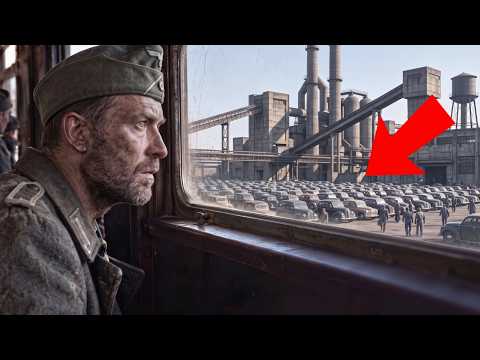
Reinhold Pabble came ashore at Norfolk on the 2nd of January, 1944, off the liner Empress of Scotland. He later wrote a memoir of his captivity, and his account of that train ride is the closest thing the record holds to the scene in the title of this video. Pabble and the men around him could hardly believe the seats. A porter came through with coffee, and Pabble remembered being served as though they were human beings. Then the train rolled out through Virginia and into Kentucky, and the prisoners pressed their faces against the glass.
Pabble put it simply years later. The first impression we had was the abundance of automobiles everywhere. Cars in a country that was supposed to be at the end of its rope. Civilians were driving along every highway the train ran beside, filling town streets and yards for mile after mile. To a German soldier by then, a private car was something the war had largely taken away from ordinary people back home. Here they were on every street.
Kellerman’s trip six months earlier had run a different way across the map. From Norfolk, his train went west to St. Louis, where the guards held the prisoners in the station for an hour so that American civilians could come and look at real Nazis. Then it swung south through the June heat. His diary complains that the sweat ran down into his shoes. It also records almost grudgingly that the food was good and came three times a day. On the 30th of June, he arrived at Huntsville, Texas.
Hino Ericson was 18 when he surrendered in Tunisia. A private in the Afrika Korps who had been pushed through the Hitler Youth like every boy of his generation. He rode a Pullman car to Camp Hearne, Texas that autumn and years later he admitted the prisoners had no idea where they were being taken. Hans Galhard’s train to Camp Trinidad, Colorado took about a hundred hours. He filed a complaint with the Swiss officials who represented German interests protesting that the prisoners had been moved like the lowest criminals. It is worth sitting with that for a moment. A man who had crossed half a continent in a passenger car, fed three times a day by his enemy, wrote a formal protest about his accommodations.
That protest is a tell, and it points straight at the thing the title of this video is really about. The title says, German prisoners thought the factories were staged. Here is what the documented record actually holds because an audience like this one deserves the straight version. Historians have not turned up a prisoner diary or memoir claiming that American factories were props. What they have found sits very close to it and in some ways it is stranger.
Krammer records prisoners who grumbled that the train routes had been contrived either to confuse them or to steer them around the devastated cities the Luftwaffe must surely have left behind. The journalist and historian William Gierau found men who insisted the trains were being driven in circles so that the United States would look bigger than it was. That is the stage theory in its real form. Nobody seriously claimed the smokestacks were painted canvas. The suspicion was about the itinerary. Somewhere just past the edge of the window, the reasoning went, lay the ruins their newspapers had promised, and the Americans were simply taking care that no prisoner ever saw them.
It was a coherent belief if you had spent years inside the German information system. It also had a fatal weakness. It needed the ruins to be somewhere, and the longer the train ran, the less room there was left to hide them. Gierau notes that the camps typically sat a thousand to two thousand miles from the coast. At some point on that ride, every prisoner who held the circling theory had to ask himself how big a circle could possibly get.
The southern trains out of Norfolk showed the prisoners a country of cars, farms, and small towns. The trains out of New York showed them something heavier. Most German prisoners, over 235,000 of them, came into the country through the New York port of embarkation. And that flood peaked after D-Day. Between June and December of 1944, more than 170,000 prisoners arrived. Many of them men who had just spent the summer in Normandy being hunted by the Allied fighter-bombers they called Jabos. They already knew something about American material. They had watched it come at them out of the sky.
On the 11th of April 1945, a fast convoy of 41 ships steamed into New York Harbor carrying more than 3,700 German prisoners. At 4:28 that afternoon, the transport USS Hermitage passed the Statue of Liberty. One of the prisoners aboard later described the moment. The propaganda ministry, he said, had told them that Luftwaffe raids had flattened New York and the other great American cities. Then the harbor opened up in front of them, and every man on deck started talking at once, amazed that the huge skyscrapers and the Statue of Liberty were still standing. Two years earlier, with U-boats working the coast, the eastern seaboard had lived under a dimout. By that spring, the lights were back. The prisoner remembered the city lit up as bright as day, neon signs blinking on the towers across the water, and he remembered that none of them slept that night.
Another man aboard summed up the shock in a single thought. These people, he said, had no idea what war meant. While back home, their families were probably sitting in air raid shelters again.
From the piers, the prisoners were deloused, processed, and fed across the Hudson to the Pennsylvania Railroad yards in Jersey City. The railroad had been hauling prisoners since the spring of 1943 in old heavyweight P70 coaches pulled from regular service with the windows blocked so they would open only five inches, later six. That was enough for air and nothing more. The rail historian Roger Thorne, working from the railroad’s own records, estimates that about 150,000 German prisoners rode Pennsylvania Railroad equipment and that most of them passed through the town of Paoli on the main line heading west. At Paoli, Thorne notes, the line was carrying heavy eastbound freight around the clock.
That main line ran on to Harrisburg, up the Juniata Valley to Altoona and then over the mountains toward Pittsburgh. This is where I have to be straight with you. No prisoner account located so far names the steel mills of Pittsburgh or the plants of Youngstown or the mills at Gary. The route strongly suggests that a great many westbound prisoner trains ran through the heart of American steel country. The testimony so far stops short of saying so. What follows is what that line ran through, drawn from the industrial record rather than from any prisoner’s diary.
West of Altoona, the Pennsylvania Railroad climbed the Allegheny Front by bending its tracks around a mountain valley in one great sweeping loop, the Horseshoe Curve. In 1942, the local historian Dennis Mikkel later calculated, trains were rounding it on average once every 15 minutes and something like 8,700 freight cars a day were passing through nearby Gallitzin. This was the same curve the Pastorius saboteurs had been sent to destroy, the main artery between the eastern seaboard and the Midwest. Within two years, trainloads of German soldiers were rolling around that loop behind American locomotives, past guards the railroad had posted because of those saboteurs, with loaded freight coming down the mountain the other way.
Beyond the mountains lay the Pittsburgh district, and its numbers are hard to hold in your head. In 1943, the United States produced about 89 million tons of steel, more than Germany and Japan combined. More than a quarter of that, according to a wartime survey of the region, came out of southwestern Pennsylvania alone. Across the whole war, the Pittsburgh district poured something like 95 million tons. At Homestead on the Monongahela, a 12,000-ton press stamped out armor plate for warships. The Jones and Laughlin works at Pittsburgh and Aliquippa turned out shell billets and tubing for bombs and more tank armor plate than any other producer in the district. Up and down the river valleys, the furnaces ran around the clock. And at night, the sky over the mill towns glowed orange.
That is the image most people carry of this story. A German prisoner staring out at miles of steel mills burning in the dark. It is an image of something real. The mills were there, the glow was there, and the railroad ran straight through it. Whether a particular prisoner was awake and at the window when his train went through is the part the record cannot yet confirm.
The valley even had its own answer to the strike story. According to the army’s wartime production statistician for the district, the Weirton Steel Works in West Virginia, third in the district by tonnage, went through the entire war without losing a single hour to strikes, walkouts, or slowdowns. The coal strikes were real, and so was Weirton.
Further west, the output only got bigger. At Willow Run outside Detroit, Ford’s mile-long assembly line was finishing a B-24 Liberator heavy bomber every 63 minutes by 1944. That year, the United States accepted about 96,000 military aircraft. The United States Strategic Bombing Survey, working from German records after the war, put the Luftwaffe’s acceptances for the whole of 1944 at just under 40,000. Tanks told the same story. American plants built nearly 30,000 armored fighting vehicles in 1943 alone, while German factories, by the most common count, built around 11,600. Those were the razor blades.
Enter a machinist from Hamburg named Johannes Kunze. He was a gunner in his late thirties, one of the Tunisian prisoners. And by the autumn after the surrender, he was behind the wire at Camp Tonkawa in Oklahoma. The camps had been built fast and placed on purpose. Army guidelines kept them away from the coasts, the big cities, and the war plants. Out in farm country, where the prisoners could be put to work. Some towns barely coped. When 3,250 Afrika Korps men arrived at Mexia, Texas, a resident remembered the column stretching the full three miles out to the camp. In mid-August of that year, Crossville, Tennessee, a town of about 2,000 people, found itself hosting 15,000 Germans and Italians.
The window worked in both directions. Americans stared back. In a Texas town, an army lieutenant escorting prisoners bought them bottles of Coca-Cola and had a shopkeeper erupt at him in fury. The head of the army’s prisoner of war division received hate mail, urging him to dump the Germans in Death Valley with a side of beef and let them starve. Locals near the camps had a name for the compounds where the prisoners ate better than rationed civilians. They called them the Fritz Ritz.
And the America the prisoners saw included the parts it was not proud of. Kellerman’s diary records German prisoners in Texas jeering at black farm workers and it describes their living conditions as those of slaves. Inside the wire, the prisoners were still an army. Their own officers and senior non-commissioned officers kept up military discipline. And in many compounds, the hardliners set the tone. Krammer describes men who filed complaints about everything from sleeping upright on the trains to the intrusion of porters bringing them coffee. A prisoner named Henry Kemper went further and told a story of Germans hauled in boxcars, fed poison jam, and thrown dead from the train. Krammer went looking and found no support for charges like his. For a committed Nazi, the comfortable train had to be turned into an atrocity because the truth about it was intolerable.
That was the world Kunze was living in when he made his mistake. He had been passing notes to the American camp doctor about what was going on inside the compound. A new doctor who could not read German handed one of those notes back to the prisoners to be translated and it reached a senior NCO named Walter Beyer. On the 4th of November 1943, Beyer read Kunze’s letters aloud to more than 200 prisoners in the mess hall. Kunze was beaten to death on the spot.
Four months later, it happened again in Arizona. Drexler, the sailor pulled out of the Atlantic when U-118 went down, had cooperated with American naval interrogators at Fort Hunt in Virginia. The Navy had warned that he should never be held with other naval prisoners. He was sent to Papago Park, a camp full of U-boat men, anyway. He arrived on the 12th of March 1944 and within hours, fellow U-boat prisoners had beaten him and hanged him in a shower room. At Camp Concordia in Kansas that same October, a prisoner whose diary expressed fear that Nazism would ruin Germany was forced to hang himself. The pattern held across the camps. The most dangerous thing a man could do in those compounds was admit what he had seen through the window.
The United States tried 15 prisoners for these killings and hanged 14 of them at Fort Leavenworth in the summer of 1945. Beyer and four others went to the gallows for Kunze on the 10th of July. The army lawyer who prosecuted that case was Leon Jaworski, who would become famous three decades later as the Watergate special prosecutor. One prisoner from the Tonkawa compound, Bernhard Poell, later said it was wrong to hang five men when 249 were guilty. Seven U-boat men were hanged for Drexler on the 25th of August, the last mass execution in the United States.
Not all the violence came from inside the compounds, and an honest account has to say so. Just after midnight on the 8th of July 1945, at a branch camp in Salina, Utah, an American guard named Clarence Bertucci turned a machine gun from his tower onto the tents where prisoners were sleeping. In about 15 seconds, he fired nearly 250 rounds. Nine prisoners were killed and 19 wounded.
So did the window change anything? The honest answer is slowly, unevenly, and not for everyone. The men of the Afrika Korps arrived still convinced they would win, and the hardliners held on to that belief with fists and ropes. What wore it down was accumulation. Letters from home described the bombing. Every new trainload from Normandy arrived with the same report about what American material looked like from the receiving end. And every prisoner who rode west carried his own memory of a country that never seemed to run out of anything.
North of the border, the same collision played out on its own stage. In 1942, Canada took in some 10,000 Afrika Korps prisoners shipped from Egypt, landed them at New York, and ran them across the continent on the Canadian Pacific Railway to a tent camp at Ozada in the Alberta foothills. At its peak that year, more than 12,600 prisoners were living there in 3,400 tents, while the huge permanent camps at Lethbridge and Medicine Hat went up. Canada eventually held around 33,000 German prisoners, and its camps saw the same defiance, including a full-scale riot at Bowmanville in Ontario that October when hundreds of prisoners barricaded themselves in a hall to resist being shackled.
The Americans eventually tried to push the process along. In the spring of 1945, a group of anti-Nazi prisoners working under American supervision at Fort Kearney in Rhode Island began publishing a newspaper called Der Ruf, The Call, and sending it to about 140 camps. It was earnest and highbrow, and plenty of ordinary prisoners ignored it. Two of the men behind it, Alfred Andersch and Hans Werner Richter, went home and founded Group 47, the most influential literary circle in postwar West Germany. Andersch later described his captivity as a golden cage.
In Tunisia, the prisoners had explained their defeat by saying the Americans had more stuff. On the train, they got to see where the stuff came from. Ericson went home with the rest in 1946 to a Germany that looked the way the propaganda had promised America would. In 1953, he came back to Texas on his own. In 1958, he became an American citizen, and he and his wife Gene went on to found an international adoption agency. Looking back on the whole of it, he said he had learned the meaning of freedom in a prison camp.
The prisoners on those trains spent days searching the view for the ruins they had been promised. They were looking in the wrong country. The smoke over the mill towns, the cars on every road, the freight coming down the mountain around the Horseshoe Curve, none of it had been staged. It simply kept going day and night the way the train did, long after the last theory about circles had run out of track.
So here is the question that stays with me. If you had spent years being told a country was finished, and then watched it roll past your window for a thousand miles without a single ruin in sight, would you have let the window change your mind, or would you have found a way to keep believing the lie?
Report this article
Select a reason for reporting:






