The crackle of the radio in Milne Bay broke the silence of late August 1942. A voice came through—a coastwatcher on Goodenough Island, unnamed on the open frequency, because that was the rule. He reported something strange: over 300 Japanese marines sitting on the northern beach, not advancing, not retreating, not building defenses. Just waiting.
No barges. No planes. No ships on the horizon. It was a mystery that would spark a chain of events leading to Australia’s first amphibious landing of the war.
Six nights earlier, seven flat-bottomed barges had slipped into the darkness from Cape Nelson. They carried men of the 5th Special Naval Landing Force—the Sasebo unit—elite Japanese marines trained for amphibious assaults. Their commander, a hardened naval officer, intended to execute a bold plan: land at Taupota and march inland to strike the rear of Milne Bay, while another force attacked from the sea.
But the sea was rough. The barges were slow. By dawn, it was clear they couldn’t reach Taupota without being spotted. So they diverted to the nearest hideout: Goodenough Island. A towering volcanic mass rising from the Solomon Sea, its slopes covered in dense rainforest and tall kunai grass. It was the last place a Japanese force wanted to be seen.
They landed at Taba Bay, cooked rice, and rested in the shade. Then a Hudson bomber from No. 32 Squadron RAAF, on a routine patrol, spotted them. The crew radioed it in. Within hours, 12 Kittyhawk fighters from Nos. 75 and 76 Squadrons were armed and briefed. Their mission: destroy the seven barges on the beach.
The Kittyhawks came in low from the sun. No Japanese fighters, no anti-aircraft fire, no defenses. The marines fled to the treeline as the fighters made pass after pass, strafing the barges until they exploded in flames. Fuel tanks burst, ammunition cooked off, and the seven barges were reduced to blackened skeletons.
When the Kittyhawks left, the marines emerged to find their transportation gone. They were now a stranded garrison on an island they had never planned to hold—no supplies, no air cover, no way back. But they didn’t panic. They moved inland, set up camp under the trees, posted sentries, and sent scouts to trade for food. They built a small radio and contacted Rabaul. The reply: wait.
And so they waited. For two months. While dysentery and malaria thinned their ranks. While they watched the coastwatcher’s smoke rise from the ridges above them. While they cooked over small fires hidden from the air. They waited for a navy that couldn’t come.
But the Australians had plans of their own. Goodenough Island controlled the sea lanes between Buna and Milne Bay—vital for both sides. The Japanese needed it to threaten the Allied supply line. The Allies needed it to protect their flank and build an airfield. So the order went out: the 2/12th Battalion would take the island.
They were veterans of Tobruk and the Middle East, back in Australia for the Pacific War. Their commander, Lieutenant Colonel Arthur Arnold, was a methodical, old-school officer. He received his orders in mid-October: transport the battalion by destroyers, land at two points on the north coast, and clear the island of the Japanese garrison.
The force was called Drake Force—about 580 men, including engineers, signals, medical staff, and mortars. They would be carried by the Australian destroyers Stuart and Arunta, with cover from U.S. and Australian task forces. This was no ordinary march. It was Australia’s first amphibious operation of the war.
The plan was simple: the main force would land at Mud Bay on the southeast coast, while a company under Major Keith Gategood would land at Taliba Bay on the north. They would advance inland and crush the Japanese between them.
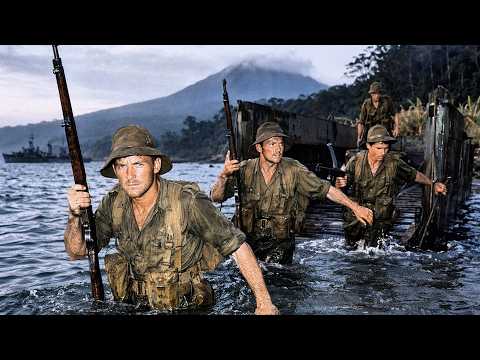
The destroyers left Milne Bay at dusk on October 22. The men sat in the steel hulls, listening to the engines and the waves, most of them never having set foot on a warship before. They climbed down into Daihatsu barges—three captured from the Japanese at Milne Bay—along with small boats and whalers. They were rowed and motored toward the shore in a slow, black procession.
The landing at Mud Bay was unopposed. The Japanese hadn’t expected an attack from the south. They had focused their defenses on the north, looking out to sea. The Australians came from behind.
But the landing at Taliba Bay was a different story. Gategood’s company hit the beach right into the Japanese main defensive line. Machine-gun fire tore into the lead platoon. Gategood ordered his men to hit the ground and return fire, but he quickly decided to withdraw. The beach was wrong, the defenses were fortified, and his company would be wiped out before reaching the link-up point.
They pulled back to the boats under fire, losing men, leaving some wounded behind with promises to return. They circled offshore until dawn, then rejoined the main force at Mud Bay.
Now the Australians were concentrated in one place. Arnold had three or four days before the moon and tides gave the Japanese their next chance to move. He sent his companies forward into the kunai grass—tall, dense, and loud. It rustled as they pushed through, revealing their positions to any sniper.
They made first contact late that morning. A patrol crossed a small stream and saw movement in the trees. They hit the ground, exchanged fire, and the Japanese withdrew. That set the pattern for the next two days. The Japanese didn’t stand and fight. They were starving, sick, and without supplies. They fought briefly, then slipped away to the next cover. They were buying time.
The Australians thought they were closing a trap on a broken enemy. They didn’t know that the Japanese commander, Tsukioka, had been preparing for this moment for two months. He had hidden two Daihatsu barges under camouflage on the north coast, and he had a plan.
On the night of October 24, with Australian infantry pressing from the south and Allied destroyers offshore, Tsukioka removed the camouflage and ordered his men to board. They left in darkness, the barges overloaded, wounded carried on improvised stretchers. They slipped across the channel to Ferguson Island, where a signal had been sent to Rabaul. The light cruiser Tenryu was dispatched. It arrived on the night of October 25, picked up the survivors, and returned north before dawn.
The Japanese had escaped. They had lost their barges, their mission, and their garrison—but most of them lived to fight again. The Australians took the island, but they didn’t know the full story yet.
They would soon learn that the Japanese had left behind more than just empty camps. They had left a question: how would the Australians hold the island against a counterattack they couldn’t repel? The answer would be one of the most audacious deceptions of the Pacific War.
Arnold’s companies pushed forward through the kunai on the morning of October 25 and found the camps empty. Cold ash in the cooking pits. Weapons deliberately smashed—stocks split, bolts gone, muzzles bent against the rocks. Piles of equipment abandoned in neat, orderly heaps, as though the men who left them had all the time in the world.
By October 27, the last stragglers had been rounded up. A handful of Japanese were killed in the final sweeps; a few more were wounded and captured. The Australians counted their own: thirteen dead on Goodenough, nineteen wounded. The operation report, written as it was first drafted, credited them with about twenty Japanese killed in action and roughly fifteen wounded left behind during the evacuation.
It was not a battle of annihilation. It was a battle of expulsion. The garrison had not been wiped out—it had been forced to leave. But the strategic effect was complete. Goodenough Island passed into Australian hands on the night of October 25 and stayed there for the rest of the war. The Japanese never came back for it. They never landed on it again. They never tried.
That should have been the end of the story. It wasn’t.
The Australian commanders at Milne Bay understood, the moment the island was theirs, that its value had just spiked. The bay on the southern side, at a place called Vivigani, was wide enough for a fighter strip. The inland slopes would shelter dispersal areas. Heavy bombers could fly from an airfield there. From Vivigani, aircraft could reach Rabaul. From Vivigani, Allied power could threaten the Japanese supply line to Buna from the flank.
The decision was made within days. Goodenough would be developed as a forward Allied base.
But there was a problem. In late October 1942, the Allied position in New Guinea was still desperately fragile. The counter-offensive in Kokoda was still grinding slowly across the Owen Stanley Range. Buna and Gona had not yet fallen. There was no amphibious capacity to move a full garrison to Goodenough. The Australian troops on the island in the weeks after the operation were small—a fraction of what would be needed to defend it against a determined Japanese landing.
If Tokyo had decided Goodenough was worth retaking, and sent a battalion to it under cover of darkness in late November or early December, the small Australian garrison could not have stopped them.
So the Australians put on a performance. It was the kind of trick that doesn’t appear in any field manual. It was improvised in meetings at Milne Bay between intelligence officers, engineers, and the staff of the units sent to the island.
The plan rested on a simple principle. The Japanese could never be allowed to know how few men were on Goodenough. If they weren’t deceived into believing a large force was there, they would come back.
The garrison set to work making the site look like it held a full brigade. They built dummy anti-aircraft guns out of tree trunks, bamboo, and lengths of stovepipe scrounged from engineer stores. They placed them on the high ground above the airfield, sited and dug in as though they were real batteries—so that if a Japanese reconnaissance plane circled overhead, it would see what any trained observer would expect to see. Multiple gun positions, neatly spaced, with obvious tracks around them.
They made fake barbed wire out of forest vines. They cut vines from the rainforest and strung them on stakes in long lines around the perimeter, so that from the air they looked exactly like the dark threads of real concertina wire. The perimeter looked, in photographs, the way a defensive perimeter is supposed to look. It looked as though a full brigade had dug itself in.
From the air, no man could tell the difference between strung vines and properly laid wire. Not from twelve thousand feet, in a Japanese reconnaissance plane moving fast. There was no meaningful difference at all.
They built a dummy field hospital. They erected tents that were empty inside. They painted red crosses on the roofs at the size hospital tents normally carried. They laid out the supporting infrastructure of a hospital—access tracks, latrines at the proper spacing, dressing huts, orderly rows—so that from the air it gave the impression of a medical facility scaled to a brigade.
And they lit cooking fires. Many cooking fires. Fires for meals no one would eat, in places where there were no men to eat them. At the times of day when smoke rises high and visible above the island, a Japanese observer counting columns of smoke on a still morning would count enough cooking fires to suggest a force of perhaps two thousand men—when the actual force on the island was a fraction of that.
They sent radio traffic in deliberately weak ciphers. These were the most delicate deceptions of all, because they required the messages to actually be read. Australian signallers, under an intelligence officer’s supervision, encrypted routine traffic in a low-grade cipher they knew the Japanese had broken. They sent messages between the supposed sub-units of the brigade. They sent supply movements, strength returns, training schedules, requests for rations. They sent it all at the volume a brigade headquarters would generate. Daily. They were careful to make the messages imperfect—to include the small operational errors any real signals operator might make under pressure.
Japanese listening posts at Rabaul read that traffic. They counted its volume. They counted its units. They built a picture of the Allied garrison on Goodenough that, from their side, looked enormous.
They never came back to the island.
In the months that followed, while the dummy guns weathered in the rain and the vine wire tangled into the real forest and the cooking fires burned to feed men who weren’t there, real Allied units arrived. A fighter strip was built at Vivigani. Bomber squadrons moved forward. Engineer battalions carved dispersal areas out of the kunai. The Goodenough garrison stopped being a bluff and became a real brigade, then more than a brigade. And by the time the dummy guns and the vine wire were no longer needed, it was because real guns and real wire had replaced them.
The whole thing worked.
That was the third answer to the original question. The first was simplest: 353 Japanese marines were stranded because their barges were forced ashore by weather, then destroyed by Australian aircraft, and the navy couldn’t evacuate them. The second took longer to see: they stayed two months because their commander hid two Daihatsu barges and spent eight weeks preparing an evacuation he knew his navy couldn’t guarantee. And the third—the one that mattered most—was the deception. The dummy guns. The vine wire. The empty hospital and the cooking fires for no one.
The 2/12th Battalion cleared the island in five days of crawling and fighting through the kunai. The RAAF had isolated the original garrison with bombing runs. The coastwatchers had counted the stranded marines week after week. But the phantom brigade finished the job. The men with rifles and bayonets took the ground. The men who tied bamboo to tree trunks in the weeks after kept it.
The 2/12th moved on to Buna, Sanananda, Lae, Finschhafen, Borneo. They lost more men in those campaigns than on Goodenough. Tsukioka and his survivors returned to Rabaul, were reorganized, and sent to the Solomons, where most died within two years. The coastwatcher went back to the jungle and did it all again under a different code name on a different island.
Goodenough was Australia’s first amphibious landing. It wasn’t perfect. The map was wrong. The Taliba Bay landing failed. The enemy escaped. But Australia did it—crossed the water, put a battalion ashore, took an island, and held it. And in five days of walking through the tall yellow grass, they learned how to do what they’d have to do again and again on every beach from October 1942 to August 1945.
They were there because their war carried them there. Nothing more. Nothing less.
What would you have done if you were the coastwatcher on that ridge, watching 353 enemy soldiers wait for a rescue that never came?
Report this article
Select a reason for reporting:






