The night was a frozen blade. On March 4, 2002, the Shahi-Kot Valley was a hellscape of snow and fire. An American Chinook, torn open by rockets, spiraled away from the peak of Takur Ghar. A Navy SEAL, Neil Roberts, fell into the drifts below—alone, surrounded by al-Qaeda fighters pouring fire from the heights. The mountain erupted. What happened next would become a legend of survival and sacrifice, a 17-hour battle that claimed seven American lives.
But on a nearby ridge, something else was happening. Something quieter. A small team of Australian SASR soldiers lay hidden among the rocks, watching the entire battle unfold—unseen. While other coalition teams in the area were compromised within a day, these men remained ghosts. How did a handful of Australians stay invisible on a mountain where everyone else was found?
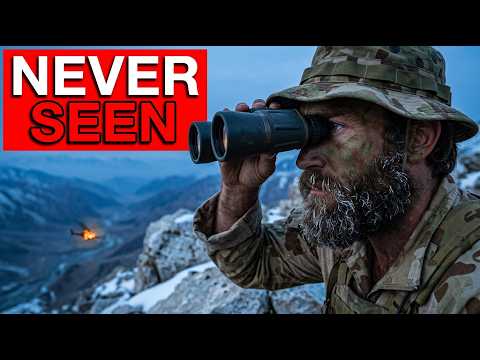
To understand, you have to go back a few hours, to the middle of that bitter night. The snow lay thick on the rocks. High above the valley floor, a massive American helicopter crept toward a peak called Takur Ghar—over 10,000 feet of frozen stone. Inside, a team of Navy SEALs prepared to set up a secret observation post. The mission seemed simple: watch the enemy, call in airstrikes. Then the night exploded.
Missiles and bullets slammed into the Chinook. The pilots wrenched the aircraft away. In the chaos, a SEAL named Neil Roberts slid from the open ramp and fell into the deep snow. His team was still in the air. He was alone on the mountaintop, and the enemy was waiting. More helicopters and soldiers raced to rescue him. The battle would rage for 17 hours. Seven Americans would die on that mountain.
But there is another story on a nearby peak. A quiet story, almost never told for years. A small team of Australian Special Air Service Regiment (SASR) soldiers, hidden among the rocks, watching the same battle from the heart of darkness. Their mission: see everything, be seen by no one. According to reports, they stayed hidden while the fight raged, calling in airstrikes to keep enemy reinforcements away from the trapped Americans.
This is the story of why American Special Forces couldn’t believe the Australian team stayed unseen on that ridge. Much of this account comes from Australian testimony. So when we tell you what the Americans thought, we’re relaying what the Australians say they believed—and we’ll always make that clear. We have one American voice, the commander of the entire battle, and we’ll get to him.
To understand why this mattered, you need to know the war’s situation. By late 2001, the Taliban government had fallen. Many al-Qaeda fighters fled into the mountains near the Pakistani border, gathering in the Shahi-Kot Valley—a place used as a safe haven in the 1980s. American commanders decided to strike hard. They called it Operation Anaconda, after the snake that crushes its prey. The operation began at dawn on March 2, 2002, and lasted until March 18.
On paper, the plan looked good. Commanders believed the enemy had 200 to 250 fighters mixed with local villagers. They were wrong. Later estimates were much higher: 500 to 1,000 fighters. The plan began to crack, and eight Americans would lose their lives before Anaconda ended.
The high ground was everything in this battle. Whoever controlled the mountains could see the entire valley. The Americans had spy planes, satellites, and special forces teams—yet they couldn’t see where the enemy was hiding. A small force of Australian SAS soldiers was in Afghanistan that month. They had trained for exactly this kind of mission: infiltrate enemy territory, hide among the rocks, and observe for days without being seen. But many American commanders didn’t seem to realize it, assigning the Australians a secondary role as a blocking force.
Here’s the strange part. On one mountain, the world’s most powerful military was being slowed by fighters they couldn’t see. On another mountain, no one could find a few Australians with only their packs, radios, and patience. Within days, according to one account, an Australian patrol spotted something that all those satellites and spy planes had missed. How do a few men stay still in the bitter cold darkness while a major battle rages nearby without being discovered? And what did they see from that ridge that no one else could?
To understand the ridge, you first have to know the men who hid on it. The Australian SAS was founded on July 25, 1957. Its first combat deployment in Borneo in 1965 wasn’t about major battles. The mission was surveillance. Small teams slipped into dense forests to track enemy movements. Later in Vietnam, the enemy gave them a nickname: “Ma Rung”—Ghosts of the Jungle. Their main base is in Perth, on Australia’s far west coast. The training is brutal. Soldiers learn to walk for hours carrying heavy packs. They learn to stay motionless in one spot for long periods. They learn to stay silent despite cold hands, aching legs, and empty stomachs. Hiding among rocks remains slow and dull—until the moment everything changes.
In October 2001, Australia promised to send the SASR to Afghanistan, and the first troops arrived in December. It started with one squadron. Their mission: comb rugged terrain on foot, find al-Qaeda and Taliban fighters, and report what they saw. The Australians worked under American generals. In the early months of 2002, Lieutenant Colonel Rowan Tink commanded the Australian task group. His force was only about 150 soldiers—a tiny number for such vast mountains. Working in cold weather and high altitudes, far from any support, was exactly what the SASR had trained for.
And how did the Americans use them? The Americans preferred quick missions: get in, strike, and leave in a day or two. The SASR was the opposite. This part comes from an Australian intelligence officer who spoke to Time magazine in 2005. He asked to keep his surname secret, so the magazine called him “Adam.” According to Adam, the Americans didn’t imagine soldiers staying in the field for long. Another old Australian warrior told the magazine that some Americans could only last two days, while his team could stay for weeks. According to Time, on one map at American headquarters, the Australians’ location was marked with a cutout of Steve Irwin, the “Crocodile Hunter.” It was funny, sure. But it also showed the Americans weren’t sure what to do with them.
Resentment began to grow among the Australians. According to one account, they were about to pack their bags and go home after only four months. Then one patrol climbed a mountain above the Shahi-Kot Valley. From the top, they watched a group of al-Qaeda fighters training and reported it. The Americans were already planning a massive attack on that valley. You might think the Australians would get thanks. Instead, Adam said: “The Americans didn’t take that reconnaissance well.” That attack was Operation Anaconda. The Australians wanted a real role in it.
They were given a small mission as a blocking force, and they objected. A verbal clash nearly broke out between an Australian SASR officer and an American major named Jimmy, the second-in-command of US special operations forces. According to Adam, the Australians asked to send their own patrols 10 days before the operation to watch the enemy, but Jimmy refused. They later learned that American teams were already heading there—but only days before the battle. That wasn’t enough time to learn what was really there. Other accounts suggest Australian patrols were in the area when the battle began. So the full picture remains unclear.
Think about what each side wanted. The Americans wanted speed and power. They believed a big, fast strike would crush a hidden enemy. The Australians wanted time and quiet. They believed you must see the enemy before you fight him. One side trusted force; the other trusted patience. Adam could only watch the plan unfold. But he had another idea. He was reading about old Soviet battles in these mountains, and that led him to predict where the enemy would flee. That prediction mattered more than anyone expected.
For now, the Australians had no choice but to wait. Snow still covered the peaks. The heights were still empty. A cold wind blew from the hills, and every rock looked like a place for someone to hide. In a few days, the mountains would reveal which side was right.
Dawn came on March 2, 2002, and Operation Anaconda began. American soldiers climbed into helicopters and flew toward the Shahi-Kot Valley. Many commanders expected a short fight. They thought the enemy would surrender once surrounded. They were wrong. As the helicopters landed, bullets and mortar shells poured from the mountains. Gunfire echoed off the rock walls. Al-Qaeda fighters controlled the high ground, and the Americans were pinned in the open in thin, freezing air. Some soldiers dropped their packs and radios as they ran for cover.
Two Australian liaison officers were with them. One was a signaller named Martin Wallace, who said he kept his pack, so his radio kept working. According to Time, the Australians held onto their equipment and warned command that the American team was trapped. The air plan failed too. The Air Force was supposed to bomb enemy positions for 55 minutes before the ground attack. Reports say the bombing was much lighter than planned—only six bombs fell after one bomb got stuck in a bomber’s bay. Major General Franklin Hagenbeck, the American commander, was counting on his aircraft to do most of the work. Commanders needed to watch the enemy quickly. The plan was to place small teams on high points to observe and direct airstrikes.
The best point was Takur Ghar. The valley is about 160 km south of Kabul near the Pakistani border, and Takur Ghar was the tallest mountain on its edge. From the top, a team could see for miles. The enemy knew that too. One estimate says at least 10 fighters controlled a camp on the summit with a heavy machine gun aimed at the small flat spot where a helicopter would land. On the night of March 3, a SEAL team called Mako 30 prepared. Senior Chief Britt Slabinski led a team of SEALs and an Air Force combat controller named John Chapman. According to one account, Slabinski asked for one more day to prepare but was ordered to go. Years later, people still argued about that decision.
Dawn was near, so the only way up was by helicopter. Do you remember the Chinook from the start of this story? Missiles and bullets hit it, and Neil Roberts fell from the open ramp into the snow. The helicopter made a hard landing lower on the mountain. His teammates didn’t want to leave him behind. A second helicopter took them to the summit before dawn. They jumped out into heavy fire. Chapman was badly wounded and believed killed, though later reviews suggest he kept fighting alone before he died. Two SEALs were wounded. They had to pull back.
Then a rescue team of Army Rangers came. Their helicopter was hit during landing, and a crew member, Philip Svitak, was killed. In the fighting that followed, Rangers Matthew Commons, Bradley Crose, and Marc Anderson were killed. Air Force pararescueman Jason Cunningham was badly wounded and died about six hours later. Commanders feared losing another helicopter, so the wounded couldn’t be evacuated in daylight. The fight lasted about 17 hours. Seven Americans died on that summit. One statistic says about 35 more enemy fighters rushed to help.
From a distance, commanders struggled to follow the battle. On the steep mountains, the SEALs’ radios didn’t work well. One writer noted that the command center, about 1,800 km away, tried to run the fight remotely. Commanders made decisions without a clear view. All this time, the Australians were watching from a nearby mountain. According to reports, they had slipped into position before the first helicopter was hit. They lay among the rocks, silent and freezing. In such a hide, a flash of light or a rolling stone could give you away. Every time enemy fighters moved toward the trapped Americans, the Australians called in airstrikes. If the enemy found them, those strikes would stop.
On one side, the noise of the war’s fiercest battle rose. On the other, the quietest men in it made no sound. And so, everything depended on one thing. A few men stayed still while rockets, bullets, and bombs filled the air around them. Could they stay hidden long enough to save the Americans trapped on Takur Ghar?
The fight on Takur Ghar was far from over. The Rangers on the summit were wounded and surrounded. Enemy fighters kept advancing up the slopes. Someone had to spot those fighters before they arrived. On the neighboring mountain, the Australians lay motionless in their hide. Reports say they were with an American Air Force combat controller named Jim Hotaling. His job was to communicate with the aircraft circling above. He was said to be essential in directing many of the airstrikes that pushed back the enemy. Every time a group of fighters crept toward the trapped Americans, the call went out and bombs rained down.
Think about what that required. By midday, the sun was high, and hiding in daylight is hardest. Snow reflects light. Something shiny, a sudden movement, or a loud cough could reveal your position. Below the slope, rockets and machine guns roared. The Australians had to stay calm and silent while the ground shook.
Remember what Time wrote about other coalition teams in the area. They barely lasted a day before shepherds or villagers discovered them. This hide, reports say, was never found. Slowly, the tide of battle turned. After heavy airstrikes requested by the Americans and joined by their nearby Australian allies, the Rangers held the summit under fire. It wasn’t an easy victory. Seven Americans died there, but the mountain was no longer in enemy hands, and according to reports, the quiet observation on the neighboring hill helped make that happen.
Then the story took a second turn. Four days after Anaconda began, Adam’s idea was put to the test. He had been reading about old Soviet battles in these same mountains. He studied the ground and made a guess. He believed that if al-Qaeda leaders took losses, they would flee along a certain route. With all their machines, the Americans hadn’t chosen that route. He wanted to watch it. So the Australians sent a patrol. According to Adam, the patrol slipped into position undetected. It was the kind of hide other teams had failed to keep.
The soldiers settled among rocks high on a mountain over 1,200 meters from the road—about three-quarters of a mile. Through their binoculars, the men watched, and hours passed. Then, according to Adam’s account, they saw something. A group of men moving along the escape route. They wore Russian camouflage and black masks. They carried modern weapons. In the middle, they seemed to guard an old man in white robes walking with a cane. They weren’t ordinary fighters. They looked like men protecting someone very important.
The patrol sent the news. At first, according to Adam, American intelligence officers thought the Australians had found Osama bin Laden. A jet took off and dropped a large bomb. Time estimated it weighed 500 kg. But the bomb missed its target. According to Adam, it exploded more than 100 meters away in a streambed. A-10 attack aircraft followed and killed a number of suspected fighters, though people still argue about how successful that strike was. Adam said the man with the cane managed to escape. No one agrees on his identity. Adam believed he was Tahir Yuldashev, leader of a group called the Islamic Movement of Uzbekistan. A journalist named Sean Naylor wrote that he might have been Ayman al-Zawahiri, bin Laden’s second-in-command. General Hagenbeck told Time he believed the target was destroyed.
Whatever the truth, one thing is clear. In Adam’s account, the Australians did what the machines couldn’t. They found the enemy’s escape route and stayed hidden long enough to spot it.
Before we go further, we must pause to remember the cost of Takur Ghar. The sun set on March 4, 2002, and the mountain finally quieted. Smoke drifted low over the snow. The air smelled of burnt metal and fuel. After a long day of fighting, the men on the summit were cold, tired, and in pain. Their breath rose in the air, and their hands shook—not just from the cold. Seven Americans were killed and many more wounded. An officer said the task force commander agonized over the decision to risk flying in daylight to evacuate them. There was kindness in the midst of this horror. When Roberts fell into the snow, his comrades went back for him even though they knew armed enemy fighters were waiting. They went because he was one of them. No one is entirely sure when Roberts died. Commanders far away tried to make sense of it. Reports say senior American leaders, including General Tommy Franks and Defense Secretary Donald Rumsfeld, praised the men’s courage and acknowledged how dangerous this war was.
Estimates of enemy dead in the entire operation range from over 500 to 800, according to US claims. It’s hard to count in snow, rocks, and caves. The American view of the Australians began to change. According to Time, it started in the early hours when Australian liaison officers kept their radios while others dropped theirs. Then came the escape-route patrol. The excitement about the man with the cane turned into argument when the bomb missed. But the Australians had proven what quiet work could achieve.
Adam believed the battle could have gone differently. He said if his men had gone in 10 days earlier, it would have given them an edge over the enemy. That’s just his view, and no one can be sure. But it’s a painful thought for anyone who remembers the seven men lost on Takur Ghar.
The loud fight on Takur Ghar ended. But the Australians’ quiet work was about to change how others saw them. The battle ended on March 18, 2002. Al-Qaeda fighters were driven from the Shahi-Kot Valley. Many called Operation Anaconda a success. Yet it was much harder than commanders planned, and writers later pointed to wrong estimates about the enemy and remote management of the battle.
For the Australians, things changed. Before Anaconda, they were given small tasks, and it was said they put a Steve Irwin cutout on the map. Afterward, according to Time, the escape-route patrol put the SASR on the planning table in the hunt for Osama bin Laden. Soon they took on bigger missions. And here is the American voice I promised. In an Australian television interview, Hagenbeck said he wouldn’t have wanted to run that operation without the Australian SASR on that hill. This is the commander of the entire battle. This doesn’t mean he didn’t believe they could stay hidden. But it tells us how important they were in his view.
In April, according to Time, the third squadron arrived and continued the same quiet work. The magazine reported that one patrol sent detailed photos of weapons being smuggled across the border in a trailer pulled by a red tractor, amazing the Americans. One soldier told the magazine that British special forces could last only about four days in the field, while his patrol lasted seven days without supplies. That’s one soldier’s boast, so take it as such. But it shows what the Australians thought of themselves.
Then came Operation Jacana, which ran from April 16 to July 9, 2002. It was a follow-up to Anaconda aimed at hunting fighters still hiding. Australian SASR soldiers worked alongside US special forces, Norwegian commandos, and British Royal Marines. It was risky work. On May 16, an Australian patrol took five hours of mortar and heavy machine-gun fire, and 20 to 60 fighters chased the soldiers across rugged terrain. Apache helicopters and a warplane came to help, and about 10 attackers were killed. Some accounts suggest the attackers were local tribal fighters who mistook the Australians for rivals. So we can’t be sure who they were. Commanders took notice.
By the time the SASR withdrew later in 2002, its three squadrons had rotated through the field. The regiment later received a Unit Citation for Gallantry for its work in Afghanistan on July 24, 2002, at Bagram Air Base. General Hagenbeck awarded Lieutenant Colonel Tink the US Bronze Star. The medal praised his outstanding contribution to the coalition fight against terrorism.
How did the enemy see all this? We know very little about how al-Qaeda fighters viewed the Australians, and it would be wrong to guess. All we know is that they lost the Shahi-Kot Valley. Adam had a simple way of expressing what Anaconda taught. Looking back, he said if he could do it again, he would tell American commanders that sending their soldiers into a valley full of caves without watching the enemy was madness.
Behind every number in Operation Anaconda stands a real person. Let’s start with the Americans who didn’t come home. Neil Roberts was a 32-year-old SEAL from Woodland, California. He was the first man lost on Takur Ghar, and the battle now bears his name. Jason Cunningham, born in 1975 in Carlsbad, New Mexico, was an Air Force rescue pilot. His job was to save others. Matthew Commons of Boulder City, Nevada, was a young Army Ranger promoted to corporal after his death. Two other airmen show how different one job can be. John Chapman and Jim Hotaling both served as combat controllers. Their job was to talk to the pilots above and guide aircraft to where bombs should fall. Chapman was with the SEALs on the summit, in the heart of the noise, and died there. Reports say Hotaling was in a hidden position on the neighboring mountain with the Australians. Same job, same day, two very different places. One was in the middle of the fire. The other was in silence.
Others lived, and they had to carry the memories of what they saw. Britt Slabinski led the SEAL team that went back for Roberts. Two of his SEALs were wounded. Nate Self, a young Army Ranger captain, led the rescue team that landed in the middle of the battle. He was later honored for his courage. People in the special forces world still argue about the decisions made that night.
It’s hard to track the Australians because most have no names in the records. Adam asked to keep his surname secret for security reasons. A few names are known. Lieutenant Colonel Rowan Tink commanded the task group. Daniel McDaniel led the first SASR squadron sent. Lieutenant Colonel Gus Gilmore commanded the regiment. Martin Wallace, the signaller who kept his radio working in that first fight, later received a bravery award. But the men who were on the hill and did the hardest part remain unknown. One soldier told Time that being described as a cutout was frustrating. It’s a soldier’s polite way of saying his skills were being wasted.
This kind of thinking appeared in other small moments that year. The Sydney Morning Herald reported that an Australian SAS patrol was hiding in 2002 and saw armed men walking toward them. The soldiers raised their rifles. Then their leader put his rifle aside and stood in the open. The Afghans stopped, lowered their weapons, and walked in another direction. A man with a gun in Afghanistan wasn’t always an enemy. Col Busby, a veteran of that tour, later said that getting into a firefight usually meant someone had made a mistake.
What about the other side? Many fighters in these mountains were foreigners who fled to the valley after earlier battles. Records about villagers are scarce. Some reports estimate the civilian population in the area at about 1,000 people. Shepherds also roamed these hills, and according to Time, they were the ones who spotted other teams’ hides. How these ordinary people lived through Operation Anaconda is a story missing from most books.
Seven American families lost loved ones on the summit of Takur Ghar. A few Australian families, unnamed in the news, waited for soldiers who came back and didn’t talk much. Both kinds of waiting happened in the same cold week.
Years passed, but the story of that ridge didn’t fade. The fight on Takur Ghar is now called the Battle of Roberts Ridge, after Neil Roberts, the first man lost there. Books and paintings tell it. Sean Naylor, a reporter who was in the valley when Anaconda began, wrote one of the most famous books on the entire operation. And Lee Neville, a writer from Sydney, wrote another book about the fight for the summit. People still argue about the decisions made that night—the way battles are remembered when they are costly.
The Australian side was more restrained. For a long time, the public knew very little. The Australian special forces don’t boast, and its soldiers keep their names private. Most of what we know appeared three years later in Time magazine in 2005, in a story based on interviews with former soldiers. Even then, the main voice refused to give his surname. Some say silence is part of the mission. The best hide is one no one ever talks about.
The two armies would work side by side again. Australian special forces returned to Afghanistan in 2005 and stayed until 2006, and a smaller Australian force continued to operate in Uruzgan province with Dutch, American, and other coalition forces. And this fact keeps the story honest. The Australian SASR wasn’t magic. Sergeant Matthew Locke’s patrol was sent to set up an observation post in Uruzgan. After a 10-hour climb up a mountainside, local fighters found them. Locke received a bravery medal in December 2006. He died in Afghanistan in October 2007. Even the best hide in the world can be found.
This brings us back to the question this video began with. Why didn’t the Americans believe the Australians stayed unseen? Here’s what the record tells us. The Australians trained for long, slow work, while according to Adam’s account, the Americans planned missions lasting a day or two. Adam studied old Soviet battles to guess where the enemy would flee. And the Australians went to the hills ready to stay still for as long as it took. Time reported that other teams in the area barely lasted a day. Remember, most of this comes from Australian voices. What we can say is that according to Time, the Americans were amazed by what the Australians brought. The Australian SASR was given a seat at the planning table. And the American commander later said he wouldn’t have wanted to fight that battle without them.
We can’t say that one hill changed the way the entire US Army fights. The honest lesson is smaller. Machines can show you a lot, but they can’t always show you what a person sitting among the rocks can see. Perhaps that is the deepest lesson. War is loud, and we remember the loud parts: the rockets, the bombs, the helicopters. But sometimes the most important work is done by people lying silently in the dark, watching and waiting, hoping no one finds them. It takes a different kind of courage. In Vietnam, the enemy called the Australian SAS the Ghosts of the Jungle. On a high hill in Afghanistan, a few men earned that name again. They stayed invisible so that others could be seen, saved, and brought home.
As the sun rose over the Shahi-Kot Valley, the Australians slipped away from their ridge, leaving no trace. They had done what machines couldn’t: they had seen without being seen. Years later, American commanders would still shake their heads, unable to fully believe it.
But the record is clear. The ghosts of the jungle had become ghosts of the mountains. Their silence saved lives, and their patience changed a war.
Now, we ask you: In an age of drones and satellites, is there still a place for the quiet soldier hiding in the rocks? Share your thoughts below.
Report this article
Select a reason for reporting:






