On the morning of February 14, 1943, Lieutenant John Waters, a 36-year-old American officer, wrote a short letter to his wife. He told her about the cold desert, that he loved her, and not to worry. Twelve hours later, he was a prisoner of Nazi Germany. His father-in-law, General George Patton, would spend the next two years not knowing if he was alive or dead.
At that moment, the U.S. Army ranked nineteenth in the world—behind Portugal, barely ahead of Bulgaria. Twenty-six months later, that same army would stand as the most powerful ground force on the planet, poised on the Rhine. What happened in between was not a miracle. It was the story of a general who fought a battle from a bunker 70 miles behind the front line, a sergeant from New Jersey who tore open enemy armor, and a boy born in Frankfurt who became the first American officer to cross the river his father’s generation had crossed from the other side.
This is the story of how American infantry advanced unlike every European army in World War II—and what that difference cost.
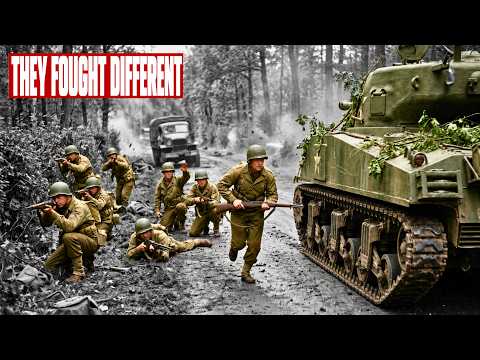
Before dawn on February 14, 1943, the sky over Tunisia was still pitch black when the ground began to shake. In the valley below Sidi Bou Zid, American soldiers of the 1st Armored Division slept in shallow trenches scraped from stone and dust. Some had been in the country barely six weeks. Most had never seen a German tank. None of them knew that two German panzer divisions—the 10th and 21st—had already been fighting in the desert for a year under Field Marshal Erwin Rommel and General Hans-Jürgen von Arnim, and were now moving through the pass toward them.
At exactly 4:00 a.m., 140 panzers rolled out of the darkness in four battle groups. The first American radio call came at 4:15. “Small arms fire. Vehicles moving east. Nothing decisive.” Within an hour, the horizon began to burn.
American infantrymen on two strategic hills, Djebel Lessouda and Djebel Ksaira, watched the panzers cut past them like sharks through open water. The tanks did not stop to fight. They flowed around them. By dawn, two American infantry battalions were surrounded, cut off from each other and from the rear.
The radios still worked. The men on the hills could see German columns wrapping around their flanks, and they could see their own armored counterattack advancing to save them. That counterattack was destroyed in less than an hour. American Sherman and light Stuart tanks rolled across open ground into the sights of hidden German anti-tank guns. The 88mm guns fired first. Then the Shermans burned in place, one after another, so fast their crews never had a chance to jump out. Half-tracks flipped into the air like tin cans. Young men who had trained in Louisiana, California, and Georgia climbed out of burning vehicles and ran. Some ran toward the enemy by mistake. Others ran until they dropped.
The desert absorbed it all and gave nothing back. By the evening of February 16, II Corps had lost 1,600 men, nearly 100 tanks, 57 half-tracks, and 29 artillery pieces. Over the next eight days, the American line kept collapsing. Kasserine Pass fell. Sbeitla fell. Feriana fell. The Americans retreated more than 50 miles. When the fighting finally ended around Thala and Sbiba on February 24, American casualties totaled 6,300 killed, wounded, captured, and missing in the sand.
General Omar Bradley, then a brigadier general, later called it “the worst performance in the long history of the American Army.”
But the numbers only tell us what happened. They do not tell us why. To understand why, we have to meet the men who were supposed to be in charge.
The commander of II Corps was Major General Lloyd Fredendall, 59 years old, who had joined the Army in 1907. He had never led troops in battle before Kasserine. He had been personally chosen by General George Marshall, the Army Chief of Staff, and Lieutenant General Lesley McNair, the architect of the ground forces. Both believed Fredendall was a rising star. He wore a neat mustache, spoke with confidence to his superiors, and was in every measurable sense a serious professional soldier in peacetime. But he was also, as it turned out, a man who could not stand the sound of gunfire.
Above the city of Tébessa on the Algerian plateau, about 70 miles behind the American front, Fredendall ordered his engineers to build him a headquarters. He called it a command post. His officers called it something else: “Speedy Valley.” It was a maze of concrete-lined tunnels blasted deep into the side of a limestone mountain range. Fredendall pulled an entire engineer battalion off the front lines for weeks to blow his bunker deeper. Trucks that were supposed to carry ammunition and fuel to the divisions at the front instead hauled cement and rebar for Fredendall’s bunker.
When the general finally moved in, some of his subordinate commanders drove three hours over winding desert tracks just to speak with him face to face, then drove three hours back. From inside this bunker, Fredendall ran the battle by radio and telephone using a private code he invented himself. Infantry were “walking boys.” Tanks were “iron.” Artillery were “little guns.” He referred to specific villages by nicknames no one outside his personal staff understood. His orders were translated through his private vocabulary, then broadcast over unreliable radios in the Tunisian mountains, arriving at the front as baffling riddles. Battalion commanders spent precious minutes trying to decode what their corps commander actually wanted them to do. Some simply gave up.
He never visited the front. Not once—not in the weeks before Kasserine, not during the battle, not after. His officers kept silent because he was a major general and they were not. But resentment rose when German panzers rolled out of the Faïd Pass on February 14 and began tearing his divisions apart.
Fredendall responded from behind the walls of Algerian stone his engineers had blasted for him. He issued orders to units that no longer existed. He distributed his tanks based on a map without ever seeing the ground. He kept saying everything was under control while the heart of the American force was coming apart in front of him.
There is a second thread in this story. It runs alongside the first. It belongs to the man Fredendall never met.
On the morning of February 14, on the northern slope of Djebel Lessouda, the American infantry battalion trapped by the German advance was commanded by Lieutenant Colonel John Knight Waters. He was 36 years old, a 1931 West Point graduate. He had bright eyes and a quiet manner, and he was in the habit of writing long, patient letters to his wife. Her name was Beatrice Ayer Patton, daughter of Major General George S. Patton Jr. John Waters was Patton’s son-in-law. He had married her in 1934, and the family called her “Little Beer.” Patton had walked her to the altar. The two men respected each other and exchanged letters constantly. When the war broke out, Patton promised his daughter he would look after her husband, but he had no way to keep that promise.
Now Waters watched from the hill line as the 10th Panzer Division encircled his battalion. He saw the American armored counterattack burn on the plain. He tried to hold his men in place until relief arrived, but it never came. On the night of February 16, the survivors of his battalion tried to escape under cover of darkness, walking through valleys and dry riverbeds while the Germans closed in from both sides. Waters did not make it. He was captured in the desert not far from Sidi Bou Zid. He was searched, disarmed, walked to a collection point, and put on a truck.
Over the following weeks, he was moved by rail and cattle car through Italy to occupied Poland, to a prisoner-of-war camp called Oflag 64. He spent the next two years there and lost 40 pounds. He received Red Cross parcels bearing his father-in-law’s handwriting and a photograph of his wife, but he was not allowed to reply. His family in the United States did not know whether he was alive.
Patton received the news at his headquarters in Casablanca. He was preparing for the invasion of Sicily. He wrote a short note in his diary that day, then fell silent for a long time. But the men who worked closely with him noticed a change in his behavior from that week. Something inside him had hardened. He did not yet know that within weeks he would be given command of II Corps himself. That decision belonged to another man.
Dwight David Eisenhower was 52 years old in the winter of 1943. He was the Supreme Commander of Allied Forces in North Africa, though he had never commanded a single division in battle. He was a farm boy from Kansas who had risen through the Army on talent, patience, and a genius for holding difficult men together. He hated conflict among his generals. He preferred persuasion to firing. For weeks, as the Kasserine disaster unfolded, he tried to give Lloyd Fredendall another chance.
On March 5, Eisenhower went to visit what was left of II Corps headquarters. He walked through the tunnels of Speedy Valley. He looked at Fredendall’s maps. He listened as Fredendall explained, in his private language, why none of it was his fault. Then Eisenhower took Omar Bradley aside. Bradley was 50, quiet, steady. He had been sent specifically to observe. He had spent the previous weeks moving among the American divisions, listening to battalion commanders, drinking coffee with first sergeants who were still shaking from what they had seen. He was known then for his blunt honesty with superiors. Eisenhower asked him one question: What do you think of the command here?
Bradley did not soften it: The situation is bad. I have talked to all the division commanders. All of them, without exception, have lost confidence in Fredendall as a corps commander.
That was March 5. By March 6, Fredendall was gone. Eisenhower sent the decision by cable to Washington. He did it quickly, before he could change his mind. Fredendall was ordered home. He was promoted on the spot to lieutenant general, given command of a training army in Tennessee, and welcomed back to the United States as a returning hero, because the truth was politically inconvenient to publish. The public would never know that the man humiliated by Rommel in the desert had spent the battle underground 70 miles away, calling his tanks on the radio. Fredendall would never command troops in combat again.
His replacement arrived at II Corps headquarters on March 6, driving a truck through the rain, followed by three staff officers with personal pistols on each hip. He was 57 years old. He was already famous in the U.S. Army for two things: his temper and his belief that any general who did not see his soldiers at the front did not deserve to be called a general. His name was George Smith Patton Jr.
He entered Fredendall’s underground headquarters. He looked at the maps. He looked at the ashtrays overflowing with cigarette butts. He looked at the elaborate signal codes for walking boys and iron. He said nothing.
Later that day, he wrote a private letter to his wife. He told Beatrice that Fredendall was a great athlete, a victim of circumstances beyond his control. Seven days later, after a tour of his new command, Patton opened his diary again. The second entry was shorter. He wrote: “I cannot see what Fredendall did to justify his existence.”
Patton did not mention his son-in-law. He did not have to. Everyone around him knew that John Waters, somewhere behind German lines in a prison camp whose location the family still did not know, was starving in silence and writing letters no one would deliver.
The transformation began the next morning. Patton stood in a mess tent full of frightened, exhausted soldiers who had been outmatched in the desert and had watched their friends burn in tanks. He told them, in language that could not be printed in any newspaper at the time, that they were going to become something new. Not because they wanted to, but because they had no other choice—because the German army they had just faced was, at that moment, the best fighting force in the world. And the United States could not outmatch it in professionalism, experience, or skill.
The question hanging over the room, the question hanging over the entire American war effort in the spring of 1943, was simple: If we cannot fight like Europeans, how will we fight? If we cannot match them soldier for soldier, sergeant for sergeant, what do we have?
The answer was already taking shape, though almost no one in that tent could see it yet. It was taking shape in closed meetings at Fort Benning and Fort Sill, on assembly lines in Detroit and Pittsburgh, and in the minds of officers like Lesley McNair in Washington, who were quietly redesigning the American infantry division from the ground up. It was taking shape in the semi-automatic rifles packed in wooden crates aboard ships crossing the Atlantic. It was taking shape in artillery schools, where a young lieutenant with a radio was being trained to call the fire of 12 artillery battalions at once. It was taking shape, above all, in the country that was making all of it. The United States, which entered the war in December 1941, was the largest industrial power in human history. In 1943, its factories began producing weapons, vehicles, and shells at a rate no European planner sitting in Berlin, London, or Moscow would have believed possible.
Every American division that would land in Europe would be fully mechanized. Every infantryman would carry a semi-automatic weapon. Every platoon would have a radio. Every battalion could reach the fire of a full artillery regiment in minutes.
None of that saved the men at Sidi Bou Zid. None of that saved John Waters. But the outlines of a different kind of war were beginning to emerge, and George Patton, standing in the rain outside a bunker he already hated, was the man who would lead II Corps into it.
He did not yet know that in less than two years, his son-in-law would be liberated from a German prison camp by American soldiers Patton himself had helped set in motion. He did not know that Fredendall would live out the war in isolation and die in Southern California, largely forgotten. He did not know that Lesley McNair, the mentor who had championed Fredendall’s career and helped design the entire American infantry system, would be dead by the following summer, killed by an American bomb dropped by an American plane on the outskirts of a small French town called Saint-Lô.
All Patton knew that morning in Tunisia in March 1943 was that his soldiers had been beaten and that the way they fought at Kasserine would not be the way they fought from now on. Somewhere in the desert, the wind was still blowing over the burned-out tanks. The dead were counted. The prisoners were on trains heading north. The American army was about to become something no European soldier had ever seen, and no one in the world was prepared for what would happen next.
The proof came at El Guettar on March 23, 1943—nine days after Patton took command. The 10th Panzer Division attacked the U.S. 1st Infantry Division through an open valley. Fifty German tanks led the way.
But American forward observers had crawled into position the night before. Every gun had been registered. When the panzers entered the valley floor, they crossed into a kill zone mapped and ranged in advance by twelve artillery battalions.
The first volley fell within seconds. Thirty of fifty tanks were destroyed in under an hour. The rest turned and ran.
No one cheered. They were too exhausted. But something had shifted. The men who walked out of Kasserine believing the German army was invincible now understood it could be broken—not by matching it, but by fire that came from everywhere at once.
That system had a name most Americans had never heard in 1943: the fire direction center. And it would carry them all the way to the Elbe.
So here is the question worth asking: if the American way of war was built on factories and radios and men who never asked to be heroes, what does that say about the country that made them—and the one we live in now?
Report this article
Select a reason for reporting:






