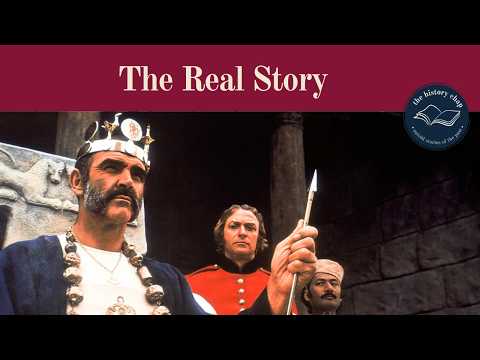
When Sean Connery strides across that rope bridge, singing ‘The Son of God Goes Forth to War’ as the ropes are slashed and he plunges into the abyss, it’s pure cinematic magic. But behind the unforgettable film and Rudyard Kipling’s classic tale lies a question that has tantalized historians and adventure enthusiasts for over a century: Did two rogue ex-soldiers really conquer a remote mountain kingdom and crown themselves kings?
The answer is as thrilling as any fiction. Kipling’s story of Daniel Dravot and Peachey Carnehan, two British adventurers who set out to become gods in the forbidden land of Kafiristan, was published in 1888 when the author was just 22. But the seeds of this extraordinary yarn were sown in real events and real people—men who risked everything for a shot at glory in the uncharted mountains of Central Asia.
Kipling, working as a journalist in Northern India, was a keen observer of the world around him. He heard tales of audacious men who had crossed into Afghanistan disguised as holy men, who had raised armies, minted their own coins, and carved out personal fiefdoms in lands where no European had dared tread. These stories of ambition, danger, and downfall were the raw material from which he forged his masterpiece.
But how much of it was true? Kafiristan—the Land of the Infidels—was a real place, a remote region in the Hindu Kush so isolated that its people had resisted conversion to Islam for centuries. They practiced a mysterious religion blending animism, ancestor worship, and ancient traditions. And they told a legend: that they were descendants of Alexander the Great’s soldiers, left behind millennia ago. It was a land that seemed to exist outside of time, perfect for a story of men who would be kings.
The film, released in 1975 and starring Connery and Michael Caine, captured the imagination of millions. It was nominated for four Academy Awards and featured a young Christopher Plummer as Kipling himself. The scene where Dravot is forced to walk across the bridge to his death, singing a hymn that was reportedly one of General George Patton’s favorites, remains one of the most iconic moments in adventure cinema. But the film, like the book, deviates from history in key ways—and the real story is even more fascinating.
Consider Alexander Gardner, an American adventurer born in Wisconsin in 1785. He claimed to have visited Kafiristan in the 1820s, and his travel writings provided Kipling with vivid descriptions of the land and its people. Gardner’s memoirs are filled with incredible adventures that blur the line between fact and fiction—he served as an artillery colonel in the army of Ranjit Singh, the Sikh Emperor, and later wrote about his exploits in Central Asia. Was he the first Westerner to set foot in Kafiristan? Perhaps. Was he a reliable narrator? That’s another question entirely.
Then there was Josiah Harlan, a Philadelphia-born adventurer who traveled to Punjab and Afghanistan with the explicit intention of making himself a king. He served the Maharaja Ranjit Singh, crossed into Afghanistan disguised as a holy man, and even served the Amir Dost Muhammad, leading armies against his rivals. Harlan never became a king, but he was rewarded with the title ‘Prince of Ghor.’ His photographs bear a striking resemblance to the physical description of Daniel Dravot—large beard, commanding presence, and a burning ambition. Like Dravot, he was a Freemason, and his stories would have circulated in Masonic lodges in India, where Kipling himself was a member.
And we cannot forget Frederick Wilson, a Yorkshireman who deserted the East India Company’s army and ended up in the remote Himalayan region of Hazara. He made a fortune shooting gamebirds for the plume trade, then persuaded the local ruler to grant him timber rights. He styled himself the ‘Raja of Harsil,’ minted his own coins with his likeness, and built a palace. Eventually, the locals turned on him, and he fled—much like Dravot and Carnehan. Wilson later ran a hotel in a British hill station, and one of his guests was a young Rudyard Kipling. One can only imagine the tales the old adventurer spun for the future Nobel laureate.
Perhaps the most direct influence was William Watts McNair, a British surveyor who, in 1883, made a clandestine expedition into Kafiristan disguised as a Muslim holy man. He published an account of his journey in The Pioneer, a newspaper Kipling was working for at the time. McNair’s descriptions of the people, their customs, and their resistance to Afghan incursions were woven into Kipling’s story. He even presented an antique seal to the Royal Geographical Society, claiming it proved the Kafiris were descended from Alexander’s soldiers—a detail Kipling used in his tale.
So while Daniel Dravot and Peachey Carnehan never existed, the men who inspired them were very real. They were adventurers, dreamers, and rogues who risked everything for a chance to rule. Their stories are every bit as compelling as Kipling’s fiction—and they remind us that sometimes, real history is stranger and more thrilling than any made-up tale.
But the story doesn’t end there. The film itself has its own secrets—like the stuntman who performed the death-defying fall from the bridge, a D-Day veteran named Joe Powell who had already cheated death once. And the real Kafiristan, now called Nuristan, still holds mysteries that continue to fascinate explorers and historians. The line between legend and truth is blurred, and the man who would be king remains an enigma—both in fiction and in fact.
Joe Powell was no stranger to danger. Born in West London in 1922, he had joined the Grenadier Guards at seventeen, then transferred to No. 4 Commando, where he took part in Operation Abercrombie and landed on Sword Beach on D-Day. By the time he became a stuntman at Pinewood Studios, he had already survived more than most men could imagine.
For The Man Who Would Be King, Powell faced a challenge that dwarfed anything he had done before. The drop from the rope bridge to the gorge floor was roughly 400 feet. To survive, a small platform had been rigged against the cliff face some 90 feet below the bridge, hidden from the cameras. If Powell missed that platform, it was certain death.
Michael Caine, his old friend from Zulu, couldn’t bring himself to watch. He turned away as Powell stepped off the bridge and plummeted out of view. But if you slow the film down, you can see that Powell didn’t tumble wildly—he executed a rehearsed, professional drop, landing squarely on the hidden platform. The stunt worked perfectly, and Powell went on to become one of Britain’s great stuntmen, with three Bond films and The Longest Day to his credit. He died in 2016, aged 94.
Yet the most intriguing question remains: was there any historical truth behind Dravot and Carnehan? The answer is both no and yes. The two men themselves were fictional, but the world they moved through was astonishingly real. Kafiristan—now Nuristan—was a genuine place, a remote pocket of the Hindu Kush whose people resisted Islam for centuries. They practiced a faith blending animism, ancestor worship, and fragments of Buddhist and Hindu tradition.
And the legend that they were descended from Alexander the Great’s soldiers? DNA research has found no Greek ancestry among the Kalash people, but strong links to Central Asia and early Indian cultures. Kipling’s characters believed the legend, and that belief was what mattered. It shaped how they saw themselves—almost Englishmen in a strange land, destined to rule.
By the time Kipling wrote his story, Kafiristan was still effectively independent. The Amir of Afghanistan claimed the territory but had no way to enforce his rule from Kabul. For the British, it was a blank space on the map—forbidden, mysterious, and irresistible to men like Dravot and Carnehan. The Durand Line, drawn in the 1890s, would eventually split the Kalash people between Afghanistan and Pakistan, and by 1896 the Afghans had conquered the region, renaming it Nuristan—the Land of the Enlightened.
So the stage was real, even if the players were invented. And the men who inspired those players—Gardner, Harlan, Wilson, McNair—were every bit as bold and reckless as Kipling’s creations. Their stories, forgotten by most, remain a testament to an age when the map still had edges, and a determined man with a rifle and a dream could carve out a kingdom of his own.
But there is one more adventurer whose story deserves telling—a man who actually succeeded where Dravot failed, and whose dynasty endured for generations. His name was James Brooke, and he became the White Rajah of Sarawak.
James Brooke was born in 1803 in Benares, India, to a British judge serving the East India Company. After a brief military career and a serious wound in the First Anglo-Burmese War, he inherited a fortune and bought a schooner, the Royalist, with a single ambition: to explore the islands of the East Indies. In 1839 he arrived in Borneo, where he found a local rebellion against the Sultan of Brunei.
Brooke helped the Sultan crush the uprising, and in gratitude was granted the territory of Sarawak as his personal fiefdom. In 1841 he became the first White Rajah of Sarawak, founding a dynasty that would rule for over a century. He established a government, fought piracy, and was even offered the throne of the entire Brunei Sultanate—an offer he declined. Unlike Dravot, Brooke never claimed to be a god; he ruled as a benevolent autocrat, but a ruler nonetheless.
What makes Brooke especially relevant is that Kipling’s characters explicitly mention him. In the book, Dravot and Carnehan speak of Brooke and Sarawak as a model to emulate. Here was a real man who had done exactly what they dreamed of—carved out a kingdom in a remote land and ruled it as king. Brooke died in 1868, but his family’s rule continued until 1946, when the third Rajah ceded Sarawak to Britain.
So the answer to our question is both no and yes. Daniel Dravot and Peachey Carnehan never existed, but the world that produced them was full of men just like them—adventurers, rogues, and dreamers who risked everything for a crown. Kafiristan was real. The Kalash people were real. The legends of Alexander’s soldiers were real. And the ambition to be a king in a far-off land? That was as real as it gets.
Kipling’s story, and the film it inspired, are not history—but they are a window into a time when the map still had blank spaces, and a bold man with a rifle and a dream could write his own legend. Sometimes, the line between fact and fiction is thinner than we think.
So the next time you watch Sean Connery stride across that bridge, singing his defiant hymn, remember: the man who would be king never existed, but the men who tried were very, very real.
And who knows? Perhaps somewhere in the mountains of Nuristan, the legend still lives on. What do you think—could a modern-day Dravot still find a kingdom to conquer, or has the age of adventure truly ended? Share your thoughts in the comments below.
Report this article
Select a reason for reporting:






