Every town has a dark side. In small places, everyone knows everyone—so when a child goes missing, the whole community feels it and mobilizes. But imagine not one child, but six boys from the same town, all vanishing on a single night, never to be seen again. No bodies. No answers. For 31 years.
This is the story of the Lost Boys of Pickering—one of Canada’s most baffling disappearance cases. Three decades later, we still don’t know what happened to them.
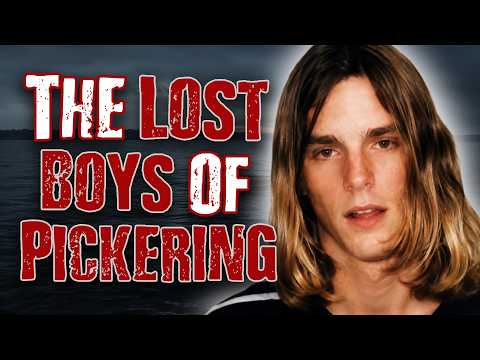
It was St. Patrick’s Day, March 17, 1995. Pickering, a quiet suburb on Lake Ontario just east of Toronto, was small enough that most kids knew each other. They grew up in the same schools, played on the same baseball teams, maybe even dated each other’s friends.
That night, a group of teenagers was celebrating at a house party—drinks flowing, typical 1995 teen stuff. Except something extraordinary was about to happen, something that still haunts this town today.
Around 12:40 a.m., six boys left together: Jay Boyle, 17, Chad Smith, 18, and Robbie Rumboldt, 17, all from Pickering; Danny Higgins, 16, from Ajax; Michael Cummins, 17, from Oshawa; and Jamie Lefebvre, 17, from Scarborough.
On his way out, Jay told a friend their destination: “To the water,” he said, “to mess around with a boat.” No one thought much of it—it was St. Patrick’s Night, everyone was having fun. Pickering sits right on Lake Ontario’s shore, so the water was familiar territory. They’d all grown up there without a single problem.
They headed toward Frenchman’s Bay, a small protected harbor dotted with moorings, yacht clubs, and rows of boats still wrapped in plastic from winter. And here, precisely, the story begins to blur—because from this moment on, everything we think we know comes from scattered fragments: a grainy security tape, a few witness statements, and a whole lot of theories.
What investigators eventually pieced together—or at least claimed to—goes like this: The boys broke into the East Shore Marina on Liverpool Road. Once inside, they allegedly grabbed a case of beer left on someone else’s boat, then took two boats that weren’t theirs either.
One was a small 13-foot Boston Whaler—basically a motorboat. The other was a three-wheeled pedal boat, described as a jet ski. Some accounts say they’d actually stolen it from another marina the night before. Either way, you had six boys on two stolen boats.
According to the official narrative, this is when they set out onto Lake Ontario in the middle of a March night, on water barely above freezing. At 1:48 a.m., a security camera at the marina caught movement. Three of the six—Michael, Jamie, and Robbie—entered the frame and walked onto the marina grounds. Jay, Chad, and Danny didn’t appear in those shots.
Then, sometime between 2:30 and 3:00 a.m., some residents living around the bay said they heard the sound of a boat engine out on the water. After that, the trail went completely cold. No camera ever caught them again. No one else reported seeing them.
Most importantly, not a single one of the six boys has been found since—alive or dead—in the 31 years that followed.
Two of the boys had girlfriends who were at that party. When the boys didn’t return, the girls got worried enough to actually call the police. At 3:30 a.m., they phoned Durham Regional Police to report six missing teenagers. They told them they believed the boys had gone out onto the lake on stolen boats.
The officer who took the call was Constable James Gillam. But instead of treating it as a real emergency—teenagers on freezing water in possibly stolen boats in the middle of the night—Gillam simply dismissed them. To him, it sounded like some kids causing trouble. He didn’t feel the need to involve the police.
He told the girls there was no specific place to search, that there was nothing he could do at that moment, and that the boys’ mothers should file a formal missing persons report through the proper channels.
According to Bruce Ricketts, a private investigator who spent nearly two decades of his life on this case, Gillam actually went further. Ricketts says the officer logged the girls’ report as unfounded—meaning he closed the file as if no one was missing or in any danger at all.
Now, it’s easy to judge in hindsight, but it wasn’t Gillam’s call to decide how serious this was. His job was to investigate. And two frightened teenage girls had done exactly the right thing—calling police in the dead of night to say their friends might be in trouble. But they were brushed off and told to come back later with a formal form.
And it gets worse. The official search for the six boys didn’t even begin until that Saturday—a full 36 hours after the girls’ first call.
When it finally started, it was a serious operation. Durham Regional Police, the Canadian Coast Guard, Toronto Metro Marine Unit, a C-130 Hercules aircraft, and a helicopter from 424 Transport and Rescue Squadron at CFB Trenton—all called in. Hundreds of volunteers from across southern Ontario combed the beaches and scanned the water.
After all that manpower and resources, they came back with absolutely nothing. Not a single trace of those boys.
So what the hell happened to them? And what about the two boats?
When I moved to my new city, I had a long list of things on my mind—and the fact that I’d left all my doctors behind and would need new ones wasn’t on it. Doctor, dentist, all of it, gone. I was starting from scratch in a place where I knew no one.
And that’s exactly where Zocdoc comes in. This episode is sponsored by Zocdoc. Thanks to them, you don’t have to feel stressed at any point while trying to take care of your health. Zocdoc lets you search for quality doctors in your network and compare them—so you’re only looking at people who already accept your insurance. You get real reviews from real patients before booking. Appointments happen fast, usually within 24 to 72 hours, sometimes the same day. Whether you’re doing it or just putting it off because it seems like a hassle, Zocdoc makes the whole thing easy. Your health matters, and taking care of yourself shouldn’t be complicated. Find the right doctor and book your appointment with Zocdoc. Head to zocdoc.com/everytown to get started and get booking off your to-do list. That’s zocdoc.com/everytown.
But before we move on, I want to talk about Jay Boyle specifically—because of the six boys, he’s the one we actually know the most about. And his story is tragic in its own right. At seventeen, Jay already had some run-ins with the law. He’d served a sentence for assault, and at the time he vanished, he was facing additional charges—assault and weapons possession this time.
He was living in a small rented basement apartment with his girlfriend Monique and their baby daughter Kiera. On the night of the party, Jay’s mother Patricia was at home watching her granddaughter while Jay was out. To police and many people who only knew the surface details, Jay fit a certain pattern: prior record, new charges, out drinking on St. Patrick’s Day while his daughter was at home. So you can understand how investigators looked at his file and eventually decided he was just a kid who’d end up in trouble one way or another.
But to the people who actually knew him, that description couldn’t be more wrong. His mother and his sisters, Yvonne and Amanda, described him as fun-loving and fiercely loyal—someone who would drop everything to stand up for a person he cared about. He was also a genuinely talented baseball player, good enough that his teammates and coaches believed he might go far in the sport. Just a young guy who’d gotten a little lost along the way. Maybe you knew someone like him growing up—rough around the edges, but with a good heart underneath. Not a saint by any means, but not a monster either.
His younger sister Amanda was fifteen at the time and was supposed to be at that party. But she got sick and stayed home instead—which means she wasn’t there the night her brother disappeared forever.
When word came from Monique that Jay hadn’t come home, the family’s first reaction wasn’t panic. Jay had plenty of friends—he could crash on plenty of couches. But as hours turned into days, all that hope slowly curdled into something darker. Then baseball season rolled around that spring, and obviously Jay wasn’t there for it. That, more than anything, was when the family truly realized their lives would never be the same.
And so for years, the case just sort of sat there. Take one missing person—it takes people time to process. When it’s six boys, it takes even longer for everyone to grasp the reality of what happened. All they really had was a theory about stolen boats on freezing water, with zero physical evidence to back any of it up.
Then in 1998, something happened that was supposed to turn the entire investigation upside down. But it simply didn’t.
Human remains were discovered along the Niagara River on the American side near Wilson, New York—about 62 miles from Pickering as the crow flies. Frankly, it’s much farther if you trace the path water would actually have to take to carry a body from Lake Ontario into the Niagara River system. Those remains, well, they were wearing red jeans. And Jay Boyle had been photographed the night he disappeared wearing red Levi’s. It’s a very specific, very distinctive piece of clothing.
You’d think a detail like that would set off alarm bells. But instead, according to his family, this discovery was kept quiet—and they didn’t learn about it at all for fifteen years. The Boyle family only found out about those remains in late 2013. And the way they found out is almost unbelievable: it happened after a psychic medium, of all people, told them to search the Ontario Provincial Police’s missing persons database. And there they found a photo of unidentified bones still wrapped in red jeans.
Jay’s sister spoke about seeing that image and just knowing, in her gut, that she was looking at her brother. So the family took the obvious step from there. They pushed for a DNA test. They asked Detective Sheridan of Durham Regional Police to have Niagara police test the remains and match them against Jay’s mother’s DNA sample—a sample that was already sitting in Durham Regional Police’s own records.
And here’s where the case takes yet another infuriating turn. Because Niagara police reportedly refused to run the test. Their reasons were almost insulting. The first was cost—even though the Boyle family said plainly they would personally pay whatever it took. The second was the claim that a body drowned in Lake Ontario simply couldn’t, due to currents, end up in the Niagara River given the way water moves between them.
And they’re not wrong about that. The Niagara River flows north from Lake Erie down into Lake Ontario, not the other way around. So no, a body wouldn’t float upstream from the lake, because the water is moving against it the whole way. But we also don’t know where these kids went with their boats. We don’t know who did what or where anyone ended up. So 62 miles is a lot, but it’s not so far that they couldn’t have at least checked.
Ultimately, after years, the DNA test the family had been demanding was finally run. And the result came back negative. Whoever those remains belonged to, well, they weren’t Jay’s. A second, separate set of remains was also found in the Niagara River in 1998, said to match the general description of two of the other missing boys—but as far as public information goes, that trail also led nowhere definitive.
So the only physical evidence this case ever had—a coincidence so precise it seemed almost too perfect—turned out to be just a coincidence after all. And that brings us to Bruce Ricketts. Without this man, I’m not sure we’d even be talking about this case today.
Ricketts was a private investigator from Ottawa who took on the Lost Boys mystery more than a decade after they vanished—and once he was in, he spent years of his life on it. He filed nearly 30 separate freedom-of-information requests, trying to pry loose the original police files. What he uncovered didn’t exactly inspire confidence.
Take the marina surveillance tape everyone was told showed only three boys entering at 1:48 a.m. When Ricketts first asked for a copy, he says he was told the tape didn’t exist at all. It took three separate requests before they finally let him watch it—and even then, it was heavily redacted.
He sat through all sixteen hours anyway. And around 2:10 a.m., roughly twenty minutes after the first three boys appeared, three other people entered the marina—two women and one man. The man stepped ahead of the women, turned, and raised his hands, gesturing toward the water or the boats. The video was far too blurry to make out faces. But according to Ricketts, none of this ever made it into the case file.
Then, at 2:21 a.m.—just minutes later—the most important camera covering the dock simply stopped working. No one has ever explained whether it was a technical glitch or something more deliberate.
Ricketts also revealed that Durham police could have accessed side-scan sonar—top-tier equipment used to find shipwrecks on the lakebed. They even contacted a man named Ed Bert, who ran a company called Ocean Scan Systems, to survey the bottom near Frenchman’s Bay. But before Bert could go out and do the job, the contract was reportedly cancelled. Why? We still don’t know.
On paper, Durham’s official theory never changed: six drunk teenagers stole a boat and a jet ski, took them onto near-freezing water without life jackets, and at some point the boat capsized or swamped. All six drowned. Some investigators suggested the boys may have tried to pile onto that tiny jet ski as the boat went down—and that their bodies are still there, trapped in a thermal layer, a band of frigid water that keeps whatever sinks into it and never gives anything back.
It’s the most logical theory. You can picture six drunk teenagers thinking a stolen boat would be fun, then tragedy striking. But it’s still just a theory—and the total lack of evidence is what keeps it from feeling like a resolution. No boat has ever been found, in a lake that’s searched, dredged, and dived fairly regularly. No confirmed remains of any of the six boys have ever surfaced. And there’s still no explanation for those three unidentified people—or why that camera died minutes later.
For nearly three decades now, the families of those six boys have essentially been left to investigate their children’s disappearance themselves. There’s a Facebook page dedicated to the case that’s still active today, still receiving the occasional tip or message from people claiming to have new information—none of which has led anywhere real.
Ricketts worked the case until his death a few years ago. He never succeeded in pushing police or the Ontario government to formally reopen the original investigation, or the 1998 Niagara remains, despite years of advocacy and dozens of information requests. He died after spending nearly two decades of his life trying to get clear answers for a group of families he had no connection to. Simply because he believed they deserved better than what they got.
For Durham Regional Police, with only theories to work with, the case remains officially open and unsolved. The boys are still technically missing. Presumed dead, but never declared drowned—just missing.
As for what actually happened at Frenchman’s Bay that night, no one can say for certain. And that’s the main reason this case doesn’t sit right with most people. One case fading into oblivion for lack of evidence is normal. But it’s something else entirely when six boys vanish and the system meant to find them never seemed to seriously start looking at all.
So that’s all we have for today’s episode of Every Town. If this story grabbed you, check out our other episodes on mysterious cases—we have plenty. Remember to come back next week for another hour of creepy, strange, and unexplained stories. You never know—maybe your town is next.
But here’s what keeps me up at night: if six boys could vanish from a quiet lakeside town and the search never truly began—what else is sitting in an unopened file somewhere, waiting for someone to finally look? What’s your theory on what happened at Frenchman’s Bay that night? Drop it in the comments below.
Report this article
Select a reason for reporting:






