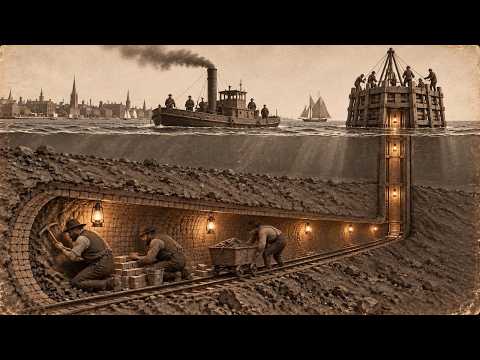
In the spring of 1864, a few dozen men with picks and oil lamps began digging a brick tube five feet wide under Lake Michigan—from both ends at once, aiming to meet in the dark. Two miles out, a five-sided wooden island the size of a courthouse sat in thirty feet of open water, a lamp in its cupola and a fog bell that rang once a minute. Fifty men spent a whole winter on it, cut off by ice, digging down through its middle toward the bottom of the lake.
They were there because Chicago was drinking its own sewage. The city drew water from a pipe just off the beach, a short walk north of the mouth of the Chicago River—and the river carried the city’s sewers and the offal of the packing houses straight into the lake. In cold weather, tiny fish swam into the intake by the millions. They came out of the hydrants alive and swimming, and people learned to look twice into a glass of water before they drank it.
The man with the plan was Ellis Chesbrough, the city engineer. He proposed a tunnel far out under the lake, tapping clean, cold water two miles from shore. The newspapers turned against it almost as one. But Chesbrough started anyway, lowering a two-inch gas pipe into the lake between two anchored scows to probe the bottom.
What he found was blue clay—soft on top, harder the deeper it went. The water out there was so clear they could see a small object eighteen feet down. On June 16, 1863, they dropped a thermometer to the bottom: 51 and a half degrees. Clean, cold water was sitting two miles out. Getting it to shore was the whole problem.
The safest way under a lake, Chesbrough knew, was to stay well below it, inside the clay, and to make the tunnel smaller, not bigger. Blue clay that tight barely lets water through. Think of pushing a drinking straw through a block of cold modeling clay at the bottom of a sink full of water—the sink stays full, the straw stays dry, because the clay is the wall.
So the tube was set at five feet across, enough to carry fifty gallons a day for each of a million people. Small was the safe bet. If the ground turned bad, a small hole is far easier to hold open than a big one.
The doubt about the ground showed up in the money. When bids were opened on September 9, 1863, the cheapest was about $240,000 and the dearest more than a million. Some bidders expected sand and gravel under the lake, others expected clay. A firm from Harrisburg, Pennsylvania, run by James Dull and Colonel James Gowen, was the only one that signed on to take every risk of the soil on itself—and it got the job.
The contract said the tunnel would be finished by November 1, 1865. That date didn’t survive the first spring.
The shore end had to start with iron. The board had ordered cast-iron cylinders for the top of the shore shaft, nine feet across inside and two and a half inches thick, from a foundry in Pittsburgh. The castings came about two months late. So the ground wasn’t broken until St. Patrick’s Day, March 17, 1864, at the old pumping works at the east end of Chicago Avenue, right on the shore.
About a hundred men in good coats stood around the spot. Mayor Francis Sherman made a short speech, took a pick, and broke the ground, and each of the gentlemen dropped a shovelful of dirt into a wheelbarrow. Colonel Gowen wheeled it away himself.
Within a few feet of that ceremony, his men hit the first enemy. The top of that shore was quicksand—about fourteen feet of it, wet and shifting—and it swallowed whatever was dug out of it. The plan had called for a shaft lined with brick all the way from the surface. Brick needs ground that stands still long enough to lay it, and this ground never did.
Worse, the pipe the whole city drank through ran out into the lake right beside the shaft, bedded in that same sand. That’s what frightened the board, and it’s why the iron went in instead of the brick.
Picture a stack of three cast-iron rings, each ten feet tall, with a sharpened bottom edge. The crew stood the stack on the sand and dug out the inside, and as they dug, the iron’s own weight pushed it down, the way a cookie cutter sinks into dough when you scoop out the middle.
It went slower than anyone wanted because the contractors didn’t have pumps fit for the water coming through that sand. The top flange of that cylinder was even made to take an airlock, the kind used for digging under pressure, in case the sand turned out deeper than anyone thought. It was never needed. A few feet below the bottom of the iron, the spade hit clay, and all serious trouble with the sand was over.
Below the iron, the shaft went on down as a brick well, eight feet across, sixty-nine feet below the surface. At the bottom, a spring kept seeping in, and a six-foot sump had to be bailed out about twice a day for the whole three years.
Near the bottom, the contractors asked the board for permission to go deeper still, to put a thicker roof of clay between their men and the lake. Then they met water and something that hissed out of the clay, and they changed their minds. They stopped at the depth on the drawings, and on May 26, 1864, two miners swung their picks into the east wall of that shaft and started walking east toward a string of buoys two miles out on Lake Michigan.
What hissed out of that clay would soon put them on their faces in the dark.
It was gas—natural gas, trapped in pockets in the blue clay under the lake—and nobody had planned for it. The board’s own history calls it the greatest and most dangerous difficulty of the whole job, and the one nobody saw coming.
A miner would swing his pick into a seam, the clay would open on a pocket, and the gas would roll out along the roof of the tunnel toward the open flame of his lamp. Early on, that happened several times. The explosions were small, but each one left a sheet of fire running along the top of the five-foot tube. The miners learned to drop flat with their faces to the ground and let it roll over them. Most came away with singed beards and eyelashes and blistered faces. In the first bad one, a miner was badly burned, and the gas kept every man out of the tunnel for three days.
They couldn’t dig around the gas and they couldn’t see it, so the miners learned to hear it. Striking the face, a man could tell from the sound under his pick when he was close to a hollow pocket. When he heard it, he stopped swinging. He took a small auger and bored a hole into the clay toward the sound. When the auger broke through, he pulled it out, and the man beside him held his lamp to the hole. The gas lit before it could gather.
Think of a gas stove. If you light the burner the moment the gas comes on, you get a small blue flame. If you wait and fill the kitchen first, you lose the kitchen. A booklet printed in Chicago in 1867 says some of those jets burned with a clear, bright flame for hours, lighting up the tube a long way back, and the men sat it out until the pocket was empty. That was the first trick of this tunnel, and it was learned by ear in the dark.
But setting fire to the air under a lake has a price. Every flame, every lamp, and every pair of lungs in that tube used up air that had no way to get in except down the shaft, and the farther the miners walked out, the worse it got.
The fix started small. A pipe of plain tin, six inches across, ran down the shaft and out along the roof of the tunnel to the face, and up top it was hooked to the furnace of the hoisting engine. The fire pulled the bad air out through the pipe, and fresh air came in down the shaft to take its place. The booklet compares the pipe to ordinary stovepipe, and that’s about what it was. Later they gave it its own engine and fan and went up to an eight-inch pipe.
It was never tight. The joints were only common tin and they leaked—worst of all near the turning places, where the mules swung their heads around and knocked into it. But it worked well enough that the board wrote the air a mile and a half out was about as good as the air near the shaft.
Now, picture the work itself, because it ran on a timetable. The day under the lake was cut into three shifts of eight hours, six days a week, around the clock. Each shift had its own job and its own boss, and each boss was a man the Board of Public Works paid to stand in the tunnel and watch the contractors’ crew.
The first shift was the trimming shift under Herman Kroechell, a trained mining engineer. Four miners and four laborers. They dug the face five feet farther and carved the hole to the exact outside shape of the brick, and Kroechell set the patterns the masons would build to. Only two of those four miners were usually regular trained men. The other two were picked laborers who had learned to handle mining tools in the clay.
Their rhythm is in the record. Two miners would work side by side hard for ten or fifteen minutes, then rest. Then again. In a tube five feet high with the smoke of a dozen lamps hanging under the roof, ten minutes of swinging a pick was about all a man had in him before he had to straighten up as far as the brick would let him.
The second shift belonged to the masons under Edwin Everett, who had spent years inspecting the city’s sewers. A few bricklayers, one man mixing mortar, and four to six helpers. Every drop of water for that mortar came down the shore shaft in tank cars made for the job and was pushed out to the face a little farther every week.
They laid the upper half of the tube on a curved frame of boiler iron, thirty inches long, built about two feet of arch at a time, and pulled the frame out within fifteen minutes of setting the last brick. The last few courses at the top couldn’t be laid by hand, so they threw cement into the gap and drove the bricks in on top of it. Two rings of brick, four inches each, all the way.
The third shift was the main mining shift. Four miners and four pushers, and its job was to keep the hole inside its lines and to watch for bad ground coming. Its first inspector was George Doer, an experienced miner. His health gave out during the work, and the man who took his place was Edward Offerman. That’s the shift that would still be digging on the last night.
The board’s history doesn’t record who those miners were by name. A modern book on the tunnel by Benjamin Sells says it was dug mainly by Irish and German immigrants. The booklet from 1867 quotes one of them saying he had been down there every day for nearly two years, and the writer says his face showed it.
By the middle of October 1864, the face was about 750 feet out, and the tunnel had a new problem that had nothing to do with gas. One track and one tube meant one direction at a time. A loaded car coming back could not pass an empty car going out. Every trip ran the full distance to the shaft and back, and the face waited.
So, on October 16, the crew stopped and dug two side rooms, one on each side of the tube, joined to it by short openings, and propped with timber and planks. In the tunnel between them, they set the turntable. Now cars could pass each other and be made up into trains. It took about a month.
Two or three weeks after it was done, cracks showed up in the brickwork. They weren’t hairlines. They ran all the way around the tube, ring after ring, for about thirteen feet on each side of the turntable. Until then, every careful check had shown the brickwork never moved once the top of the arch was keyed in. Now the masonry had split right where the tunnel had been opened up for the turning room. Nobody could say why.
The guess was that the clay under the turntable pit had sunk. So when they built the next set of side rooms, a thousand feet farther out, they put heavy brick buttresses on each side of the turntable to hold everything rigid. Weeks later, the same cracks showed up—the same number, the same pattern—as if the buttresses weren’t there.
That’s when they understood it. The clay itself was moving slowly the whole time. Blue clay that tight will slowly creep toward any hole you leave in it, the way a thumbprint in bread dough fills itself back in if you leave it alone. The side rooms were held up with wood, and wood couldn’t stop the clay from leaning in on that gap a little more every day.
So they stopped leaving gaps. At the next turning room, the masons carried the brick right over and around the turntable and bricked in every opening between the side rooms and the tube, shaping the joints carefully where they met. The cracks stopped. From then on, every thousand feet a turning room went in the same way, all the way out to about a mile and a half from shore.
Those side rooms were more than passing places. Each one held the cement and sand, a place to mix mortar, the turntable, and a stable. Because at the second set of rooms, men stopped pushing the cars, and mules took over. Two small mules, with a third kept in reserve up top in case either one went lame. They were lowered down the shore shaft on the elevator, and in the tunnel they could barely stand between the walls without rubbing their ears on the brick. Each one wore a little lamp on its collar.
And because nobody could step aside for a train in a five-foot tube, the contractors made up a real railroad timetable for the mule trains, so a man walking out toward the face would never meet a loaded car coming back.
With the mules in the turning rooms working, the face went faster the farther it got from shore, because the men had learned the clay. The best week on the shore side made ninety-three feet. Only once did they hit a boulder big enough to blast, and the board admits there was a little nervousness about setting off powder under the lake. It cracked nothing.
There were other sounds down there. One day, Colonel Gowen was leading a party of visitors out along the tube when they all heard the paddle wheels of a steamer passing over their heads. When they came back up, there she was, steaming toward the harbor. The miners said they heard it often. Twenty or thirty feet of water and a roof of clay, and they could still hear the boats.
Above ground, the job was a small yard on the shore at Chicago Avenue. One superintendent ran it for the contractors, John Offerman, and the booklet names Edward as his son. Under him, a night foreman, two engine tenders, four top men working the elevator, a carpenter, and a laborer. Two shifts of twelve hours. An employee of the board inspected every single brick before it went down the shaft.
In all that time, the city was paying and complaining. When the contract was signed, the newspapers that had liked the idea turned almost as one against it. And there was talk of a court order to stop the work before it buried the city in debt. On the evening before the contract date, an ordinance went before the city council to cancel the whole thing on the grounds that a crib in the lake would block the shipping. It failed.
The contractors had their own trouble. They’d planned to bake their bricks out of the clay they dug, and it turned out to be no good for brick. So every brick had to be bought. Prices climbed through the last years of the war. By the fall of 1865, Dull and Gowen were asking the city for more money, and that fight dragged on through the next winter.
Gowen’s answer, as far as I can tell, was to show the tunnel off. Important visitors got a ride. In July of 1865, General Ulysses Grant and his officers came down the shaft, changed into old miners’ coats from a chest in the colonel’s office, sat four to a car on blankets and buffalo robes, and rode a mule train out under the lake toward the end of the tunnel, then about 3,400 feet from shore. On the way back, the mule stopped dead, and the cars ran into it. It had been spooked by a senator’s hat, blown off on the way out and lying on the track.
A few weeks later, officials from Boston made the same trip at night, crawled the last stretch bent double to the face, and each of them laid a brick in the tunnel so they could say they had. The booklet notes that each one left a greenback in the hand of the miner who spread the cement for him. That’s a good story.
But the other end of that tunnel was the part nobody was riding to yet, because two miles out there was still nothing to ride to.
The plan for the far end was strange enough that the booklet of 1867 explained it like a jailbreak. Put a gang of convicts on an island two miles out in the lake, hand them picks to farm with, and they dig a hole straight down through the island until they’re under the lake bed, then tunnel for shore. Except here the island had to be built first, on land, and then floated out and sunk. They called it the crib.
Its foundation should have gone down in the spring of 1864, but the contractors couldn’t get the timber in time. And it wasn’t until May that the first beams were laid on the north side of the river, about 800 feet west of the lighthouse. What went up over the next year was a five-sided box of solid timber, forty feet high. Each of its five sides fifty-eight feet long. Think of it as a wooden donut with five corners. The hole in the middle, the well, was open at the top and the bottom, twenty-two feet on a side, and that’s where the shaft would go down. The ring around it was the breakwater, twenty-five feet thick, built as three walls of twelve-inch square timber, one inside the other. All of it tied together with cross timbers and caulked like the hull of a ship.
The details tell you what they were afraid of. The top ten feet of the outside were white oak instead of pine, because oak stands up to grinding ice. The corners got iron plates where the ice would hit first. The big iron bolts that held the timbers together were driven at a slant, each one leaning the opposite way from its neighbor, because a box that big floating in water pulls upward on every bolt, and a straight bolt can be pulled out. The board’s history says it plainly: “That care looked excessive, and it turned out to be none too great.”
The booklet gives the bill of materials: more than 618,000 feet of lumber, 500 bales of oakum for the caulking, and sixty-five tons of iron bolts. About $100,000 of crib before it ever moved. It stood on the bank near the mouth of the Chicago River, almost as big as the county courthouse, and somehow it had to get into the water in one piece.
To launch it, they jacked the whole box up with screws and tipped it toward the river—one foot of drop for every twelve feet of length—and built seven slides under it running sixty-four feet out into the river on timber trestles. Those slides gave the crew no end of trouble. The river bottom was stony and uneven, and passing boats kept knocking into the trestle work.
On July 24, 1865, thousands of people climbed onto rooftops and wharves along the river to watch. Seven tugboats waited with flags flying, and the governor of Illinois stood on one of the decks. On top of the crib, Colonel Gowen walked back and forth giving orders, waving his hat. A little after ten in the morning, it moved. Cannon fired, steam whistles screamed, and the crib slid into the river and floated.
The launch went off without a hitch, and the trouble started once the crib reached the lake.
The tugs towed the crib out past the bar, and the crew opened three small gates near the bottom to let water in so it would sink lower and steadier. It went from a draft of about eight feet to twenty-one. Then it reached the spot where it was supposed to be moored, and the moorings were gone. The plan had been to tie each corner to a heavy screw anchor already twisted into the lake bed, each one marked by a chain running up to a buoy. Passing lake boats had wrecked three of those buoys.
So they rigged ordinary anchors and hemp ropes instead and started filling the crib with loose stone. Almost at once, the crib went out of trim, tilted, and one corner came to rest on a sandbar. They lost time trying to pull it straight and got nowhere. The board started to fear that a storm would catch it like that, half sunk and crooked, and told the engineer to spend whatever it took.
A wrecking pump was brought out, the heavy salvage kind, and the crew used it to pump water into some compartments and out of others to bring the crib level. The walls between those compartments were supposed to be watertight. They leaked. The board’s history calls that a matter of rejoicing, because it let the pump work on several compartments without being moved.
Three powerful tugs were hired, and with enough rope and tackle they finally dragged the crib onto its spot, and the crew started throwing stone into it again.
Then the weather turned. A violent storm blew up off the lake and drove the stone boats back into the harbor before they could unload. It lasted three days. The crib was only half filled, not yet heavy enough to stay put, so the crew kept the wrecking pump going and flooded it with lake water to give it weight. It was still not enough. Every wave that hit it made the whole crib rock. The men on that crib could feel it moving under them—a heap of timber and loose stone two miles out on a stormy lake with no shore to run to.
At the corners, the inner and middle walls began to pull apart. The board’s history sums up those three days in two words: intense anxiety.
When the storm was over, two of the corner joints had opened an inch at the top. The whole crib had been shoved thirteen feet across the bottom of the lake against the wind and the waves, and it was sitting crooked, one corner a few feet lower than the opposite one. They thought about dragging it back. The fear of a second storm while they tried it settled the matter. They left it where the storm had put it.
That had a cost under the water. The tunnel was aimed at the old spot, and now the far end had moved. The line had to bend very slightly to meet it. The board later said that bend made no practical difference at all, and that the lean of the crib, though always an eyesore, never hurt its strength.
The filling with stone was finished about the middle of August, and from that day on, nobody ever saw the crib move again.
Back under the shore, the tube from the land shaft, by then most of a mile long, had trouble of its own that same season. In September of 1865, a pick opened a crack in the clay, and water started to drip into the tunnel—lake water coming through the roof. The booklet says the frightened miners fled. Then they came back, sealed the crack, and went on digging.
The same booklet says none of them was ever entirely without fear down there, and that more than once men dropped to their knees and prayed when the tunnel made a sound they didn’t know.
Out on the crib, the race now was against the ice. Once the river froze, the tugs would stop, and nothing could reach the crib for months. So on top of the stone-filled breakwater, the contractors put up a wooden house with rooms above and below, a kitchen, and a cupola with a lamp in it. Brick, cement, tools, and food went out by tug as fast as the boats could carry them, and a cook was hired.
The booklet puts the crew at about fifty men for that first winter, two miles out with the open lake on every side. The board’s later history adds one detail I wasn’t expecting. The air out there was so clean that the cook, at first, complained about how much the men ate. The board says the crib kept that reputation for good health for years afterward.
Their first job was to get a shaft down through the well in the middle and twenty-three feet into the clay under the lake. That meant iron again. Seven cast-iron rings, each nine feet long and nine feet across inside, from James Marshall and Company of Pittsburgh, the same works that made the rings for the shore. The booklet puts each one at about eleven tons, and says getting them out to the crib cost the contractors no end of delay and expense.
The plan had been to slide them down a set of sloping timber rails built inside the well while the crib was still on land. The storm that shoved the crib off its spot had smashed those rails. So the contractors’ foreman, George Bramhall, a mechanic the board called a man of unusual skill and judgment, worked out a new rig of tackle on the spot to hang the rings over the open water inside the well.
The trick was the bottom. Before the lowest ring went down, they fitted it with a false floor of wood to keep as much water out as they could. That turned eleven tons of iron into something that floated. Think of pushing an empty glass upside down into a sink of dishwater. It wants to come back up, and you can steer it with one hand. That’s what the false bottom did for the cylinder. It made the iron light enough to handle with blocks and ropes from overhead.
They bolted the rings together one on top of another, letting the stack down a little at a time on screws and chains until there was about forty-five feet of iron standing in the well, enough to reach from the bottom of the lake to above the waves. When the bottom ring finally rested on the lake bed, it sank two or three feet into the clay under its own weight, then stopped against the wooden floor. So they bored a hole in the false bottom. Water came in, the iron lost its float, and the whole stack slid down several more feet into the clay on its own.
After the sixth ring, the one with the gates, the wooden floor came out completely, and men climbed down inside to dig. The iron kept sinking as they dug out from under it until the last ring was on, and a moderate push drove it to twenty-three feet below the bottom of the lake. And down there, they hit no water at all.
At the shore end, the spring at the bottom of the shaft had to be bailed twice a day for three years. At the lake end, under thirty feet of Lake Michigan, the little leakage was carried out in buckets. The clay was doing exactly what Chesbrough had bet it would do.
The air was another matter. Out here, the bad air was pulled out through tin pipes hooked to the furnace of the crib’s hoisting engine, and every so often ashes from that furnace clogged the pipe, and the draft quit. Nobody needed a gauge to tell them. The men at the face found out first when the air stopped moving.
Then they dug the rest of the shaft down in brick below the iron to the level of the tunnel. On December 22, 1865, the first brick of the lake end of the tunnel was laid at the bottom of that shaft. On New Year’s Day, 1866, the crib crew started digging west toward shore. By then, the crew from the land side was already 4,815 feet out.
Just before the harbor froze, a party of city officials from Boston came out to see the crib. The booklet describes the steam engine moving stone and timber, men shouting as they hauled, and the lake beating on the walls without being able to stir them. The Bostonians asked whether the two tunnels would ever meet. Colonel Gowen assured them they would to within an inch.
That promise is the whole job, and it’s where this story gets hard. Two crews were now digging toward each other from opposite ends of a two-mile line. Neither could see the other. Neither could see the line, and the far end of it had been moved by a storm.
How do you draw a straight line two miles long under a lake from both ends?
You start on land. Chesbrough’s assistant engineers laid out a measured base on the shore and fixed the crib’s position by triangulation, the way you’d fix a ship’s position from two lighthouses. To sight the direction of the tunnel, they built a wooden tower about 166 feet west of the shore shaft and mounted a telescope on it, an astronomical transit with a four-inch lens made by Pike of New York. From that tower they could sight the line out over the lake, but the only place that line could be carried down into the ground was the shaft itself, nine feet across.
The booklet puts the problem this way. They had to take a straight line nine feet long and stretch it two miles without bending it.
Here’s what that means. Hold a ruler at arm’s length and tilt one end the thickness of a pencil line. At the end of your arm, nothing. Two miles out, that tiny tilt has grown into a miss of yards. A compass couldn’t help them either. The booklet says the pull of the earth itself threw a compass off down there, so it was good for a rough direction and nothing more.
So they built the line out of candles. At the bottom of the shore shaft, a short side passage ran fifty feet west, back under the land, with a room at the end where the transit could be set up below ground. About 280 feet out along the tunnel, they sank a six-inch pipe from the surface straight down to the tube. Hanging a plumb line down that pipe gave them a second fixed point, carried down from the surface with great accuracy.
From those points, the line was carried forward with sperm candles, the hard white candles made from whale wax that burned cleaner than tallow. A candle at the back, a candle ahead, and the instrument lined up between them. When the tunnel ran beyond the distance a candle could be seen, they switched to an instrument with two telescopes, sighting forward and back at once, and carrying the line along from point to point.
And then the tunnel itself got in the way. The board’s history says that on an ordinary working day, there was so much smoke from the miners’ lamps, and so much steam off the men’s bodies, that it was impossible to see clearly enough to run the lines and levels at all. The tube was full of haze from end to end every day, because people were working in it.
Except on Sunday. The work stopped one day in seven, and on Sunday nights and holidays, with the lamps out and nobody breathing in it, the air in the tunnel cleared. The board wrote that the candles then burned with a beautiful silver brightness, sometimes visible 2,000 feet away. That’s how the line was kept, a stretch at a time, on the nights when the tunnel was empty.
I find that one of the most human things in the whole record. The most precise work on the job couldn’t be done while the job was going on. It had to wait until the men were gone and the air had settled. And then the engineers could walk out with their candles and see whether the tunnel was still pointing at the island.
The man in charge of all of it was Chesbrough’s principal assistant, an engineer named Clark. He ran the lines and the levels himself, down in the tunnel, and later out at the crib, until, in the board’s words, “Other duties and ill health made it necessary for him to keep out of the tunnel.” The board gives him full credit for how it came out. It doesn’t say what was wrong with him, and I won’t guess.
At the lake end, they had their own fixed points. The crib shaft was dug about fifty feet past the line of the tunnel eastward, both to give the mule cars a place to turn and in case the tunnel was ever pushed farther out. Another six-inch pipe went straight down from above the lake surface to the end of that extension, so the crib crew could start their line with the same kind of accuracy as the shore crew.
The lake crew dug about nine and a half feet a day on average. The shore crew, a mile and a half out and working with mules and turning rooms, kept coming. Through the summer and fall of 1866, the two faces closed on each other a few feet a day from each side, both following lines drawn by candlelight on Sunday nights toward a spot neither of them could see.
The pressure on Chesbrough was real. The contract date had passed a year earlier. The city had borrowed for the work. The contractors were still fighting the council for more money, and the papers had doubted him from the start. If the tunnels passed each other in the dark, there was no easy fix. You can’t pull two miles of brick back and start over.
When the shore crew was about a hundred feet from where the meeting should be, the board stopped the brickwork. Instead of carrying the full five-foot tube forward, the miners ran a small rough passage ahead held up with timber, just to find out how the two lines were going to meet before they committed any more brick to them.
On November 24, 1866, the morning papers told the city that only a thin wall of clay was left between the two crews, about two feet thick. The shore crew was 8,277 feet from its shaft. The lake crew was 2,290 feet from the crib. Nobody yet knew if those two holes were facing each other or about to slide past each other in the dark.
The night crew went down not knowing either. The booklet says the gang on the shore side that night was in the charge of Edward Offerman, the superintendent’s son, and that his orders were exact. Dig the small passage forward to a certain distance and stop. From the other side, the lake crew had driven an iron rod out into the clay ahead of their face. So whoever got there first would feel it.
He reached his mark, and there was no rod. He measured again, carefully, back along the passage, and found his men had already gone as far as they’d been told. There was still no rod.
Picture that moment. A man with a lamp in a timbered hole a mile and a half out under Lake Michigan. The clay in front of him blank, and nearly three years of work riding on the next few feet. The booklet asks the questions he must have been asking. Had all their calculations been for nothing? Had the true course been lost somewhere back in the smoke?
He grabbed an auger, set it into the clay face, and started to turn it. A few turns in, the auger gave way in front of him into empty space on the other side. They trimmed the clay back around the hole, and there was the iron rod. The two tunnels were facing each other. The men went back up to the mouth of the shaft and, in the booklet’s words, made the early morning ring with their cheering.
Toward evening on the last day of November, 1866, the official parties went down both shafts at once. The lake party by tug out to the crib, and at twenty minutes to four, the picks went up and the last wall of clay came down. The superintendent, John Offerman, was the first man to step from one tunnel into the other. James Dull and George Bramhall, who had come in from the crib, walked on west and came up the shore shaft—the first men ever to pass all the way under the lake from the island to the land. The booklet describes handshakes, cheering, and the noise of it rolling back along the tube.
So how close did they come? The booklet says they met within an inch, which was exactly what Gowen had promised the men from Boston. The board’s own report, a few months later, is more honest and more impressive. The brickwork from the lake side was about seven and three-quarter inches off the line of the brickwork from the shore. The levels matched, and the length was only three inches longer than the triangulation had said it would be.
Think about what they had to work with. Two miles of tunnel aimed with candles and a telescope on a wooden tower, through smoke so thick they could only sight on Sunday nights, toward an island a storm had pushed off its mark—and they came in less than eight inches off line and three inches long. The board said the result was much better than was generally expected, and I’d say that’s the understatement of the whole record.
On December 6, 1866, about two hundred guests went down the shore shaft. Twenty-one earth cars were made up into trains, and Mayor John Rice crawled on his hands and knees to reach the first one. A mule pulled them out a mile and a half to the meeting point. There, the mayor set a block of white marble, one foot long and six inches wide, into the last gap in the arch, and the guests dropped American coins into it. The stone was cut with the word CLOSED and the date. The trains went on out to the crib, the guests came up into the big room on the island, and cannon fired from the crib and from the shore at the same moment. The mayor called it the wonder of America and the world. Then the guests ate lunch in the crib’s kitchen two miles out on the lake and rode home.
And here’s the honest count, since it’s the question that always comes up: how many died? The booklet of 1867 boasts that in three years of tunneling no accident of any moment occurred. The board’s own history is more careful. No one was killed. There were the gas burns, one of them bad, and one inspector of masonry, Thomas McMahon, broke his ankle working on an extension of the shore shaft, which the board calls the only serious accident to anyone on the work.
But a tunnel full of air proves nothing about water. The side rooms had to be filled in with brick and the whole tube cleaned out before the lake could be let in. On March 8, 1867, they let Lake Michigan into the tunnel slowly, filling only the flat run first, so the brickwork wouldn’t take the full weight all at once. By the morning of the 11th, the shafts were full to the level of the lake.
Then they did something I would not have done. They pumped the water back down far enough to float a small boat in the tube, and the engineer and three newspaper men climbed in at the crib end and pushed themselves more than halfway to shore through the flooded tunnel, checking the brick by lamplight. The report says not a single brick had shifted under the weight of the water. On the way back, the boat turned over. The board’s report says they were upset and left in total darkness, about six hundred feet from the crib shaft, in water too cold to be endured for long. They walked the rest of the way back to the shaft in the dark. The report adds that if it had happened a mile out instead of six hundred feet, it would have been very serious, if not fatal, to most of them.
That left one question. Would the lake actually push its own water into the city? There was no pump at the crib, nothing out there but gates and a well. The whole plan rested on the idea that if the pumps at Chicago Avenue drew water down at the shore end, the lake would refill the tunnel from two miles out by its own weight.
Think of two buckets standing side by side, joined by a hose at the bottom. Scoop water out of one, and the other one pours through the hose until both are level again. Lake Michigan was the big bucket. The well at the pumping works was the small one. The tunnel was the hose, two miles long and five feet wide.
On March 24, 1867, at about four in the afternoon, they cut off the mouth of the old shore inlet from the lake. The pumps never stopped. Now the only water reaching them would have to come through the tunnel. Within moments, the pumps had pulled the water down at the old inlet by more than a foot, and for a moment, the board says, some of the people watching thought the tunnel wasn’t going to work. The next instant, the water began to bubble up, beautiful and clear, at the top of the well. The board’s word was beautiful in a report otherwise full of measurements, and I don’t blame them.
The next day, March 25, 1867, the city held its celebration. The tunnel had cost about $458,000 against an estimate of a little over $300,000.
Then came its first winter, and the lake had a weapon nobody had tested it against. It was ice, and the worst of it was the kind you can’t see.
The ice you can see came first. That first winter, field ice piled up against the south side of the crib in enormous masses, cut grooves into the oak sheathing, and on one corner rubbed right through the planking into the solid timbers behind it. In some winters, the board says, “The broken ice built banks several hundred feet long from the bottom of the lake to ten or fifteen feet above the surface.” The board describes the noise of that ice as fearful. To a man standing on the crib, the whole island seemed to be a huge plow moving through the ice field. Twice that winter, storms broke into the wooden house on top, and it had to be patched. The stone-filled crib underneath never moved an inch. That oak and iron armor had been worth every dollar.
The real danger came from underneath. On very cold nights, when the open water is chilled below freezing but still moving, tiny crystals of ice form all through it and stick to anything they touch underwater. The board’s reports call it anchor ice. Think of slush in a cooler clinging to the side of the can and building up until the spout is choked.
Across the gateways into the crib shaft sat screens, put there to keep the fish out—the same fish that used to swim out of the city’s hydrants. One night that first winter, anchor ice built up on those screens until it choked them, and the flow through the tunnel was partly cut off. It happened at night, and the board noted that the people of the city never knew. The screens were taken out, and the fish were left to take their chances.
By the spring of 1869, anchor ice had stopped the water three times, each time for a few hours. On December 24 the next winter, it partly stopped it again, and the men on the crib kept watch night and day all through the cold for the rest of the season. By the winter after that, they’d learned enough that there wasn’t a single interruption, not even a momentary one.
Around the same time, the board sent a diver down. His name in the report is P. E. Falcon. They were worried silt might be filling the tunnel. He went into each end and found some mud in the pits at the bottom of the two shafts, a few inches in the first stretch of tunnel, and then clean floor as far in as he went. On the roof and the walls, he found something else. A great many small, delicate stalactites hanging from the brick. That’s the last picture the record gives of the inside of that tube while it was working. Bare brick under the lake, clean water moving through it, and little stone icicles growing down from the arch the masons had driven into place by hand.
The same report gives the reason it couldn’t last. In 1858, each person in Chicago used about thirty-three gallons a day. By 1870, it was about seventy-three. The tunnel had been sized for a million people using fifty gallons a day each. Chicago was already using more than that per person, with more people every year, and the board was already warning that by the middle of the 1870s, on the hottest days of summer, the city would want more than the tube could carry. A second tunnel was dug to the same crib a few years later, and in time, new ones went out much farther.
So where can you still see any of this today?
Start at Chicago Avenue and Michigan Avenue. The old pumping works where Mayor Sherman broke the ground stood here at what was then the edge of the lake, and the Chicago Avenue pumping station went up on the same ground with a new pumping engine drawn up by an engineer named Craeger who had run the old works. Across the street stands the Chicago Water Tower, finished in 1869, a limestone castle built around a standpipe 138 feet tall that steadied the pressure from those pumps. In October of 1871, the Great Fire burned this whole neighborhood. The pumping station stopped working during the fire. The Water Tower came through it, and it’s still standing.
Look east from here, and the lake is a good walk away now, past blocks of buildings. The booklet’s writer, standing at the top of this shaft the night the Boston officials went down, says the lake roared and tossed half a rod away—about eight feet from where he stood. Now, walk east and south to where the Chicago River meets the lake. The crib was built on the north side of the river, near its mouth, about eight hundred feet west of the old lighthouse, and launched into that water in July of 1865, while thousands watched from the rooftops. There’s nothing left of the slides or the yard. You’re standing where the island started.
Then go to the lakefront itself, due east of Chicago Avenue, and face the water a little north of straight out. The board’s plan put the tunnel on an east-northeast line from the shore shaft. Somewhere down there, under the beach, under the drive, under thirty feet of water and another stretch of blue clay, that five-foot brick tube still runs out toward the open lake.
From here, walk up the shore to North Avenue Beach, the place this story started. That round gray shape about two and a half miles out is really two cribs side by side. The older one, the Carter Harrison crib, was finished in 1900 and took over the job of the old wooden one. The newer one, the William Dever crib, went in beside it in 1935, and it still draws water for the city today. The wooden crib itself is gone. In 1936, the old two-mile tunnel and its crib were closed for good. Crews pumped the water out of the well in the middle of the crib and poured concrete into it, and the concrete ran down the shaft and into the tunnel. Then they blew up the old island above it. A Chicago radio station put the story on the air along with the sound of the final blast.
So the shaft that the winter crew dug down through the middle of that island, on top of eleven-ton rings floated into place on a wooden floor, is now a plug of concrete in the bottom of the lake. And somewhere out along the tube under all that water is a small white marble block with American coins inside it, set into the arch by a mayor who crawled to his seat on his hands and knees.
Last stop, back at the Water Tower. In 1933 a tablet was put up there honoring Ellis Chesbrough. Benjamin Sells, who wrote the book on this tunnel, said in 2017 that the plaque was missing. Chesbrough is barely mentioned in most histories of the city he gave clean water to, and the miners who dug his tunnel aren’t on any tablet at all. The reports named the engineers, the inspectors, and one foreman, James Brown, who ran the regular mining for the contractors. Everyone else is there only by the job they did. The miners at the face, the masons, the mortar mixers, the mule drivers, the top men on the elevator, the cook out on the crib, and the miner who was badly burned in the first gas fire, whose name the board never wrote down.
Go back, then, to the picture we started with: a five-sided wooden island off Chicago, tilted a little since the storm, a lamp in its cupola and the fog bell going. Underneath it, a shaft of iron and brick. And from the bottom of that shaft, a tube five feet wide still lying in the clay that a few dozen men with picks and candles pointed at the shore and hit.
Those men went under the lake because the city couldn’t stand drinking its own river anymore. The tunnel worked, and it kept working—but the river kept pouring the city’s waste into the lake. How Chicago finally turned that river around and sent it away from the lake is the story for another day.
So here’s my question for you: if a city today asked for a tunnel like this—two miles under a lake, aimed by candlelight, dug by hand—would anyone sign up to dig it? And would you trust the water that came out the other end?
Report this article
Select a reason for reporting:






