Hollywood is a place where dreams are made, but for some of its brightest stars, the final act was a nightmare of isolation. While many celebrities exit surrounded by family, friends, and flashing cameras, others vanish into silence, their deaths discovered only when the stench of decay or the bark of a hungry pet alerts the world. One actress was found mummified in her own home, nearly a year after her last breath. Another Oscar winner lay dead for four days after a simple fall, his fame unable to summon a single visitor. And one legendary beauty was discovered in bed, still clutching a telephone receiver, as if frozen in a final plea for help.
These are the stories of 20 classic stars who died alone—some forgotten for days, others for months, their once-glittering lives reduced to grim discoveries in apartments, cars, and hotel rooms. Behind the glamour, a darker truth emerges: fame does not guarantee companionship, and the spotlight can fade into the coldest of shadows.
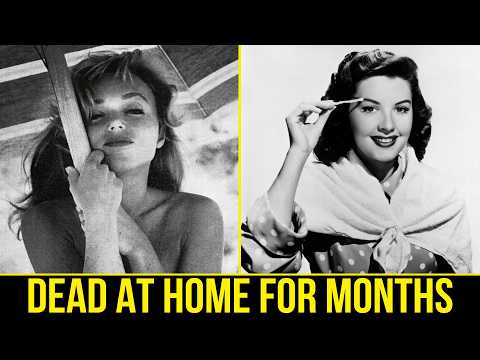
Take Yvette Vickers, a B-movie siren from the 1950s. She appeared in cult classics like Attack of the 50 Foot Woman and was a Playboy Playmate, but by 2011, she had become a recluse. Her mummified body was found in her Benedict Canyon home, possibly a year after her death. Neighbors hadn’t seen her since the previous summer, and only a concerned actress friend discovered the horrifying scene. No foul play—just heart failure and utter neglect.
Then there’s Thelma Todd, a major comedy star of the 1930s. On December 16, 1935, she was found dead in her Lincoln Phaeton inside a garage, still wearing her evening gown and mink wrap. Carbon monoxide poisoning was the official cause, but the circumstances—a locked garage, a mysterious note—fueled decades of speculation. She had been dead for at least 12 hours before anyone found her.
Bobby Driscoll, the voice of Disney’s Peter Pan, met a far sadder fate. Once a celebrated child star, his career collapsed, and by 1968, he was living in a deserted East Village tenement. Two children playing found his body on a cot, surrounded by beer bottles and religious pamphlets. No identification, no one to claim him—he was buried as a John Doe on Hart Island. His family didn’t learn the truth for years.
And then there’s Marilyn Monroe, the most iconic of them all. On August 5, 1962, she was found dead in bed, still holding a telephone receiver. Her housekeeper noticed light under the door, and her psychiatrist broke in through a window. She had been dead for hours, alone in her Brentwood home, a symbol of fame’s ultimate loneliness.
These stories are just the beginning. From Albert Dekker’s bizarre death scene to Barbara Bates’s suicide in her mother’s garage, the pattern repeats: stars who shone brightly, then faded into silence. Their endings remind us that Hollywood’s golden age had a dark underbelly—one where loneliness was often the final co-star.
Albert Dekker was a character actor with dozens of film and TV credits, but he was also a former California State Assemblyman—a man of stature and respect. On May 5, 1968, his fiancée, Geraldine Saunders, entered his Hollywood home and found him dead in the bathroom. The scene was grotesque: his body was partially undressed, and crude words and drawings had been scrawled on and around him in red lipstick. The front door was covered with notes from callers whose rings had gone unanswered. The official ruling was accidental autoerotic asphyxiation, but the bizarre staging left a permanent stain on his memory.
Marie Prevost, a major silent film star from the Mack Sennett era, saw her career fade by the late 1930s. Her body was discovered on January 23, 1937, though she had likely died two days earlier. Neighbors had complained about the non-stop barking of her dachshund, Maxie, and when the door was finally opened, a houseboy found her dead inside. Empty bottles lay nearby, along with an IOU for $110 made out to Joan Crawford. A later legend claimed Maxie had fed on her body, but the truth was far sadder—the loyal dog had only bitten at her legs, trying desperately to wake her.
Alan Ladd, the quiet, tough leading man of Shane, was found dead in his Palm Springs home on January 29, 1964. He was only 50. The coroner ruled his death accidental, caused by a combination of alcohol, a barbiturate, and tranquilizers. Ladd had suffered from chronic insomnia, using pills and booze to chase sleep. Two years earlier, he had been found with a gunshot wound near his chest, which he claimed was accidental. This time, there was no recovery—just a silent end in an empty house.
Barbara Bates, remembered as the ambitious young admirer in All About Eve, seemed poised for stardom in the 1950s. But her career faded, her first husband died of cancer, and she left Hollywood. On March 18, 1969, she was found dead in her mother’s garage in Denver, sitting in the front seat of a Volkswagen. The garage had been sealed, and officials determined her death by carbon monoxide poisoning was self-inflicted. She was 43, newly remarried, but the new life did not hold.
Mary Nolan, once a famous Ziegfeld girl and silent-era actress, saw her career destroyed by scandals, abusive relationships, and drug problems. On October 31, 1948, she was found dead in her small Hollywood apartment, the autopsy revealing Seconal poisoning. She was 45. Her few remaining possessions included an antique piano that had once belonged to Rudolph Valentino—a ghost of Hollywood’s golden past. No public timeline says exactly how long she had been dead before she was found.
Carole Landis, one of the most striking studio beauties of the 1940s, was last seen alive by Rex Harrison on the evening of July 4, 1948. She was found the next day on her bathroom floor in Pacific Palisades, discovered by Harrison and a housemate. But Harrison did not call a doctor or police right away—he waited for several hours. The case grew murkier when sources claimed Landis left not only a note to her mother but also a separate note to Harrison that was later destroyed. She was 29.
Dorothy Dandridge made history as the first Black actress nominated for the Best Actress Oscar, but by 1965, her finances and personal life had unraveled. On the morning of September 8, she called her manager, Earl Mills, to postpone a hospital appointment for her injured foot. He arrived at 10 a.m., got no answer, and hours later forced the door open with a tire iron. She was found unresponsive inside. The coroner listed a fat embolism from a recently fractured foot, though one investigation reported an accidental overdose of imipramine.
Lupe Velez, the fiery “Mexican spitfire” of 1940s comedy, had dinner with friends on the evening of December 13, 1944, then retreated to her bedroom with 75 Seconal capsules and brandy. Her secretary, Beulah Kinder, found her later that same morning and at first thought Lupe was simply asleep because she looked so peaceful. A note to Harold Ramond was found nearby, telling him she was tired, deeply unhappy, and wanted him to raise their unborn child. She was 36.
Jean Seberg became a symbol of the French New Wave after Breathless, but by 1979, her life was a cascade of emotional collapse and public pressure. She disappeared on August 30, and her body was not found until September 8 inside her Renault parked near her Paris apartment. It lay on the back seat, wrapped in a blanket, barbiturates and a note to her son nearby. The alcohol level in her system was so high that investigators doubted she could have gotten into the car herself.
Gail Russell, a soft-spoken beauty of the 1940s, had long struggled with alcoholism and anxiety. In August 1961, two neighbors realized they hadn’t seen her for days and entered her Brentwood home to find her dead. An empty vodka bottle was beside her, and the house was littered with more. The official cause was severe liver damage linked to chronic alcoholism, along with exhaustion and malnutrition. She was 36.
Gia Scala, known for The Guns of Navarone, was found dead in her Hollywood Hills home on April 30, 1972. The coroner ruled it an accidental overdose of alcohol and barbiturates. She was only 38, her film career already faded, her marriage to actor Don Burnett over two years prior. No public account specifies how long she had lain there before discovery.
George Sanders, the Oscar-winning master of cynical elegance, checked into a hotel in Castelldefels, Spain, on April 23, 1972. Two days later, he was found dead in his room, empty Nembutal containers nearby and a note saying he was leaving because he was bored. He had called his friend George Mickel shortly after checking in, but no one came to check on him until the hotel manager noticed he had missed breakfast and stopped answering calls.
Clara Blandick, forever Aunt Em in The Wizard of Oz, was 85 and suffering from severe arthritis and failing eyesight when she returned home from Palm Sunday services on April 15, 1962. She arranged photographs, memorabilia, her resume, and old press clippings around the room before taking an overdose of sleeping pills and tying a plastic bag over her head. Her landlady found her on the couch, dressed in a royal blue dressing gown and covered with a gold blanket. A note said she could no longer endure the pain or face the coming blindness.
Phyllis Haver, a silent-era star and one of the Sennett Bathing Beauties, was found dead in her Connecticut home in November 1960. The housekeeper discovered her lying in bed fully dressed and wearing full makeup. The death was ruled a barbiturate overdose, and some sources claimed she had made an earlier attempt on her life a year before. She was 62.
Peg Entwistle never built a major film career, but her name became forever linked to the Hollywood sign. On September 18, 1932, a woman walking below the Hollywoodland sign found a shoe, a purse, and a jacket; inside the purse was a note. Farther down in the ravine, police found her body. Her uncle later identified her through the initials P.E. and connected the discovery to her disappearance on September 16. She had been dead about two days.
William Holden, one of classic Hollywood’s defining leading men, was found dead in his Santa Monica apartment on November 16, 1981. Coroner Thomas Noguchi determined he had actually died on November 12, meaning the Oscar winner lay there for four days. Holden had slipped on a rug, struck his forehead on a bedside table, and bled to death. Evidence suggested he remained alive for at least half an hour after the fall—alone, with no one to call for help.
These twenty stories share a haunting thread: the greater the fame, the deeper the silence that followed. From Vickers’ mummified remains to Holden’s four-day wait, each ending proves that stardom cannot fill an empty room. The applause fades, the phone stops ringing, and even the most recognizable faces become strangers to the world outside their door.
Yet their legacies endure—not just in films and photographs, but in the cautionary tales they left behind. Hollywood still churns out new icons, but the pattern repeats: isolation, addiction, and the cruel illusion that success equals connection. Their deaths were not just personal tragedies; they were indictments of a culture that celebrates the spotlight but ignores the darkness around it.
Perhaps the most chilling lesson is how easily these stars slipped from memory. Days, months, even a year passed before anyone noticed. In a town built on visibility, they became invisible.
So next time you watch a classic film or see a star on the red carpet, ask yourself: who will check on them when the cameras stop flashing? What does it say about us that we only notice the lonely after they’re gone? Share your thoughts below—because maybe, just maybe, paying attention is the one tribute that could change an ending.
Report this article
Select a reason for reporting:






