On the evening of December 18, 1795, a seventeen-year-old girl walked out of the Temple Tower in Paris, leaving behind the only life she had known for three years, four months, and five days. Behind her, in a second carriage, rode a small dog named Coco. Ahead of her lay a future that would include two more revolutions, three exiles, and a lifetime of being both a symbol and a prisoner of her own past.
Her name was Marie-Thérèse Charlotte de France, Madame Royale, the first child of Louis XVI and Marie Antoinette. She entered the tower with her father, her mother, her aunt, and her little brother. She was the only one walking out.
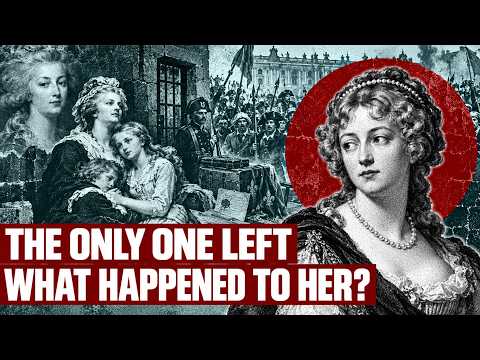
But this was no simple release. The French Republic was trading her—exchanging a princess for prisoners of war held by Austria. Among the men France demanded back was Jean-Baptiste Drouet, the postmaster who had recognized her father during the failed escape to Varennes in 1791. The man who helped capture her family was now part of the price of her freedom.
What happened inside that tower is well documented, partly because Marie-Thérèse wrote it down herself. Her father was executed on January 21, 1793. Her eight-year-old brother, Louis Charles, was torn from their mother and given to a cobbler named Simon, who raised him harshly. In early October 1793, the boy was even forced to accuse his own mother of sexual abuse—a child used as a weapon against his mother, all in the name of the revolution.
A month after her brother was taken, Marie Antoinette was moved to the Conciergerie to await trial. She was executed on October 16, 1793. On May 9, 1794, Madame Élisabeth, the king’s sister and the last adult left with Marie-Thérèse, was taken away. She was executed the next day.
And this is the part that’s hard to sit with. For almost two years, Marie-Thérèse didn’t know her mother was dead. She didn’t know her aunt was dead. She could hear her brother somewhere in the tower being beaten. She had two books, and her requests for more were refused. On the wall of her room, she wrote that Marie-Thérèse Charlotte was the most unhappy person in the world.
Her brother, whom royalists now called Louis XVII, died in the Temple on June 8, 1795. He was ten. A doctor who examined him in early May had described him as dying a victim of extreme deprivation and neglect. He was buried in secret—and that secrecy would come back to haunt his sister decades later.
So why did she live when the others died? No single document answers that, but here’s one way to read it. Under France’s Salic law, a daughter couldn’t inherit the throne. Her brother was a king in the eyes of royalists; she wasn’t. And a republic still at war with Austria had more use for a living princess than a dead one.
In June 1795, things began to change. A woman named Renée de Chanteleine was sent in to be her companion. And in August, it was Chanteleine who finally told her the truth: her mother, her aunt, and her brother were all gone. She broke down sobbing. She was also told she’d be leaving France for her mother’s family in Vienna. By one account, she said she’d rather have stayed.
But she was going because two governments had started to bargain over her. For revolutionary France, the men held by Austria were representatives of the nation. For Austria, Marie-Thérèse was the granddaughter of Empress Maria Theresa, held by the regicides who’d killed her parents. Each side saw the other as holding its own people.
The talks ran through Switzerland. Austria first offered a ransom of two million, but the Republic refused—it wanted its men back. The Directory ratified the terms on November 28, 1795. Then came that night in December.
Her carriage left Paris at midnight, the very start of her seventeenth birthday. She was recognized at Provins, and a crowd gathered at Nogent-sur-Seine. After six days on the road, she reached Huningue, just outside Basel, at six in the evening on Christmas Eve and took a room at an inn under the name Sophie.
On December 26, 1795, at a small house belonging to a Basel merchant, she was handed over to Austrian representatives. An Austrian official signed a written receipt for her. A receipt. The French prisoners went home. She reached Vienna on January 9, 1796.
You’d think that’s where the story softens. It doesn’t.
Vienna gave her safety, not freedom. The Habsburg court had plans for her. They expected her to marry Archduke Charles and become more Austrian—a match that would have tied the last daughter of Louis XVI, and any claims attached to her, to Vienna. In 1796, she refused. She regarded the Archduke as an enemy of France, and she held her cousin, the emperor, responsible for her mother’s death because he hadn’t acted to save her. She wore nothing but black mourning, and the court found her uncooperative.
Meanwhile, her uncle, the Count of Provence—who now called himself Louis XVIII—had his own plan. His marriage had produced no children. After him came his brother, the Count of Artois, and then Artois’ elder son, Louis Antoine, Duke of Angoulême. If Marie-Thérèse married that son, the daughter of the executed king would be bound to the future of the dynasty. Louis XVIII told her it had been her parents’ dearest wish. The jewelry historian behind the site The Court Jeweler argues that this was invented—that neither Louis XVI nor Marie Antoinette had ever said so.
Whether she suspected it, we don’t know. She agreed.
On May 3, 1799, she left Mitau—now Jelgava in Latvia—where Tsar Paul I of Russia was letting the exiled Bourbon court live in the palace of the old Dukes of Courland. The palace had been partly destroyed by fire and was never fully repaired. On June 10, 1799, in that half-mended palace, she married her first cousin. Louis Antoine was three years older, shy, and described by one royalist writer as small, ugly, and awkwardly built. The marriage was childless. There were rumors that he was impotent, and rumors, probably unfounded, that he mistreated her. In public they were courteous, and one marshal who knew them described them as affectionate.
According to the site History of Royal Women, she treasured a ring her father had been wearing as he climbed the scaffold, engraved with the initials M A A A and the date, May 16, 1770.
Then the ground moved again. On January 20, 1801, after supper, Louis XVIII came into his niece’s rooms, pale, and told her that the Tsar had ordered them out of Mitau and out of Russia. The order reportedly followed an intercepted letter from the exiles mocking the Russian court. The next day—January 21, the eighth anniversary of her father’s execution—the court’s belongings were sold off in the palace courtyard.
On the road, a carriage overturned. Officers refused to give up their rooms at the inns to the women. On the 24th, a snowstorm forced the convoy back. Louis XVIII, forty-five and suffering from gout, got out and walked through the deep snow with his niece. Coco walked with them.
They ended up in Warsaw after the Queen of Prussia obtained permission for them to stay. This was her life for the next thirteen years—Warsaw, then Courland again from 1805 to 1807 after Paul I had been assassinated and his son Alexander let the exiles return. Then England. The men landed at Yarmouth in December 1807, and she followed the next summer, reaching Gosfield Hall on August 24, 1808. In April 1809, the court moved to Hartwell House, which became a royal court in exile surrounded by French émigrés. When Louis XVIII’s wife died in 1810, Marie-Thérèse became the highest-ranking woman in the family.
And this is where historians start to disagree about who she really was. The traditional story—the one her nineteenth-century admirers told—is of a saintly orphan, silent and suffering. The French historian Hélène Becquet, in a 2012 biography, paints something more active. In Becquet’s reading, Marie-Thérèse became the living symbol and hope of French royalism. And Becquet asks how far she herself shaped that public image. She used her status as the survivor of the royal martyrdom to rally royalists and win sympathy abroad. She wasn’t just carried by the dynasty—she was its most powerful symbol, and she knew it.
But a symbol needs a throne. And in the spring of 1814, after Napoleon’s defeat, there suddenly was one.
The French Senate restored the Bourbons, and Louis XVIII became king. Marie-Thérèse broke down in tears when she was told she’d finally be going home. She entered Paris on May 3 to crowds shouting for the king. She held herself rigidly through the procession. Then, at Notre Dame, she collapsed onto a prayer stool and cried.
There was no Temple to go back to. The tower had already been demolished. She had a cypress and a weeping willow planted where it had stood. She visited the Madeleine Cemetery where her parents had been buried after the guillotine. On January 21, 1815—twenty-two years to the day after her father’s death—the remains of Louis XVI and Marie Antoinette were reburied at the Basilica of Saint-Denis, the traditional resting place of French kings. She spent the day in prayer.
Later, she and Louis XVIII shared the three-million-livre cost of a memorial on the old cemetery site: the Chapelle Expiatoire, the expiatory chapel. It was consecrated on January 21, 1824, and inaugurated in 1826. It still stands in Paris.
And then, less than a year into the Restoration, Napoleon came back.
He escaped from Elba in March 1815, and Louis XVIII fled abroad. Marie-Thérèse happened to be in Bordeaux, a city that had declared for the Bourbons early. Her husband went to lead royalist forces in the Rhône Valley, where most of his officers abandoned him. He surrendered, and Napoleon spared him. She stayed.
Every morning she went out and spoke to the soldiers of the garrison. General Clausel, sent by Napoleon, pressed her to leave. The troops told her they’d protect her—but they wouldn’t fight for her. They didn’t want a civil war. She told them it was cruel, after twenty years of exile and unhappiness, to be sent away again. Then she ordered them to stand down and left.
Napoleon supposedly called her the only man in her family. The line is probably apocryphal, surfacing in a Paris newspaper that April—but it tells us what people wanted to believe.
Waterloo came, and the Bourbons returned. This time she came back harder. During the Restoration she had real influence, backing the ultra-royalist faction and opposing Louis XVIII’s attempts to reconcile with moderates. She never hosted a single ball. Plenty found her cold, haughty, obsessed with etiquette. Both things can be true: she had suffered horribly, and she turned that suffering into political authority.
In July 1830, Charles X issued the ordinances that suspended press freedom and dissolved the Chamber. Paris rose. In three days of street fighting, about two hundred soldiers and nearly a thousand insurgents were killed. Chateaubriand, a royalist who knew the family, admitted the ordinances pleased her.
On August 2, Charles X abdicated in favor of his nine-year-old grandson. But the king’s son came first—so Louis Antoine had to give up his own rights, too. It took twenty minutes to talk him into countersigning. For those twenty minutes, in the eyes of legitimists, he was King Louis XIX of France. Which made Marie-Thérèse, technically, Queen of France. Her reign lasted about as long as a lunch break.
The Chamber proclaimed Louis Philippe king instead. The family sailed from Cherbourg. She watched the French coast disappear. It was her third exile, and it would be her last.
Scotland, then Prague, then Gorizia. Charles X died of cholera in 1836. Her husband went blind and died in 1844; at the end she repeated the words a priest had spoken to her father on the scaffold: “Son of Saint Louis, ascend to heaven.” She bought Schloss Frohsdorf outside Vienna. Her days were walking, reading, sewing, and praying. Chateaubriand called her the princess of thrones and scaffolds.
Two ghosts followed her. The first was her brother: impostors multiplied, the most stubborn a Prussian clockmaker named Naundorff. She refused to meet him. Science later backed her up—mitochondrial DNA showed no relationship. The boy’s heart, secretly taken at autopsy, was finally placed in the royal crypt at Saint-Denis in 2004, 209 years after his death. The second ghost was her own: the veiled Dark Countess of Hildburghausen, rumored to be the real Marie-Thérèse in hiding. In 2013 her grave was opened. The DNA matched neither Marie Antoinette’s line nor the heart. Whoever she was, she wasn’t Marie-Thérèse.
She caught a chill in October 1851. On the 16th, the anniversary of her mother’s execution, she wanted to mark the day as always and was too ill. She died on the 19th, aged seventy-two. In her will she pardoned, without exception, everyone who had injured her. Less than two months later, Louis Napoleon seized power.
She lies at Kostanjevica, beside her husband and father-in-law—now in Slovenia, some 1,256 kilometers from Paris. The crypt is nicknamed the little Saint-Denis. A campaign has called for the Bourbons to be brought home; as of 2016, France had made no official request. Her last words, according to her biographer, were: “I am annihilated.”
The revolution didn’t kill her, but it never let her be anything other than the girl from the Temple. So here’s my question: was Marie-Thérèse a victim with every right to hate the revolution—or a political player who helped ensure the restored monarchy couldn’t last? Tell me where you land in the comments.
Report this article
Select a reason for reporting:






