On April 28th, 1945, Hermann Fegelein was dragged into the Reich Chancellery Garden and shot. He was weeping, begging, stripped of his rank. Eight hours earlier, he had been an SS general married to Eva Braun’s sister. Eight hours later, Hitler would marry Eva, making the man he had just executed his own brother-in-law.
But Fegelein’s execution wasn’t the darkest secret in the family. His younger brother Waldemar had personally directed the killing of over 14,000 Jews in 12 days. So what happened to the Fegelein family after the war?
One faced justice that day in the garden. The others built comfortable lives in postwar Germany, raised families, and grew old in peace. And one of them died at 88 years old, never charged with a single crime despite documentation of mass murder in his own handwriting.
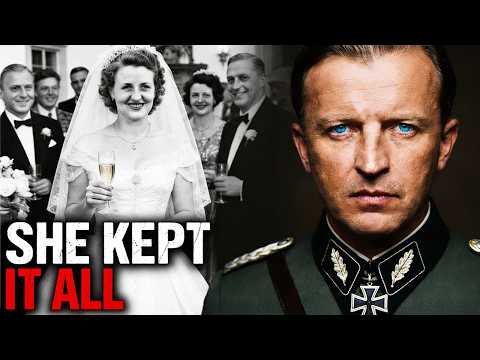
The execution that wasn’t the end. Most people assume Hitler’s execution of his own brother-in-law meant the Fegelein family was destroyed. The Führer had turned on one of his inner circle. Surely everyone connected to that name would suffer. They’d be wrong. Hermann’s death wasn’t the end of this story. It was just the beginning.
When he died in that garden, Hermann left behind a pregnant wife named Gretl. She was Eva Braun’s younger sister, which made her Hitler’s sister-in-law twice over after the bunker wedding the very next day. He also left behind a younger brother named Waldemar, who had spent the war commanding SS cavalry units on the Eastern Front. And he left behind a daughter who would be born seven days after his execution. A girl who would carry a name that felt more like a sentence than a birthright.
The standard narrative tells us that Nazi families suffered after the war. They lost their wealth, faced denazification tribunals, endured public shame. Some of that is true, but the Fegelein story reveals something darker about how postwar justice actually worked and how often it didn’t work at all. The man who deserted Hitler got a bullet. The man who murdered 14,000 civilians got a riding stable in Bavaria. And the only person who truly paid the price was the one who had no choice in the matter—a daughter born into ashes, named after the dead, who couldn’t escape a legacy she never created.
The widow who walked free. Seven days after her husband’s execution, Gretl Fegelein gave birth to a daughter at Zell am See in Austria. She was far from Berlin’s collapse, far from the Soviet advance swallowing the city block by block, far from anyone who might ask difficult questions about what she knew or what she’d witnessed. She named the baby Eva Barbara after her sister who had died just five days earlier in the bunker alongside Hitler. It was a memorial in human form, a living reminder of everything that had been lost, a child born into the ashes of everything the family had built.
The timing of that birth mattered. By early May 1945, the war was over in all but name. Germany’s unconditional surrender came on May 8th. When Allied forces swept through Germany and Austria that summer, they arrested thousands of Nazi officials, their wives, their secretaries, their associates. Anyone connected to the regime faced interrogation at minimum, imprisonment or trial at worst.
But when investigators reached Gretl Fegelein, they made a curious decision. They deemed her peripheral, a woman who had avoided public appearances throughout the war, someone who had simply married the wrong man. She wasn’t Emmy Göring, who had styled herself the First Lady of the Third Reich. She wasn’t Magda Goebbels, who had murdered her own children in the bunker. Gretl was just a widow with a newborn. While thousands faced denazification tribunals across occupied Germany, while former party members lost their jobs and their property and sometimes their freedom, Hitler’s own sister-in-law walked free. No charges, no tribunal, no consequences.
But Gretl didn’t just escape accountability. She actively profited from the regime’s collapse. Before the Allies could seize Nazi assets, before investigators could catalog what belonged to whom, she had already hidden Eva Braun’s most valuable possessions at Schloss Fischhorn, an Austrian castle near Zell am See. Jewelry—not costume pieces, but real gems given as gifts by one of the most powerful men in Europe. Photograph albums documenting life at the Berghof. Amateur films shot by Eva herself. Home movies of Nazi leaders at leisure, personal letters between Eva and Hitler. These weren’t just sentimental keepsakes. They were Eva’s inherited estate, worth a fortune to collectors and historians alike. The Allies never found them. Gretl retained her sister’s wealth while the regime that created it collapsed around her, while millions of displaced persons wandered through bombed-out cities.
Thirty-three years of silence. By 1954, Gretl had completely reinvented herself. On February 6th, she married Kurt Berlinghoff in Munich. A businessman, respectable, unremarkable. She took his surname and shed the Fegelein name like dead skin. She moved into a comfortable middle-class life in Bavaria. And she disappeared from history. No interviews with journalists hungry for insider accounts. No testimonies to war crimes investigators. No memoirs. No public statements. No participation in the endless postwar reckoning that consumed Germany. For 33 years, Gretl Berlinghoff maintained absolute silence about everything she had witnessed.
Think about what she knew. She had attended her wedding at the Berghof in June 1944, a three-day celebration with Hitler as guest of honor. She had been connected to the regime’s innermost circle through both her husband and her sister. She knew things historians would spend decades piecing together from fragments. She told no one. When she died on October 10th, 1987 at age 72, rumors circulated about deathbed confessions. Historians searched for documentation. They found nothing verified. She took whatever she knew to her grave at Munich’s Waldfriedhof Cemetery.
Gretl’s escape was remarkable. But she wasn’t the only Fegelein who evaded justice. And the other one had far more to answer for—the brother who killed 14,000.
Hermann Fegelein had a younger brother named Waldemar. While Hermann climbed the SS hierarchy through charm, connections, and his skill with horses—talents that brought him to Himmler’s attention and eventually into Hitler’s inner circle—Waldemar took a different path. He became a field commander on the Eastern Front.
During the summer of 1941, while the Wehrmacht drove deep into Soviet territory and the SS followed behind to conduct what they called security operations, Waldemar commanded SS cavalry units in the Pripet marshes of Belarus. These weren’t frontline combat troops fighting the Red Army. They were killing squads on horseback, mobile units designed to sweep through territory and eliminate anyone the regime deemed undesirable.
In August 1941, Waldemar’s brigade conducted what the SS officially called anti-partisan sweeps. The reality was systematic mass murder of Jewish civilians. Villages were surrounded. Populations assembled in town squares. Men, women, and children marched to pits or driven into marshes and shot. The operations were methodical, efficient, and documented with the precision that the SS demanded of its officers.
Waldemar’s personal reports stated the results in bureaucratic language. 14,178 Jews killed, 1,001 partisans, 699 Red Army soldiers—all in 12 days of operations. His signature appeared on those reports. His command authority was documented in the chain of communications. His operation was part of a broader campaign that killed 85,000 people under Reichsführer-SS command that summer. One of the largest mass murder operations before the death camps reached full industrial capacity.
When Germany surrendered in May 1945, Waldemar wasn’t arrested. He wasn’t interrogated by Allied intelligence officers hunting for war criminals. He wasn’t charged by any tribunal. The documentation of his crimes existed, would continue to exist in archives for anyone who cared to look, but no one came looking for him. He simply changed his name and vanished into the chaos of postwar Germany.
The horsemen of Bavaria. Waldemar became Axel Fegelein and went underground. Eventually, when searches slowed and attention shifted elsewhere, he surfaced near Bad Wiessee in Bavaria, doing something that felt like coming home—running a riding stable. The Fegelein family had operated an elite riding school before the war, one that became the SS main riding school in Munich by 1937. Horses were the family trade, so Waldemar returned to what he knew.
He married a woman named Anneliese. They had five children together. He raised a family in the Bavarian countryside while the victims of his orders lay in mass graves across Belarus. At some point, Waldemar stopped hiding altogether. He began using his real name again openly. No one came for him. No investigators knocked on his door. No prosecutors built a case. The man who had documented the murder of 14,000 people in his own handwriting lived as a free man in democratic West Germany for three decades.
Another member of the family carried a different kind of burden—one she never chose and couldn’t escape.
The daughter who never knew her father. Eva Barbara Fegelein never knew her father. He was executed five days before she was born. Her aunt Eva, whose name she carried, died 36 hours before she took her first breath. She entered the world as the daughter of a disgraced war criminal and the niece of Hitler’s companion, bearing a name that connected her to the regime’s darkest final chapter before she could even open her eyes.
The circumstances of her birth were not something she could escape or hide. Everyone in postwar Germany knew what Fegelein meant. They knew about the execution in the garden. Knew about Eva Braun’s suicide alongside Hitler. Knew about the bunker and the collapse and all of it. When Eva Barbara introduced herself at school, at work, anywhere, she was introducing herself as the daughter of the man Hitler shot for cowardice, the niece of the woman who chose to die with the Führer.
Albert Speer, Hitler’s architect and armaments minister, knew Hermann Fegelein personally. After the war, when Speer wrote his memoirs and gave his testimonies, he called Fegelein one of the most disgusting persons in Hitler’s circle. This from a man who had worked closely with some of history’s greatest monsters. This was the legacy Eva Barbara inherited. Not money or property or social standing, but a reputation for disgust attached to her surname.
Historians now study children like Eva Barbara as examples of intergenerational trauma. The term describes people psychologically burdened by events they had no part in creating. Children of perpetrators who inherit guilt they didn’t earn, who carry weight they never chose to pick up. Eva Barbara had no say in who her father was. No control over who her aunt married. No ability to change the name on her birth certificate. She was born into it and lived with it every single day of her life.
The thirty-year echo. On April 25th, 1971, Eva Barbara Fegelein took her own life. She was 26 years old. The method was a pesticide, slow and deliberate. The immediate trigger was reportedly the death of her boyfriend in an automobile accident. Another loss in a life that had known nothing but loss.
But the timing created an echo that historians still debate. Her father had been executed on April 28th, 1945. She died on April 25th, 1971—almost exactly 30 years later, just three days before the anniversary. Some researchers see this as coincidence. Others see something darker. A daughter so haunted by her father’s execution date that she couldn’t survive another anniversary of it. Either way, the symmetry is striking. Hermann Fegelein’s death rippled forward through three decades and claimed one more victim. The only innocent member of the family paid the highest price.
Two brothers, two fates. Hermann Fegelein faced a firing squad for desertion. Waldemar Fegelein died in his own bed at 88, never charged for 14,000 murders. The documentation existed the entire time—his reports, his signature, his command authority. Any investigator could have built a case within weeks. None ever did.
This wasn’t an anomaly. It was a pattern. Nuremberg focused on top leadership, while mid-level perpetrators like Waldemar vanished into postwar obscurity. Some fled via rat lines to South America. Others simply stayed home, changed their names or didn’t, and waited for the world’s attention to shift elsewhere. Waldemar waited. He raised horses. He raised children. The world forgot about the Pripet marshes.
The Fegelein story strips away the comfortable narrative that Nazi families paid for their crimes. A widow profited from hidden assets and lived quietly for decades. A mass murderer raised a family and died of old age. And a daughter who had no part in any of it became the only one who couldn’t survive what she’d inherited.
Hermann Fegelein was shot for running away from Hitler. His brother ran away from 14,000 murders, and no one ever came looking. What does that say about the justice we believe was served?
Report this article
Select a reason for reporting:






