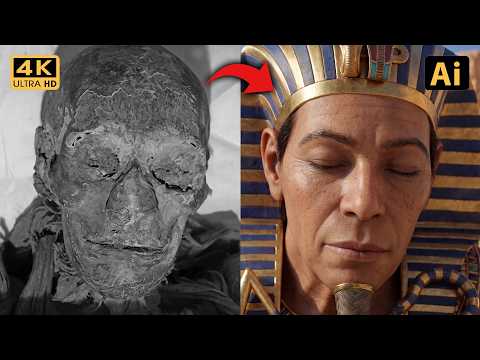
Behind the golden masks and towering pyramids, the truth is far more chilling. The kings and queens of ancient Egypt were worshipped as gods, but their sacred bodies tell a different story—one of brutal executions, erased identities, and restless journeys into the darkness. Modern science has now peeled back the bandages to reveal the violent ends and tragic afterlives of 20 royal mummies. Their stories are not of eternal glory, but of betrayal, disease, and desperate escapes from tomb robbers.
Take Seqenenre Tao, a pharaoh who dared to challenge the Hyksos invaders. In 2021, CT scans of his mummy exposed a horrific truth: his hands were bound behind his back, and his skull was shattered by multiple axe blows. He was executed kneeling, defenseless, his face frozen in agony. The crown was never a shield—it was a target.
Even in death, there was no peace. In 1881, archaeologists descended into the hidden cache of DB320 and found a jumbled pile of displaced royalty. Queen Ahmes-Inhapy, once a revered matriarch, lay crammed into a borrowed wooden coffin, stripped of her identity. She had been moved by priests desperate to save her from looters, but in doing so, they erased her name from history. For three thousand years, she has hidden in a stranger’s box, her own story lost to the shadows.
Her descendant, Ahmes-Nefertari, fared no better. This powerful queen was worshipped as a living goddess, yet her massive coffin was found jammed into a secret shaft alongside her displaced descendants. She had built an empire that conquered the ancient world, but that empire could not protect her body from being treated as cargo.
The pattern repeats with heartbreaking consistency. Thutmose I, a warrior who expanded Egypt’s borders beyond any before him, was smuggled into a hidden cave to escape robbers. His descendant, Thutmose II, suffered a different fate—his mummy reveals a wasted body, riddled with disease, a king who could barely survive in his own palace. And then there is Hatshepsut, the female pharaoh who ruled for two decades. After her death, her successors systematically chiseled her name from monuments and smashed her statues, trying to erase her from memory. For years, her identity was a mystery—until a single broken tooth in a wooden box matched her mummy, restoring her name from oblivion.
Perhaps the most famous tragedy is that of Tutankhamun. A boy king who inherited a crumbling empire, he was buried with unimaginable treasure. But beneath the gold, his body tells a story of suffering—a club foot, malaria, and a host of ailments. He died at around 19, a frail teenager who could barely walk, yet his golden mask made him immortal in the modern imagination. The irony is bitter: the weakest pharaoh achieved eternal fame only because ancient robbers failed to find his tomb.
The mummies of Egypt’s royalty are not just archaeological wonders—they are forensic evidence of lives cut short, of power that came at the ultimate price. As we continue to uncover their secrets, one thing becomes clear: the throne demanded blood from the very beginning.
Ramesses III, the last great king of Egypt, ruled for 31 years and defended his empire from invaders. But his own family turned on him. In 2012, CT scans revealed a 7-centimeter wound across his throat—a deep, lethal cut hidden for millennia by embalming packing. He was ambushed in his own palace by his wife and son, bleeding out on the floor as a god. The conspirators tried to hide the murder, but the forensic evidence was undeniable.
The plot was orchestrated by Queen Tiye, one of his secondary wives, who hoped to place her son Pentawere on the throne. The coup failed. Pentawere was captured, forced to drink poison, and denied proper mummification. His body was wrapped in goatskin—a ritual disgrace—and dumped into a cache alongside his father’s remains. He was buried as a traitor, his name erased, his face frozen in a silent scream.
Even the most powerful could not escape the indignities of the afterlife. Ramesses V ruled for only four years, inheriting an empire crippled by economic collapse. His mummy shows a face covered in smallpox scars. He died in his late twenties, his tomb unfinished, and his successor stole it for himself. Later, priests moved his body to a crowded cache, where he lay beside other discarded kings.
His successor, Ramesses VI, ruled for eight years and watched his kingdom crumble. He couldn’t afford his own tomb, so he usurped one—scraping away the names of his predecessor and carving his own over the stolen walls. He died in his thirties, leaving behind a monument built on theft. But even that stolen tomb offered no protection. Ancient looters cut his mummy to pieces, stripping amulets from his skin.
The story of Ramesses I is even more fleeting. He took the throne in his late forties and founded a dynasty that would produce Egypt’s greatest warriors. But his own reign lasted less than two years. When tomb robbers ransacked the royal valleys, his status as a founder meant nothing. Priests dragged his body from its original tomb and shoved it into a crowded cache, reducing a dynasty’s founder to cargo.
Seti II fought to hold his family’s crumbling empire together. His reign of about nine years was consumed by internal strife—court conspiracies, a usurper seizing the south, and constant battles for control. He died in his twenties or early thirties, leaving a fragile kingdom. Centuries later, priests moved his body to KV35, where he lay hidden in darkness. He had spent his life fighting for the throne, only to spend eternity crammed into a side chamber.
And then there is Siptah, a boy king who inherited a kingdom he could barely walk across. Modern scans revealed a severely deformed left foot—a permanent disability from polio. While court officials manipulated the dynasty from the shadows, their figurehead pharaoh struggled to stand. He sat on the throne for about six years, a prisoner of his divine title. He died before his twentieth birthday, wrapped in thick linen that could not hide the forensic truth: the boy chosen to lead the ancient world was a disabled teenager who never truly ruled.
Beyond the palace walls, the roll call of broken royalty continues. Thutmose IV, who carved his dream of divine election onto a massive stone stele between the paws of the Great Sphinx, was found in 1898 in a side chamber of KV35—stripped of his grandeur, his treasures plundered. The king who immortalized himself in stone died in his thirties after a ten-year reign, his bones left to rest among the displaced. The gods promised him eternal glory; history handed him a robbed skeleton.
Queen Tiye, the great matriarch who steered Eighteenth Dynasty politics for decades and negotiated with foreign kings, met the same fate. For over a century, archaeologists knew her only as the “Great Lady”—a nameless mummy with thick reddish hair spilling across a fragile face. The woman who engineered a golden age spent her afterlife as an anonymous corpse in the dark.
Then there is Akhenaten, the heretic king who shattered a thousand years of tradition to worship a single sun disc. His desecrated mummy in KV55—face smashed, identity contested for decades—became a forensic battleground. The king who tried to erase the gods became a nameless body, his name chiseled from every monument. If you erase the heavens, who remains to remember you?
In 2010, DNA testing finally mapped another tragedy written in bone. A mummy long dismissed as the “Younger Lady” was identified as Tutankhamun’s biological mother—a sister-wife of Akhenaten, trapped in the inbreeding that would doom her son. Her face was a shattered cavity, crushed near the time of death, and her true name remains lost. She gave birth to Egypt’s most famous boy king, yet history left her with a broken face and an empty title.
The boy himself, Tutankhamun, inherited a fractured empire at nine years old. He could barely walk without a cane. Howard Carter’s 1922 discovery of his tomb revealed a dazzling hoard of gold—but beneath the glitter lay a bitter biological reality. Severe bone necrosis and malaria ravaged the young king, who relied on a pharmacy of ancient remedies and walking sticks to survive. He died around nineteen, and the world marveled at the golden mask of a god. The weakest pharaoh in Egyptian history conquered the modern imagination, achieving immortality only because ancient robbers failed to find his door.
Ramesses I, founder of Egypt’s most famous military dynasty, barely had time to wear the crown. He took the throne in his late forties and ruled for less than two years. When generations of tomb robbers later ransacked the royal valleys, his status as a founder offered no protection—priests dragged his body into a crowded cache, reducing him to cargo. He gave Egypt its greatest kings, yet history packed his bones like unwanted goods.
His descendant, Ramesses III, seemed untouchable—until the night of betrayal. For three thousand years, thick linen bandages hid the truth. In 2012, CT scans finally revealed the crime scene: a seven-centimeter wound cutting straight through his throat. The king who defended Egypt for thirty-one years was ambushed by his own wife and son, bleeding to death on his palace floor. Embalmers desperately stuffed fabric into the wound to conceal the assassination, but history eventually exposed the forensic truth.
His would-be usurper, Prince Pentawere, was denied even a dignified death. Forced to drink poison, his body was wrapped in ritually impure goatskin and dumped beside his father’s remains—buried as a traitor, his face frozen in a silent scream. If betrayal buys eternity, what is honor worth?
And so the parade of power ends not in glory, but in boxes and borrowed graves. Queen Duatentopet of the 21st Dynasty, like so many before her, was pulled from her own tomb by priests desperate to save her from looters. She spent eternity as anonymous cargo in the crowded darkness of DB320, her age at death still unknown. The throne demanded blood from the very beginning—and it never stopped demanding.
These twenty mummies are not just museum exhibits. They are forensic witnesses to a brutal truth: divinity was a death sentence, and the crown was a target, not a shield. From Seqenenre Tao’s shattered skull to Ramesses III’s slit throat, from Hatshepsut’s erased name to Tutankhamun’s frail bones—each body tells the same story. Power came at the ultimate price, and even eternity offered no refuge.
So when you look at the golden masks and towering pyramids, remember what lies beneath. The pharaohs were not gods. They were human beings—betrayed, diseased, and displaced—whose only true immortality came from the very science that exposed their tragedies.
Which of these twenty royal fates shocked you the most—and what does it say about the true cost of power? Share your thoughts in the comments below.
Report this article
Select a reason for reporting:






