The courtroom was a monument to irony. In the city that once hosted the Nazi Party’s grandest rallies, the surviving architects of the Third Reich now sat in the dock. Outside, Nuremberg lay in ruins, its streets still choked with rubble. Inside, the world watched as the Allies attempted to deliver justice for crimes so vast they defied comprehension.
But from the very beginning, the scales were tipped. The Holocaust—the systematic murder of six million Jews—was barely mentioned. It was treated as just one atrocity among many, its unique horror buried under a mountain of evidence about war crimes and crimes against humanity. The world was not yet ready to confront the full truth.
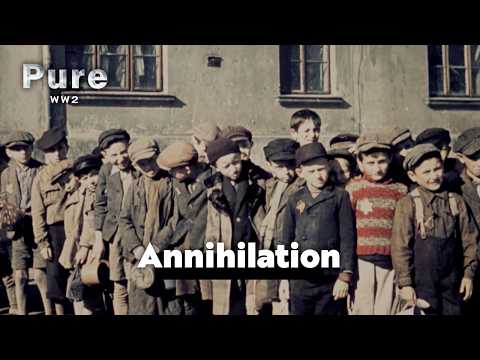
Rudolf Höss, the commandant of Auschwitz, took the stand. He spoke in a monotone, detailing the machinery of death he had overseen. Yet his words, meticulously recorded, stirred little curiosity among the prosecutors and judges. Why? Because no one in the dock was charged specifically with organizing the extermination of the Jews. The masterminds—Hitler, Himmler, Heydrich—were all dead. The trial was not about the Holocaust; it was about aggression and conspiracy.
As the verdicts approached, the world waited. Five million words had been spoken. The crimes described were beyond belief. On September 30, 1946, twelve death sentences were handed down. Seven received prison terms. Three were acquitted. All appeals were rejected.
On October 12, the condemned met their families one last time. Hermann Göring, the Reichsmarschall, cheated the hangman by swallowing a cyanide capsule—a final act of defiance. Only Hans Frank showed remorse. “A thousand years will pass and still Germany’s guilt will not be erased,” he confessed. But his late conscience could not erase the 300,000 Jews he had sent from Warsaw to Treblinka. When he was hanged, he embraced Catholicism, seeking forgiveness. For him, justice was a noose.
The trials, however, were far from over. The Americans, led by Telford Taylor, launched a second wave of proceedings—twelve additional trials. These focused on the enablers: judges, doctors, industrialists, and the Einsatzgruppen—the mobile killing squads responsible for over a million murders.
Benjamin Ferencz, a 27-year-old prosecutor, was assigned to the Einsatzgruppen case. He had in his hands the Nazis’ own meticulous reports, daily logs of mass shootings. “I was not afraid,” he recalled. “I knew the evidence was overwhelming.” The defendants included Otto Ohlendorf, a father of five with two law degrees, who calmly explained his methods: “You aim at the infant, and the mother holds it, so you kill both and save ammunition.”
But as the trials dragged on, the world’s attention waned. The Cold War loomed, and the new enemy was the Soviet Union. Denazification became a farce. Thousands of perpetrators returned to their old jobs. The industrialists of IG Farben, who produced the Zyklon B gas, were acquitted. The judges who had enforced Nazi laws walked free.
Survivors struggled to rebuild their lives. In Poland, returning Jews faced pogroms like the one in Kielce, where 40 were killed. The myth of Jewish gold fueled violence. Peasants dug through ashes for diamonds. The dead were stripped of everything, even their memory.
And so, the story of the Nuremberg trials is not just one of justice, but of what happens when the world looks away. The Holocaust was pushed to the margins, its survivors left to bear the weight of silence. But the evidence was there, waiting to be found. In the archives, in the testimonies, in the ashes. The question remains: what did we learn?
Ferencz had seen the photographs, but nothing prepared him for the moment a researcher opened a heavy folder and showed him the Einsatzgruppen reports. Each page listed the number of Jews killed in a given town, the date, and the name of the commanding officer. It was a ledger of genocide, kept with bureaucratic precision. “That was all I needed,” he said. He took a sample, flew to Nuremberg, and told General Taylor: “We have to hold a new trial.”
Taylor looked at him, exhausted. “We don’t have the staff. Can you do it on top of your other work?” Ferencz nodded. “Sure.” And just like that, he became the chief prosecutor in the Einsatzgruppen case—the youngest in Nuremberg’s history. He was twenty-seven, barely five feet tall, and looked like a boy. But he held in his hands the proof of over a million murders.
The defendants were not the architects of the Holocaust; they were its executioners. Six SS generals, most with doctorates, sat in the dock. Otto Ohlendorf, the main defendant, had a degree in law and another in economics. He was a father of five. He had commanded Einsatzgruppe D, which operated in the Ukraine and Crimea, and had personally overseen the murder of tens of thousands.
When Ohlendorf took the stand, he spoke without emotion. He described how his men would round up Jews, Roma, and Communist officials, march them to the edge of a ravine, and shoot them in the back of the head. He explained that this method was more “humane” than others. “Some commanders took infants and smashed their heads against trees,” he said. “I did not want my men to do that. I ordered that the mother hold the child, and then we would shoot both. It saved ammunition.”
The courtroom was silent. Ferencz listened, his face pale. He later recalled: “I could not believe what I was hearing. He was describing the murder of children as if it were a logistical problem.”
But Ohlendorf’s testimony was not the most disturbing. One witness, a member of the Einsatzgruppen, described how he had to wade through blood to finish off the wounded. “I had to go into the ditch and shoot them in the head,” he said. “I was up to my knees in blood. Can you imagine that?” He said it as if he were the victim.
Ferencz pressed him: “Did you ever refuse to carry out an order?” The man looked confused. “No. We were soldiers. We followed orders.” But no German soldier was ever executed for refusing to kill Jews. The defense of “just following orders” crumbled under the weight of evidence.
Another defendant, Otto Rasch, had been a commander of Einsatzgruppe C. He was responsible for the massacre at Babi Yar, where 33,771 Jews were murdered in two days. His lawyer argued that Rasch was too ill to stand trial—he had Parkinson’s disease. Ferencz was unmoved. “If I had killed that many people, I’d tremble too,” he said. “Does he breathe? Then I’ll indict him.” But Rasch died before the trial began, and the case against him was dropped.
As the trial proceeded, the prosecution presented document after document. The reports were signed by the commanders themselves, detailing the body counts. For Ferencz, the case was airtight. But he knew that justice was not guaranteed. The world had already begun to look away.
On the day of the verdict, Ferencz arrived early. He sat alone at the prosecution table, the empty courtroom echoing around him. He was twenty-seven, a father of five, and he had just finished prosecuting the largest murder trial in history. The judges filed in, and the defendants—twenty-two men who had overseen the slaughter of over a million people—rose to hear their fate.
The verdicts were read in a monotone. All were found guilty. Thirteen were sentenced to death. The rest received long prison terms. But Ferencz felt no triumph. He looked at the defendants, searching for a flicker of remorse. There was none.
After the trial, he went down to the death row cells. He stood before Otto Ohlendorf, the man who had ordered the murder of tens of thousands. “Is there anything I can do for you?” Ferencz asked. Ohlendorf looked at him with cold eyes. “The Jews of America will suffer for what you have done,” he said. Ferencz turned and walked away.
Only four of the thirteen were eventually hanged. The others had their sentences commuted. By the early 1950s, most were free. The Cold War had begun, and Germany was now an ally. The world had moved on.
Ferencz returned to the United States and tried to build a life. But the images stayed with him. He had seen the photographs of the killing fields, the piles of corpses, the reports with their neat columns of numbers. He had heard the killers describe their work as if it were a mundane job.
Years later, he would say: “The Holocaust was not just the work of a few madmen. It was the work of thousands of ordinary people—teachers, lawyers, doctors—who believed they were doing the right thing. And when it was over, they went back to their families and their jobs as if nothing had happened.“
The Einsatzgruppen trial was the first ever to deal with genocide. But it was quickly forgotten. The press had lost interest. The public had moved on. No one wanted to remember.
Yet the evidence remained. The reports, the photographs, the testimonies—they were all there, waiting for someone to look. And in the decades that followed, as the world confronted other genocides, the lessons of Nuremberg would be invoked again and again. But the question remained: had anyone truly learned?
Ferencz continued to fight for justice. He campaigned for compensation for survivors, for the recognition of the Holocaust as a unique crime, for the establishment of the International Criminal Court. He was driven by a simple belief: that the law must protect the weak, and that those who commit atrocities must be held accountable. But he knew that justice was never complete.
In the 1950s, he negotiated with German industry for compensation for slave laborers. The companies denied responsibility, claiming they had no records, that the Jews had been paid, that the work was voluntary. It was a lie. Ferencz had the documents. But the companies stalled, and many survivors died waiting.
When the agreements were finally signed, some in Israel rejected the money as “blood money.” “You cannot compensate for a life,” they said. But others argued that the survivors needed the money to live. It was a bitter debate, one that tore at the fabric of a people still reeling from the Holocaust.
Ferencz understood the anger. He had seen the survivors in the displaced persons camps, the orphans searching for their parents, the parents searching for their children. He had seen the Jews behind barbed wire in the DP camps—more Jews behind barbed wire than had been in 1936. They had nowhere to go. They were stateless, homeless, broken.
And in Poland, the violence continued. The Kielce pogrom of 1946, in which forty Jews were killed, was a turning point. Survivors realized they were not welcome in their own country. They fled to the DP camps in Germany, of all places. Within three months, half of the Jewish survivors in Poland had left.
Ferencz watched it all. He had been a young man when the war ended, full of hope that justice would prevail. But the world was already forgetting. The Cold War divided the Allies, and the Germans were needed as allies against the Soviets. Denazification was abandoned. Former Nazis returned to power.
He would later say: “The trials were a warning. But the world did not listen. We have seen genocide again and again—in Cambodia, in Rwanda, in Bosnia, in Darfur. And each time, we say ‘never again.’ But we do nothing.”
He was not bitter. He was determined. He believed that the law could still be a force for good. He believed that the evidence, the records, the testimonies—they mattered. Because even if the world forgot, the archives would remember.
And so, the story of Nuremberg is not a story of triumph. It is a story of what happens when the world tries to reckon with the unthinkable. It is a story of justice delayed, and justice denied. But it is also a story of a few individuals—Ferencz, Taylor, others—who refused to look away.
They were not heroes. They were just people who did their jobs. But in doing so, they held up a mirror to humanity. And the reflection was not pretty.
The trials ended, and the world moved on. But the questions remained. What is justice? Can it ever be achieved? And who will remember the victims?
Ferencz, in his later years, would often speak to students. He would tell them about the trials, about the evidence, about the killers. He would tell them that the Holocaust was not an accident. It was planned, executed, and celebrated by thousands of ordinary people.
He would tell them that the world knew. The reports were there, the photographs were there, the testimonies were there. But the world chose not to look.
And he would tell them that the fight for justice is never over. That each generation must confront its own evils. That the law is a fragile thing, easily broken, easily ignored.
But he would also tell them that there is hope. That the evidence can be found, that the truth can be told, that justice can be done. Even if it is incomplete. Even if it is late. Even if the world looks away.
He would tell them about the photograph of the farmers digging through the ashes. The image of peasants standing with piles of bones, looking for gold. He would tell them that this was the true face of the Holocaust—not just the gas chambers, but the greed, the indifference, the silence.
And he would tell them that we must never forget. That we must never stop asking: who is responsible? Who is guilty? And what can we do to prevent it from happening again?
The answers are not easy. But the questions must be asked.
Ferencz closed the folder and looked out the window at the German countryside. He thought of the suitcase—his mother’s suitcase—and the young man who had found it among the piles of stolen belongings. “It’s in heaven,” the man had said. Ferencz finally understood: she was gone, and the things of this world could not hold her.
He returned to Nuremberg one last time, an old man now, to speak to a new generation. “I was a boy when I stood in that courtroom,” he said. “But the evidence was not a boy’s work. It was the truth, and truth does not age.” He told them about the 3,000 men of the Einsatzgruppen who had walked free, about the industrialists who died in their beds, about the world that chose to look away.
Then he asked them the only question that mattered: “When the next crime begins, will you be the ones who look? Or will you be the ones who look away?”
The room was silent. The answer, he knew, was not his to give.
So now I ask you, the reader, the witness to this story: when the evidence is placed in your hands, what will you do with it?
Report this article
Select a reason for reporting:






