August 1944. Paris erupts in celebration as German forces surrender the city, but the joy is short-lived. As Allied troops push east, they encounter fierce resistance and a crumbling supply line. Meanwhile, Hitler unleashes his ‘miracle weapons’—the V1 and V2 rockets—raining terror on British cities. The world holds its breath as the war enters its most desperate phase.
“Is Paris burning?” Hitler’s frantic signal to his generals echoed through the bunkers. The answer was no—Paris was free, but the battle for Europe was far from over.
Allied troops raced toward Germany, but logistical nightmares threatened to grind the advance to a halt. Ports were destroyed, fuel ran low, and the Red Ball Express convoys struggled to keep up. “We’re running out of fuel,” warned commanders. The German army, though retreating, was far from beaten.
In a bold move, British General Bernard Montgomery devised Operation Market Garden—a daring airborne assault to seize key bridges and outflank the German defenses. But the plan was risky, and the stakes were enormous. “It was a bridge too far,” one survivor would later say.
As Allied paratroopers descended into Holland, they met fierce resistance. The Germans, far from broken, fought with a ferocity that stunned the Allies. At Arnhem, British forces held out for days against overwhelming odds, but ultimately, the operation failed. The war on the Western Front had reached a stalemate.
Then, in December 1944, Hitler launched his final gamble—a massive counteroffensive in the Ardennes. The Battle of the Bulge caught the Allies off guard. “The Germans are coming!” panicked soldiers cried as tanks rolled through the snow. But American resilience held firm, and the German advance was eventually crushed.
Meanwhile, on the Eastern Front, Stalin’s Red Army was closing in on Germany. The world was about to witness the full horror of the Nazi regime as Soviet troops liberated the death camps. “We found gas chambers and piles of corpses,” a soldier recounted. The scale of the atrocities would shock humanity.
As 1945 dawned, the Allies closed in on Berlin from east and west. The final chapter of the war in Europe was about to be written—but not before more blood was shed.
The Battle of the Bulge had cost the Germans dearly. Over 120,000 men were killed, wounded, or captured, and their armored reserves were shattered. “The German army has suffered a decisive defeat,” declared General Eisenhower. But the war was not over yet.
In the east, Stalin’s Red Army resumed its relentless advance. On January 12, 1945, Soviet forces launched a massive offensive across the Vistula River. “The earth shook as thousands of guns opened fire,” recalled a Soviet soldier. The Germans, outnumbered and outgunned, fell back in disarray.
By the end of January, the Red Army had reached the Oder River, just 50 miles from Berlin. “The road to Berlin is open,” Stalin declared. But the Western Allies were also closing in. In the west, Allied forces crossed the Rhine in March and raced across Germany.
Then, in April 1945, the world learned the full extent of the Holocaust. As Allied troops liberated concentration camps like Buchenwald and Bergen-Belsen, they found unspeakable horrors. “We saw piles of corpses and starving survivors,” reported a British officer. The world was stunned.
In Berlin, Hitler retreated to his bunker beneath the Reich Chancellery. “The war is lost,” he reportedly admitted to his generals. On April 30, 1945, as Soviet troops stormed the city, Hitler took his own life. His mistress, Eva Braun, died with him.
The fighting continued for a few more days, but the end was near. On May 7, 1945, Germany surrendered unconditionally. “The war in Europe is over,” announced President Truman. The following day, May 8, was declared Victory in Europe Day.
But the war in the Pacific raged on. Japan, refusing to surrender, prepared for a final, desperate defense of its homeland.
In the Pacific, the island of Iwo Jima loomed as the next objective. Its airfields would provide a crucial base for American bombers striking the Japanese mainland. But the island was a fortress, honeycombed with tunnels and caves, and its defenders were determined to fight to the last man.
“Hold your fire until the Americans are right under your guns,” ordered General Tadamichi Kuribayashi. On February 19, 1945, US Marines stormed the beaches, expecting a fierce but brief battle. Instead, they walked into a trap.
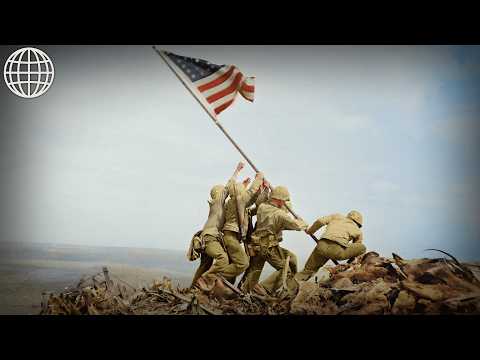
For weeks, the Marines clawed their way forward, inch by inch. The iconic image of the flag raising atop Mount Suribachi became a symbol of hope, but the fighting was far from over. “Every cave had to be blasted with flamethrowers,” recalled one veteran. By the time the island was secured, nearly 7,000 Americans and over 20,000 Japanese had died.
The battle for Okinawa was even bloodier. The Japanese unleashed waves of kamikaze attacks, sinking dozens of Allied ships. “The sky was filled with suicide planes,” said a US sailor. On land, the fighting was savage, with civilians caught in the crossfire. Over 100,000 Japanese soldiers and 40,000 civilians perished.
In the Marianas, US B-29 bombers pounded Japanese cities relentlessly. The firebombing of Tokyo in March 1945 killed over 100,000 people in a single night. “The city was a sea of flames,” reported a survivor. Yet Japan refused to surrender.
As the summer of 1945 approached, the Allies prepared for the invasion of Japan itself. The estimated cost in American lives was staggering—over a quarter of a million. Then, in July, President Truman received news of a secret weapon that could end the war.
The Manhattan Project had produced the atomic bomb. On August 6, 1945, the B-29 Enola Gay dropped Little Boy on Hiroshima. “A blinding flash, then a mushroom cloud,” recalled a crew member. Three days later, Fat Man devastated Nagasaki. Japan finally surrendered.
The war was over. But the world had changed forever. The atomic age had begun, and the scars of conflict would shape the decades to come.
The formal surrender took place on September 2, 1945, aboard the USS Missouri in Tokyo Bay. “We hereby proclaim the unconditional surrender of the Japanese forces,” declared Foreign Minister Mamoru Shigemitsu, his prosthetic leg tapping softly on the deck. General Douglas MacArthur signed for the Allies, then spoke words that echoed across the water: “Let us pray that peace be now restored to the world and that God will preserve it always.”
Behind him, a fleet of over 2,000 Allied aircraft roared overhead, a final show of force that had brought two empires to their knees. The Second World War—the deadliest conflict in human history—was truly over. Somewhere in the crowd, a young sailor wept, not from joy, but from exhaustion.
In Europe, the rubble of Berlin became the front line of a new struggle. The Potsdam Conference had carved Germany into four zones, and the Iron Curtain was already descending. “An iron curtain has descended across the continent,” Churchill would warn months later. The Grand Alliance, forged in blood, was fracturing.
In Asia, the atomic ruins of Hiroshima and Nagasaki became grim reminders of humanity’s new power. The nuclear age had dawned, and with it a terrifying arms race. “The world will never be the same,” wrote one scientist who had helped build the bomb. He was right.
Millions of displaced persons wandered Europe’s roads, searching for homes that no longer existed. Concentration camp survivors, emaciated and hollow-eyed, began the slow, painful work of rebuilding their lives. The Nuremberg Trials would bring some Nazi leaders to justice, but the scars would never fully heal.
In the Pacific, isolated Japanese soldiers emerged from jungles years later, unaware the war had ended. One holdout on Guam finally surrendered in 1972. “I am ashamed I have lived so long,” he said, laying down his rusted rifle.
The world that emerged from the ashes was divided between East and West, democracy and communism, freedom and fear. The Cold War had begun, and the specter of nuclear annihilation would hang over humanity for decades. Yet from the ruins, a new order was born—one shaped by the sacrifices of millions.
As the sun set on September 2, 1945, the guns finally fell silent. The generation that fought and won the war would be forever marked by its horrors and its heroism. Their stories—of courage, sacrifice, and unimaginable loss—would be passed down to children and grandchildren, a warning from history that must never be forgotten.
But as the world rebuilt, one question haunted the survivors: Could humanity ever truly learn from its darkest hour, or would the cycle of war repeat itself once more?
Report this article
Select a reason for reporting:






