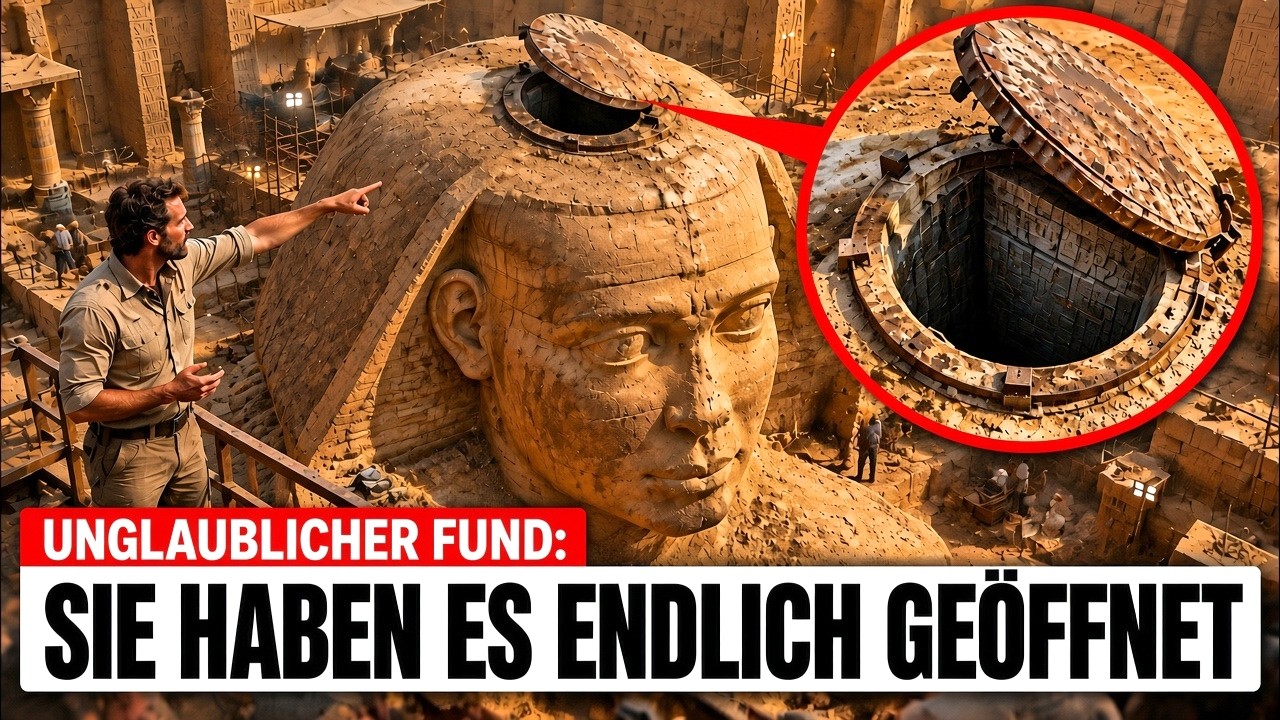
Archäologen haben endlich die geheimnisvolle Luke auf dem Kopf der ägyptischen Sphinx geöffnet. Jahrzehntelang galt diese Öffnung als unzugänglich, umgeben von Spekulationen über verborgene Kammern.
Auf dem Kopf der Sphinx von Gizeh befindet sich eine eiserne Luke, die vom Boden aus nicht zu sehen ist. Eine flache Metalltür, die in den Schädel der weltberühmten Statue eingelassen wurde. Als Archäologen sie öffneten, konnte ein erwachsener Mann bis zur Brust in den Kopf der Statue steigen. Diese Luke ist nicht die einzige Öffnung. Weitere befinden sich im Rücken, unter der Brust und am Schwanz…
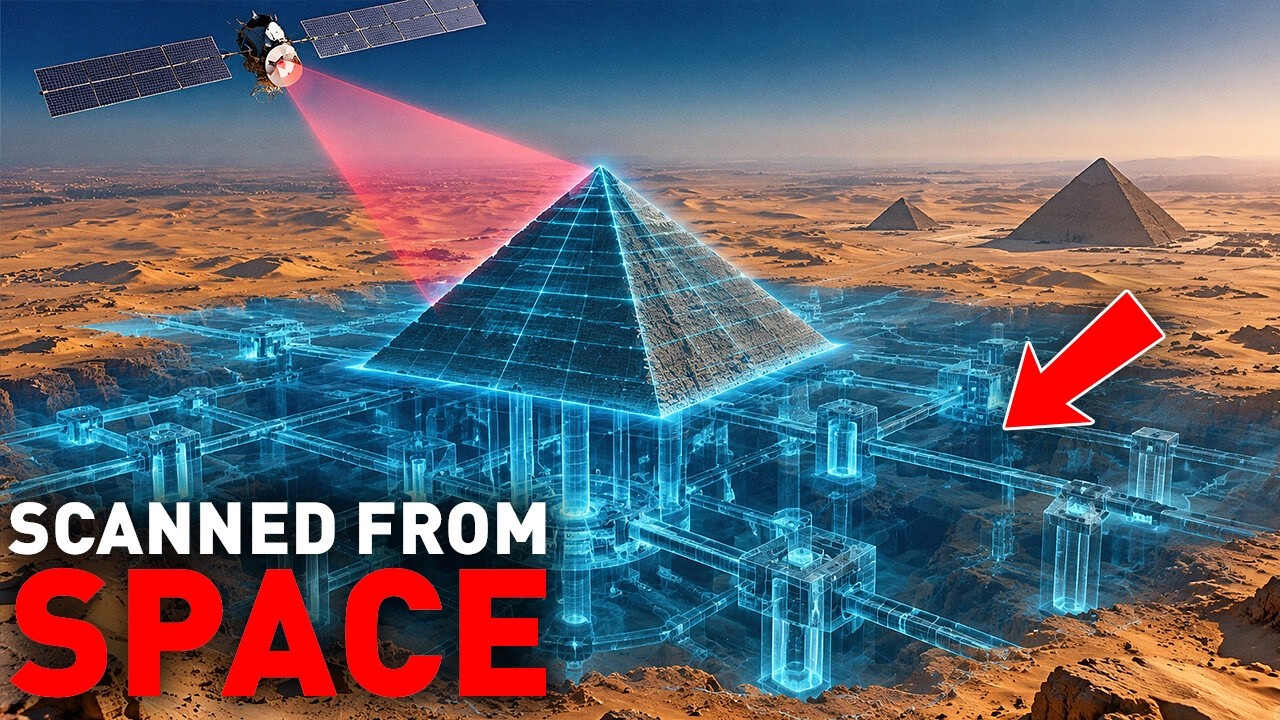
Four satellites scanned beneath the Khafre Pyramid, and the results are shaking the foundations of archaeology. The scans detected massive, unexplained structural anomalies hidden deep under the ancient stone, structures far larger and more complex than any known chamber.
The Osiris Shaft is an underground structure on the Giza Plateau, located near the causeway connecting the Sphinx and Khafre’s pyramid. Its location under one of the most visited sites in Egypt means it has gone largely unnoticed by the millions of tourists who pass nearby each year.The shaft was first identified by archaeologist Selim Hassan in 1933. He was unable to proceed past a certain point…
The Sphinx’s mysterious hatch has finally been opened, and what teams found inside challenges everything Egyptologists believed. For over a century, this sealed chamber beneath the ancient monument remained untouched, dismissed as a legend.
The Great Sphinx of Giza contains several sealed openings that have raised questions for nearly a century. A metal hatch sits on top of the monument’s head, covering a square shaft roughly six feet deep cut into the skull. Workers discovered the shaft in the 1920s during a cleaning campaign led by French engineer Émile Baraize. Photographs from that period show a man standing inside the pit, which…
AI decoded the hieroglyphs inside the Great Pyramid—and found what looks like a warning. The carvings, long dismissed as simple religious text, were re-analyzed by a machine-learning model that flagged a hidden, repetitive phrase.
The Great Pyramid of Giza has stood in silence for over 4,500 years. Inside its largest chamber, a granite box without a lid rests in darkness. No inscriptions cover the walls. No carvings depict gods or guide a dead king toward the afterlife. Every other royal tomb in Egypt is covered in texts and artwork. The Great Pyramid, the most precisely built structure of the ancient world, contains none.F…
Researchers just found something behind the Great Pyramid’s sealed door that shouldn’t exist. For decades, the mysterious blocking stone guarding a narrow shaft in the 4,500-year-old structure has frustrated archaeologists with its stubborn silence.
In the depths of the Great Pyramid of Giza, there is a sealed door that appears to have been built for no human visitor. It sits at the top of a passage only 20 centimeters wide, made from polished white stone fitted with two copper fixtures, and it remained closed for roughly 4,500 years. A robot located it in 1993. Researchers drilled through it during a live broadcast in 2002. In 2011, a camera…
The Great Pyramid has hidden a secret for thousands of years—a massive underground cave discovered just beneath its base. Radar scans first hinted at something strange below the ancient stones, but no one could confirm it.
Researchers using muon tomography, a technique that tracks cosmic particles to map dense structures, identified an anomaly beneath the Great Pyramid of Giza during the Scan Pyramids mission. Initial teams suspected an equipment error, but subsequent scans from Nagoya University and France’s CEA confirmed the finding: a vertical cavity beneath the monument, extending more than 30 feet into a chambe…
An AI posed a single question about the Sphinx—and its answer may rewrite history. Elon Musk’s Grok was given decades of geological and survey data to analyze who really built the monument, and it returned a stunning verdict.
The standard account of the Great Sphinx is well known: it was built around 4,500 years ago during the Fourth Dynasty, under the rule of Pharaoh Khafre, and its face is his likeness. The statue was carved from a limestone ridge that remained after quarrying for the nearby pyramids, with the body of a lion and the head of a king, serving as a guardian monument within the Giza complex. This version…

Elon Musk’s Grok AI just dissected a 4,500-year-old mystery, and its verdict undermines the official story. The AI reviewed decades of archaeological and geological data on the Great Pyramid of Giza, built for Pharaoh Khufu, whose 2.3-million-block structure features precision beyond textbook explanation.
The question of how the ancient Egyptians built the Great Pyramid of Giza remains unresolved. Recent attention has focused on an analysis of this question by Grok, an artificial intelligence system developed by Elon Musk’s company. The AI reviewed archaeological surveys, engineering reports, geological data, and academic studies on the pyramid. Its conclusion was not about lost alien technology or…