In the darkest days of World War II, as Nazi Germany’s shadow fell across Europe, Britain stood seemingly alone. But behind the iconic image of solitary defiance lay a vast network of allies—the British Empire and Commonwealth, comprising a quarter of the world’s population. From the Caribbean’s small contingents to Canada’s industrial might and India’s millions of volunteers, these nations were the backbone of Britain’s fighting power. Yet, among them all, which did Britain truly love and value the most? The answer is far from simple, and the stories of these forces reveal a complex web of admiration, tension, and sacrifice.
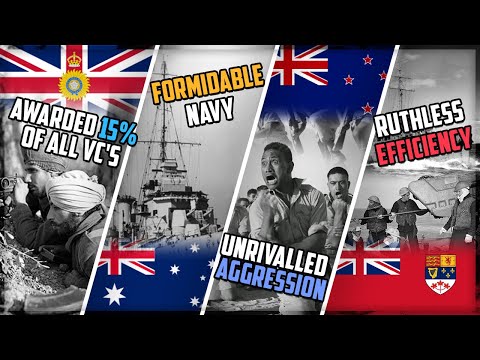
When war erupted in September 1939, Australia and New Zealand were quick to stand by Britain, declaring war on Germany the very same day. Their troops soon proved their mettle in the Mediterranean and North Africa, but the relationship was far from smooth. Australia’s decision to recall its divisions to defend the Pacific after Japan entered the war infuriated Churchill, who saw it as a betrayal. The tension between Churchill and Australian Prime Minister John Curtin spiked, leaving a bitter taste. New Zealand, though smaller, contributed proportionally more casualties—nearly 12,000 dead from a population of just 1.6 million—and their fierce Maori Battalion earned respect even from Rommel. Yet, their loyalty to the European theater spared them Churchill’s cold shoulder.
South Africa’s entry was fraught with internal conflict. After a heated parliamentary debate, pro-war General Jan Smuts ousted the former prime minister and swiftly declared war. But the apartheid policies meant that only white men could serve in combat roles, limiting their frontline contribution. South African troops struggled in key battles, and the fall of Tobruk in 1942 was largely blamed on them, straining relations with the British. However, Smuts himself was one of Churchill’s closest confidants—a personal bond that earned him affection, even if his nation’s military efforts were less impactful. Canada, too, hesitated initially, but its industrial and financial contributions were staggering: over 800,000 military vehicles, 50,000 tanks, and billions in aid. Without Canada’s factories and farms, Britain’s war machine would have ground to a halt.
India, the jewel in the imperial crown, provided the most men—2.5 million volunteers—and fought across North Africa, Europe, and Asia. Yet, the relationship was marred by neglect and exploitation; the Bengal famine killed millions while Britain continued to extract resources. Churchill recognized India’s military importance but did little to alleviate its suffering, fueling anti-British sentiment. So, which nation did Britain love the most? The answer lies in a delicate balance of strategic need, personal ties, and the sacrifices that shaped the war’s outcome. The full story reveals not just love, but necessity, resentment, and the unbreakable bonds forged in conflict.
To understand which Commonwealth nation Britain valued most, one must look beyond the battlefield and into the corridors of power, where Churchill’s personal affections and strategic calculations often diverged. His relationship with Smuts was undeniably warm—the South African leader was one of the few men whose counsel Churchill genuinely sought. Yet affection for a leader did not translate into reliance on his nation’s army. Smuts could whisper in Churchill’s ear, but South Africa’s segregated forces could not plug the gaps in Britain’s lines. The British PM needed men, munitions, and food in staggering quantities, and that need overrode sentiment.
Canada’s role, by contrast, was less about personal chemistry and more about sheer, unglamorous indispensability. While Churchill fretted over Australian withdrawals and Indian unrest, Canadian convoys crossed the Atlantic through wolf-pack-infested waters, and Canadian factories churned out everything from boots to bombers. Ottawa’s willingness to bankroll the Commonwealth Air Training Plan—paying for airfields, instructors, and fuel—turned Canada into the RAF’s nursery. Without it, Britain’s skies would have been far emptier during the Battle of Britain and beyond. Still, gratitude in Whitehall was often grudging; Canada was seen as a loyal but distant cousin, useful but not always consulted.
India, however, presented the starkest paradox. The British Indian Army was the largest volunteer force in history, and its soldiers won fifteen percent of all Victoria Crosses awarded during the war. Field Marshal Claude Auchinleck’s admission that Britain could not have survived without the Indian Army was not flattery—it was fact. Indian troops held the line in Burma, fought in the deserts of North Africa, and bled in Italy. Yet the same government that relied on them refused to address the Bengal famine, shipping grain out of India even as millions starved. The love Britain felt for India was the love of a landlord for a fertile but restive estate: deep dependence masked by indifference.
As the war dragged on, another dimension emerged—the Caribbean. Though small in numbers, West Indian volunteers and conscripts served in the RAF and the merchant navy, and their labour built airfields and repaired ships. Their contribution was rarely acknowledged in the popular memory of the war, but it underscored a broader truth: Britain’s survival depended on a global patchwork of manpower and resources, stitched together by necessity rather than affection. The question of which nation Britain loved most may be unanswerable, because love was never the operative emotion. Need was.
By 1945, the balance sheet was clear. Canada had given treasure and technology. India had given blood on an unmatched scale. Australia and New Zealand had given elite soldiers and then, in Australia’s case, a painful lesson in imperial limits. South Africa had given a trusted statesman but a limited army. If Britain loved any of them, it loved Canada for its reliability and India for its sheer, terrible sacrifice—but it loved neither enough to change the imperial calculus. The war’s end would soon reveal how quickly gratitude faded when the bills came due.
The end of the war did not bring clarity to the question of Britain’s affections—it brought amnesia. Within five years of victory, India was independent, and the British Indian Army that had saved the empire was partitioned between two new nations. The men who had won fifteen percent of Britain’s Victoria Crosses were now citizens of countries Britain no longer commanded. Churchill, voted out of office before the war even ended, watched from opposition as the imperial ties he had fought to preserve unraveled one by one.
Canada, by contrast, slipped comfortably into a new role—no longer a loyal dominion but a middle power with its own voice. The factories that had armed Britain now armed NATO, and Ottawa’s wartime generosity was quietly forgotten in Whitehall’s ledgers. Gratitude, it turned out, had a remarkably short shelf life. The Canadians who had bankrolled the air training plan and stormed Juno Beach were now simply allies, not saviors.
Australia and New Zealand drifted toward a new patron—the United States—whose Pacific fleet had done what Britain could not: halt the Japanese advance. The ANZAC legend endured, but the emotional anchor shifted from London to Washington. Churchill’s fury over the Australian withdrawal was remembered Down Under long after the British had forgotten it. The kiwis, ever pragmatic, maintained their ties with quiet dignity, their proportional sacrifice a point of pride rather than a claim on British affection.
South Africa’s story curdled fastest of all. Smuts, Churchill’s cherished confidant, lost power in 1948 to the National Party, whose apartheid system would make South Africa a pariah within a generation. The general whose words had once carried such weight in Churchill’s war rooms died in 1950, his country’s British ties already fraying. The affection between two men could not survive the politics of a nation.
So the ledger closed with no clear winner. Britain had loved Canada’s reliability, India’s sacrifice, Smuts’s counsel, and the ANZAC fighting spirit—but it had loved them all conditionally, as an imperial power loves its assets. The war had been won by a coalition of the willing, bound not by love but by a shared fear of tyranny. When the fear faded, so too did the bonds, leaving only monuments and memories of what had briefly been a united front.
Yet the question lingers, refusing to be dismissed. In the pubs of London and the halls of Canberra, in the archives of Ottawa and the classrooms of Delhi, the debate continues. Perhaps the truest answer is that Britain never loved any of them as equals—it loved them as parts of itself, and when that self-image shattered, so did the love. The Commonwealth that emerged from the war was not a family of affection but a club of convenience, its members forever bound by what they had survived together rather than what they felt for one another.
The historian’s ledger may never balance, but the human heart keeps its own accounts. In the decades that followed, the children of those wartime volunteers grew up hearing stories that Britain had long since filed away. West Indian RAF veterans settled in Brixton and Birmingham, their service acknowledged in medals but rarely in memory. Indian soldiers who had fought at Monte Cassino returned to a partitioned homeland, their pensions frozen by a treasury that had moved on.
And yet, something endured. When Britain faced new crises—from the Falklands to the pandemic—the old Commonwealth reflexes stirred, however faintly. The bonds of 1939 were never about sentiment; they were about showing up. Canada sent ships, Australia sent sailors, India sent nurses, and the Caribbean sent its sons and daughters once more.
Perhaps that is the real answer to the question. Britain did not love any single Commonwealth nation best—it loved the idea of being the kind of country that others would rally to. When the rallying stopped, the love story ended, and the ledger became history. The monuments stand in Whitehall and Delhi alike, each telling a different version of the same truth.
So the debate belongs now to us, the inheritors of that complicated legacy. Which nation do you think gave the most—and which one did Britain repay the least? Was it Canada’s quiet industrial might, India’s staggering sacrifice, or the ANZACs who learned that loyalty runs both ways? The archives hold the facts, but the verdict is yours to render.
If you had to choose one Commonwealth nation that Britain truly loved—or failed most shamefully—which would it be, and why? Share your answer below; the argument is far from over.
Report this article
Select a reason for reporting:






