The mud was the first enemy. Not the Argentines, not the cold, not the wind that cut through everything—just the peat, soft as a sponge and twice as treacherous. On the night of June 13, 1982, two Para assaulted Wireless Ridge, and the British had learned a hard lesson at Goose Green: infantry without armor support dies. Lieutenant Colonel David Chandler had sworn his men would never again go in alone. He got his wish. Three troop of the Blues and Royals crawled across terrain that should have swallowed them whole. Their vehicles—light, aluminum-hulled, almost insultingly fragile—floated where Land Rovers sank. They fired from ridgelines using passive night sights the Argentines didn’t have, and one by one, they dismantled the 7th Argentine Infantry Regiment’s positions.
When Lance Corporal of Horse Dunkley was knocked unconscious inside Scimitar 23 Bravo, Captain Roger Field climbed in and fought the vehicle through the rest of the night himself. The next morning, four CVR(T) light tanks led 2 Para into Stanley. A Union Jack flew from the radio antenna of 23 Bravo. General Sir John Frost later said the speed and accuracy of the Blues and Royals fire had been, in his words, a severe shock to the enemy. The Scimitar had won its war on mud the same way it would later win in a different one. By being too light to sink.
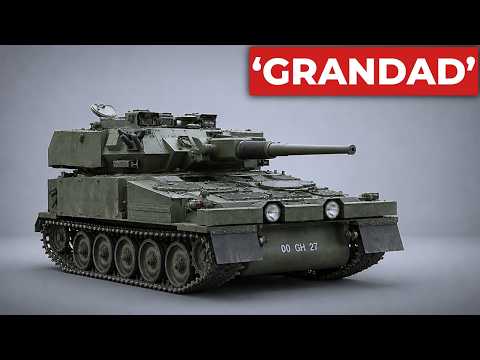
Now fast-forward forty-three years. April 2025. A muddy field outside a Ukrainian training center. The vehicle moving across the screen looks wrong. The hull is too small, the armor too thin, the shape belongs in a museum next to Falklands relics. And the main cannon—the 30-mm British Rarden—has been ripped out and replaced with a Soviet machine gun. Four antennas bristle around the turret like the legs of a dying spider, all aimed at jamming Russian drones. This is the FV107 Scimitar. It first rolled out of an Alvis factory in 1971. It fought a war on islands most British soldiers had never heard of. And by some accident of history and engineering, it is now one of the most useful vehicles in the Ukrainian army.
To understand why, you have to look at what the Scimitar is actually made of. The 30 mm L21A1 Rarden cannon does not fire like other autocannons. It fires three-round clips loaded by hand. Maximum burst is six rounds before the gunner has to reload. Cyclic rate is just 90 rounds per minute. Compare that to the Russian BMP-2’s belt-fed 2A42 autocannon, which spits 550 rounds per minute in long suppression bursts. But the Rarden was never meant to suppress. It was meant to kill cleanly with two rounds from far away. The cartridge is 30 by 170 mm, longer than the Russian round. The APDS projectile leaves the muzzle at 1,170 m/s. Effective range is 2,000 m. Accuracy is a grouping of 1 m at a range of 1,000 m. That is rifle precision from a tank gun.
This was a scout’s weapon, not a brawler’s. The Scimitar was designed to spot a Soviet reconnaissance vehicle on the North German plain before that vehicle spotted you, kill it with two well-placed rounds, and disappear. The hull is welded aluminum alloy. The British called it AS7017. It is roughly equivalent to 12.7 mm of rolled steel. Proof against 14.5 mm armor-piercing rounds in the frontal arc. Proof against rifle fire all around. Anything heavier—a rocket-propelled grenade, an anti-tank guided missile, a BMP’s main gun, an artillery splinter at close range—will go straight through. This is where the tin can comes from. The armor is not steel. The armor is paper thin by modern standards. The vehicle was built on the assumption that being seen first meant dying first. So the answer was not to get seen.
The Jaguar petrol engine in the original Mark 1 was the same block as the Jaguar XK sports car. The Mark 2 upgrade swapped in a Cummins diesel that pushed the range to 640 km. Top speed remained 80 km/h. Two Scimitars fit inside a C-130 Hercules. A Chinook helicopter can sling one underneath. Britain built around 600 of these vehicles and retired the type from frontline service in April 2023. But the story was far from over.
August 2023. Rheinmetall BAE Systems Land in Telford finished refurbishing 23 Scimitar Mark 2s in 32 days. Bar armor bolted on. Electronic interference systems installed. The vehicles shipped to Ukraine. This was the first formal British Scimitar transfer of the war. What followed was a slow flood. In May 2024, Prime Minister Rishi Sunak announced a 500 million pound aid package, the largest single tranche to date. It included 162 armored vehicles, a mix of AS90 howitzers and CVR(T) family scouts. Defense Minister James Cartlidge confirmed in a written parliamentary answer that the British Army held 114 CVR-T vehicles, of which 97 were Scimitars, all marked for disposal. Most went east. By August of that year, Army Technology estimated around 150 CVR-T family vehicles had crossed into Ukraine across the war. Then in March 2026, Latvia began transferring its own ex-British Scimitars and Spartans, drawn from a fleet of 198, to equip a Ukrainian battalion.
The Ukrainians did not use them the way the British had. In March 2025, the 242nd unit training center published a video. In it, crews trained on Scimitars whose turrets had been heavily modified. The 30-mm RARDEN cannon—the weapon the vehicle was designed around—had been removed entirely. In its place sat a Soviet 14.5-mm KPVT heavy machine gun. Defense Express, the Ukrainian military analysis outlet, called it brutal pragmatism. The RARDEN was accurate, but its three-round clips and slow cyclic rate were a liability in a war fought at close range against infantry, drones, and lightly armored trucks. The KPVT fires belt-fed at 600 rounds per minute. The ammunition is Soviet caliber, plentiful in Ukrainian stocks. The RARDEN’s specialized British ammunition has to cross the channel. The same vehicles had four antennas mounted around their turrets. Each one was an electronic warfare emitter aimed at jamming the frequencies used by Russian FPV drones. The Scimitar had been designed to die from being seen. Now it was being modified to make itself impossible to target.
This is the most important fact about the Scimitar in Ukraine. As of mid-2026, Oryx, the open-source loss tracker that visually verifies every destroyed vehicle, has confirmed exactly one Scimitar destroyed in the war. Compare that to the FV103 Spartan, the troop carrier variant from the same family, which has lost 39. The Scimitars are being kept alive. Whoever is operating them is being very careful with them. Who is operating them is harder to pin down. Ukrainian Ground Forces Command, according to fundraiser Serhiy Prytula, forbids the disclosure of details about which brigade got what. The 80th, 82nd, and 95th Air Assault Brigades have all received British armor of one kind or another. The 82nd led the Kursk Incursion of August 2024. But no Ukrainian brigade has publicly confirmed operating Scimitars in combat.
What we can say is what the Scimitar offers that nothing else does. The Russian BMP-2 sits at a ground pressure of 0.63. The American M3 Bradley sits at 0.53. The Leopard 2 main battle tank that Ukraine fields sits at 0.89. A T-72, the Russian workhorse, sits at 0.83. The Scimitar, with its aluminum hull and its wide tracks, sits below all of them in the band of a foot soldier. In Ukrainian Chernozem mud, the kind that turns into a soft black soup every spring and autumn during the Rasputitsa, a Bradley can get stuck where a Scimitar walks across. A T-90, the most modern Russian tank, sinks in fields the Scimitar crosses without slowing. The same aluminum hull that makes it vulnerable to anything bigger than a rifle is also what lets it weigh under 13 tons. The same physics that mattered on Falklands peat now matters on Ukrainian black earth.
The Scimitar is not destroying Russian tanks. Open-source intelligence has not credited a single Russian vehicle to a Scimitar’s RARDEN cannon in this war. What it is doing is harder to film. It is creeping through tree lines that other reconnaissance vehicles cannot reach. It is sitting in overwatch positions on muddy ridgelines, using optics to spot Russian columns before the columns spot it. It is feeding targets to Ukrainian artillery and HIMARS launchers. It is doing exactly what it was designed to do in 1971. Reconnaissance, screening, the deeply unfashionable work of seeing first.
The Ukrainian Ministry of Defense’s own official statement on the Scimitar emphasizes its lightweight aluminum alloy hull and its low ground pressure, noting that the wide tracks prevent the vehicle from becoming bogged down in sand or mud. That is the closest thing to an official endorsement that exists in print. And it explains why a fifty-five-year-old design keeps appearing in places where modern armor cannot follow.
Consider what the Scimitar is competing against. The American M3 Bradley has dominated this war. Forbes correspondent David Axe has called it the best fighting vehicle of the Ukraine conflict. In early 2024, two Bradleys disabled a Russian T-90M outside of Stepove in an engagement that defined the platform’s reputation. But the Bradley weighs three to four times what a Scimitar weighs. It is loud. It is large. It carries TOW anti-tank missiles, second-generation thermal sights, and applique armor that can shrug off 30-mm hits. It cannot fit inside a Hercules transport. It cannot be slung under a Chinook. It cannot cross a field that has been raining on for two weeks.
The Russian BMD-2 airborne fighting vehicle is the Scimitar’s closest weight peer. Both are aluminum-hulled. Both weigh around 8 tons. The BMD-2 has a heavier punch with its 2A42 cannon and its anti-tank missile rails. But the Scimitar has better range, better accuracy at distance, and 40% lower ground pressure. The BMD, ironically, was built for the Soviet Airborne Forces who are now being bled white attacking Ukraine. The Scimitar and the Bradley are not competitors. They are doctrinal opposites. The Bradley fights its way through. The Scimitar slips around. In a war where Russian electronic warfare jams everything and Russian artillery hunts anything that moves loudly, slipping around has become a survival strategy.
There is a question that has hovered over every story about Western armor in Ukraine since 2022. Why did this work? The Challengers, the Leopards, the Abrams, the Bradleys. Why does old British or German or American engineering hold up against modern Russian fire? The answer in the Scimitar’s case is honest and slightly uncomfortable. The vehicle works because its designers in 1971 made an assumption that turned out to be correct fifty-five years later. They assumed that the future of armored reconnaissance was not heavier armor. It was lower visibility. It was lower weight. It was getting somewhere first and leaving before being hit. That philosophy has aged better than almost anything else in the British defense inventory.
The Challenger, the Warrior, the Saxon, the Saracen, the FV432—all of these were designed around either heavy direct fire or troop transport. They have all aged differently. The Scimitar alone was designed around a problem that the Ukrainian battlefield has now made urgent again. Russian FPV drones cost a few hundred dollars each. They hunt main battle tanks worth millions. A Leopard cannot hide. A T-90 cannot hide. A Bradley cannot hide. But a small aluminum vehicle sitting in a tree line with electronic warfare antennas humming, supported by tracks wide enough to cross a flooded field, has a fighting chance to never be seen at all.
The Falklands taught the British a lesson the British eventually forgot. Ukraine has remembered it for them. The vehicle that came off the landing craft at San Carlos on May 21, 1982, has now been donated, modified, jammed up with antennas, rearmed with Soviet machine guns, and sent forward into ground its designers never imagined. And it is, against every reasonable expectation, still alive out there.
There are now perhaps 100 Scimitars on the Eastern Front, give or take. Britain has emptied its disposal yards into Ukraine. Latvia is sending more. The British Army does not operate the Scimitar anymore. The Ukrainian Army increasingly does. Some of those vehicles still have their RARDEN cannons. Some have KPVT machine guns instead. All of them have electronic warfare emitters. All of them carry in some quiet way the ghost of two Para assaulting Wireless Ridge under naval gunfire and the ghost of a captain climbing into a Scimitar whose commander had just been knocked out cold.
The Scimitar was never the most powerful British weapon. It was never the most photogenic. It was never the one that won the headlines, but it was always the one that arrived first, saw what no one else could see, and left before the enemy understood what had happened. That is the job in Ukraine in 2026. That has been the job since 1971. And there is now strong evidence that no other Western light armored vehicle of any era does this particular job better.
The aluminum hull does not stop much. The cannon fires three rounds at a time. The vehicle has no thermal imager on most variants. By every modern metric, the Scimitar is obsolete—except for the one metric that actually matters. Out of roughly 150 CVR(T) family vehicles donated by Britain across this war, the Scimitar has the lowest verified loss rate of any variant in the family. A 1971 design in 2026 doing its job quietly, almost invisibly, from a tree line in a country its engineers had never heard of, watching a Russian column it was never supposed to fight. The vehicle that came back from the Falklands, still hunting.
And if a machine built for a war that ended before most of its current crews were born can still outlast weapons designed to destroy it, what does that say about everything else we’ve been told is obsolete?
Report this article
Select a reason for reporting:






