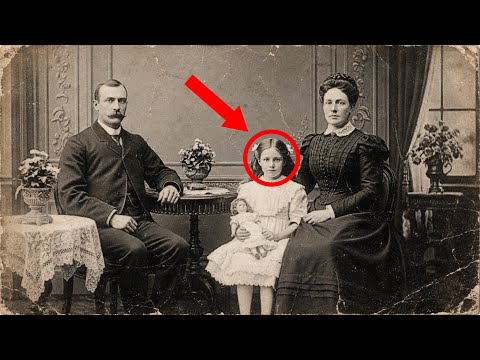
The November rain drummed against the small ground-level windows of the Boston Historical Society, a steady rhythm that had lulled Elena Martinez into a meditative state as she sorted through the final box of donations. Her fingers brushed against something wrapped in yellowed cloth. Carefully, she unwrapped it to reveal a wooden frame holding a large photographic portrait mounted on heavy cardboard.
The image showed a Victorian family—a stern man with a thick mustache, a woman in an elaborate dark dress, and between them, a girl of perhaps eight or nine, holding a porcelain doll. The inscription on the back read: “The Harrison family, Boston, October 1890. Photographer Theodore Welch.”
Elena positioned the portrait under her lamp. The photograph was remarkably well preserved, every detail sharp. But as she studied the image more closely, something caught her attention. She leaned forward, her breath catching slightly.
The shadow cast by the young girl didn’t align with her parents’. While the man and woman’s shadows fell naturally to their left, suggesting a light source from the right, the girl’s shadow extended almost straight behind her, as if illuminated from directly in front.
Elena blinked. She retrieved a magnifying glass and examined every inch of the photograph. The furniture, the curtains, the decorative vase—all consistent with a single light source. Except for the girl’s shadow. Her hands trembled slightly as she turned the portrait over and read the inscription once more. Something about this photograph wasn’t right.
In her fifteen years as a conservator, Elena had examined thousands of historical photographs. She had seen double exposures, chemical stains, scratches on negatives. But this was different. The shadow appeared intentional—and physically impossible.
She glanced at the clock. Past six. The building would close soon. But she knew she wouldn’t be able to leave this mystery behind.
Elena arrived before sunrise the next morning, the portrait tucked under her arm. She had barely slept, her mind racing with questions about the Harrison family and their impossible photograph. The conservation laboratory was her sanctuary—specialized lighting, microscopes, chemical analysis tools. She positioned the portrait on the examination table and switched on the overhead lights.
Under magnification, the photograph became even more mysterious. The paper showed no signs of manipulation or retouching. The emulsion was intact. The shadow wasn’t painted on or added later. It was embedded in the original image, captured at the moment of exposure.
Elena measured the angles of every shadow. The parents’ shadows indicated a light source positioned approximately fifteen degrees to the right. But the girl’s shadow suggested direct frontal illumination—as if someone had stood directly in front of her with a powerful light. Yet there was no evidence of a second light anywhere else in the photograph.
She pulled up the historical society’s database and began searching for the Harrison family. After an hour, she found them. Charles Harrison, age forty-three in 1890, had been a prominent merchant in Boston’s textile trade. His wife, Catherine, came from old Boston money. Their daughter, Grace, had been their only child.
Elena’s fingers hesitated over the keyboard as she clicked on a newspaper article from November 1890—just weeks after the portrait was taken. The headline made her blood run cold.
Tragedy Strikes Prominent Boston Family. Young Girl Vanishes Without Trace.
Grace Harrison had disappeared from her home on a foggy evening, never to be seen again. The article described a massive search effort, the family’s devastation, and the complete absence of clues. It was as if the child had simply ceased to exist.
Elena sat back in her chair, staring at the portrait. The girl’s face looked back at her, serene and unknowing, frozen in that moment before everything changed.
Elena spent the following days immersed in research, barely noticing the passage of time. Grace’s disappearance had devastated her parents. Catherine became a recluse, rarely leaving their Beacon Hill mansion, while Charles threw himself obsessively into his business, working sixteen-hour days until his death from a heart attack in 1895.
But it was the photographer, Theodore Welch, who began to intrigue Elena most. She found his name in several city directories from the 1880s and early 1890s, operating a studio on Tremont Street. Welch had advertised himself as a specialist in scientific photography and experimental processes—unusual for the time. Most photographers focused on portraiture and commercial work, but Welch seemed to have broader ambitions.
Elena discovered that Welch had published several articles in photographic journals discussing his experiments with new chemical compounds and exposure techniques. He was particularly interested in capturing what he called “the essential nature of his subjects.” His writings were often vague about what exactly that meant. Some colleagues praised his innovation; others dismissed him as an eccentric who prioritized experimentation over commercial success.
Then Elena found something that made her pause. In December 1890—just two months after taking the Harrison portrait and one month after Grace’s disappearance—Theodore Welch had died. The death certificate listed the cause as chemical poisoning. A brief newspaper obituary mentioned that he had been found in his studio surrounded by bottles of photographic chemicals.
The coincidence was too striking to ignore.
Elena contacted the Massachusetts State Archives and requested access to any records related to Welch’s death. While she waited for a response, she decided to examine the portrait more closely—this time looking for clues about the photographic process itself.
Using a technique called raking light—shining a narrow beam across the surface at a sharp angle—Elena could see the texture of the photograph in minute detail. What she discovered made her heart race. Along the edges of the girl’s shadow, there were microscopic variations in the emulsion density that didn’t appear anywhere else in the image. Under extreme magnification, these variations formed patterns—almost like residue from an unknown chemical compound.
Elena carefully took samples from the very edge of the photograph where the mounting board met the image and prepared them for analysis. The historical society didn’t have the equipment for detailed chemical testing, but she knew someone who did. Her former professor, Dr. Robert Chen, now ran the conservation science department at Harvard and had access to some of the most advanced analytical tools available.
She called him that evening, explaining what she had found. His voice grew serious as she described the shadow anomaly and the chemical traces.
“Bring it to the lab tomorrow,” he said. “This sounds like something we need to examine very carefully. If Welch was experimenting with unknown compounds, we might be looking at something historically significant—and potentially dangerous.”
That night, Elena locked the portrait in the society’s climate-controlled vault, but she couldn’t lock away her growing unease. The shadow in the photograph seemed to watch her—a dark presence that defied explanation and hinted at secrets buried for over a century.
The Harvard Conservation Laboratory occupied a modern wing of the Fogg Museum, its clean white walls and sophisticated equipment a stark contrast to the dusty archives where Elena usually worked. Dr. Chen met her at the entrance, his silver-rimmed glasses reflecting the morning light as he examined the portrait she carried.
“Remarkable preservation,” he murmured, leading her through security doors into the main lab. “1890, you said? The emulsion should have degraded significantly by now, but this looks like it was taken yesterday.”
They positioned the portrait under a specialized microscope connected to a computer monitor. As Dr. Chen adjusted the magnification, the image of young Grace Harrison filled the screen. Her face enlarged until individual grain structures in the photographic emulsion became visible. He focused on the shadow, and Elena watched as patterns she hadn’t been able to see with her magnifying glass emerged on the monitor.
“There,” Dr. Chen pointed to the screen. “See those crystalline formations? That’s not standard silver halide. There’s something else mixed into the emulsion.”
He carefully scraped a microscopic sample from the edge of the photograph and transferred it to a slide for spectroscopic analysis. The machine hummed as it worked, processing the chemical composition. When the results appeared, Dr. Chen’s expression shifted from curiosity to concern.
“Mercury,” he said quietly. “High concentrations of mercury compounds mixed with something I’ve never seen in a photograph before. There are traces of phosphorus compounds, too, and what appears to be an organic binding agent.”
Elena felt a chill run down her spine. “Mercury? That would have been incredibly toxic.”
“Lethal if handled improperly,” Dr. Chen confirmed. He pulled up a database on his computer, searching through historical records of photographic processes. “Mercury compounds were used in daguerreotypes in the 1840s and ’50s, but by 1890, they had been largely abandoned because of the health risks. If Welch was still using mercury-based chemistry, he was either very brave or very foolish.”
“Or desperate,” Elena added softly. She told Dr. Chen about Grace’s disappearance and Welch’s death from chemical poisoning. As she spoke, she could see him making connections, his academic mind assembling the pieces of the puzzle.
“There were photographers in that era who believed they could capture more than just physical appearance,” Dr. Chen said, leaning back in his chair. “Some thought that with the right chemicals and exposure times, they could photograph the soul itself—or the life force of a person. It was pseudoscience, of course, but it was taken seriously by some practitioners.”
Elena looked at the portrait—at Grace’s serene face and that impossible shadow. “What if Welch believed he could capture something essential about his subjects? What if that’s what this shadow represents?”
Dr. Chen didn’t dismiss the idea immediately. Instead, he pulled up several historical photographs on his computer—images from the spiritualist movement of the late 1800s that claimed to show ghosts or auras. “Spirit photography was popular in that period. Most of it was fraudulent—double exposures and trick photography. But some photographers genuinely believed they were capturing invisible forces.”
They spent hours analyzing the portrait, running test after test. The mercury compounds were concentrated specifically in the area of the girl’s shadow—nowhere else in the photograph. Whatever Welch had done, he had done it deliberately, targeting that specific area of the image with his experimental chemistry.
As evening fell and the lab grew quiet, Dr. Chen made a suggestion that would change the direction of Elena’s investigation. “You need to find Welch’s original glass plate negative,” he said. “If this effect was created during the exposure and development process, the negative will show us exactly what he did. Without it, we’re just guessing.”
Elena nodded, though she had no idea where to begin looking for a glass negative that was over a century old. Most photographers’ archives had been lost to time, destroyed or discarded when studios closed. But she had to try. The answer to the shadow’s mystery lay somewhere in Theodore Welch’s forgotten legacy, waiting to be uncovered.
Finding Theodore Welch’s studio proved harder than Elena expected. The address at 127 Tremont Street no longer existed; the building had long since been demolished. She spent a week combing property records until a breakthrough came from an obituary for Welch’s widow, Miriam, who in 1923 had donated her husband’s equipment to MIT.
Two days later, an archivist named Sarah emailed: “We’ve located a collection of glass plate negatives labeled Welch Photographic Estate, 1923.”
Among the crates, Elena found a small box marked Experimental Processes—Handle with Caution. Third from the bottom lay a plate labeled “Harrison Family, October 12th, 1890. Formula 7, extended exposure.” Even in negative, the impossible shadow was there.
Welch’s journal revealed the truth. Grace had been ill; her father begged him to capture her essence. The mercury-laced emulsion didn’t record a soul—it recorded the poison that would kill her. Weeks later, Grace wandered off in a mercury-induced delirium and died unidentified in a hospital.
DNA testing confirmed the Jane Doe was Grace Harrison. At last, a new headstone bore her name: “Lost and found, finally home.”
Elena stood before the portrait one final time. The shadow no longer seemed supernatural—only evidence, waiting patiently to be understood.
What other secrets might be hiding in plain sight, just waiting for someone curious enough to look?
Report this article
Select a reason for reporting:






