The air inside the freight car was thick with the stench of death and fear. Eighty-nine women, packed like cargo, had been locked inside for days. No food. No water. No light. Just the sound of their own breathing growing weaker, and the words of their officer echoing in their minds: “If the Americans find you, they will shoot you on sight.”
It was April 1945. The Reich was collapsing. And these women—radio operators, nurses, secretaries—had been abandoned to die in a locked box car on a forgotten railway siding outside Frankfurt. They did not know that twelve days of hell were about to end. They did not know that their enemies were about to become their saviors. And they did not know that what happened next would shatter everything they believed about humanity.
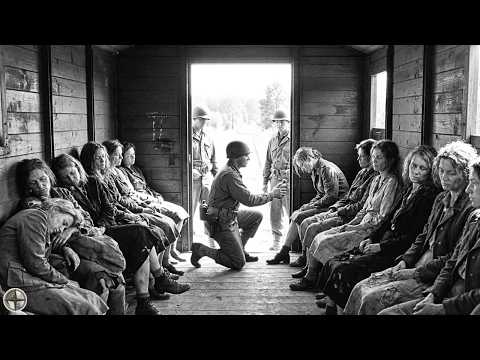
Hannalore Voss, a 24-year-old radio operator from Hamburg, counted the women as they climbed into the freight car. Eighty-nine bodies pressed into a space meant for grain. The iron doors slammed shut. The lock clicked. The world became darkness.
“Two days,” the officer had said. “Maybe three.” But the train never stopped. It rolled through the night, then sat idle for hours, then moved again. No one came. No one opened the doors.
By the second day, thirst became the enemy. Mouths went dry. Lips cracked. One woman had a small canteen. She shared it one capful at a time. It was gone by noon.
By the third day, hunger joined thirst. The smell inside the box car changed. There was no toilet—only a corner they designated for human waste. The stench grew unbearable. Hannalore kept a diary, writing by touch in the darkness. “Day three,” she wrote. “No water. Tongue feels like leather. Dorl fainted this morning. We revived her, but she is weak. The train has not moved in six hours. I think they have forgotten us.”
They had not been forgotten. They had been abandoned. The Wehrmacht was disintegrating. Officers deserted. Supply chains vanished. In the chaos of a collapsing empire, eighty-nine women in a locked box car simply ceased to matter.
By day five, the first woman died. Her name was Alfreda Hagedorn, a signals auxiliary from Leipzig. She had stopped speaking on day four, stopped moving on day five. They laid her body in the corner as far from the living as the cramped space allowed. There was no ceremony, no prayers—just silence and the grinding knowledge that she would not be the last.
Day six. The heat during the day became suffocating. The cold at night cut through their thin uniforms. Women slipped in and out of consciousness. Some hallucinated, calling out for water that did not exist. Trudy Ebner, a 28-year-old nurse, tried to keep people alive using nothing but words. “Stay awake,” she whispered to those fading. “Breathe slowly. Conserve your strength.” But strength was a resource that ran out.
By day nine, two more had died. Three bodies now propped against the walls because there was no room to lay them flat. Dorl Feifer, the youngest at twenty, sat near the door, her hand resting on the wood. Sometimes she scratched at it weakly, her fingernails leaving faint marks. She did not know why. Maybe she hoped someone would hear. Maybe she just needed to feel like she was doing something—anything—other than waiting to die.
On day ten, the train stopped moving entirely. The engine went silent. The box car sat in absolute stillness on a forgotten siding. Hannalore’s final diary entry, written on day eleven, said simply: “No water for eight days. Three dead. I cannot feel my legs. Trudy says to hold on, but hold on to what? We are already ghosts.”
Day twelve came. And then, finally, the sound of voices outside. American voices.
April 29, 1945. A railway yard on the eastern edge of Frankfurt. Sergeant Rosco Henrikson led his squad through the abandoned rail yard, searching for anything useful the retreating Wehrmacht might have left behind. They had done this dozens of times. Crates of ammunition, abandoned vehicles, warehouses full of uniforms that would never be worn again.
Henrikson was a steel mill worker from Pittsburgh before the war. He was thirty-two, which made him ancient compared to most of his men. He had seen Normandy. He had fought through France. And three weeks earlier, he had walked through the gates of Dachau concentration camp. He thought he had seen the worst of what human beings could do to each other.
He was wrong.
Private Virgil Lundquist, a wheat farmer from Kansas, stopped first. He was twenty years old, with a face still young enough to show every emotion. Right now, that emotion was confusion. “Sarge,” he said quietly. “You hear that?”
Henrikson raised his hand. The squad stopped. They listened. At first, nothing. Just wind moving through the empty rail yard. Then, faint as a whisper—a sound. Scratching. Weak tapping. The sound of someone trying to knock, but lacking the strength to make a fist.
The smell hit them next. Henrikson’s nose wrinkled. He had smelled death before. Every soldier had by then. But this was different. This was death mixed with something else—something living.
“It’s coming from that box car,” Lundquist said, pointing to a rusted freight car sitting alone on a forgotten siding.
They approached carefully. The box car doors were sealed with iron bars and heavy chains. Wehrmacht standard procedure for transporting prisoners. “Get bolt cutters,” Henrikson ordered.
While they waited, the sounds from inside grew clearer. Not quite moaning, not quite crying—something human, but barely. Corporal Chester Pilaski, a Polish-American from Milwaukee who understood fragments of German, pressed his ear to the door. “Someone’s alive in there,” he said. “I can hear breathing.”
When the cutters arrived, it took three men to break the rusted chains. The door resisted at first, swollen in its frame from moisture and neglect. Then it gave way with a shriek of metal. The smell poured out like a physical thing. Lundquist stumbled backward, his hand flying to his mouth. Two other soldiers turned away, gagging.
Henrikson held his ground, but his face went pale. He had walked through Dachau. He had seen the ovens. He had seen the mass graves with thousands of bodies stacked like cordwood. He thought nothing could shock him anymore. But this was different—because these women were still alive.
Sunlight poured into the box car, illuminating a scene from hell. Bodies everywhere. Dozens of them. But as Henrikson’s eyes adjusted, he realized with horror that some of the bodies were moving. Hands lifted weakly toward the light. Eyes opened, though barely. Mouths moved, though no sound came out.
“Jesus Christ,” someone whispered behind him. “They’re alive.”
Not all of them. In the corner, three bodies lay absolutely still. Their skin, waxy and gray, dead for days—maybe longer. But the others—sixty, seventy, maybe more—were breathing. Barely breathing, but breathing. And every single one of them was a woman.
They wore the remnants of Wehrmacht auxiliary uniforms, now filthy and torn. Some had lost their shoes. Their hair hung in matted tangles. Their faces were skeletal—cheekbones jutting sharp beneath skin stretched tight. One woman sat propped against the wall near the door. Her eyes were open, staring at the soldiers with an expression that held no hope, no fear—nothing at all, just emptiness.
It was Dorl Feifer. She had been in the box car for twelve days.
Henrikson knelt beside her. “Can you speak?” he asked. “Do you understand English?”
Her lips moved, but no sound came. Her throat was too dry. Henrikson grabbed his canteen, unscrewed the cap, and tilted it toward her mouth. She flinched, pulling back as if expecting a blow. But when the water touched her lips, her eyes widened. She grabbed the canteen with both hands, shaking so badly she could barely hold it. She drank in tiny sips, each one followed by a gasp, as if her body had forgotten how to process liquid.
“Get medics!” Henrikson shouted over his shoulder. “Get everyone! We need water! Blankets, medical supplies—everything!”
Within minutes, the rail yard transformed into controlled chaos. Soldiers ran in every direction. Field hospital units were called in. Trucks arrived with supplies. Officers who had been coordinating occupation duties now found themselves organizing an emergency rescue operation.
One by one, the women were lifted from the box car. Most could not walk. Many could not even stand. The medics worked with desperate efficiency, checking pulses, starting intravenous lines, wrapping skeletal bodies in army blankets. Some women cried when they were touched. Others stared in silent disbelief, unable to process what was happening.
Hannalore Voss was among the first carried out. As they lifted her onto a stretcher, she grabbed Henrikson’s wrist. Her grip was weak but insistent. She pulled him close, her cracked lips moving. “Zwölf Tage,” she whispered. “Twelve days.”
Pilaski translated quietly. “She says twelve days, Sarge.”
Henrikson looked back at the box car, at the hell they had been living in. Twelve days locked in darkness. No food, no water, no hope. “You’re safe now,” he told her, knowing she probably could not understand his words, but hoping she might understand his tone. “You’re safe.”
Her eyes closed. Not in death, but in exhaustion so profound it looked like death.
By noon, all the survivors had been evacuated. The medics counted them as they loaded into ambulances. Eighty-six women pulled from that box car alive. Three bodies left behind to be buried later with whatever dignity could be managed.
Henrikson stood beside the empty box car, staring into the darkness inside. He had liberated a concentration camp three weeks ago. He had seen industrialized murder. He had documented evidence of genocide. But somehow this felt worse—because this was not a death camp designed for extermination. This was simple abandonment. These women had been locked inside and forgotten. Left to die not because someone hated them, but because no one remembered they existed.
Private Lundquist stood beside him. “Who were they, Sarge?”
“Enemies,” Henrikson said quietly. “Twelve days ago, they were our enemies.” He paused, then added, “Now they’re just people we need to save.”
What happened next would challenge everything those eighty-six women had been taught about the Americans who had defeated them.
The field hospital became a place of small miracles. Dr. Corin Ashworth moved from cot to cot, her voice steady even as her hands trembled. “You’re safe,” she repeated in broken German, though the words felt inadequate against twelve days of darkness. Dorl Feifer stared at the IV in her arm as if it were a foreign object, unable to comprehend that her enemy was fighting to keep her alive.
Trudy Ebner, the nurse who had kept so many breathing in that box car, now lay on a stretcher herself. Private Milo Jankowski checked her pulse and smiled. “You are a nurse? Then you understand—we will make you well.” Trudy whispered back, “I do not understand you people.” But she did not pull away.
Three women died in the first week despite every effort. The Americans buried them with full military honors, marking their graves with wooden crosses. The survivors watched in silence, unable to reconcile the enemy they had feared with the enemy who mourned their dead.
Then came the showers. Dorl froze at the tiled entrance, whispering “Nein, bitte—” Lieutenant Kavanaugh understood. “It’s just water. You are safe. I promise.” When the hot water touched Dorl’s skin, she broke down sobbing—not from pain, but from relief so overwhelming it felt like breaking.
In June, the Americans showed them the footage. Dachau. Buchenwald. The ovens. The mass graves. When the lights came back on, the room was silent except for weeping. Colonel Whitmore spoke quietly: “We treat you with kindness not because we forgot what Germany did, but because we refuse to become what Germany became.”
That night, Hannalore wrote in her diary: “I thought captivity would destroy me, but it is rebuilding me instead. And I do not know if I will ever forgive myself for needing the enemy to teach me how to be human.”
In August, the buses came. Eighty-three women climbed aboard, carrying small bags and heavy memories. Dorl looked back through the rear window. The Americans were still waving. She raised her hand in return.
Some lessons can only be learned from those we are taught to hate.
What would you have done, standing at the door of that box car—opened it, or walked away?
Report this article
Select a reason for reporting:






