The alarm shattered the pre-dawn silence at 3:00 AM. Men stumbled from their bunks, their breath misting in the cold English air. They had no idea where they were going—only that they might not come back.
This was the reality for the crews of the Eighth Air Force in 1944. Over 400 B-17 Flying Fortresses and B-24 Liberators would soon roar to life, carrying 4,000 young men into the teeth of Nazi Germany’s defenses. Their target: the very heart of the German war machine.
In the briefing rooms, tension hung thick as a weather officer delivered the forecast. “Visibility 6 to 8 miles. Cloud cover minimal. Gentlemen, the target for today is Anklam.” A collective intake of breath. The Focke-Wulf 190 factory—a site responsible for nearly half of Germany’s fighter production.
The room fell silent. Every man knew what this meant. If they succeeded, they would cripple the Luftwaffe’s ability to defend the skies. If they failed, they might not live to see another sunrise.
Outside, ground crews worked frantically in the darkness. Engines were tested, bombs loaded, guns checked. Each 500-pound general-purpose bomb had to be fused with precision—a single mistake could render an entire mission useless. The mechanics moved with practiced urgency, their fingers numb from the cold and the weight of what lay ahead.
As dawn broke over the English countryside, the aircrews suited up. They donned heated flight suits, oxygen masks, and parachutes. Some scribbled last letters home. Others prayed quietly with the chaplain. “I firmly resign my life,” one man whispered, the words barely audible above the roar of warming engines.
At 6:00 AM, the first B-17 lumbered down the runway. One by one, the massive bombers lifted into the gray sky, their wings trembling under the weight of fuel and explosives. Within an hour, a staggering armada of 400 aircraft had assembled—a sight that would have made any enemy tremble.
But the Germans were waiting. As the formation crossed the Danish coast, the first bursts of flak exploded around them—black puffs of smoke that rocked the bombers like toys. Then came the fighters. Focke-Wulfs and Messerschmitts dove from every direction, their cannons blazing.
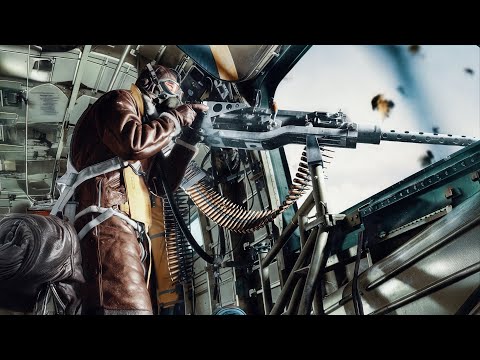
The gunners opened fire, their turrets spinning wildly. “Enemy at 3 o’clock high!” a voice screamed over the intercom. Tracers streaked through the sky. A German fighter exploded in a ball of flame. Another spiraled toward the earth, trailing smoke.
But the cost was mounting. On the ground, back in England, the control tower waited. 18 dispatched. 17 returned. 20 dispatched. 14 returned. The numbers were grim. Each missing plane carried ten men.
The survivors would later describe the mission as “the greatest strike ever.” But for now, the battle raged on. The bombers pressed toward their target, their bomb bays ready. The crucial moment was approaching—the moment around which the entire mission revolved.
The lead bombardier’s voice crackled over the intercom, calm despite the chaos. “Bomb bay doors open.” The doors groaned apart, exposing the payload to the freezing air. Below, Anklam’s industrial sprawl crept into view through the bombsight—rail lines, factory roofs, the winding river.
Flak burst around them in relentless rhythm. A shell tore through the wing of a nearby Fortress, peeling back aluminum like paper. The wounded bomber lurched, then held formation. No one broke ranks. No one could.
“Bombs away.”
The words came almost softly, but the effect was immediate. The bomber jumped upward as thousands of pounds of explosives fell free. Below, the Focke-Wulf factory erupted—first one explosion, then a chain of them, fire blooming across the assembly halls.
Across the sky, the same scene repeated. At Marienburg, the second task force released its load over the FW-190 plant. At Danzig, bombs tore through the harbor, sending ships and cranes into the water. At Gdynia, the naval yards vanished beneath a wall of smoke and fire.
For fifteen minutes, the armada had done its work. Now came the most dangerous part—getting home.
The fighters returned with a vengeance. A Messerschmitt 109 dove through the formation, guns chattering. A Fortress caught fire, its crew bailing out one by one. The gunners kept firing until the barrels glowed red.
“Scratch one 109!” a gunner shouted. Another voice answered, quieter: “We lost Baker’s crew. Saw them go down.” Silence followed.
Over the North Sea, the survivors limped home. Some planes had wounded aboard—their flares arcing red against the gray sky, signaling for priority landing. Others never made it. They ditched in the freezing water, hoping for rescue.
Back at the English airfields, the control towers counted. 18 dispatched. 17 returned. 20 dispatched. 14 returned. The numbers were read aloud, each one a name, a face, a family waiting somewhere in America.
But the mission was a success. Reconnaissance planes would later confirm what the crews already knew in their bones: the Focke-Wulf factory at Anklam had been shattered. Nearly half of Germany’s fighter production lay in ruins.
As the weary airmen climbed from their planes, they were handed coffee and cigarettes. Some laughed. Some wept. Most simply sat in silence, staring at the sky that had nearly killed them.
“Best bombing job we’ve ever done,” one navigator said, his voice flat. “But I don’t want to do it again.”
The interrogation room smelled of sweat, coffee, and cordite. Crews sat in clusters, still in their flight suits, answering questions from intelligence officers who scribbled notes with urgent precision. Every detail mattered—every sighting, every burst of flak, every enemy fighter’s marking.
“They jumped us at 10:30, just off the Danish coast,” one pilot reported, his hands wrapped around a tin mug. “Stayed with us all the way to the target and back. I counted sixty-five fighters myself before I stopped counting.”
The interrogator looked up. “Sixty-five? You’re certain?”
“I stopped trying when I hit fifty, sir. After that, it was just survival.”
In another corner, a young gunner described the rockets—the strange, smoking projectiles that streaked past the formation without exploding. “Like clay pigeons,” he said. “Streamlined, smoking all the way down. Never blew. Just fell.” The intelligence officer exchanged a glance with his colleague. New weapon. Something to report.
Meanwhile, in the photo lab, strike photos were developing in chemical baths. The images emerged slowly—gray shapes resolving into factory roofs, rail yards, harbor basins. Analysts leaned close with magnifying glasses, marking hits and near-misses.
“Anklam’s main assembly hall—direct hit,” one interpreter said, tapping the print. “Marienburg—almost every building destroyed or seriously damaged. General Arnold’s already calling it the greatest example of precision bombing on record.”
But the cost was still being tallied. At the dispersal areas, ground crews stood beside empty hardstands, waiting for planes that would never return. Some men kicked at the turf, cursing softly. Others simply stared at the sky.
“Twenty dispatched. Ten returned,” a duty officer read aloud, his voice hollow. The room fell silent. Ten planes. A hundred men. Gone.
That evening, the survivors gathered in the officer’s club. Someone had scrounged a bottle of whiskey. Someone else played a battered piano. The laughter was too loud, the jokes too sharp—the way men laugh when they’ve stared into the abyss and walked away.
“To the ones who didn’t make it,” a navigator said, raising his glass. The room answered in unison. “To the ones who didn’t make it.”
Outside, the English night was quiet. But somewhere across the Channel, in the ruins of Anklam and Marienburg and Danzig, the fires still burned. And somewhere in Berlin, men in gray uniforms were staring at maps, counting their losses, and wondering how much longer they could hold.
The men of the Eighth Air Force had done their part. The Focke-Wulf factory at Anklam was a smoking ruin, its assembly lines silenced. Marienburg and Danzig had suffered similar fates, their industrial hearts torn out by precision bombing that General Arnold would later call “the greatest example of precision bombing on record.”
But victory came at a price. Back in England, the empty hardstands told the story. Twenty dispatched, ten returned. The numbers were repeated in briefing rooms and mess halls, each one a name, a face, a family waiting somewhere in America.
Yet the mission had succeeded. Photo reconnaissance planes brought back images that confirmed what the crews already knew: the Luftwaffe’s ability to produce fighters had been crippled. Nearly half of Germany’s remaining FW-190 production lay in ruins.
For the men who flew that day, the war would go on. More missions, more targets, more friends lost. But they had struck a blow that would echo through the halls of the Reich Chancellery. The battle of Germany was being won—one bombing run at a time.
As the sun set over the English countryside, the survivors gathered in silence. They had done their duty. They had brought their crews home. And they had shown the enemy that no target was beyond their reach.
“We’ll be back tomorrow,” one pilot said quietly, staring at the horizon. “If the weather holds.”
And it would. The battle of Germany continued. The battle of Europe would be won. But at what cost? That was a question only history could answer.
Report this article
Select a reason for reporting:






