Dawn brought with it a deafening roar that shattered the tranquility of the Polish countryside. Years of accumulated tension had just exploded. The sound of engines advancing to the rhythm of Adolf Hitler completely dominated the scene. Nazi Germany had set its war machine in motion, and the smell of death began to spread.
Shortly after midnight on September 3rd, 1939, a young, elegant former socialite from Boston, Massachusetts, was heading to London after crossing the English Channel. Virginia Cowles, a foreign correspondent for the Hurst Newspaper Group and the London Sunday Times, was returning from a stay in Berlin when she saw flashes on the southern horizon and heard a series of distant explosions before boarding a train bound for Liverpool Street Station in London.
Miss Cowles asked a dock worker if war had been declared. “Not yet,” he replied, “but I hope it won’t take long. This waiting is making us all nervous.” When the journalist arrived on the outskirts of the British capital, she was greeted by torrential rain and realized she had witnessed a violent storm, not the beginning of a war in Europe.
However, Miss Cowles, who had been awakened on the morning of September 1st by the heavy sound of Nazi soldiers’ boots marching along Unter den Linden in Berlin, still felt uneasy.
At the same time that Virginia Cowles was heading to London, young Lieutenant Peter Parton of the Royal Artillery was attending a nighttime showing of Wuthering Heights at a cinema in the small port town of Watchet, Somerset. In the middle of the screening of the newly released film starring Laurence Olivier and Merle Oberon, a threatening message suddenly appeared on the screen. All officers and soldiers must return immediately to their barracks.
Parton feared that, as British slang of the time put it, the balloon was about to go up. Held by heavy steel cables, thousands of large barrage balloons were raised over many British cities, ports, and military installations as a deterrent against dive bombers and other low-flying enemy aircraft.
Lieutenant Parton was right that night of September 2nd, 1939. Years of European appeasement and months of diplomatic maneuvers and increasing tension were coming to an abrupt end. Two days earlier, on Friday, September 1st, masked German forces had invaded Poland without warning. British and French ultimatums to Nazi dictator Adolf Hitler demanding withdrawal went unanswered. And now it was only a matter of hours before hostilities escalated into full-scale war.
Only two decades after the end of the First World War, Europe was on the verge of engaging in an even more catastrophic conflict. An inevitable but unnecessary war. It could have been avoided in the 1930s if the free nations had united firmly against the spread of tyrannical fascism across Europe. Now peace had slipped away like grains of sand in an hourglass.
Sunday, September 3rd, 1939, dawned as a sunny and dreamlike day of apprehension, which would be forever remembered by all who experienced it. While impeccably dressed diplomats still rushed between European capitals that morning, British Prime Minister Neville Chamberlain presided over an emergency session of his cabinet in London. In Paris, French authorities insisted on gaining more time to mobilize their powerful army before proceeding with another ultimatum to Berlin.
But British military leaders and some members of the cabinet wanted to act quickly. The Secretary of State for War, Leslie Hore-Belisha, called for a final deadline of 6:00 a.m. Eventually, it was decided that Berlin would receive an ultimatum expiring at 11:00 a.m. demanding that its forces cease hostilities in Poland.
After the shameful era of appeasement during which the well-meaning Chamberlain mistakenly believed that Hitler’s word could be trusted, the honor of the British Empire was now at stake. It was up to Sir Nevile Henderson, British ambassador in Berlin, to deliver a note to Hitler’s foreign minister, Joachim von Ribbentrop, at 9:00 a.m. Berlin time—8:00 a.m. in London.
The pompous and clumsy Ribbentrop left the task to Hitler’s chief interpreter, Paul Schmidt, who accepted the British ultimatum. Henderson liked Schmidt and told him, “I sincerely regret having to deliver such a document to you in particular.” The German then proceeded to the Reich Chancellery where he slowly read the ultimatum to Hitler and Ribbentrop.
When I finished, Schmidt reported, there was complete silence. Hitler remained motionless, staring straight ahead. Moments later, the Führer turned to Ribbentrop with a fierce look and asked, “And now?” Schmidt withdrew.
The note gave Hitler three hours to order the cessation of operations in Poland. He reserved his fury for his inner circle: Ribbentrop, Nazi party deputy leader Rudolf Hess, SS Chief Heinrich Himmler, and propaganda minister Joseph Goebbels. The Poles, Hitler raged, were nothing but a miserable rabble, and it was a shame to treat them as a sovereign nation. The British understood this, he said, but were willing to crucify him for recognizing natural realities.
The French ultimatum was communicated by telephone to the French embassy in Berlin. And at 10:00 a.m. in London, BBC radio announcer Alvar Liddell informed listeners that they should expect a statement from the Prime Minister within an hour. Shortly before 11:00 a.m. London time on that fateful morning, Paris’s ultimatum was delivered to the German Foreign Ministry by French ambassador Robert Coulondre. This time, Ribbentrop deigned to receive it. The French envoy asked if Ribbentrop could give a satisfactory response to France’s demand that Germany withdraw from Poland. The minister replied negatively and accused France of aggression.
World War II had begun.
Meanwhile, in London, air raid sirens echoed over the rooftops, but they were premature. Miles away in Munich that day, gallerist Adolf Wagner received an envelope from a twenty-five-year-old English socialite. She was Unity Valkyrie Mitford, a blonde with blue eyes and the unmarried daughter of the eccentric Lord Redesdale.
Wagner opened the envelope and found a suicide note. A member of Hitler’s salon in Munich, Unity had fallen in love with the Führer and begged him to maintain good relations with Britain. The prospect of a war between the two countries was too much for her, she wrote. So she decided to put an end to herself.
Hitler ordered specialists to care for her, and she was taken to a clinic. As soon as she could travel, Unity was sent back to England in a special railway carriage through Switzerland. Eight years later, she succumbed to the bullet lodged in her brain.
At 11:14 a.m. on Sunday, September 3rd, Prime Minister Neville Chamberlain, a seventy-year-old man with a mustache and a soft voice, looked melancholically at a microphone in the cabinet room at Number 10 Downing Street and made a broadcast to the British people. His heart was heavy.
He had done everything he could, said Chamberlain, but there had been no response to the final ultimatum. So, a state of war exists between His Majesty and Germany as from 11:00 today. In a resigned and sorrowful tone, the prime minister declared, “You can imagine how bitter the blow is to me that all my long struggle to win peace has failed. Yet, I cannot believe that there is anything more or anything different that I could have done, and that would have been more successful.”
“Today, we and France, in fulfillment of our obligations, are going to the aid of Poland, who is so bravely resisting this wicked and unprovoked attack upon her people. Our conscience is clear. We have done all that any country could do to establish peace.”
Chamberlain was courageously declaring a war he did not want. Peace would have been preferable. He had hoped that Hitler would somehow prove to be a man of his word. However, by early 1939, he no longer harbored many illusions about the Nazi dictator. In March, Chamberlain told a guest that Hitler was “the blackest devil I’ve ever met.” The prime minister had acknowledged the strong possibility of war, and like much of the British and French public, was ready to accept it.
Few BBC listeners were surprised by Chamberlain’s announcement, but most were nonetheless stunned by the shock. For many, the dark memories of 1914 to 1918 were still very vivid. King George VI, who had been a young midshipman in the Royal Navy when hostilities began in August 1914, wrote in his diary, “Those of us who went through the Great War never wanted another.”
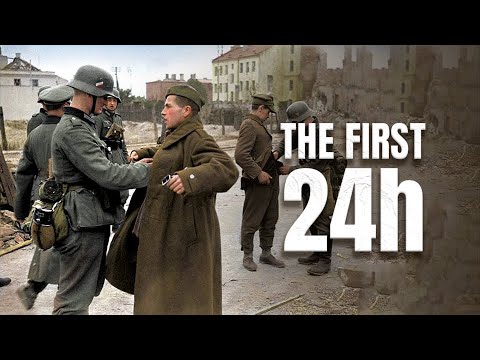
Life, as it was known and understood, changed forever when World War II began in 1939. After the surrender of the devastated Polish capital, Warsaw, German troops goosestepped through the city’s ruined streets. The devastation of Warsaw was a harbinger of the destruction to come as the Nazi war machine advanced across Europe.
The Daily Telegraph recorded, “The truth is that Parliament and indeed the nation had been in suspense for weeks, even months, waiting for war. Nobody was unaware of the threatening events on the European continent.” The newspapers were full of advice on procedures in the event of an air raid, and the Navy had already participated in a plan to evacuate Polish ships in anticipation of conflict.
The reaction of ordinary Britons to the declaration of war was varied. After the initial shock, some felt a sense of relief that all the uncertainty of the past few weeks had come to an end. For those who were in church on that sunny Sunday morning, it seemed they were in the right place at such an important moment.
Others thought more about survival than sermons and began to prepare for the worst, making sure there was an air raid shelter for the whole family and stocking up on canned food in the cupboards. Children old enough to understand were excited by the news. There was the possibility that schools would be closed due to widespread fear of German air raids.
Some city children had already been evacuated in the days before the declaration of war and were with their host families in the countryside when they heard the news in London. According to one reporter, the news of the declaration of war was received with a deeply impressive calm. He wrote, “On an extensive round through the city, I saw no emotion of any kind.”
After the sounding of the air raid sirens, the streets quickly emptied. Preventive measures had been taken. Sandbags were piled outside town halls, offices, shops, and police stations, and criss-crossed strips of anti-bomb tape covered the glass windows. Firefighting vehicles were on the streets, and policemen, auxiliaries, and air raid wardens patrolling on bicycles wore steel helmets.
After the premature warnings, hundreds of Londoners carrying gas masks strolled good-humoredly along the avenues. Others wandered and sunbathed in the city’s many leafy parks. As on any other pleasant Sunday afternoon, restaurants and cafes were crowded.
But beneath that calm, the British were methodically preparing for war. The War Office opened additional recruitment offices across London, and urgent appeals went out for dock workers and volunteers for the Royal Engineers, the Army Service Corps, the Medical Corps, and the Artillery Corps.
Outside the recruitment office at Scotland Yard, an enthusiastic group of men banged on the closed gates and shouted, “Open up, please. We want to join the army.” The government’s evacuation program proceeded smoothly, and thousands of women and children crowded the railway stations to board trains bound for Berkshire, Devon, Somerset, and other rural regions.
On the night of September 4th, an estimated three million evacuees were in new homes, nearly half of them from greater London. Chamberlain announced that the seat of government would remain in London as long as possible, and entertainment centers—cinemas, theaters, and sports grounds—were ordered closed.
Across the Atlantic, President Franklin D. Roosevelt invoked the Neutrality Act, promising his people, “There will be no blackout of peace in the United States.” Yet behind the scenes, he maintained regular contact with Britain, seeking ways to help without compromising neutrality.
The distant dominions answered swiftly. Australia’s Prime Minister Robert Menzies declared, “The great family of British nations is now involved in a struggle that we must at all costs win.” New Zealand’s Michael Savage vowed, “Wherever she goes, we will go. Where she stands, we will stand.” Canada would declare war on September 10th, and South Africa followed after Field Marshal Jan Smuts replaced the neutralist Herzog.
Poland’s suffering was the first glimpse of the terror of the Nazi regime. Historians consider it the only nation occupied by Hitler where there was no collaboration between conquerors and conquered—some 5.5 million of its people died, half of them Jews.
After the conquest of Poland, several months passed before Hitler’s next move, sustaining British and French hopes for a peaceful solution. That illusion was shattered when the tanks of the Third Reich rolled through Western Europe—the Netherlands, Belgium, and finally France.
What would you have done on that sunny Sunday morning, hearing Chamberlain’s trembling voice announce that the world had changed forever?
Report this article
Select a reason for reporting:






