The German pilot leveled his fighter at 25,000 feet, scanning the horizon with the calm of a hunter who knew exactly how the day would end. Below, American bombers crawled across the sky in tight, deadly boxes—and he smiled. He had done this a hundred times. The escort fighters always turned back at the border, their fuel tanks too small for the long haul to Berlin. After that, the bombers were alone. Easy prey.
But on this winter morning, something was different. The escorts didn’t turn back. They kept coming—sleek, unfamiliar shapes with a strange scoop beneath their bellies—and they were fast. Terrifyingly fast. In the months that followed, these planes would hunt him over his own homeland, from the moment his wheels left the ground to the moment he prayed he could land again. This is the story of how a rejected American fighter became the most feared aircraft in the German sky.
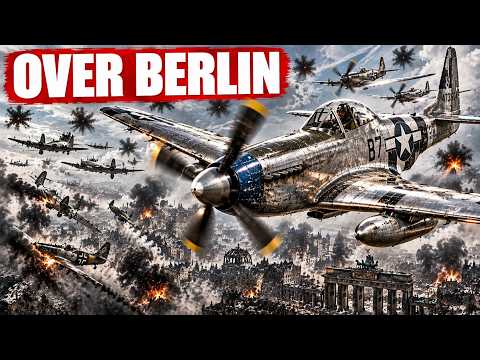
In the first four months of 1944, the German day fighter force lost over a thousand pilots. Its commander begged for help that never came. The men vanishing were the veterans—the ones Germany could not replace. And the plane responsible had been born in a California factory, designed by a team led by a man born in Germany. Its first engine had left it gasping for air at altitude. For two years, it was used mostly for low-level photo runs and train attacks. How did that plane become the last thing German pilots wanted to see when they looked over their shoulders?
On the morning of October 14, 1943, men of the U.S. Eighth Air Force climbed into their bombers in the darkness of England and tried not to think about the target’s name. Schweinfurt. Most had heard it before. Two months earlier, the Eighth had gone to Schweinfurt and Regensburg—and sixty bombers never came home. Now they were going back to the same ball-bearing factories deep inside Germany, to a target the enemy knew they would have to hit again.
The B-17 Flying Fortress was a beautiful plane, but a brutal place to work. Ten men rode inside each one. Waist gunners stood at open windows while winds tore at their bodies in temperatures far below zero. The ball-turret gunner folded himself into a steel and glass sphere under the belly, knees touching his chin, only inches of glass between him and the ground. Every man wore a heated suit that sometimes failed, an oxygen mask that sometimes froze, and a parachute he hoped he’d never need.
They believed in a promise. Before the war, American planners built their strategy around one idea: a tight formation of heavily armed bombers flying in daylight could defend itself. Every Flying Fortress bristled with machine guns. Stack enough of them together, the theory went, and their crossfire would turn the sky into a wall no fighter could break through.
On the way out that morning, the crews had company. American P-47 Thunderbolts flew above them—huge, heavy fighters with radial engines and eight machine guns apiece. It was good to see them up there. But it was temporary. Every man in those bombers knew what would happen as they neared Germany. The Thunderbolts would turn and head home. They had no choice. They simply didn’t have enough fuel to go farther and make it back to England. And the German pilots knew it.
They had learned to wait, holding their fighters back until the escort left. Then they came. From every side, in Messerschmitt 109s and Focke-Wulf 190s. Twin-engine fighters lobbed heavy rockets from beyond the bombers’ gun range. Single-seat fighters attacked head-on at closing speeds that gave gunners a split second to aim. The formations that had looked like steel walls began to break apart.
A Fortress would slide out of position trailing smoke, then fall. Men in other bombers counted parachutes. Sometimes there were ten. Often there were fewer. By the end of that day, sixty Flying Fortresses were gone. Around six hundred American airmen were killed, missing, or captured on their way to prison camps. Many of the bombers that did return to England were so badly damaged they would never fly again. The men of the Eighth Air Force would remember it for the rest of their lives. They called it Black Thursday.
After Schweinfurt, one uncomfortable fact could no longer be ignored. The self-defending bomber was a myth. Deep raids into Germany without fighter protection could not continue at that cost. In the weeks that followed, the Eighth Air Force stopped sending its bombers deep into Germany without escort. The air campaign that was supposed to cripple German industry before the invasion of Europe was in danger of crippling the American bomber force instead.
What the Allies needed was a fighter that could fly from England to the heart of Germany, fight there, and come all the way back. In the fall of 1943, no fighter in service from England could do that. But the answer had already been built. In fact, it had been flying for three years. It had simply been built for someone else.
To find it, we have to go back to the spring of 1940, when time was running out for Britain. German armies were sweeping across Western Europe. France was on the brink of collapse. The Royal Air Force knew it would soon be fighting for Britain’s very survival, and it needed every fighter it could get. A British purchasing commission in the United States was trying to buy anything American factories could produce. They approached a company in Southern California called North American Aviation.
North American built training planes. It had never designed and produced a modern fighter of its own. The British wanted it to build Curtiss P-40 fighters under license. But North American’s president—a blunt, forceful engineer named James Kindelberger, known to everyone as “Dutch”—had a different idea. Instead of building someone else’s fighter, his company would design a new and better one. It was a bold promise from a company with no fighter experience. The British agreed, but they wanted results fast. In the spring of 1940, they placed an order for 320 aircraft.
The man who led the design work was a quiet, intensely focused engineer named Edgar Schmued. He was forty years old, and he had been born in Germany. Schmued grew up in the small town of Hornbach in southwestern Germany, near the French border. As a boy before World War I, he was fascinated by airplanes and taught himself how they worked. After that war, Germany was in ruins, and there was little future for a young engineer who dreamed of aircraft. He emigrated first to Brazil, then in 1930 to the United States. He worked his way through American aviation companies until he reached North American.
And now, this immigrant from Germany sat in a California office drawing the lines of the fighter that would one day help tear apart the air force of the country of his birth. He did not work alone. Chief engineer Raymond Rice and a team of designers and draftsmen threw themselves into the project with an urgency that matched the news from Europe. They worked long hours, often seven days a week.
The design they produced was strikingly simple and clean. It had a thin wing, carefully shaped to reduce drag. It had a radiator mounted under the belly inside a scoop designed so that the hot air flowing out the back helped cancel much of the drag the radiator created. Everything about it was built for speed and for production, with simple lines that factory workers could reproduce quickly and in large numbers. About 102 days after getting the go-ahead, the first airframe rolled out of the workshop. It had no engine yet. When the engine arrived and the prototype finally flew in late October 1940, it was clear that North American had built something special.
The British named it the Mustang. But there was a hidden problem inside that beautiful airframe: the engine. The Mustang ran on an American Allison engine. Near the ground, the Allison was powerful and reliable, and the Mustang was already very fast. But the version installed in the Mustang had only a single-stage supercharger—the device that pumps air into the engine as the atmosphere thins. As the Mustang climbed, its engine began to gasp. Above about 15,000 feet, its performance fell off sharply. And in the skies over Europe, the great air battles were fought far higher than that. As a high-altitude fighter, it was dangerously disappointing.
But the RAF did not throw the plane away. Instead, it found missions the Mustang could do brilliantly. From the spring of 1942, Mustangs flew low and fast over occupied France and the Low Countries, photographing enemy positions, attacking trains and barges, and racing home at treetop height. Down there, the Mustang was in its true element. It was faster than most of what Germany could send after it at low level, and it had far greater range than the Spitfire. The U.S. Army Air Forces showed some interest. They took a few for testing and later ordered versions for ground attack and dive bombing. But at that point, few in Washington imagined that this low-altitude workhorse would one day become the most important American fighter over Germany.
Meanwhile, far from England, the men whose lives the plane would shape were still preparing for war. In the farming country near Newcastle, California, a young man named Clarence “Bud” Anderson grew up watching airplanes cross the sky and dreaming of flying them. He learned to fly through a government program for civilian pilots, then joined the Army as an aviation cadet in early 1942. He wasn’t rich, wasn’t famous, wasn’t especially loud. He was simply very good at flying and very serious about getting better at it. By the fall of 1943, while the bombers were being torn apart over Schweinfurt, Bud Anderson was twenty-one years old and training in the American West with a new fighter group, the 357th Fighter Group. They were flying P-39 Airacobras, and that was the plane most of them expected to take to war. No one yet knew what they would actually fly.
On the other side of the war, in northern Germany, another young pilot was learning what it meant to fight bombers. His name was Heinz Knocke. Born in 1921, he was a Messerschmitt pilot tasked with defending the Reich. He had watched the American formations come in growing numbers, and he had seen his friends die attacking them. The bombers were dangerous prey, and German pilots tried every possible trick to break their formations apart. In March 1943, Knocke dropped a bomb from his fighter into an American formation and, by his own account, managed to bring down a Flying Fortress that way.
For pilots like Knocke, the war over Germany in late 1943 was savage. But it followed a pattern. The American escort would arrive, stay for a while, then turn back. The real battle began after they left. A German pilot could choose his moment. He could climb, gather with his comrades, and attack the bombers on his own terms. He didn’t have to look over his shoulder much—not yet. That pattern was about to change. Not with a new bomber, not with a new German weapon, but with the plane the Americans had almost ignored. All it needed was a new heart.
The man who gave the Mustang its new heart was not American. He was a British test pilot named Ronald Harker. Harker worked for Rolls-Royce, which built the Merlin engine—the engine that had carried the Spitfire and Hurricane through the Battle of Britain. His job was to fly with front-line units, listen to their pilots, and report on how Rolls-Royce engines performed in service. On April 30, 1942, he visited the Air Fighting Development Unit at Duxford, where the RAF tested new aircraft and tactics. There, he was offered the chance to fly one of the American Mustangs.
It was a short flight. Harker settled into an unfamiliar cockpit, built in an American factory, with controls laid out a little differently from what he was used to in Spitfires. He took off over the flat green fields of Cambridgeshire, and he felt how smoothly the plane moved through the air, how lightly it answered the controls, how little it resisted him. Then he landed and looked at the numbers. Harker was an engineer as much as a pilot, and he noticed something important. With an engine of roughly similar power, the Mustang was faster than the Spitfire at low altitude. That meant the airframe itself—the clean, streamlined design from California—was extremely efficient, and it carried a large amount of fuel.
Harker realized the Mustang’s weakness wasn’t in its wings or its structure. It was in the engine that gasped at high altitude. So he asked a simple question. What would happen if we put the latest Merlin engines in this plane? The Merlin 61, which was just entering service, had a two-stage supercharger. It compressed the air twice before pushing it into the engine. Where the Allison had gasped, the Merlin kept working powerfully up to the thin, frozen air where the bombers flew and the real battles were fought.
Harker wrote down his recommendation. Not everyone was convinced at first. There were priorities and other programs, and every Merlin engine was precious. But within weeks, the idea gained strong support in Britain and the United States. Rolls-Royce began converting Mustangs to Merlin power at its flight test center at Hucknall. In America, North American Aviation began its own conversion using Merlin engines manufactured under license by the Packard Motor Car Company in Detroit. One of the men who pushed the American side hard was Thomas Hitchcock, the famous polo player who was serving as an assistant air attaché in London, who saw the potential of the Merlin Mustang and urged Washington to take it seriously.
On November 30, 1942, the first American Mustang with a Merlin engine flew in the skies of California. The difference was astonishing. The same plane that had been struggling above 15,000 feet was now alive at high altitude. At around 30,000 feet, it could exceed 400 miles per hour. It could climb rapidly. It could dive like a stone, and it still carried more fuel and used it more efficiently than other American fighters in Europe. The airframe was built by a team led by a designer of German origin. A British test pilot found the engine, an American car company built it by the thousands, and North American’s factories in California and later Texas would produce the new fighter in enormous numbers. The new version was called the P-51B.
The first group to take it into combat over Europe was the 354th Fighter Group, part of the Ninth Air Force. Its men became known as the “Pioneer Mustang Group.” They flew their first mission on December 1, 1943. Less than two weeks later, on December 13, they escorted bombers all the way to the German port of Kiel and back—a round trip of about 1,000 miles. Never before had single-engine American fighters from England stayed with the bombers for such a distance. The Germans noticed.
German pilots who climbed to attack the bombers expected to find the Americans alone. Instead, they found these slim, unfamiliar fighters waiting for them. At first glance, the Mustang looked a bit like a Messerschmitt 109, and that resemblance caused problems for both sides. After a short time, Mustangs were given broad white identification bands on their noses, wings, and tails, so that friendly gunners wouldn’t mistake them for German planes.
The Mustang was not a miracle machine, and the men who flew it learned that quickly. Early P-51B models carried only four .50-caliber machine guns, two in each wing. To fit inside the thin wings, the guns were mounted at an angle on their sides. When a pilot made a sharp maneuver, the forces on the ammunition belts could cause the guns to jam at the most important moment of a dogfight. When a pilot finally had a German fighter in his sights, he might squeeze the trigger and hear one gun fire—or nothing at all.
Then there was the fuel problem. To extend the Mustang’s range even further, an 85-gallon auxiliary tank was installed behind the pilot’s seat. This tank made very long missions possible. But it also made the plane dangerous. With that tank full, the plane’s center of gravity shifted backward, and the Mustang became unstable and difficult to control in hard maneuvers. Pilots learned to burn off that tank’s fuel first at the start of a mission before switching to the external tanks under the wings. Only then did the Mustang regain its usual balance.
Then there was the cold. At 30,000 feet over Germany, the air outside could drop to 50 degrees below zero. Pilots spent five or six, sometimes seven hours, strapped inside a cramped cockpit, unable to stand, barely able to move. Canopies could frost over. Hands and feet went numb. The oxygen mask pressed against the face for hours, cutting the skin, and ice built up where breath condensed. The engine roared a few feet from the pilot’s feet for the entire flight—a sound so constant that some men said they heard it in their sleep. There was no one to talk to except over the radio, and the radio was kept silent unless there was something important to say. And through all of it, the pilot had to stay alert, scanning the sky again and again—because the German fighter you don’t see is usually the one that kills you.
On January 11, 1944, one pilot of the Pioneer Mustang Group showed both the plane’s potential and its weaknesses in the same afternoon. His name was Major James Howard. He was thirty years old, and before joining the Army Air Forces, he had flown with the American Volunteer Group in China—the famous “Flying Tigers.” That day, the Eighth Air Force was attacking aircraft factories in central Germany around Oschersleben and Halberstadt. Howard became separated from the rest of his group. He saw below him a formation of B-17s under attack by German fighters. He was alone. Yet he dove into the fight.
For about half an hour, Howard kept diving and climbing among the German attackers, breaking up their attacks again and again. He was officially credited with destroying three enemy aircraft. By the end of the fight, three of his four guns were out of action. He kept attacking anyway, charging at German fighters when he could barely fire at them, just to drive them away from the bombers. Imagine what the men inside those bombers saw that evening. They had been through this before. They knew the rhythm of it well. The German fighters line up, then swoop in, and one of them goes down. They were waiting for that to happen. And instead, one small fighter kept charging through the enemy formations again and again, turning and diving and climbing and coming back, one American against dozens of Germans, refusing to leave. Gunners who should have been watching their own sectors found themselves staring in disbelief. Some of them had never even seen a Mustang before. The bomber crews could hardly believe their eyes.
Howard later received the Medal of Honor. He was the only fighter pilot in the European Theater to earn it during the war. But for every story like Howard’s, there was a harsher truth. There were still far too few Mustangs. All that winter, the burden of escort fell mainly on Thunderbolts and twin-engine P-38 Lightnings, which struggled with the cold and with their limited range. The bombers were still taking terrible losses, and many Mustang pilots were entering combat with very little experience in the type.
Just days before Howard’s fight, a new commander had arrived to lead the Eighth Air Force. General James Doolittle was forty-seven years old and already a legend. Before the war, he had been one of America’s most famous racing and test pilots. In April 1942, he had led sixteen B-25 bombers off the deck of an aircraft carrier in the first American air raid on Tokyo—a mission for which he received the Medal of Honor. He took command of the Eighth Air Force on January 6, 1944.
Shortly after his arrival, Doolittle visited the headquarters of his fighter command under Major General William Kepner. He noticed a sign on the wall. It said that the first mission of Eighth Air Force fighters was to bring the bombers back safely. To most people, that seemed exactly right. To Doolittle, it was the problem. As long as fighters stayed glued to the bombers, they could only react. They had to wait for the Germans to choose the time and place of every attack, then try to beat it back. German pilots still held the initiative. Doolittle wanted to reverse that completely.
He told Kepner to take down the old sign and put up a new one. It was to say that the first duty of Eighth Air Force fighters was to destroy German fighters. It was a change of only a few words. It changed the course of the air war. Under the new approach, some fighters stayed close to the bombers, but others were free to range far ahead of the formation, sweeping the sky in front of it, hunting German fighters while they were still climbing, still forming up, still heavy with fuel and ammunition. When German fighters broke away, the Americans were allowed to chase them. And on the way home, fighter pilots could drop down and attack German airfields, trains, and anything else that kept the German Air Force in the fight.
Not everyone liked this. Many bomber crews were furious. To them, a fighter you could see out the window was protection. A fighter chasing Germans miles away looked like abandonment. Doolittle later admitted that many bomber men resented him bitterly for the decision. He understood their anger, but he believed the only way to truly protect the bombers was to destroy the force that was killing them.
Doolittle’s new orders needed something more to succeed. They needed fighters that could actually reach the places where the Germans were. And now, slowly at first and then in a flood, the Mustangs began to arrive. Among the groups that received them was the 357th—Bud Anderson’s group. They had crossed the Atlantic expecting to fly Airacobras. Instead, in England, they were handed brand-new P-51Bs. They became the first Mustang group in the Eighth Air Force, flying from an airfield called Leiston, near the Suffolk coast. Anderson flew in the 363rd Fighter Squadron. He named his Mustang “Old Crow.” In the same squadron flew another young pilot, a sharp-eyed kid from West Virginia named Chuck Yeager.
On February 11, 1944, the 357th flew its first combat mission in Mustangs. The pilots were young and mostly inexperienced, flying over a continent controlled by an enemy with years of combat experience. There was a lot to learn. How to hold formation for hours, how to manage fuel down to the last gallon, how to scan the sky without stopping, and above all, how never to be caught by surprise.
In the Fourth Fighter Group, there was a hard-driving leader named Don Blakeslee who was so determined to get Mustangs that when his group finally received them in late February, he gave his pilots almost no time to get used to them. They flew their first Mustang mission within days. According to a story often told about him, when one of them expressed worry about learning to fly the new plane, Blakeslee replied that they could learn to fly it on the way to the target.
A long escort mission began long before dawn. Pilots were woken in the dark, fed, and taken to a briefing room where a curtain was pulled back to reveal a map of Europe with a ribbon stretched across it. The length of that ribbon told them how long their day would be. When the ribbon reached deep into Germany, the room went quiet.
Outside on the airfield, ground crews had worked through the night. They had fueled the planes, loaded ammunition, patched holes from the last mission, and warmed the engines. These mechanics, armorers, and radio men rarely had their names in the newspapers. They worked in the wet English cold under dim lights with numb fingers and frozen tools. Each crew chief came to think of his plane as his own and of his pilot almost as a younger brother. When a Mustang didn’t come back, it was the ground crew who stood at the empty space on the airfield, waiting long after everyone else had gone inside.
But in the darkness before takeoff, all of that was still hours away. The Merlin engine coughed, then caught, settling into its deep, smooth roar. One by one, the Mustangs took off, heavy with fuel, external tanks hanging under the wings like weights tied to a runner’s ankles. Climbing through England often meant climbing blind through thick cloud, trusting the instruments and hoping the plane next to you stayed exactly where it was supposed to be. Above the clouds, the formations gathered and turned east. Somewhere over the continent, they would meet the bombers—hundreds of them, their contrails stretching behind them like long white ribbons across the blue sky.
When the German fighters appeared, the Mustang pilots dropped their external tanks. The tanks fell away, and the Mustangs, suddenly lighter, became the fighter they were built to be. Then came the fight itself—short, violent, and confusing. Planes flashed past each other at closing speeds of hundreds of miles per hour. Radios filled with shouted warnings. A battle that felt like it might last forever could be over in three or four minutes. Then came the long, cold flight home, alone or in pairs, watching the fuel gauge, scanning the sky, counting the minutes until the English coast appeared through the haze.
On the German side, the defenses were a huge machine. Radar stations tracked the bomber streams as they formed over England. Plotters in bunkers drew their course and ordered fighter units into the air. German pilots took off, climbed, and gathered in large formations, sometimes from different airfields, so they could hit the bombers together and hard. That process took time. In 1943, that time had been safe. Now, with Mustangs and other American fighters flying ahead of the bombers, that time was the most dangerous of all. A German formation still climbing and gathering, heavy with fuel and weapons, was exactly what the American hunters were looking for.
Even before every new Mustang group was ready, there came the week that would test whether Doolittle’s new tactics would really work. In the second half of February, the weather over Germany finally began to clear. On February 20, 1944, the U.S. Army Air Forces launched a massive, sustained offensive against the German aircraft industry. Bombers from England and Italy struck fighter factories and parts plants day after day for six days. The official name of the operation was “Argument.” The men who flew it remembered it simply as “Big Week.”
The bases in England barely tasted sleep for six days. Crews flew, landed, ate, slept for a few hours, and flew again. Ground crews worked through the night to repair and refuel planes for the next morning. Over Germany, the sky filled with contrails, with black bursts of flak, with falling planes and drifting parachutes. Men who had been strangers on Monday were veterans by Friday. Some were gone before anyone knew their names.
The bombers were bait as much as they were weapons. The Luftwaffe had to defend its aircraft factories. It had to come up and fight. And this time, when the German fighters came up, the American fighters were waiting for them—and many of them no longer turned back at the border. Losses were terrible on both sides. The Americans lost more than 200 heavy bombers that week, each carrying ten men. But the Luftwaffe lost hundreds of fighters, and worse for Germany, it lost many of the pilots who flew them. Factories could be repaired, production dispersed and reorganized. In fact, German fighter production rose in the months that followed. But experienced men could not be easily replaced.
For the men on the German side, something was changing in a way that was hard to describe and impossible to ignore. Adolf Galland was thirty-one years old, the General of Fighters and the officer responsible for the German fighter force. He was a brilliant and famous pilot, a veteran of Spain, France, and the Battle of Britain, usually seen with a cigar in his mouth, and fiercely loyal to his pilots. For months, he had warned his superiors that the American daylight offensive was growing faster than German defenses. He wanted more fighters, more fuel, more pilots, and more time to train them. What he got instead, often, was contempt.
Hermann Göring, the head of the Luftwaffe, blamed his fighter pilots whenever the bombers got through. In 1943, he had publicly accused them of lacking courage. Galland was furious. His men were dying by the hundreds, attacking heavy bomber formations through walls of fire, and their commander called them cowards.
To bring down heavy bombers, German leaders tried turning their fighters into flying artillery. They mounted extra cannon under the wings of Messerschmitts. They hung heavy rocket tubes beneath them. They sent twin-engine destroyers, like the Messerschmitt 110 and the newer Messerschmitt 410, carrying heavy cannon and rockets that could knock down a bomber from beyond its gun range. Some Focke-Wulfs were fitted with extra armor to protect the pilot as he closed in. Against unprotected bombers, this worked with terrifying effect. That is how many Flying Fortresses fell in 1943.
But the Mustang changed the equation. All that extra weight made the German fighters slower, heavier, and less able to maneuver. A fighter loaded with rockets and extra cannon could tear a bomber apart, but it could not fight a dogfight. And now, over Germany, there was always someone to dogfight with. The twin-engine destroyers suffered worst of all. When American fighters caught them, they were cut to pieces. In the months that followed, they had to be pulled from the battle against American daylight bombers. The weapons the Germans built to kill bombers made their own pilots easier prey.
For pilots like Heinz Knocke, the new reality did not arrive as a single shock. It came as a slow, creeping sense of dread. The old pattern was gone. There was no longer a safe moment to climb and gather. The enemy might be waiting for you anywhere along the way—from above, from behind, sometimes near German airfields as tired pilots came in to land. Knocke’s unit, like every German fighter unit defending the Reich, saw its experienced men killed or wounded one by one, replaced by younger pilots who had spent far fewer hours in the air than the Americans they faced.
Imagine what that felt like for a German fighter pilot in early 1944. The faces in the mess hall changed constantly. A friend might be with you at breakfast, then gone by lunch. The names of men who had survived years of war—over France, Russia, the English Channel—began to appear on the lists of dead and missing. The new arrivals looked incredibly young. Some had barely learned to land their planes, and now they were being sent against the largest air fleets in history. Every alarm, every order to scramble carried the same unspoken question: who won’t come back this time?
That last point mattered more than any single air battle. Germany was running out of fuel and running out of time. Its new pilots often reached the front with a fraction of the flying hours an American pilot received in training. Many were sent against Mustangs flown by men who had trained far longer, in a plane that could outfight theirs at high altitude. That is where the fear came from—not from one plane or one battle, but from the sense that the sky was no longer theirs. A German pilot might survive twelve missions, but each time he took off, the odds against him grew a little worse. And when he looked over his shoulder, he increasingly found a Mustang there.
In the first days of March 1944, the Americans turned toward the capital of the Reich. Berlin was the heart of Nazi Germany, and the Luftwaffe would defend it with everything it had. On March 6, the Eighth Air Force sent a huge force of heavy bombers against targets in and around the city. It became one of the bloodiest days the Eighth Air Force ever experienced. Sixty-nine American bombers were lost. The Germans had massed their fighters and flak along the route, and the battle raged for hours across the sky.
From the ground, Berliners could see the long white trails of the bomber stream crossing the winter sky. They could hear the deep drone of thousands of engines and the sharp crack of flak guns firing from towers and parks. Burning planes fell over the countryside around the city, German and American alike. Inside the bombers, men watched fighters turning and twisting above them—and for the first time over the German capital, some of those fighters were theirs.
That was the difference. American fighters, including Mustangs, were flying over Berlin itself, fighting German defenders above their own capital. Anyone in the city who looked up could see it. After the war, Hermann Göring was quoted as saying that when he saw Mustangs over Berlin, he knew the game was up. Historians are not certain he said those exact words, but whether he did or not, the meaning was clear to anyone in Germany who was watching the sky that spring.
The Americans came back to Berlin again that week, and again after that. The losses did not stop. American bomber crews kept dying in large numbers throughout 1944. The Mustang did not make the bombers invulnerable. What it did was make every German attack more costly than the one before.
The Mustang pilots paid their own price as well. On March 5, one day before the big raid on Berlin, Chuck Yeager—Bud Anderson’s squadron mate—was shot down over France. He evaded capture with the help of the French Resistance, crossed the Pyrenees into Spain, and eventually returned to England. Many others were not so lucky. The Mustang’s liquid-cooled engine was both its great strength and its weakness. A single bullet through the cooling system could make the engine overheat and quit within minutes. Men bailed out over enemy territory and spent the rest of the war in prison camps. Others simply never returned, and no one ever knew exactly what happened to them.
Through that spring, the American fighters kept pressing. On the way home, with Doolittle’s orders permitting it, they dropped low to attack German airfields. Strafing was one of the most dangerous things a fighter pilot could do. Low altitude, thick flak, almost no chance to bail out. But it meant the German Air Force was no longer safe even on the ground. A German pilot might survive an air battle and land, only to find American fighters roaring over his airfield and setting parked planes on fire. For the men at those airfields, there was no such thing as a quiet afternoon anymore. Ground crews learned to listen for the sound of approaching engines and run for slit trenches. Pilots who returned exhausted from one fight might find themselves jumping into a trench beside their own runway, watching tracer fire pass through the grass toward the plane they had just left.
Then came the numbers. Adolf Galland later wrote that between January and April 1944, the German day fighter force lost more than 1,000 pilots. Among them were many of its best and most experienced leaders—men who had commanded squadrons and groups, men whose skills could not be bought or manufactured. Machines could be replaced. German factories, reorganized and dispersed, were producing more fighters than ever. But the young men climbing into those new fighters were less trained, with less fuel for training, and with fewer chances of survival than the men they replaced.
This was the deeper reason German pilots feared the Mustang. It was not just a fast plane with good guns. It was a sign of a war they could not win. It meant there was no longer any part of the German sky where they could catch their breath.
By late spring of 1944, the Allies were preparing to invade France. Their greatest fear was a German air force strong enough to attack the invasion fleet and the crowded beaches. That fear never materialized. On June 6, 1944, D-Day, thousands of Allied ships and aircraft crossed to Normandy. In the air, the Allies had thousands of fighters. The German Air Force, exhausted by months of fighting over Germany, could send only a tiny fraction of that number over the invasion coast.
The young soldiers—American, British, and Canadian—waiting on the beach in the surf faced terrible fire from bunkers and heights. Thousands were killed or wounded that day. But when they looked up at the gray Normandy sky, almost every aircraft they saw was theirs. The German bombers that could have torn apart crowded landing craft and packed beaches simply did not come in any real strength. One of the most famous German sorties of the day was flown by Oberstleutnant Josef Priller and a single wingman, who made one quick strafing pass over the beaches in their Focke-Wulfs and then raced inland. Among the German soldiers in Normandy, a bitter joke began to spread. If you see a silver plane, it’s American. If you see a dark one, it’s British. And if you see no planes at all, it’s the Luftwaffe.
That summer, the latest Mustang models reached the front in large numbers. The P-51D featured a clear bubble canopy that gave the pilot nearly uninterrupted vision around him, with six .50-caliber guns mounted upright in its wings, largely solving the old jamming problems. But Anderson flew one too, and like his earlier fighter, it carried the name “Old Crow.”
Then, in the second half of 1944, the Germans introduced something into the fight that the Mustang could not match. The Messerschmitt 262 was the world’s first operational jet fighter. It was about 100 miles per hour faster than the Mustang. It carried four 30-millimeter cannon, enough to destroy a heavy bomber with a few hits. In a straight race, no Mustang could catch it. For American pilots, seeing it for the first time was unforgettable. A shape with no propellers, trailing black smoke from two engines slung under its wings, closing on the bombers at what looked like impossible speed, firing, then vanishing before anyone could turn to chase it.
Mustang pilots, who had grown used to being the fastest in the sky, suddenly understood what German pilots had felt all through the spring. But the jet had weaknesses. Its engines were fragile and slow to respond to the throttle. It was most vulnerable at takeoff and landing, when it was slow, low, and predictable. American pilots learned to wait near the jet bases. On November 6, 1944, Chuck Yeager—back in action after his escape through Spain—caught a Messerschmitt 262 as it came in to land and shot it down. Other Mustang pilots did the same. The jet was an amazing machine, but it arrived late, in far too few numbers, flown by an air force that had been almost bled dry.
Bud Anderson completed two combat tours with the 357th. He was credited with destroying more than 16 enemy aircraft in the air. He returned to America before the war in Europe ended, became a test pilot, and served in the Air Force for decades afterward. He never described himself as a hero. He saw himself as one of thousands of young men who did a hard job in an exceptional plane, and who were lucky enough to come home. In the years that followed, he spoke often about the friends who had not been so lucky. The young men from his own squadron, whose names he carried with him all his life. Even as an old man, he returned and climbed back into the cockpit of a Mustang and flew it again. Behind the controls of the plane he had flown when he was young. Its engine still roaring with that same deep, distinctive sound.
Heinz Knocke survived the war, though he was severely wounded more than once. His memoir, published later, became one of the most famous accounts of what it felt like to fly for Germany while the sky closed in around them. Adolf Galland survived as well. Göring removed him from his post in early 1945, and Galland finished the war leading a small unit of jet fighters, flying the Messerschmitt 262 against the bombers he had fought for so long. Edgar Schmued, the boy from Hornbach, went on to design aircraft in America for years after the war, including the jet fighters that followed the Mustang into service. He had built a fighter for Britain, powered by a British engine built in Detroit, and it helped defeat the dictatorship that ruled his birthplace.
So why did the Mustang terrify German pilots? It wasn’t because it was perfect. Its guns jammed. Its fuel tank made it dangerous. Its engine could quit from a single bullet. Other Allied fighters, like the Thunderbolt and the Lightning, fought hard in the same skies and destroyed huge numbers of German aircraft. The Mustang was feared because it took away the one thing German pilots had always counted on: distance, time, and empty sky behind the border where the escorts turned for home. Once the Mustang arrived, that safe sky vanished. The hunters became the hunted from the moment they took off to the moment they landed—and sometimes even after that.
In May 2024, Bud Anderson died at his home in California. He was 102 years old, one of the last great American pilots to fly the Mustang over Germany. Ask the bomber crews who came home what that little fighter meant to them, and many will tell you the same thing. It meant that someone was still with them over the target. Ask the German pilots, and the answer is harder to hear. It meant the sky was no longer theirs.
So here’s the question: if you were a young pilot in 1944—on either side of that war—would you have wanted to fly the Mustang, or would you have dreaded seeing it appear on your wing?
Report this article
Select a reason for reporting:






