The Navy had built the most powerful carrier fighter in the world—and then, in a devastating reversal, they refused to let it land on their own ships.
It was 1942, and the Vought F4U Corsair had already broken every speed record in American aviation. Yet four specific, lethal flaws in carrier trials had killed pilots and forced the Bureau of Aeronautics to declare it unsuitable for fleet operations. The most advanced naval fighter ever conceived was officially banned from the decks it was designed to defend.
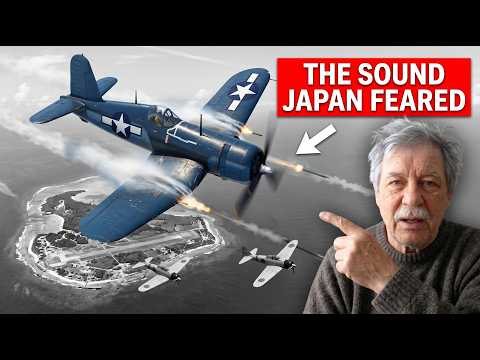
What happened next would become one of the strangest and most consequential trajectories in military aviation history. The Navy’s rejection was not the end of the Corsair—it was the beginning of a legend forged in blood, borrowed tactics, and a bent wing that changed everything.
To understand how an American fighter ended up flying from British carriers before American ones, you have to go back to 1938, when the Navy issued a specification that was essentially a dare: build the most powerful carrier-based fighter that human engineering could produce. Not the safest. Not the most conventional. The most powerful.
Vought’s chief engineer, Rex Beisel, made a single decision that determined everything that followed. He chose the Pratt & Whitney R-2800 Double Wasp—a nearly 2,000-horsepower engine so massive that its propeller measured 13 feet, 4 inches from tip to tip. That propeller had to clear the deck of an aircraft carrier. Standard landing gear could not lift the aircraft high enough without becoming impossibly heavy and complex.
So Beisel bent the wing. The inverted gull wing—that instantly recognizable silhouette—allowed short, light landing gear to attach at the lowest point of the bend, keeping the fuselage low while the propeller cleared the deck. Three engineering problems solved by a single bent wing.
When the prototype flew in May 1940, it hit 417 mph in level flight—the first American aircraft of any kind to exceed 400 mph. The contract was signed. The most powerful carrier fighter in history was real, proven, and apparently ready.
Then the problems arrived.
During carrier qualification trials, the Corsair failed in four specific, individually dangerous ways. The oil tank sat behind the engine, and at high power settings, oil migrated forward and coated the windscreen, blinding the pilot on approach. The cockpit sat fifteen feet behind the nose, blocking forward visibility exactly when the pilot needed to see the deck. The landing gear struts bounced on impact, sometimes throwing the aircraft back into the air after catching the wire. And at low approach speeds, the right wing had a tendency to drop suddenly—lethal when the deck was thirty feet below and the aircraft was already near stall.
Pilots were dying in trials. In early 1943, the Navy formally declared the F4U unsuitable for carrier operations and reassigned it to land-based units.
What could not have been anticipated was what that rejection would set into motion.
The Marine Corps got the fighter the Navy didn’t want. Marine aviation operated from land bases—no carrier deck geometry, no arresting wire dynamics, no low-speed approach problems. The Marines took the Corsair and discovered almost immediately what it could actually do when no one was trying to land it on a ship.
In February 1943, VMF-124 arrived at Henderson Field on Guadalcanal—a dirt and coral strip captured from the Japanese, rebuilt under fire, and operated under regular attack. The pilots there flew under real combat conditions from the start. One of them was Kenneth Walsh, who worked out through experience what the aircraft could and couldn’t do.
It was faster than the Mitsubishi Zero above 20,000 feet—not marginally, but noticeably. It couldn’t match the Zero in a sustained low-altitude turning fight, but it could dive at speeds that would structurally overstress the Japanese fighter. It could absorb punishment that would have killed a lighter aircraft. Its six .50-caliber machine guns delivered enough concentrated firepower to destroy any Japanese aircraft it hit cleanly.
The Zero was not a simple adversary. It was the product of a philosophy that had deliberately stripped weight in every direction—no pilot armor, no self-sealing fuel tanks, lighter structure throughout—trading protection for agility. The Corsair was the opposite philosophy: accept the weight, build in the protection, rely on speed and firepower.
At Guadalcanal, the Marine pilots worked out what that difference meant in practice. The tactic that emerged was demanding but clear. Maintain altitude advantage, attack vertically, extend into a dive if threatened, use speed to break off the engagement, climb back above the fight, and repeat. Never enter a low-altitude turning fight. Never give the Zero the conditions it was built to exploit.
Walsh claimed 20 aerial victories using this approach and received the Medal of Honor. He was the first Corsair ace, and the doctrine he proved in practice was not instinct—it was the rational exploitation of what the design actually rewarded. Other Marine pilots were developing the same understanding through the same dangerous education.
By late 1943, Gregory “Pappy” Boyington was commanding VMF-214—the Black Sheep Squadron—accumulating a combat record that brought the Corsair significant attention from people who had largely moved on from the carrier rejection. Boyington’s credited total of 28 aerial victories is not without historical dispute, but the attention his squadron brought to what the aircraft could do was real and consequential. The Navy brass in Pearl Harbor and Washington were paying attention again.
The reversal that followed is where most accounts tell only half the story.
The popular version says the Navy eventually overcame its concerns, fixed the problems, and cleared the Corsair for fleet use once the evidence from land-based combat became impossible to dismiss. That version is accurate as far as it goes. What it omits is that the United States Navy cleared the Corsair for American carriers after the British Royal Navy was already operating it routinely from theirs.
Britain received Corsairs through Lend-Lease beginning in 1943. The Fleet Air Arm was chronically short of capable fighters. British industry could not produce enough high-performance aircraft to meet operational needs, and the types available were not competitive at the altitudes and ranges that mattered most. The Corsairs were accepted and put into service because the alternative was flying inferior aircraft in a war where that cost lives.
The British had no option of waiting for a better solution. Fleet Air Arm pilots developed a technique that American carrier doctrine had not applied to this aircraft: the curved final approach. Flying a slight arc toward the carrier’s stern rather than a straight line kept the ship’s deck visible in the pilot’s peripheral view throughout the approach, even when the nose was elevated. The pilot did not need to see past the cowling because the deck was always slightly to one side of it.
The technique demanded more practice than a straight-in approach, but it solved the visibility problem practically through airmanship rather than engineering. The oil contamination on the windscreen had been partially addressed in production updates to later variants. The strut calibration could be adjusted for carrier use. The wing-tip stall characteristic could be managed once pilots understood what triggered it. The Fleet Air Arm also clipped approximately eight inches from each wing tip so the aircraft could fit through the below-deck hatches and into the hangar spaces of British carriers, which were tighter than American fleet carriers.
By 1944, British carriers were recovering Corsairs routinely in operational service in the Indian Ocean, conducting strikes against Japanese-held territory. The American fighter the United States Navy had declared unsuitable for carrier operations was being safely recovered on Allied carrier decks every day.
When the US Navy revisited the question of carrier clearance, they had something they hadn’t had in 1942: operational evidence gathered in a combat zone proving the problems were not insurmountable. The version cleared for American fleet carriers was the F4U-1A. The key modifications were a raised pilot seat—about eight inches—which improved forward visibility enough that the deck remained visible even from the far-back cockpit position, and revised oleo strut specifications addressing the bounce. Neither change was exotic. Both were targeted corrections to specific documented failures, informed by two years of feedback from Marine pilots, British naval aviators, and the engineers who had watched the whole painful process from Stratford.
The aircraft cleared for American fleet service in late 1944 was recognizably the same machine rejected two years earlier. The wing was the same. The engine was the same. The geometry was unchanged. What had changed was the calibration of the gear, the position of the pilot, and the collective understanding of how to fly it onto a moving deck. That knowledge had been purchased by thousands of hours of combat by people who had no institutional support for making it work.
Production at this point was no longer a Vought problem alone. The demand was too large. Goodyear, the tire company with available manufacturing capacity, received a license to build the FG-1D, functionally identical to Vought’s own aircraft. Brewster Aeronautical was contracted as well, but their production quality proved so inconsistent that their contract was eventually terminated. The Goodyear line ran effectively.
The production expansion required by the war was not simply a matter of building more factory space. It demanded training a workforce with no aviation manufacturing background to work to tolerances that conventional industrial work didn’t require. The women who entered the Stratford plant and the Goodyear production lines were not performing simple assembly. They were fabricating complex curved structures in a wing design that allowed no easy shortcuts. And the quality they maintained determined whether the aircraft that came off the line was reliable or dangerous.
When final production of all variants ended in December 1952, the combined total from Vought and Goodyear was 12,571 aircraft—seven years after Japan surrendered. The number is larger than most people expect, and the timeline is longer than any 1938 specification had reason to anticipate. Production extended into the early Cold War because the aircraft had proven its value well beyond the specific carrier fighter role it was originally built for. The inverted gull wing was structurally complex to build. It demanded precision that simpler wing designs didn’t. But the structure that was difficult to manufacture was also exceptionally strong in use—and that strength would matter in ways the Stratford engineers couldn’t fully calculate in 1940.
Spring 1945. Okinawa. The largest amphibious invasion of the Pacific War, approximately 350 miles from the Japanese home islands. Both sides understood exactly what was at stake.
The Japanese response was the most concentrated and sustained kamikaze campaign of the entire conflict—aircraft loaded with explosives, flown by pilots who intended to fly them into Allied ships, launched in coordinated waves against the fleet. The scale exceeded anything existing air defense doctrine had been designed to manage. On the worst days, hundreds of aircraft attacked simultaneously from multiple directions and altitudes.
The threat at Okinawa was not simply the number of kamikazes. It was the particular nature of the problem they created. A conventional enemy aircraft that was damaged or threatened would typically break off an attack and try to survive. A kamikaze was committed before it left the ground. The defensive calculus was completely different. Every aircraft that was not destroyed before it reached attack position was a potential catastrophe.
The pilots flying combat air patrol over the fleet were not contesting airspace in any conventional sense. They were standing between the ships and attacks that would not turn back regardless of what happened to the attacker before it arrived. The Corsair’s speed made it effective at this. Above 300 mph, it could close with incoming aircraft before they reached the fleet perimeter. Its six .50-caliber guns ensured that a hit was decisive.
Marine and Navy Corsair pilots flew combat air patrol over the fleet and close air support missions over the island, striking Japanese positions directly in support of Marines fighting on the ground—sometimes both tasks on the same day. The close air support expertise had been built over two years at Henderson Field, at Bougainville, and a dozen other land bases across the central and southwestern Pacific. Marine aviators and infantry commanders had developed the communication procedures, the strike coordination, and the mutual understanding of what close air support actually required under fire.
That relationship had been built because the Marines had been handed an aircraft the Navy didn’t want and were left to determine what to do with it. The rejection that looked like a dead end had generated exactly the expertise the fleet urgently needed in the spring of 1945.
Ground troops on Okinawa called it the Sweetheart of Okinawa—not a public relations designation, but a name given by exhausted men on the ground who watched the bent-wing fighter appear when they needed it.
The credited kill ratio for Corsair pilots across the entire Pacific War is approximately 11:1. 189 American pilots who flew it became aces. More than 2,000 enemy aircraft were credited to Corsair pilots across the conflict. Those numbers are real. They are not the complete story.
The Grumman F6F Hellcat flew from American fleet carriers throughout the period when the Corsair was land-based, and its total credited victories actually exceeded the Corsair’s. The Hellcat was present in far greater numbers during the critical 1943 and 1944 campaigns that broke Japanese naval air power. The Corsair’s 11:1 ratio also reflects the quality of the opposition it faced—by 1945, Japan’s most experienced aviators were gone, replaced by pilots flying with inadequate training and chronic fuel shortages.
What the Corsair accomplished was more specific and arguably more interesting than any ratio. It survived a formal institutional rejection. It proved itself under a foreign flag before its own navy would clear it. It absorbed two years of Marine combat experience that became engineering modifications. It returned to the fleet carrying a close air support doctrine no other American carrier aircraft had developed—because no other type had been forced to operate from land for two years while the fleet moved on without it.
Kenneth Walsh survived the war. Boyington survived Japanese captivity and came home to find his squadron famous. The Corsair’s greatest battles—the kamikaze intercepts over Okinawa, the final carrier campaigns of 1945—were fought while the man most associated with its early reputation sat in a prison camp outside Tokyo.
The aircraft did not retire when Japan surrendered. In Korea, the same range, payload, low-altitude stability, and structural durability that the Marines had exploited at Henderson Field made the Corsair better suited to ground attack than many early jets. The last US combat mission in a Corsair was flown in 1953—thirteen years after the prototype first flew, eleven years after it was banned from American carriers. Three wars. 12,571 aircraft.
The Navy refused to land it. Then they landed it everywhere. The machine was never the problem. The machine was always the answer.
So here is the question worth asking: if the Corsair had landed cleanly on that first carrier trial in 1942, would the Marines have ever developed the close air support doctrine that saved so many lives on Okinawa? What did the rejection actually cost—and what did it quietly give us?
Report this article
Select a reason for reporting:






