Somewhere east of Kreminna, in the summer of 2023, a Ukrainian officer with the call sign “Drone” watches something that shouldn’t be possible. His fighting vehicle has just been hit, then hit again. A Lancet drone attacks from the front. FPV drones follow. And while the crew is still processing that, a 120mm shell slams directly into the rear of the hull.
Inside, the sound isn’t really a sound. It’s pressure, like a hammer struck against the inside of the skull. By every rule Drone ever learned, this crew is finished. He spent years on Soviet armor. He knows what a mortar round does to a BMP. He knows the math of thin metal and stored ammunition where men sit. He’s seen it himself.
Yet the engine still runs. The gun still answers. His gunner, concussed and ringing, pulls the sight back onto target and keeps working. Then, when the moment comes, the vehicle reverses out under its own power and carries the entire crew out of the treeline.
Drone tries to explain it later, but the explanation runs out before the facts do. The armor held. True, but other armor has held before, and the men inside were finished anyway. Something here is different, and the difference isn’t only in the steel. It’s in the thinking behind the steel.
This is not a story about a Swedish fighting vehicle. It’s a story about what happens when a nation builds a machine around the people inside it, then hands that machine to soldiers who have only ever been given machines built around everything else.
It’s a story about a design almost no one outside Scandinavia had heard of, arriving in the hardest battlefield on earth and simply refusing to be written off. And it’s the story of the crews who fight from inside it, and who, whatever it costs them, hold onto it.
They will never give it back. Hold onto that fact.
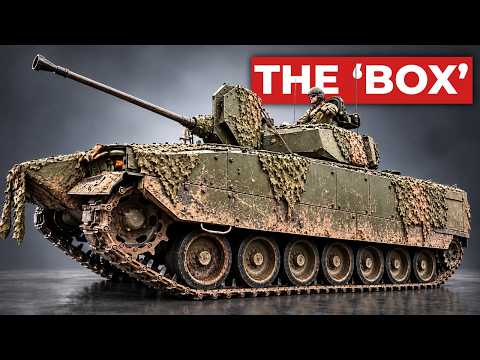
Part One. To understand why the Russian army couldn’t explain what it was seeing at that treeline, you have to realize that by the numbers alone, their assumptions were logical. Russian mechanized doctrine didn’t begin in 2022. It inherited it almost whole from the Soviet Union. And to understand it, we have to go back not to this war, but to 1966 and a vehicle that genuinely changed warfare.
That year, the Soviet Union unveiled the BMP-1. The world’s first true infantry fighting vehicle, a low tracked box that could carry a squad of soldiers, swim rivers, and fire artillery shells and anti-tank missiles. Western armies studied it with something close to panic. It was fast. It was cheap to build in enormous numbers, and it fit a very specific idea of war.
That idea was this. A great mechanized army wins by mass and momentum. You don’t build a small number of precious vehicles. You build a flood of adequate ones. The vehicle is a taxi on the battlefield, a way to push the squad forward under shellfire and keep pace with the tanks. If you lose some, the flood keeps advancing.
The math is the whole point. Follow that math into this war, and at first it looks unbeatable. A Soviet-style fighting vehicle can be produced for a fraction of what the West spends on a single armored vehicle. The modern Western machine Sweden was about to send costs between 9.5 and 13 million dollars each. Put those two numbers against each other, and the Russian plan reaches an obvious conclusion. It can lose many cheap vehicles for every expensive Western one it destroys and still come out ahead. Trade metal for metal, and the side with more metal wins.
There was a second assumption built on the first, and it was just as logical. Western equipment, so the thinking went, is delicate equipment. It’s complex. It’s built by rich armies with clean workshops and long supply lines, and it won’t survive the mud, the cold, and the constant improvisation of a real continental war. Give it to a force under pressure with no spare parts, and it will quietly break itself.
And there was a third assumption beneath both. This particular vehicle was Swedish. Not American. Not German. Not from a major arms exporter. It came from a small neutral country of 10 million people, with a design shaped by empty northern forests, and almost no real combat testing anywhere. Why would a specialized machine from the edge of the map matter on an industrial scale against the second-largest army on earth?
None of this was stupidity, and I want to be careful here, because it’s easy, from the safe distance of hindsight, to mock the losing side, and mockery is always wrong. The Russian model wasn’t madness. It was a rational reading of a century of mechanized war, made by professionals who studied it hard. Mass had won wars before. Cheap numbers had beaten expensive few many times. The model worked. It worked in 1945. It worked, more or less, across decades of careful planning afterward. It worked right up until the morning a Swedish fighting vehicle entered a Ukrainian treeline, and the math quietly stopped matching.
Part Two. The vehicle is called the CV90. Combat Vehicle 90. It was designed in Sweden in the 1980s by Hägglunds, together with the weapons makers at Bofors, and entered Swedish service in the mid-1990s. It had seen combat before Ukraine with Nordic forces in Afghanistan and on peacekeeping missions in Africa, and the version Sweden sent east is the CV9040C, and almost everything that matters about it flows from one design choice the Russian model never made.
It was built, first and foremost, to bring its crew home.
Start with the gun, because it’s the part the enemy learned to fear first. It’s a 40mm Bofors autocannon, adapted from a naval weapon, and it is far heavier than the guns on most fighting vehicles of this size. One defense journalist wrote that it tears a target apart the way a saw tears a branch, but the raw caliber isn’t the secret. The secret is in the ammunition. The Swedish 40mm can fire a programmable shell that the gunner sets to burst exactly where he wants it, over a trench, over a treeline, or in front of an incoming drone. Each round throws fragments across roughly 15 meters. The same gun can also fire an armor-piercing round that punches through the side of a Russian fighting vehicle with ease from long range.
So one turret can shred infantry in their cover, knock a drone out of the sky, and kill a BMP, and switch between those jobs in the time it takes you to move your thumb. Crews call it “the Beast,” and they usually mean the gun. If you’ve only ever fought from a Soviet vehicle, the difference isn’t a small one. It’s the difference between a machine that treats you as something to be consumed and a machine that treats you as something worth protecting.
Because now come the choices that crew at the treeline was sitting inside. The seats don’t bolt to the floor over the fuel and the ammunition, the way they do in Soviet vehicles. They hang from the ceiling and the walls, so when a mine detonates underneath, the shock travels through the hull and not straight up your spine. An inner liner in the armor catches the storm of metal fragments any hit throws off. The whole vehicle is quiet, solid, almost comfortable. Most of it.
One crewman was asked what it feels like inside, and he answered simply: “You feel protected.” The armor is good. It’s warm. None of this is luxury. Every one of those decisions is the same decision, repeated over and over. Protect the crew. Protect the crew. Protect the crew.
It is the exact opposite of the expendable transport, and the men who fought from both recognized the difference immediately. Soldiers of Ukraine’s 21st Separate Mechanized Brigade, a unit built around these vehicles, told their army’s television channel that a single vehicle took as many as five drone hits and stayed in the fight, still moving, still firing.
It isn’t only armor and gun. The CV90 was designed for the marshes and snow of northern Sweden, and it crosses the black glue of eastern Ukraine that swallows heavier vehicles whole. Over its hull, crews cover the machine with a special thermal camouflage called Barracuda, which hides it from the night vision and heat-tracking optics that now dominate the front. A commander with the call sign “Tureto” said it makes the vehicle far harder to see than anything else they drive.
When Ukrainian crews ran an informal contest between the Swedish vehicle and the American Bradley used by a sister brigade, the CV90 was the faster of the two. A company commander named “Neo” explained why his weapon commands such respect. Its shells spread fragments across a wide arc, and its armor-piercing rounds can drive deep through armor. It wasn’t a knockout. Both vehicles have their partisans. But it tells you how much the men who use it value the Swedish machine.
The enemy valued it too, in his own way. The Russians began hunting these vehicles as a priority target. According to Ukrainian crews, in the early days Russian gunners kept mistaking the Swedish vehicle for a tank, because a vehicle this size wasn’t supposed to be this hard to kill, so they engaged it as a tank. On one occasion, crews say, the Russians sent two T-90 tanks to hunt a single fighting vehicle. On others, they dropped an entire volley of Grad rockets on one machine. When the enemy spends a tank to kill your fighting vehicle, he has already told you what he thinks of it.
What the men of the 21st Brigade did with this machine, from Kreminna and Bakhmut to Kupiansk and beyond, changed a war full of expensive Western donations’ view of the value of one small Swedish design. But before we go on, if this deep dive into engineering and armor interests you, take a second and subscribe to the channel. It costs nothing, and it guarantees more work like this keeps coming.
And now, back to the record. Part Three. So where does a machine like this come from? Not from nothing, and not by accident. To understand the CV90, you have to understand the country that built it, because this vehicle is really an argument about people, cast in steel.
Sweden spent the Cold War as a small, heavily armed, neutral country wedged between much larger powers. It couldn’t match anyone in raw numbers. Its entire defensive idea, what Swedes call total defense, started from a hard fact. A nation of a few million cannot afford to treat its soldiers as a flood. Every conscript is a person the state trained and cannot quickly replace, and it is responsible for him. If war ever reached the Swedish forests, Sweden would not win by trading men for ground. It would have to keep its soldiers alive and fighting again and again for as long as that took.
Design a fighting vehicle from that belief and you get something very specific. You get a machine built for marsh and snow and endless northern forest, light enough on its tracks to cross ground that would swallow a heavier vehicle, fast, and arranged with an obsession for the survival of the people it carries. A crew of three, eight in the back, and a compartment designed seat by seat and liner by liner to give all eleven the best possible chance of coming out.
This is the part that turns a national trait into a weapon of world class. And because it was built to be modular, designed from the start to be adapted and re-armed and upgraded, the design didn’t stay a Swedish secret. It sold. And this is the number that tells the whole story. Roughly 1,900 CV90s have now been ordered in 17 versions by 10 European countries, and between them they have driven more than 8 million kilometers. Eight million. This is no curiosity from the edge of the map. It is one of the most chosen fighting vehicles in the Western world, adopted by Norway, Finland, Denmark, the Netherlands, Switzerland and others. Most of them were free to buy anything they wanted, and they chose this.
When Sweden announced its donation to Ukraine in January 2023, one of its ministers described it simply as one of the best fighting vehicles in the country. Now, go back to the math from the beginning, the one that looked unbeatable. The Russian record put a cheap vehicle against an expensive one and concluded that trading metal for metal favors the side with more metal. That’s true as far as it goes. The problem is what it leaves out. It assesses the vehicle and forgets the crew.
When a cheap Soviet vehicle is finished, its crew is often finished with it. And when the expensive Swedish vehicle is destroyed, the crew gets out, again and again, climbs into another, and fights the next morning. The real product of the CV90 was never the vehicle at all. It was the experienced soldier. And the experienced soldier is the one thing a mass army cannot produce in bulk. This, in the end, is why the men who own it will not let it go. It’s also why the enemy couldn’t simply copy the answer. You cannot add survivability to a doctrine built on the opposite assumption. An entire industry, an entire officer culture, an entire idea of what soldiers are for, was organized around the concept of flow. To build the Swedish vehicle, Russia would have had to stop believing in the very thing that made it feel strong. That is not a factory problem. It is a belief problem, and belief is the hardest thing to repair under fire.
And those Swedish designs didn’t shrink because of the war. They were refined by it. While some expected Western manufacturers to grow cautious, the production line in northern Sweden did the opposite. The plant poured in hundreds of millions of dollars, raised its workforce from a few hundred to a few thousand, and set itself a goal that would have sounded absurd a decade earlier. One fighting vehicle ready every working day.
The Czech Republic ordered more than 200. Slovakia ordered over 150. Denmark and Sweden together funded a new batch of the latest model, built specifically for Ukraine. And in the autumn of 2025, Ukraine — which began as a country that simply received a few dozen of these machines — became a full member of the club of nations that own and develop the design. The student became a partner.
If you’re watching this because someone you know follows this war closely, or serves, or works on the machines that fight in it, I’d really like to hear from you in the comments below. If you’ve seen these vehicles or know the crews who operate them, tell us what you know. This kind of history is always best when the people closest to it help write it down.
Part Four. The clearest sign of what the Russians secretly understood wasn’t anything they said. It was what they did with the first vehicle they managed to capture. Because the vehicle isn’t invulnerable, and an honest account has to say that plainly. In late July 2023, near Kreminna, a CV90 was struck in the side at very close range by a rocket-propelled grenade fired from roughly 100 feet away, setting it ablaze. The crew and infantry managed to get out. But the machine did not survive. Russian forces recovered it nearly intact, and then Moscow made a revealing move. They didn’t quietly take the prize to a workshop for study. They put it on public display.
Sergei Shoigu, then Russia’s defense minister, was filmed inspecting the captured vehicle like a war trophy. A senior general paraded before cameras what he claimed were weaknesses in Western equipment — the lack of spare parts and tools, the fragility they had always talked about. They needed to convince their audience that the vehicle was a disappointment. You don’t stage a show like that about equipment you aren’t worried about.
Meanwhile, on the actual front, things weren’t going the way the paper math promised. They hunted it with tanks but it kept coming back to the field. They rained Grad rockets on it but it kept coming back. They threw Lancets and FPV drones and mines at it in numbers that theoretically should have ended the entire small fleet, and yet, again and again, the crew drove it, the machine was recovered and repaired and pushed forward again.
Even a recovery version built on the same hull took a Lancet strike and, in the crew’s words, left only scars on the armor and everyone walked out unharmed. Here is what the Russian model got right and what it got wrong. It was right that the Swedish vehicle was expensive. There were indeed very few of them. The equivalent of a single brigade against a front stretching for hundreds of miles, and the unfamiliar spare parts and ammunition would be a constant headache. On all these points, the Russian math was accurate.
But what they got wrong was the only thing that mattered in the end. They were counting the wrong asset the whole time. Listen to how Ukraine’s own leadership described it. Hanna Maliar, then deputy defense minister, told the story of one of these vehicles in the autumn of 2023. It was protecting infantry from tank fire when a Lancet drone struck it. Not a single crew member or soldier inside was injured. They climbed into another vehicle and went back to continue the fight. Then she said the line at the heart of this whole argument. She said: “If it had been a Soviet vehicle in the same place, no one would have survived.”
Those who make this machine make an even bigger claim. The manufacturer, BAE Systems, stated that to its knowledge, no soldier has lost his life inside a CV90 in Ukraine. This is the manufacturer’s own statement, and no independent count has confirmed it. It’s a claim from an interested party, and it’s worth no more than that. But when compared with everything the crews say, and with what the enemy chose to do with the vehicle it captured, a reality emerges that is hard to argue with. The Russians weren’t really fighting the vehicle. They were fighting the idea that the crew deserves protection, and that idea has proven very hard to kill.
Part Five. So let’s return to the question the war kept asking at that treeline east of Kreminna. Why won’t these soldiers give up this vehicle? Why, of all the machines granted from all the arsenals of the allies, is this the one they refuse to return? The answer isn’t that it’s invincible, because it is beaten. Honest numbers matter, and they aren’t pretty. Of the roughly 50 vehicles Sweden sent, independent analysts have visually confirmed about 27 as damaged, lost, abandoned, or captured over 3 years of the hardest fighting on earth. That’s heavy attrition for a single brigade.
The manufacturer itself admits the older generation of the machine was never designed for mass drone war, and it had to learn that the hard way, like everyone else. A 40mm gun almost unique to Sweden means every round and every spare part is a supply line to be defended. One brigade’s vehicles can’t protect an entire country. All of this is true, and a serious report acknowledges it openly.
And yet, let’s put the two philosophies side by side one last time. The Russian math assessed the vehicle, and by that measure it won many of its encounters. The Swedish math assessed the crew, and by that measure it lost almost no one who mattered. One side built a flood of force and wasted the men it carried. The other built a lifeboat and counted every soul it saved.
When the drone gunner pulled his sight back onto target while his ears still rang, he wasn’t proving the machine couldn’t be destroyed. He was proving the machine could be built to care, in cold engineering terms, whether he lived. That is the difference the crews feel in their hands every day. And that is what they will not surrender. And in it is a justification that has nothing to do with the enemy at all. A design almost unheard of outside Scandinavia, from a small neutral country building for its own survival, fought the worst war of its generation, and earned the loyalty of the people it carried.
The nations that make it are now building it faster than at any point in its history. The soldiers of the 21st Brigade took it to places that destroyed less capable machines, and came back to tell the story. And Deputy Minister Hanna Maliar put in one sentence what an entire spreadsheet left out. In a Soviet vehicle, no one would have survived. So they keep it. They patch the scars in the armor, they care for the wheels and the hoses, they beg Sweden for more ammunition, and then they take it out again the next morning. Not because it doesn’t break, but because when it breaks, it gives their men back alive.
That is the final verdict, and that is why, whatever it costs them, they will never give it back. That is the story of the CV90 in Ukraine. One machine among many in a war still raging. There are many others like it. Other quiet arguments about what a fighting vehicle is really for. If you want to follow these stories with me, stay for the next episode.
So here’s my question for you: if you had to ride into battle tomorrow, would you trust the math of mass or the math of the crew — and what does your answer say about the army you’d want to fight for?
Report this article
Select a reason for reporting:






