The morning air was cold and still as the reconnaissance plane banked sharply, its single engine droning against the silence. Below, hidden in the dense German forest, lay a monster of steel and ambition—a weapon so massive it had its own railway line, so powerful it could punch through seven meters of concrete. The pilot’s heart pounded as he lined up his shot. One bomb. That’s all he had. That’s all it would take.
But this story doesn’t begin with a bomb. It begins with a gun so audacious, so absurdly huge, that it demanded 2,000 soldiers just to fire a single shot. The Germans called it Dora. The barrel alone stretched 32 meters—taller than a ten-story building. Each shell weighed seven tons, a projectile of steel and explosives that could travel 48 kilometers and obliterate an underground depot buried 30 meters beneath the earth. Nothing else on the planet could touch such a target.
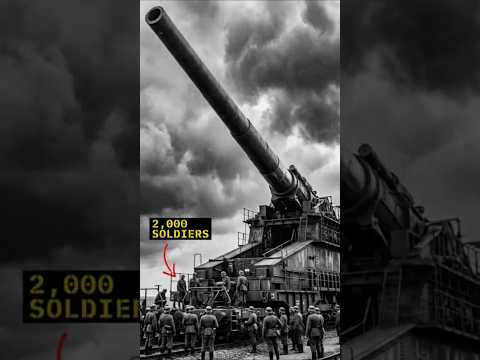
To move Dora, they needed 60 railway cars. To assemble it, a week and 2,500 workers. To fire it once, a crew of 2,000 soldiers. Every shot was a logistical nightmare, a symphony of coordination that consumed men and material on an industrial scale. Yet the Germans were proud. They called it the greatest engineering achievement of the war, a testament to their ingenuity and power.
But pride, as they say, comes before the fall. Dora was a marvel of destruction, but it was also a sitting duck—a massive, unmovable target that demanded an entire railway network to function. It was a weapon designed for a war of static fronts and sieges, not the fluid, fast-moving battles that would come to define the conflict.
By early 1945, the tide had turned. The Allies were pushing deeper into German territory, and every day brought new reports of enemy movements. Dora had been deployed to the Eastern Front, but its presence there was more symbolic than strategic. It fired a few shots, but its impact was minimal. The Germans, however, remained convinced of its invincibility. They had no idea that a single reconnaissance plane was about to change everything.
On that fateful morning, the pilot spotted the gun’s massive silhouette through the trees. He radioed back to base, his voice steady despite the adrenaline coursing through his veins. “Target confirmed. It’s the Dora.” The order came back almost immediately: destroy it. He had one bomb, a single chance to end the greatest gun in human history.
As he dove toward the target, the gun crew below scrambled in panic. They had never expected an attack from the air—not here, not now. The plane released its bomb, and for a moment, time seemed to hang suspended. Then the explosion ripped through the forest, a thunderous roar that echoed for miles. Seven years of engineering, 2,000 soldiers, 60 railway cars—all gone in four seconds.
The smoke cleared, and where Dora had once stood, there was only twisted metal and a crater. The greatest gun ever built had been silenced before it could fire a single shot on the Western Front. But the story doesn’t end here. The men who built it, the soldiers who crewed it, and the pilot who destroyed it—their lives would never be the same. And the war, still raging, had one less monster to fear.
The pilot pulled back on the stick, his engine screaming as he climbed away from the burning wreckage. Below him, secondary explosions rippled through the forest—fuel tanks, ammunition, and something else. Something that made the ground shudder even at altitude. He didn’t look back. He didn’t need to. The radio crackled with confirmation: direct hit.
But on the ground, the truth was messier than the after-action report would ever admit. Dora hadn’t been destroyed by a single bomb—not really. The bomb had struck the loading crane, and the resulting fire had spread to the ammunition storage. The gun itself, that 32-meter barrel of forged steel, had cracked but not shattered. It could have been repaired. Given enough time, enough men, enough steel.
There was no time. The Red Army was advancing from the east, and the Western Allies were pushing through the Rhineland. The Germans made a choice. They blew up what remained of Dora themselves, scuttling the gun rather than letting it fall into enemy hands. The same engineers who had spent seven years building it now spent four hours planting charges along its spine.
One of those engineers was a man named Friedrich. He was fifty-three years old, with hands that had forgotten how to do anything but machine precision steel. He had watched Dora’s birth from the first blueprint to the final test firing. He had believed in it. Now he stood in the cold morning air, a detonator in his hand, and wondered what he had actually built.
The charge went off at noon. The barrel split like a rotten log, the metal peeling outward in long, jagged strips. Friedrich felt the blast in his chest, a physical blow that knocked the breath from his lungs. He didn’t cheer. Neither did the soldiers around him. They just stood there, watching the smoke rise, as if they were witnessing a funeral.
What none of them knew—what none of them could have known—was that Dora had already fired its most important shot months earlier, on the Eastern Front. Not at a fortress or a bunker, but at a city. Sevastopol. The shell had landed near a harbor, and the explosion had been so violent that it cracked the foundations of buildings three streets away. Dozens died. Hundreds more were wounded. And the gun had been aimed at a target that wasn’t even military.
The men who fired that shot never spoke of it afterward. They had been told it was a strategic strike. They had been told it would shorten the war. It hadn’t. It had only added to the ledger of destruction that Dora had been built to write.
Now, as Friedrich watched the smoke drift over the German forest, he thought about the shell. He thought about the seven tons of steel, the forty-eight kilometers of flight, the moment of impact. He thought about the fact that the greatest engineering achievement of the war had been used to kill people who had never seen it coming.
He dropped the detonator in the mud and walked away. Behind him, the gun that had demanded 2,000 soldiers and 60 railway cars and seven years of his life was nothing but scrap. The war would go on for another three months. Friedrich would survive it. But he would never build anything again.
Friedrich’s story might have ended there, swallowed by the ash of a weapon he could no longer believe in. But the men who crewed Dora did not simply vanish when the smoke cleared. They scattered across a collapsing Reich, carrying with them the strange, heavy knowledge of what they had operated. Some deserted. Some surrendered. Some fought on out of habit or fear, because stopping felt more terrifying than dying.
One of them was a young gunner named Erich, twenty-two years old, who had spent eighteen months of his short life learning to load a seven-ton shell into a barrel taller than a church steeple. He had never actually fired a shot in anger. His crew had trained, drilled, rehearsed—but the orders never came. Dora sat. Dora waited. Dora became a monument to a war that had already moved past it.
When the scuttling charges blew, Erich was half a kilometer away, guarding a supply depot that no longer had anything worth guarding. He felt the blast, saw the plume of black smoke rise above the treeline, and understood immediately what it meant. He sat down on a crate of expired rations and cried. Not for the gun. For the years he had given it.
What Erich didn’t know—what almost no one knew—was that Dora’s story had a strange, almost poetic coda waiting for it in the archives of the Soviet Union. When the Red Army overran the site weeks later, they found the wreckage and catalogued it with the same grim efficiency they applied to everything. Photographs were taken. Measurements recorded. A report was filed and buried in a vault in Moscow, where it would sit forgotten for decades.
That report contained a single detail that the Germans had never publicized. Dora’s most devastating shot—the one that struck Sevastopol—had not been aimed by a German officer at all. The firing solution had been calculated by a captured Soviet engineer, a man named Pavel, who had been given a choice: compute the trajectory or watch his family die. He had chosen to compute.
Pavel survived the war. He never spoke of what he had done, not to his children, not to his wife. But in 1962, on a night when he could not sleep, he wrote it all down in a notebook and hid it inside a hollowed-out copy of a mathematics textbook. The notebook would not be found until 1989, when his grandson was cleaning out the attic of the family dacha.
By then, the world had moved on. The Cold War was ending. Dora was a footnote in military history, a curiosity for engineers and weapons enthusiasts. But the notebook told a different story—a story of a man who had been forced to help build a monster, and who had spent the rest of his life trying to forget the math.
Friedrich never learned about Pavel. Erich never learned either. They lived out their lives in a divided Germany, one in the West, one in the East, both carrying the same weight without ever knowing the other existed. The gun had connected them all—builder, gunner, captive, pilot—in a chain of consequence that stretched across decades and borders.
And somewhere in that chain, buried in the wreckage of a forest in 1945, was the truth that no one wanted to say aloud: the greatest gun in human history had never really been about engineering or strategy or pride. It had been about fear. The fear of a regime that knew it was losing, building bigger and bigger weapons to drown out the sound of its own collapse.
Dora was gone. But the fear that built it—that fear was still out there, waiting for the next blueprint, the next barrel, the next seven tons of steel.
Erich never fired a shot. Neither did the gun that defined his youth. But the fear that built Dora did not die with the Reich. It simply changed uniforms, changed flags, changed the names of its enemies.
In the decades that followed, engineers in other countries built other monsters—smaller, smarter, deadlier. They called them missiles. They called them deterrence. They called them peace. The language changed. The math did not.
Friedrich died in 1971, a quiet man in a quiet town, never speaking of the barrel that split like a rotten log. Pavel’s notebook gathered dust in a dacha attic until a curious grandson opened it and felt the weight of seven tons of steel in a single sentence.
And somewhere, in a vault in Moscow, a report still waits—photographs, measurements, a catalogued wreck. Proof that the greatest gun in history was destroyed before it ever truly fired. Or was it?
What do you think—was Dora a weapon of war, or a monument to fear? Let me know in the comments.
Report this article
Select a reason for reporting:






