September 1942, Owen Stanley Range, Papua New Guinea. The Japanese South Seas Force had stormed through the Pacific without a single defeat—Singapore, Rabaul, the Philippines, Guam—and now they stood just 32 miles from Port Moresby, close enough to put Australia itself within bombing range. In their way: the 7th Australian Division, men with no jungle training, still dressed for the deserts of North Africa, riddled with malaria and dysentery. How did these ordinary farmers and clerks become the first ground force in World War II to break Japan’s elite army?
Rain falls in heavy sheets through a thick green canopy. High on a muddy ridge called Ioribaiwa, an Australian sergeant from the 2/14 Battalion crouches in a shallow pit. His uniform is torn, his boots full of water. He hasn’t eaten a real meal in five days. His hands shake from a fever he cannot shake off. He looks down through the trees and far away makes out tiny pinpricks of light. Those lights are Port Moresby. They are only 32 miles away. If those lights go out, Australia itself may be next.
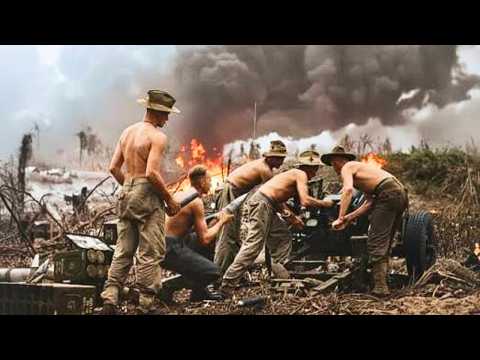
Behind him, fewer than 300 men are still able to stand and fight. They lean on bamboo sticks because they are too weak to hold their rifles up for long. Many have lost 30 pounds. Many have malaria, dysentery, or both. They came to this jungle straight from the deserts of the Middle East, still wearing khaki uniforms made for sand, not mud. In front of him, somewhere in the dripping jungle, a Japanese army is moving closer. Not just any army—this is the Nankai Shitai, Japan’s South Seas Force. They are some of the best jungle fighters in the world. They have not lost a single battle since the war in the Pacific began.
This is the story of how that broken, sick, starving group of Australians did the impossible. This is how the 7th Australian Division broke Japan’s elite forces.
You came here to find out how a few thousand farmers, shop boys, and office clerks stopped the unstoppable. That is exactly the story you are about to hear.
To understand why this moment mattered, you have to understand what was happening in the world. By the middle of 1942, Japan was winning everywhere. In just six months, they had stormed across the Pacific. They took Singapore, the most powerful British base in Asia, forcing around 130,000 Allied soldiers to surrender. Then Japan rolled through Malaya, the Philippines, the Dutch East Indies, Guam, and Rabaul. Each victory came faster than the last. Many Allied troops believed the Japanese could see in the dark, climb any tree, and march for days without food or rest.
In May 1942, the Japanese Navy tried to sail to Port Moresby and take it from the sea. American and Australian ships stopped them at the Battle of the Coral Sea. So Japan tried something no one thought was possible: they would march to Port Moresby by land, over the Owen Stanley Mountains, on a thin strip of mud and rocks called the Kokoda Track. Allied planners had looked at that track and called it impassable. Japan was about to prove them wrong.
If Port Moresby fell, the danger was huge. Japanese bombers would reach the cities of northern Australia. Australian Prime Minister John Curtin had already said something no one expected from a leader of the British Empire: that Australia now looked to America for help. Mothers in Sydney and Melbourne went to bed at night wondering if invasion was coming.
So picture that ridge again. Picture that sergeant soaked and shaking. Behind him is his country. In front of him is an army that has crushed every other army it has ever met. The Japanese commander, Major General Tomitaro Horii, can almost taste victory. His men can see those same lights too. They are sure they will be in Port Moresby in a matter of days. But something is about to go wrong for Japan. And it will not happen because of bombs from the sky or fresh American tanks. It will happen because of these men on this muddy ridge in this rain.
So the question is simple: How did these starving, sick, forgotten Australians stop the army that no one else in the world had been able to stop?
To understand how these men ended up in the jungle, you have to go back to the beginning. The 7th Australian Division was born in 1940. It was made up of volunteers—every single one. They were farmers from Queensland, dock workers from Sydney, sheep shearers from the Outback, and shop clerks from quiet country towns. They were part of the Second Australian Imperial Force, or Second AIF. The division had three brigades—the 18th, the 21st, and the 25th—each with about 3,000 men.
Their first real fight was not in the jungle at all. It was in the dry hills of Syria and Lebanon in June and July of 1941, against French troops loyal to the German-controlled Vichy regime. The 7th Division pushed through towns like Damour and fought their way toward Damascus. They were tough, proud, and battle-tested. After Pearl Harbor and the fall of Singapore, Australia begged for them to come home. They were rushed back across the world. They had trained for desert war. Now they were about to be thrown into a wet, green hell. Most had never seen a rainforest in their lives.
The leaders mattered just as much as the men. Major General Arthur Allen, known as “Tubby,” was their commander when the Kokoda fighting began. He was quiet, careful, and steady. His men loved him. Later, Major General George Vasey would take over—sharper, faster, more aggressive. There was Brigadier Arnold Potts of the 21st Brigade, who would have to fight the first big battle on the track with almost nothing. And above them all stood General Thomas Blamey, the top Australian commander, being squeezed by the famous American General Douglas MacArthur in Brisbane.
Now meet the enemy. The Nankai Shitai was led by Major General Horii. The heart of his force was the 144th Infantry Regiment, called the Kochi Regiment. These men had spent years fighting in China. Horii also had the 41st Infantry Regiment plus mountain artillery units. At their peak, around 13,500 Japanese soldiers were on or near the track. Their plan was simple: move fast, slip around the enemy, surround them, wipe them out. They had done it everywhere else.
But there was a third enemy on the Kokoda Track, and this one had no flag. It was the land itself. The track was a thin trail of mud that snaked 96 kilometers—about 60 miles—through some of the worst land on Earth. The mountains rose more than 7,000 feet. Some areas got more than 250 inches of rain a year. Malaria, dengue fever, scrub typhus, and dysentery struck men down faster than bullets. There were no roads, no trucks. Every bullet, biscuit, and bandage had to be carried by hand on the backs of brave Papuan porters who became known as the Fuzzy Wuzzy Angels, or dropped from low-flying planes.
Before the 7th Division arrived, the only force standing in Japan’s way was the 39th Battalion—young militia boys from Victoria, hardly trained at all. The tough AIF veterans had laughed at them and called them “chocolate soldiers.” But those boys held on at a tiny mountain village called Isurava. They bled. They died. They held. And they bought just enough time for the men of the 7th Division to climb the track. The real fight was about to begin.
By August 1942, the news was getting worse by the hour. The Japanese had pushed past Australian outposts at Awala, Kokoda, and Deniki. Now the men of the 21st Brigade were being rushed up the track to plug the hole. They came straight off the ships. Some had not even been issued jungle gear, still in the dusty khaki shirts and shorts they had worn in the Middle East.
The first big test came at Isurava between August 26th and August 31st, 1942. The 2/14th and 2/16th Battalions arrived under heavy rain. The jungle was so thick men could not see ten feet ahead. Mortar shells came whistling down through the trees. The smell was a mix of wet leaves, rotting wood, gunpowder, blood, and unwashed men. Soldiers fought at distances of five or ten paces. They could see the enemies’ eyes. They could hear them breathing.
It was during this fight that a young soldier named Bruce Kingsbury did something no one who saw it ever forgot. The Japanese had broken through a weak spot in the line. Kingsbury grabbed a Bren gun, jumped up, and charged straight at the enemy. He fired from his hip as he ran. He cut down many Japanese soldiers and broke their attack. Moments later, a sniper shot him dead. He was 24. He would be given the Victoria Cross—the first one ever earned in the defense of Australian territory.
But brave deeds alone could not stop a force four or five times larger. So Brigadier Potts gave a hard order: fall back, fight, fall back again. This was called a fighting withdrawal. For more than 60 kilometers, the men of the 21st Brigade pulled back ridge by ridge. They fought at Eora Creek, at Templeton’s Crossing, on a sharp peak called Brigade Hill. Every step backward was paid for in blood.
The conditions broke men faster than the bullets did. Dysentery was so bad that some soldiers cut the seats out of their trousers. Many lost more than 30 pounds in just a few weeks. Their faces turned yellow from Atabrine, the medicine that fought malaria. Their feet rotted inside their wet boots. They were down to half a hard biscuit a day. One soldier wrote, “We are like ghosts. We carry the dead in our eyes.”
The Japanese were suffering, too. Captured letters told a strange story. One Japanese soldier wrote, “We are fighting in a green hell. The Australians give no ground without making us pay for every meter.” Their supply lines were stretched too far, but Horii pushed his men forward anyway.
Far away in Brisbane, MacArthur was furious. He could not understand why the Australians kept falling back. He told his staff that “the Australians won’t fight.” It was an unfair thing to say. He had no idea what those men were going through. By the middle of September 1942, the brigade that had started at full strength of about 2,000 men had fewer than 300 still able to stand. The Japanese, even with their losses, kept coming. They climbed onto Ioribaiwa Ridge—the last high ground before the city. The whole campaign now hung on a single, fragile thread.
And then, on September 16th, 1942, something amazing happened. The Japanese stopped. Horii looked toward Port Moresby, so close he could almost touch it, and gave the order no Japanese commander wanted to give: Halt. Dig in. Wait.
The reasons piled up like stones. Their supply line had snapped—some soldiers were down to one rice ball a day, eating leaves and grass. Far to the east at Milne Bay, Australian troops had crushed a Japanese landing force, the first time in the Pacific War a Japanese ground attack was beaten back into the sea. And Tokyo had decided Guadalcanal mattered more. Horii was on his own. For the first time in the entire war, a Japanese army on the attack had been stopped on land.
Now the 7th Division pushed forward. At Oivi-Gorari, Vasey sent part of his force wide around the Japanese flank, and when the trap snapped shut, the proud South Seas Force shattered. Eight days later, Horii himself drowned trying to cross the flooded Kumusi River, shouting “Tenno Heika Banzai!” as the water pulled him under. Captured diaries said what no one had ever read before: “We who were never to retreat are retreating. We who were never to be defeated are defeated.”
The unbeaten army had turned and run. A single slouch hat lies in the mud at Isurava, and that is enough. But tell me—when you stand on that ridge today, what do you think those four words carved in granite ask of us?
Report this article
Select a reason for reporting:






