The color film flickers to life, and for a moment, the war looks almost like a holiday. German soldiers lounge on the steppe, playing cards, grinning for the camera, their sleeves rolled up under a blazing sun. They are confident—arrogant, even—as they bridge rivers and pose with their weapons. The enemy, they believe, is already beaten. Ahead lies only Stalingrad, a name that will soon echo through history as the graveyard of their invincibility.
But this is not the story of a triumphant march. It is the story of the calm before the storm—the most destructive storm of the Second World War. And these rare color frames, captured by cameramen like Hans Bastanier, offer a chilling window into the moment when everything still seemed possible.
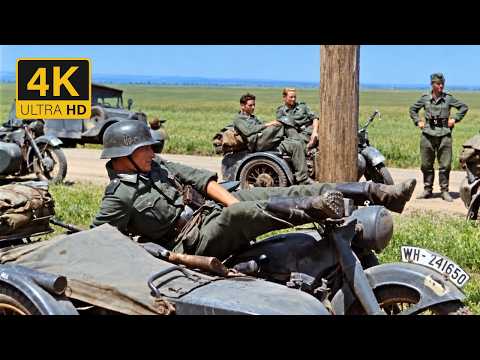
The German strategy in the summer of 1942 was a masterpiece of mobile warfare: maximum maneuver, minimum direct engagement. Armored spearheads raced across the open plains, bypassing strongpoints, encircling Red Army formations, and leaving them to wither behind the lines. The Luftwaffe ruled the skies, pounding Soviet defenses into dust, while engineers threw pontoon bridges across rivers that had once seemed like barriers. The Don, the Volga—they were just lines on a map, obstacles to be crossed.
Soviet resistance, though desperate, appeared futile. After the catastrophe at Kharkov, the Red Army had lost hundreds of thousands of men, thousands of tanks, and most of its air force. By July, over 1,200 aircraft had been destroyed on the Southwestern Front alone—many of them on the ground. The Germans advanced almost at will, and the road to Stalingrad lay wide open.
Yet beneath the surface of this seemingly unstoppable advance, something was shifting. The Soviets were not merely retreating—they were evacuating factories by the thousands beyond the Urals, producing 3,000 tanks a month, and mobilizing millions. Order No. 227, “Not a step back,” issued on July 28, 1942, was not born of confidence but of existential despair. There was nowhere left to retreat.
As the German Sixth Army pushed toward the Volga, it met resistance that grew fiercer with every mile. The open steppe offered no cover, but the Soviets turned every ravine into a fortress, every village into a strongpoint. The 62nd and 64th Armies, though battered, fought with a tenacity that stunned the Wehrmacht. At the Don bend, near Kalach, the Germans would soon discover that their easy crossings had been a prelude to a bloodbath.
By late August, the first German tanks reached the Volga. On August 23, the 14th Panzer Corps crossed the Don and seized Spartanovka, a northern suburb of Stalingrad. The city was now cut off, and the siege—a battle that would last more than five months and consume over a million lives—had begun.
But the story of Stalingrad is not just one of German hubris. It is also the story of a nation that refused to break, of factories that churned out victory from the ashes of defeat, and of soldiers who fought for every inch of rubble. The machines that would soon encircle the Germans—the T-34s, the Il-2 Sturmoviks—were already rolling off the assembly lines. The tide was about to turn.
In the next part, we will follow the German columns as they enter the city itself, where the real nightmare begins. The streets of Stalingrad will become a maze of death, and the confidence captured in these color frames will give way to desperation, starvation, and the slow, grinding annihilation of an entire army.
The cameras kept rolling as the first German patrols edged into the northern suburbs. The footage is grainy, the colors bleeding into one another, but the mood is unmistakable. Soldiers who had laughed on the steppe now moved in crouched, hesitant files, their eyes fixed on the shattered apartment blocks ahead. The open plains had offered them speed and safety. The city offered neither.
What the cameramen captured in those early September days was the death of a certain kind of war. The panzers that had raced across the steppe now crawled through streets choked with rubble, easy prey for anti-tank teams hiding in cellars. Chuikov’s 62nd Army had orders to hold the city at any cost, and they turned every factory, every stairwell, every sewer into a killing ground. The Germans called it Rattenkrieg—the rat war—and the name stuck.
By mid-September, the fighting had shifted to the Mamayev Kurgan, the hill that dominated the city’s skyline. Both sides understood that whoever held the heights held Stalingrad. The hill changed hands so many times that the bodies of the dead were never buried—they simply became part of the earthworks.
It was here that the German infantryman’s war became something no training had prepared him for. In the ruins of the Red October factory, soldiers fought room to room, sometimes floor to floor, with grenades and bayonets and bare hands. The front line was measured not in kilometers but in meters—sometimes in the width of a single wall.
The Luftwaffe, which had once cleared the way with ease, now found itself bombing its own positions as the lines dissolved into chaos. Stukas dove on buildings that had been German-held an hour earlier. Pilots could no longer distinguish friend from foe in the smoke and dust that hung over the city like a shroud.
And still the Germans came, driven by the belief that one more push would break the Soviet defense. Division after division was fed into the meat grinder—the 71st, the 295th, the 100th Jäger. By October, the Sixth Army had suffered over 40,000 casualties in the city alone, and still the Volga remained just out of reach.
Across the river, the Soviets were not merely holding on. They were preparing something the Germans could not yet see. Under the cover of darkness, entire armies were being ferried across the Volga—the 13th Guards, the 284th Rifle Division, fresh troops with orders to fight for every brick. The city was bleeding, but it was not dying.
In the next part, we will follow the men who fought in the cellars and the sewers, where the war became something ancient and primal. And we will see how the very confidence captured in those early color frames curdled into something far darker: the realization, creeping through the German ranks, that Stalingrad was not a prize to be won but a trap that had already closed.
The German assault on the Mamayev Kurgan began with a barrage that turned the hill into a volcano of earth and steel. Wave after wave of infantry surged up the slopes, only to be met by a hail of bullets from Soviet riflemen entrenched in the reverse slopes. The fighting was so close that soldiers could hear each other breathing, cursing, dying. By nightfall, the hill was a moonscape of craters and corpses, and still neither side could claim it.
In the city itself, the battle had devolved into something the German command barely understood. Chuikov’s order was simple: cling to the Volga bank, fight for every building, every floor, every room. The 62nd Army was cut off from the rest of the front, supplied only by boats that ran the gauntlet of German artillery and Stukas. Yet those boats kept coming, bringing ammunition, food, and fresh troops—and taking back the wounded.
The Germans called it the Rattenkrieg, and the name was apt. In the ruins of the Red October factory, soldiers fought in darkness lit only by muzzle flashes, the air thick with dust and the stench of death. Tanks could not maneuver in the rubble; they became stationary pillboxes, picked off one by one by Soviet anti-tank teams. The Luftwaffe, which had once ruled the skies, now hesitated to bomb its own troops, so fluid was the front line.
It was in these weeks that the color film captured something new: the faces of German soldiers who had once grinned for the camera now stared hollow-eyed at the ruins. They no longer posed with their weapons; they huddled in cellars, waiting for the next Soviet counterattack. The cameramen, too, seemed to sense the shift—the footage grew shorter, more furtive, as if they were filming their own doom.
By early October, the German Sixth Army had suffered over 40,000 casualties in the city alone, and still the Volga remained just out of reach. Paulus, the army commander, requested reinforcements, but none came—Hitler had diverted them to other sectors, convinced that Stalingrad was on the brink of collapse. It was a fatal miscalculation.
Across the river, the Soviet Stavka was preparing a counteroffensive of staggering scale. Under the cover of darkness, entire armies were being ferried across the Volga—the 13th Guards, the 284th Rifle Division, fresh troops with orders to fight for every brick. The city was bleeding, but it was not dying. And in the cellars and sewers, the men of the 62nd Army held on, knowing that help was coming.
In the next part, we will follow the men who fought in the cellars and the sewers, where the war became something ancient and primal. And we will see how the very confidence captured in those early color frames curdled into something far darker: the realization, creeping through the German ranks, that Stalingrad was not a prize to be won but a trap that had already closed.
The trap was sprung on November 19, 1942. Operation Uranus unleashed a million Soviet soldiers, backed by 900 tanks, against the weak Romanian flanks. The Sixth Army, still fighting in the rubble of Stalingrad, never saw it coming.
Within four days, the pincers met at Kalach, sealing the encirclement of some 300,000 Axis troops. Paulus pleaded for permission to break out, but Hitler refused: “Stalingrad must be held at all costs.” The Luftwaffe promised an air bridge; it delivered a fraction of what was needed.
Inside the pocket, the color film grew darker. Soldiers who once posed for cameras now burned their letters and ate their horses. The confident grins from the steppe had vanished, replaced by frostbitten faces and hollow eyes.
By January 1943, the Soviets had squeezed the pocket to a few square miles of ruined city. On February 2, Paulus surrendered—the first German field marshal to do so. The cameras captured the end: columns of ragged prisoners stumbling through the snow, their invincibility shattered.
The color frames from those final days show a different army entirely. No more playing cards, no more posing with weapons—just silent, defeated men trudging toward a future they could not imagine. The cameras kept rolling, even as the Reich they served began to crumble.
What do you think those cameramen felt as they filmed the beginning and the end of the same doomed army?
Report this article
Select a reason for reporting:






