On August 6, 1945, the world changed forever. A blinding flash, a deafening roar, and then silence—a silence more terrifying than any sound. In the heart of Hiroshima, thousands of people were instantly transformed into shadows, their bodies vaporized by a heat hotter than the sun. Those who survived found themselves in a landscape of nightmares, where the living envied the dead.
This is the story of the walking ants—the name given to the countless survivors who, stripped of their skin, their dignity, and their hope, shuffled through the ruins in a trance-like procession. Their bodies were burned beyond recognition, their eyes empty, their minds shattered. They moved like insects, driven by a primal instinct to survive, yet already dead in spirit.
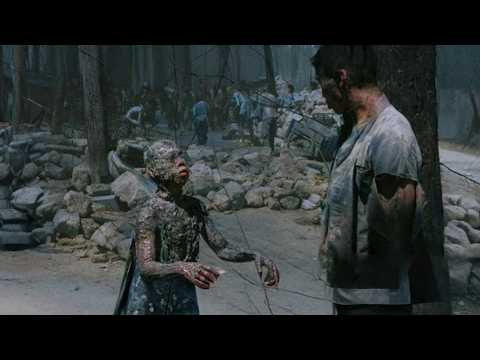
Among them was a 14-year-old boy named Akahiro. He had been walking along the tram tracks when the bomb fell, and by some miracle, he was still alive. But as he looked around, he saw that the world had turned to ash. Twisted tram cars, charred bodies, and a sky dark with smoke. It was then that he heard a voice calling his name—a childhood friend. But when he turned, he saw a figure so disfigured that it barely resembled a human. His friend’s teeth were falling out, his belly dark with purple blotches, and he vomited a thick gray substance. Akahiro realized that this was not a rescue; it was a death march.
As he stumbled forward, Akahiro saw horrors that would haunt him forever: a woman with an eye hanging from its socket, a dead horse flayed of its skin, its muscles glistening. And then, the image that would never leave him—a young mother, her body completely skinned, yet beside her, a baby still cried, alive but charred. Akahiro ran, but the ghostly figures followed, more dead than alive, but still walking.
Not far away, a woman named Mrs. S had been tending her garden when the sky lit up. Miraculously, she and her 2-year-old daughter survived without a scratch. But as she emerged from the rubble, she saw a man running toward the smoke. He was thin, covered in ashes, and with each step, he made a rhythmic metallic click, like tap dancing. Only when he came closer did she realize the truth: the man had no feet, only two stumps of white bone striking the hot asphalt. The sound was the bones shattering with every step. He ran until he disappeared into the smoke, taking the sound of tap dancing straight from hell.
Meanwhile, a foreign missionary known only as Father M had been preparing for his day when he heard the drone of two planes. He remembered no flash, only waking to an apocalyptic scene. A crowd of nearly naked people, covered in wounds, walked in silence. In front of him, a man’s skin hung from his back like strips of soaked cloth, his arms so burned that the bones were visible. Father M followed, unknowingly leading a line of survivors. Then he saw a building—the only one still standing—with three naked children screaming from the top. One seemed bathed in blood. He never knew their fate, but their screams echoed in his dreams for the rest of his life.
The horror did not end with the initial blast. A black rain began to fall, thick with radioactive dust and soot. It brought temporary relief but carried silent death. Many survivors who escaped the bomb eventually succumbed to radiation sickness. Thirst became a scourge; people drank contaminated water, their bodies dissolving from within.
One man, a naval designer named Swami, had been thrown into an irrigation ditch by the blast. His left arm was burned to a crisp, the skin like overroasted chicken. He ran to a river and drank, only to notice the bodies floating there had absurdly long arms—the flesh had melted and slid down, clinging only by the fingertips. On the riverbank, he saw children with black glass shards embedded in their flesh. He tried to help, but one by one, they collapsed and died.
As the days passed, the living envied the dead. A mother walked across a partially destroyed bridge, carrying her severely burned son. The bridge gave way, leaving them stranded above the murky waters. Her anguish grew, but she held on, begging for a miracle.
A soldier named Nishioa was stationed outside the city when he felt the earth tremble. He saw the mushroom cloud rise and then a train appear on the horizon—a train of death. The windows were shattered, and inside, the passengers were burned to the bone. Some were still alive, their faces frozen, staring with empty eyes. The engineer hung from the locomotive window, vomiting a thick yellowish foam. The soldiers stopped the train and decided to continue to Hiroshima. Along the tracks, an endless line of people walked, fleeing the city. They murmured one word: “Water. Water.” They moved mechanically, like ants. Nishioa watched in silence as the locomotive advanced through the wreckage of a city that had ceased to exist.
These are the stories of the ant walkers—the survivors who walked through hell and lived to tell the tale. But their suffering was far from over. The physical and psychological scars would last a lifetime. And as the world struggled to comprehend the magnitude of the destruction, the ant walkers continued their silent march, carrying the weight of history with every step.
But the walking ants were not the only ones whose lives were shattered that morning. In a bank just 250 meters from the epicenter, two young women named Ako and Asami were beginning their workday when the world turned white. The granite walls shielded them from the flash, but the shockwave hurled Asami against the wall like a rag doll. Ako felt her lungs crush from within, the air ripped from her chest.
When they finally stumbled outside at 8:25, the sky was black with smoke, and the streets were paved with corpses. Ako saw a man standing upright, a carbonized statue still clutching the handles of a cart. Inside the cart, two small children lay curled together, their bodies baked into charcoal. Beside her, a severed hand burned like a candle, fat dripping from the fingers to feed the flames.
Then the black rain began. They lifted their faces and drank, desperate for moisture, not knowing that every drop was poison. Asami survived only a few days before radiation sickness took her. Ako lived, but she would never forget the taste of that rain—bitter, oily, and lethal.
Thirteen-year-old Yoshikata had been trapped in an air pocket beneath his collapsed school. When he clawed his way free, he saw the mushroom cloud devouring the sky. All around him, burned hands reached up from the rubble, clinging to his ankles, begging for help. He was just a boy. The terror was too much. He pulled free and ran, the cries of his classmates chasing him into the smoke.
Not far away, a young soldier named Shigo Shimoyama had been pinned to a warehouse wall by loose nails. He tore himself free and staggered outside, where he witnessed something surreal: government officials carrying a full-body portrait of the emperor through the flames. A military boat on the river stopped, and the crew stood at attention, saluting the image. Even the wounded turned and bowed their heads. In the midst of annihilation, the old order demanded its due.
Then Shigo saw the horse. It stood there, completely flayed, its raw pink flesh exposed to the air, its skin torn away by the pressure wave. It did not seem to feel pain. It simply followed him with its eyes, desperate and humanlike, as if begging for help he could not give.
Another boy, burned in the throat and mouth, could not speak. He communicated only through gestures, his eyes screaming what his voice could not. He asked for water with trembling hands, and those who passed understood without a word. His silence was louder than any cry.
By nightfall, the city was a graveyard of the living. In the river, bodies floated with arms stretched impossibly long, the flesh melted and dangling from the bone. On the banks, children sat motionless, their backs studded with black glass shards like porcupine quills. One by one, they slumped forward and did not rise again.
And still, the procession continued. The ant walkers shuffled through the ruins, their eyes fixed on nothing, their feet carrying them toward a horizon that held no promise. Behind them, the fires burned. Ahead, only smoke. And in between, the silence of a world that had learned what humanity was capable of.
Years later, the survivors would speak of a strange phenomenon: the way the human mind clings to small details when the world collapses. Ako remembered the taste of the black rain, yes, but also the way a single blade of grass had survived in the bank’s courtyard, green and trembling amid the ash. She would water it with the last drops from her helmet, a silent ritual of defiance.
Mrs. S never told her daughter about the tap-dancing man. But sometimes, on quiet evenings, she would catch herself staring at the girl’s bare feet as she ran through the house, and she would shudder without knowing why. Some sounds live in the bones, not the memory.
Father M returned to his order a broken man. He spent his remaining years teaching children in a small village far from Hiroshima, never speaking of what he had seen. But every August 6th, he would wake before dawn and sit in the garden, waiting for a flash that never came. The three children on the building—he never learned their names. He never tried.
Akahiro grew up and became a watchmaker. He said it was because he wanted to understand how small things held together. His shop was filled with ticking clocks, each one a tiny heartbeat against the silence. He never spoke of the walking ants, but he kept a photograph of his childhood friend on the wall—the boy whose teeth had fallen out one by one.
The city rebuilt itself. New buildings rose, trees were planted, and the Otagawa River flowed on as if nothing had happened. But the ant walkers carried their memories like stones in their pockets. They formed associations, shared their stories, and slowly, painfully, taught the world what had happened.
Swami, the naval designer, lived to be 89. He never ate chicken again. The sight of roasted skin, he said, was too close to the truth. He spent his final years writing letters to schoolchildren, answering their questions about the bomb with a patience that surprised even him.
Nishioa, the soldier who had watched the train of death, became a teacher. He told his students about the walking ants, about the silence of the locomotive, about the engineer vomiting foam from the window. “They were not ants,” he would say, his voice steady. “They were people. And they walked because they refused to fall.”
But the most haunting legacy belonged to the children—the ones who had lost their parents, their voices, their futures. Twelve thousand orphans. Some were adopted, some raised by relatives, some left to fend for themselves in a city of ruins. They grew up with scars that no one could see.
And yet, amid the ash, there were moments of grace. A woman who found her husband alive beneath a collapsed wall. A doctor who worked for three days without sleep, saving dozens of lives. A child who shared a single sip of water with a stranger, not knowing it would be the last kindness either of them would receive.
Pelgro wrote that the story of Hiroshima is not just a story of death. It is a story of survival, of the human spirit refusing to be extinguished. The walking ants were not ghosts. They were witnesses. And as long as their stories are told, the world will remember what happened on that August morning.
So when you look at the photographs—the shadows burned into stone, the twisted metal, the empty eyes—remember that behind every image is a person who lived, who suffered, who walked through hell and kept walking. Their silence was not surrender. It was the loudest cry for peace the world has ever heard.
And now, dear reader, the question remains: what will you do with their story?
Report this article
Select a reason for reporting:






