In the suffocating humidity of the New Guinea rainforest, a sound echoed that the Japanese soldiers had been told was impossible. It was not the roar of American bombers or the rattle of machine guns, but the sharp, metallic bark of the QF 25-pounder—a gun that should never have been there. The Australians had hauled these massive steel beasts by hand up near-vertical slopes and through swamps where a man could drown standing up. And now, as the elite Japanese Nankai Shitai advanced along the Kokoda Track, they were about to discover that their invincible spirit was no match for Australian steel.
The Japanese command had made a fatal assumption. They believed the Australians could never bring heavy artillery into this vertical hell. Without it, the diggers would be forced into a purely infantry fight—a battle of bayonets and bravery that the Japanese were certain they would win. But at a place called Owen’s Corner, that certainty was obliterated.
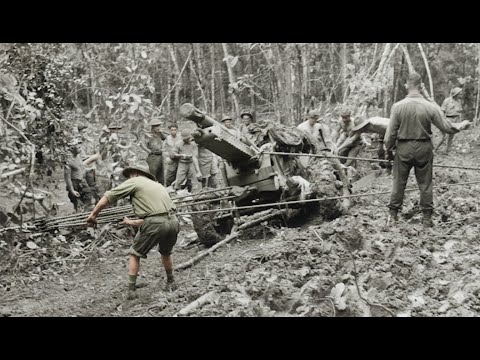
“The first rounds didn’t just cause casualties—they shattered the Japanese psychological advantage.” For the first time in the campaign, the Imperial Japanese Army found themselves pinned down, staring up at the ridges as the Australian 25-pounders methodically dismantled their formations. The hunters had become the hunted.
The 25-pounder was not just a gun; it was a mechanical chimera. Unlike specialized artillery, it could fire directly into a bunker at point-blank range or launch shells high over mountain peaks to crash into hidden valleys. But its true terror lay in its rate of fire. A well-trained Australian crew could fire 10 to 12 rounds per minute—a continuous wall of explosions that sounded like a mechanized nightmare.
And then there was the ammunition. Airburst shells, fitted with time-delay fuses, detonated several meters above the ground. For the Japanese infantry, this was a terrifying evolution in lethality. Foxholes and trenches offered no sanctuary; the explosion occurred overhead, raining white-hot jagged steel fragments vertically downward. Staying in cover meant being shredded from above; jumping out meant being mowed down by small arms. The jungle canopy, once a hiding place, now caught the shells and sprayed shrapnel through the foliage.
But the raw power was only part of the story. The true lethality lay in the invisible web of intelligence that guided the steel. Forward observers—the unsung eyes of the artillery—crawled through mud and razor grass, whispering coordinates back to the gun pits. Because the Australians had pre-registered every trail, junction, and clearing, the response time was terrifyingly fast. The first round was often a direct hit. The Japanese began to believe the Australians possessed supernatural foresight, that the trees themselves were reporting their positions.
For the Imperial Japanese Army, the Banzai charge was more than a tactic—it was the spiritual essence of their military identity. Rooted in Bushido, it was based on the belief that absolute spiritual resolve could shatter any Western army relying on machines. But on the battlefields of New Guinea, that fanatical spirit collided with the cold, mechanical reality of the Australian 25-pounder. The result was not a glorious struggle, but a systematic slaughter.
Japanese commanders would assemble hundreds of men for a decisive strike, screaming Banzai as they surged forward. But the Australian kill zones were already waiting. The 25-pounder crews, informed by their forward observers, unleashed a wall of fire that caught the Japanese in the open. Formations were obliterated in seconds. Officers were killed before they could draw their swords. The banzai spirit evaporated the moment the first salvo landed. Instead of a heroic clash of bayonets, the Japanese found themselves trapped in a whirlwind of hot iron and flying timber.
Survivors spoke of the Australian thunder that followed them everywhere—a sound that signaled the end of hope. The banzai charge, once a symbol of invincible willpower, became a source of dread. The Japanese lost their faith in the grand decisive charge. They saw that the Australians were not fighting a war of spirit, but a war of systems, where the 25-pounder acted as the ultimate judge and executioner.
By late 1942, the terrifying efficiency of the Australian 25-pounder had forced a radical shift in Japanese military thinking. To gather in large numbers was to invite immediate annihilation. The Japanese abandoned mass daylight attacks, broke their battalions into tiny isolated groups, and burrowed deep into the earth like animals. They tunneled into reverse slopes and carved out L-shaped fortifications, hoping that meters of earth and timber would shield them from the vertical rain of shrapnel.
But this defensive posture stripped them of their greatest asset: the initiative. They were no longer the hunters; they were the hunted, trapped in dark, damp holes, waiting in terror for the sound of the next barrage. Night raids became the only viable offensive option, but the Australians countered with illumination shells, turning night into day and exposing the infiltrators to deadly machine gun fire.
The Japanese began to view the 25-pounder as an omnipresent entity—a god of war that dictated when they could move, where they could sleep, and how they could fight. This shift was a tacit admission of defeat. By forcing the Japanese to abandon large-scale operations, the 25-pounder had effectively won the war of attrition before the main infantry battle had even concluded.
But how had the Australians achieved such dominance? It was not luck. It was the result of a massive industrial and educational effort back home. While the Japanese fought at the end of a collapsing supply line, the Australians were supported by a domestic war machine that had transformed the country into the arsenal of the South Pacific. Factories in Melbourne and Adelaide produced a steady stream of high-explosive and airburst rounds, allowing Australian gunners to maintain a generous rate of fire. When a target was identified, it was not just suppressed—it was completely obliterated.
Beyond the hardware, the human element was the true secret. The Royal Australian Artillery emphasized a level of teamwork that bordered on the telepathic. A standard six-man crew lived, breathed, and worked in a tight synchronized loop. Through thousands of hours of drills in the Australian Outback, they had shaved seconds off every part of the firing process. This precision meant that the first ranging shot was often unnecessary—the crew could trust their calculations to hit the mark on the first attempt.
This culture of excellence extended to the integration between infantry and artillery. Forward observers lived in the mud with the infantry, sharing their rations and their risks. This created a bond of total trust. When an infantryman called for fire, he knew the shells would fall exactly where they were needed, often dangerously close to his own position, without fear of friendly fire. The Australian soldiers developed a deep emotional affection for the weapon, famously calling it “the gun that never let us down.”
While the Japanese viewed the 25-pounder with a dark, visceral hatred, the Australians saw it as their guardian—a symbol of their nation’s ingenuity and their kinsmen’s skill. This combination of industrial strength and crew discipline ensured that the 25-pounder remained the undisputed master of the Pacific battlefield.
The terror inspired by the 25-pounder in New Guinea was not an isolated phenomenon. While the Japanese in the Pacific were learning to loathe the Australian thunder, the weapon was simultaneously carving out a legendary reputation across every major theater of World War II. From the blistering sands of North Africa to the hedgerows of Normandy and the jagged peaks of Italy, the QF 25-pounder proved itself to be perhaps the most successful and beloved field gun of the mid-20th century.
In the Western Desert, the Australian 9th Division utilized the gun’s unique circular firing platform to fend off German panzer divisions. Unlike other artillery that could be easily outflanked, the 25-pounders at Tobruk and El Alamein could pivot 360 degrees to engage Rommel’s tanks with armor-piercing rounds at point-blank range, acting as both field artillery and formidable anti-tank guns. Even the elite Afrika Korps grew to respect the rapid, accurate barrages that the Australian and British gunners could summon in an instant.
As the war progressed into the mountains of Italy and the plains of Burma, the 25-pounder continued to adapt. In Burma, much like in New Guinea, its ability to be disassembled and transported via pack mules or light aircraft made it the only source of heavy fire support in terrain where modern tanks and heavy bombers were useless. The Japanese forces in the China-Burma-India Theater faced the same calculated kill zones that had decimated their comrades in the Pacific, further solidifying the weapon’s status as the ultimate jungle buster.
Even after the surrender of Japan and Germany, the 25-pounder refused to fade into obscurity. It saw extensive service during the Korean War, where Australian gunners once again used it to hold back massive human wave assaults during the Battle of Kapyong. In the freezing ridges of Korea, the gun’s reliability in extreme temperatures and its devastating airburst capability proved as effective against the Chinese Volunteer Army as it had against the Imperial Japanese Army a decade earlier.
The global impact of the 25-pounder lies in its longevity and the tactical shifts it necessitated. It was more than a weapon—it was a symbol of Commonwealth military synergy. It proved that a medium-caliber gun, when designed with enough versatility and manned by highly disciplined crews, could outperform much heavier and more complex systems. Today, the 25-pounder is remembered not just as a piece of museum steel, but as the weapon that defined the Australian artillerymen’s identity—a legacy of precision, reliability, and an unwavering commitment to the soldiers on the front line.
The story of the QF 25-pounder in the Pacific is more than a chronicle of ballistic superiority. It is the story of a fundamental shift in the nature of modern warfare. For the Imperial Japanese Army, the war was supposed to be a clash of wills, a spiritual crusade where the purity of the warrior’s soul would inevitably overcome the material wealth of the West. But on the bloody ridges of New Guinea and the muddy tracks of the Solomon Islands, that mystical belief was ground into the dirt by the cold, calculated logic of Australian fire support.
The 25-pounder did not just kill soldiers—it executed an entire military philosophy. The dark reason the Japanese hated this gun so intensely was that it rendered their primary virtue—absolute suicidal bravery—completely irrelevant. In the face of a calculated kill zone and the vertical rain of airburst shrapnel, a soldier’s willingness to die for the emperor did not bring him closer to victory. It only made his demise more certain and less productive.
The 25-pounder proved that a well-organized system of track, observation, communication, and industrial logistics was more powerful than any amount of individual fanaticism. It was the triumph of the system over the swordsman. To the Australian diggers, the 25-pounder remains an immortal icon—the guardian of the jungle, the thunderous voice that spoke when the infantry was pinned down and the odds seemed insurmountable. It was a weapon born of necessity and perfected through the ingenuity of a nation that refused to be intimidated by the scale of the Japanese threat.
The men who hauled these steel monsters through the New Guinea mud were not just artillerymen—they were architects of a new kind of special operations warfare, proving that heavy fire could be made mobile, adaptable, and surgically precise in the most extreme environments on Earth. Ultimately, the legacy of the 25-pounder is a testament to the power of human ingenuity and institutional discipline. It taught the world that a small, highly trained group of professionals, backed by a resilient domestic industry, could neutralize an enemy that possessed far greater numbers.
The Japanese banzai charge died at the mouth of the 25-pounder, replaced by a modern era of combat where intelligence and coordination reigned supreme. As we look back on the history of the Pacific War, the QF 25-pounder stands as a silent sentinel of the Allied victory. It was the weapon that broke the spirit of the invincible Imperial Army, turning the tide of the war one precise shell at a time. It remains in the hearts of veterans and historians alike—the gun that never let us down, a masterwork of steel and spirit that ensured the darkness of fanaticism would eventually be shattered by the light of precision and the thunder of Australian resolve.
And so the jungle fell silent—not with the echo of a banzai cry, but with the lingering ring of Australian steel. The Nankai Shitai, once the terror of the Pacific, melted into the shadows, their spirit broken by a weapon they could neither see nor answer. The 25-pounder had spoken, and history listened.
For the diggers who hauled those guns through hell, the thunder was never just noise—it was a promise kept. A promise that no matter how dark the jungle grew, the gun would never let them down.
But wars end, and legends endure. The question now is not whether the 25-pounder won the Pacific, but whether we remember what it cost—and what it taught us about the price of fanaticism and the power of precision.
What do you think—was the 25-pounder the true turning point of the Pacific War, or just one piece of a much larger puzzle? Share your thoughts below.
Report this article
Select a reason for reporting:






