At Firebase Coral in May 1968, three US Marines opened fire on what they later swore were demons emerging from the jungle darkness. Their incident report described “unknown hostiles with disfigured faces” approaching from the southeast. They weren’t shooting at the enemy—they were shooting at Third Squadron SAS, Australia’s elite special forces, returning from a five-day reconnaissance patrol.
The Australians hit the deck, screaming their call signs, waiting for the Americans to stop firing. When the base commander finally sorted out the chaos, the marine sergeant said something that ended up in classified after-action files: “Sir, I swear to God, I thought I was looking at demons.”
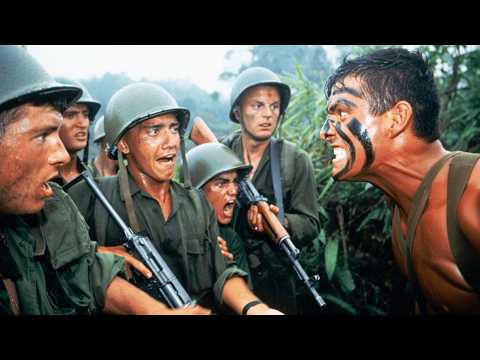
He wasn’t the first American to say it. He wouldn’t be the last. What those Marines saw wasn’t random war paint. It was a carefully developed system of facial camouflage that drew on indigenous Australian tracking traditions, scientific understanding of human pattern recognition, and a philosophy of warfare that most Western armies didn’t want to acknowledge existed.
The Australians had figured out something the Americans, with all their technology and firepower, had missed completely. In jungle warfare, being invisible wasn’t enough. You had to be terrifying.
You had to make the enemy’s subconscious scream warnings that overrode his training. You had to transform yourself into something that lived in the space between human and animal—something that moved through the forest like it belonged there. And you didn’t.
The Americans thought face paint was about blending in. The Australians knew it was about standing out, but only at the exact moment when standing out meant the enemy was already dead. This is the story of how a group of soldiers from the smallest Allied force in Vietnam developed face paint tactics so psychologically effective that they scared their own allies more than they scared the enemy.
How they turned their faces into weapons as powerful as their rifles. How they understood something fundamental about human fear that military doctrine manuals still don’t acknowledge. And how the Pentagon, after watching Australian methods produce kill ratios that made American operations look like amateur hour, tried to classify the techniques rather than admit their entire approach to jungle warfare was built on a philosophical error.
Stay with me on this one. It gets darker than you think.
The Australian Army Training Team Vietnam deployed in July 1962. Small numbers, massive impact. By 1965, when the First Battalion Royal Australian Regiment arrived, the Australians had already established something the Americans were still struggling to understand.
The jungle wasn’t your enemy. Your enemy was your enemy. The jungle was neutral territory, and whoever understood its laws better would own it.
The Americans brought air conditioning, hot meals, artillery support, and the assumption that technology could override terrain. The Australians brought an understanding that in the jungle you either adapted or died—and there was no third option.
Phuoc Tuy Province became the Australian area of operations in 1966. Sixty kilometers of coast, dense jungle, rubber plantations, and a Viet Cong presence that had controlled the region for two decades. The province sat southeast of Saigon, bordering the South China Sea.
The terrain was brutal. Triple-canopy jungle where sunlight penetrated maybe two hours per day. Swamps that could swallow a man to his chest. Wait-a-while vines that tore through uniforms and skin. And a humidity level that made wounds fester in hours.
The Viet Cong knew every trail, every water source, every firing position. They’d been fighting there since the war against the French. The Americans had been in country maybe eighteen months. The Australians were the new kids, the smallest force, the ones everyone expected would follow American doctrine because what else were they going to do?
Except the Australians didn’t follow American doctrine. They followed their own. And it was built on a philosophy that most American commanders found baffling.
Don’t dominate the environment. Join it. Don’t announce your presence with artillery and air strikes. Disappear so completely that the enemy doesn’t know you’re hunting him until his blood is on the ground. Don’t paint your face to look like trees and leaves. Paint your face to look like death itself.
The Americans were fighting a conventional war in unconventional terrain. The Australians understood that in the jungle there was no such thing as conventional warfare. There was only patient hunting, perfect silence, and the willingness to become something other than human for as long as the mission required.
This philosophical difference showed up in everything. Patrol sizes: Americans moved in platoon strength, thirty to forty men crashing through the jungle with enough firepower to level a village. Australians moved in six-man teams, sometimes four. And the only sound they made was the sound the jungle was already making.
Fire support: Americans called in artillery strikes on suspected enemy positions, announcing their presence to every Viet Cong soldier within ten kilometers. Australians killed with knives and suppressed weapons—and the enemy often didn’t know they’d lost men until bodies failed to report at dawn muster.
Camouflage: Americans used standard-issue face paint in green and brown, applied in straight lines and geometric patterns that looked military. Australians used face paint in ways that made their own allies file incident reports about possible enemy infiltration.
The difference wasn’t just tactical. It was psychological. The Americans wanted to be soldiers operating in the jungle. The Australians wanted to be the jungle. And if that meant looking like something that crawled out of a nightmare, then that’s what they became.
But this didn’t happen by accident. It happened because the Australians brought something to Vietnam that no other Allied force had: a cultural memory of what it meant to track and hunt in terrain that wanted you dead.
Australia is a country where the land kills you if you don’t understand its rules. Deserts that stretch beyond horizon where water sources are separated by hundreds of kilometers. Jungles in the north where crocodiles hunt on land and in water. Spiders, snakes, jellyfish, ants, plants—everything evolved to be either poisonous or predatory.
The indigenous peoples of Australia had survived in this environment for sixty thousand years through knowledge that wasn’t written in manuals. Knowledge about how to move without disturbing the landscape. How to track animals through terrain that left no obvious sign. How to read the behavior of birds and insects to know what was coming before it arrived. How to become invisible in country where there was nowhere to hide.
The Australians who deployed to Vietnam in the 1960s carried that cultural memory. Not all of them came from the bush, but enough of them did. The sheep farmers from Queensland who’d grown up reading the land. The trackers from the Northern Territory who could follow a trail three days old through spinifex. The commercial fishermen from the coast who understood how to move in relationship to currents and tides. And crucially, the soldiers who’d served with indigenous Australian trackers and learned lessons the British Army manual never taught.
In 1966, the Australian Army made a decision that American commanders thought was either brilliant or insane. They recruited indigenous Australians as trackers and embedded them with regular infantry and SAS units. These weren’t tokens. They were force multipliers.
Men like Private Billy Kooler, who could look at a bent leaf and tell you not just that someone had passed, but how long ago, how heavy they were, and whether they were carrying a load. Men like Corporal Jack Bohemia, who once tracked a Viet Cong unit for eleven kilometers through terrain the Americans said was untrackable—and did it by reading scratches on tree bark that no one else even saw.
The indigenous trackers brought knowledge systems that Western military doctrine didn’t acknowledge existed. They didn’t just track with their eyes. They tracked with their sense of smell, detecting the fermented fish sauce the Viet Cong ate, the particular sweat smell of fear, the disturbed earth that smelled different from undisturbed earth.
They tracked by listening to bird behavior—the go-away birds that called when humans approached, the specific silence patterns that meant something was wrong. They tracked by reading the forest’s memory of disruption, understanding that the jungle kept a record of every passage, and you just had to know how to read it.
And they brought something else. An understanding that camouflage wasn’t about becoming invisible. It was about becoming part of the forest’s pattern in a way that bypassed conscious human recognition. About painting your face not to hide your features, but to disrupt the facial recognition pattern that every human brain is hardwired to detect.
This is what the Americans didn’t understand about Australian face paint doctrine. It wasn’t aesthetic. It was neurological warfare.
The human brain can recognize a face in one-tenth of a second. Two eyes, a nose, a mouth in standard configuration. You process that pattern before your conscious mind even engages. It’s survival wiring from when recognizing friend versus threat versus food meant the difference between living and dying.
Camouflage doctrine in every Western army focused on blending into the environment—green and brown patterns that made you look like vegetation. The Australians understood that was backwards. The enemy wasn’t scanning the jungle for vegetation. He was scanning for human faces. And if you broke up the face pattern in the right way, his brain wouldn’t register you as human until it was too late.
Standard US Marine Corps face paint doctrine in Vietnam: apply in straight lines alternating green and brown. Dark paint on high points of the face—forehead, nose, cheekbones, chin. Light paint in recessed areas. The goal was to eliminate shine and reduce facial definition. It worked fine for static positions. It was garbage for patrol work, because the pattern was still obviously artificial, still obviously military, and still registered as a human face to anyone looking at it from less than twenty meters.
Australian SAS face paint doctrine: destroy the face, not hide it. Destroy it as a recognizable pattern.
This meant irregular applications that followed no geometric logic. Black paint extending from hairline down across one eye to the jaw, leaving the other eye unpainted. Brown and green swirls that broke the symmetry of the face. Deliberate creation of asymmetry, because the human brain expects faces to be symmetrical. White paint used not for highlighting but for creating false shadow lines that made the face read as fractured, damaged, wrong.
And critically, the application was different every single time—because pattern recognition doesn’t just identify faces, it identifies specific faces. If you wore the same face paint twice, you became recognizable. The SAS learned this from indigenous trackers who explained something Western military theory had never considered: the enemy isn’t looking for you. He’s looking for the pattern of you. Break the pattern and you could walk past enemy positions in situations where standard camouflage would get you killed.
But the Australians took it further than simple disruption. They weaponized it.
Master Sergeant Colin “Rowdy” Yates, Third Squadron SAS, explained it in a 1970 debriefing that was classified for thirty-three years: “We weren’t trying to hide. We were trying to trigger an unconscious fear response that would slow their reaction time by maybe two-tenths of a second. Doesn’t sound like much, but in a contact situation where you’re outnumbered fifteen to one, that two-tenths of a second is the difference between ambushing them and them ambushing you.”
Not human. That was the key. The Australians started experimenting with face paint patterns that deliberately triggered the uncanny valley response—that instinctive revulsion humans feel when looking at something that’s almost human but subtly wrong. They elongated features with paint extensions. They created false shadows that made the face look skeletal. They used white paint around the eyes in patterns that made the eyes look larger than human. Predatory. Wrong.
They painted mouths to extend past the natural lip line, creating an impression of teeth that went further than teeth should go. And they went deeper than that. They studied how nocturnal predators looked when illuminated by flashlight or flare—the eye shine, the way light caught teeth and turned them into bright points in darkness. They started applying reflective paint around the eyes and on teeth, so that when an enemy soldier’s flashlight caught them for a split second, what he saw wasn’t a human face but something with glowing eyes and bright teeth emerging from shadow.
Lance Corporal Marcus Webb, Sixth Battalion Royal Australian Regiment, described a 1967 night patrol where this technique saved his life: “The sentry’s cigarette tip moved and I knew he was turning our direction. I froze, dead still. He pulled out a flashlight, swept it right across my face. I saw his expression—his mouth opened like he was going to scream, but nothing came out. He just stood there, frozen, looking at me. I put two rounds through his chest before his brain could process what his eyes were telling him.”
When they did a post-action sweep, the sentry’s rifle was still on his shoulder. He’d never even reached for it. That’s what the face paint did. It bought you that half second of paralysis. Half a second in jungle warfare—that was eternity.
The Americans started noticing Australian kill ratios that didn’t make mathematical sense. Six-man SAS patrols engaging Viet Cong units of forty to sixty and coming out with zero casualties while the enemy lost fifteen to twenty killed. Four-man reconnaissance teams making contact with NVA regulars and winning firefights they should have lost catastrophically.
The American after-action analysts kept looking for the technological advantage. Better weapons? No—Australians used the same M16s and M60s. Better intelligence? Sometimes, but not consistently. Better training? Yes, but not so much better that it explained kill ratio disparities of 1:31 versus the American average of 1:2.
What the analysts missed was the psychological component. The Australians weren’t just fighting more effectively. They were fighting in a way that introduced hesitation into enemy decision-making at the exact moment when hesitation was fatal.
A classified CIA study from 1969, declassified in 2002, analyzed Viet Cong and NVA after-action reports and prisoner interrogations. The study found that enemy soldiers who survived contact with Australian forces described a consistent pattern: initial visual contact followed by a moment of cognitive dissonance—seeing something that looked wrong, that didn’t fit the pattern of what a soldier should look like. That moment of confusion, averaging between 0.3 and 0.8 seconds, was the window where the Australians killed you.
One interrogation transcript from a Viet Cong company commander captured after an engagement with Second Squadron SAS near Nui Dat included this statement: “I saw the first Australian and I thought ghost. Not metaphor. I actually thought I was seeing a ghost or a demon. My training told me to shoot, but my eyes told me this was not a human thing. By the time I understood it was a soldier, he had already shot my two men and disappeared. We fired at shadows for ten minutes and hit nothing. They were gone like smoke—like ghosts, like demons.”
The terminology kept appearing in enemy reports. The Australians had found a way to weaponize superstition—but it wasn’t superstition. It was applied neuroscience that happened to look like black magic.
The Australian Army was studying fear response patterns years before the Americans started their SCOP programs. In 1965, Australian military psychologists embedded with First Battalion RAR conducted field research on enemy reaction times during contact scenarios. They discovered something the academic literature had already documented but military doctrine had ignored: the amygdala hijack.
When the human brain perceives a threat that doesn’t match known threat patterns, it triggers an emotional response before the rational brain can engage. That’s the flash of fear you feel before you understand what you’re afraid of. For most people, this response lasts under a second. But under combat stress, when adrenaline is already elevated, the response duration extends. And if the threat is ambiguous—looks like a human but doesn’t quite register as human—the brain cycles between fear and analysis, creating a processing loop that delays action.
The Australians weaponized this delay. Every pattern choice in their face paint doctrine was designed to trigger threat ambiguity. Not clear threat, which would trigger immediate fight or flight. Not clear non-threat, which would trigger relaxation. Ambiguous threat—which would trigger hesitation.
They tested variations in training. Face paint that was too extreme, completely covering features and creating an obviously masked appearance, actually reduced the psychological effect because it registered as “soldier in disguise” rather than “something wrong.” Face paint that was too subtle, standard military patterns, provided no psychological advantage at all. The sweet spot was partial disruption—enough to trigger the “something’s wrong” response, not enough to allow easy categorization.
Sergeant David “Digger” Morrison, First Squadron SAS, worked with the psychology team to develop what became known internally as the “predator standard”—named after the crocodile hunters in the Northern Territory who taught him that the most effective camouflage made you look like something that belonged in the environment but was also dangerous.
“We weren’t trying to look like trees,” Morrison said in a 1972 interview. “We were trying to look like the thing that eats you when you’re not paying attention. There’s a reason crocs survive. They look like logs until they don’t. That transition—log to predator—it happens so fast your brain can’t catch up. That’s what we wanted. You see us and your brain goes ‘vegetation, rock, shadow.’ Wait, no, that’s moving. Wait, that’s not right. Wait, is that a face? Wait, why does the face look like that? Wait, why are the eyes like that? And by the time you finish waiting, you’re dead.”
This is the philosophy of warfare the Americans couldn’t grasp. Warfare isn’t about firepower. It’s about decision-making under stress. And if you can introduce half a second of delay into your enemy’s decision loop while maintaining perfect clarity in your own, you can defeat forces ten times your size.
The proof came in Operation Toan Thang in May 1968. The operation was American-designed—a multi-battalion sweep through the Long Hai hills to clear NVA forces that had used the area as a staging ground during the Tet Offensive. US forces were assigned the main approach routes. Australian forces were assigned what the American planners called “blocking positions”—static locations where they’d catch any enemy fleeing the main American push. It was a secondary role, and everyone knew it.
The Australians didn’t do static positions. They did hunting.
Third Squadron SAS put four six-man teams into the Long Hai hills three days before the American sweep began. Standard insertion: helicopter drop four kilometers from the operational area, then foot patrol through terrain that made the word “hills” seem inadequate. These were vertical climbs through jungle so thick you couldn’t see three meters ahead. Slopes where you gained elevation by climbing roots instead of walking paths. And heat that turned your uniform into a wet compress that never dried.
The SAS teams carried twenty-one days of rations compressed into packs that weighed thirty-five kilograms. Water purification tablets because the streams were contaminated with everything from buffalo shit to human remains. Ammunition loads that assumed they’d be outnumbered and have to fight their way out. And face paint—not the prepackaged tins the Americans used, but custom mixes each man prepared himself using charcoal, mud, plant material, and yes, sometimes their own blood when they wanted the paint to have that red-brown color that looked like dried gore.
Team Delta Two, led by Sergeant Kevin “Bones” Hartley, moved into position on a ridge line overlooking three confirmed NVA trails. The team was two indigenous trackers, three infantry, and Hartley himself—a Queenslander who’d grown up hunting feral pigs and apparently decided humans weren’t that different.
They established a hide site that took six hours to construct: a position dug into the hillside, covered with local vegetation, with firing angles on all three trails and an escape route that led down a cliff face no sane person would attempt to climb. Then they waited for sixty-eight hours. No movement except to piss and shit in plastic bags they’d carry out with them. No sound except breathing through their mouths because nose breathing was too loud. No cooked food, no fires, nothing that would disturb the forest’s rhythm. And every six hours they reapplied face paint, because sweat degraded the patterns and the pattern was the weapon.
On the third night, the NVA came through—not fleeing from American pressure, but moving toward it. A full company, maybe 120 men, moving in column formation with point security that looked professional and trail discipline that would have impressed any Western army. They were heading toward American positions to set up an ambush of their own. The Americans didn’t know they were coming. But the Australians were sitting on top of them.
Hartley made a decision that contradicted every tactical manual. Instead of calling in artillery or air support, instead of radioing the American units that were about to walk into an ambush, he decided to kill the NVA leadership himself and scatter the unit. Six men versus 120. The mathematics should have been suicide—but Hartley understood something about human psychology in darkness. People don’t process threats well when they can’t see clearly. And the NVA were moving with red-lens flashlights, which preserved their night vision but limited their ability to see detail. What they would see was shapes, shadows, movement—and if those shapes looked wrong enough, their brains would hesitate before firing.
At 0220 hours, the NVA column passed directly below the Australian position. Hartley waited until the company commander, identifiable by the radio operator following him, was directly beneath their position. Then he stood up in full view, ten meters from enemy soldiers, and he started walking down the trail toward them.
The indigenous tracker beside him, Private Billy Nankaro, described what happened next in a 1985 oral history interview: “Bones just stood up and started walking. We thought he’d lost his bloody mind. But he’d done his face paint like nothing I’d ever seen. Black base, white around the eyes and mouth, some kind of red mud streaks down his cheeks. In the dark, with just the red light from their torches, he looked like a skull—like a walking dead thing.”
He got maybe five meters before the first NVA soldier saw him and froze. Just stopped moving. Bones kept walking. The NVA said something and Bones answered him in Vietnamese—said something about the forest taking its dead back. The soldier’s rifle came up, but it came up slow, like he wasn’t sure what he was pointing at. That’s when Bones shot him. One round through the head, then the soldier behind him, then the radio operator. Three shots, three kills before anyone else in the column even understood what was happening.
The NVA column disintegrated—not from overwhelming firepower, but from confusion and terror. Soldiers fired in every direction. Some fired at Hartley, but he’d already dropped prone and disappeared into the hillside. Some fired at each other. Some ran. The remaining five Australians opened up with precision fire, picking off anyone who looked like leadership or anyone who was trying to organize a response.
The engagement lasted four minutes. When it was over, thirty-two NVA soldiers were dead or dying, and the rest had scattered into the jungle. The Australians suffered one casualty—a grenade fragment in Nankaro’s leg that he walked out on.
The American sweep arrived the next morning to find the NVA ambush site abandoned and a trail littered with bodies. Their after-action report credited “effective Australian blocking positions.” They had no idea what actually happened. The Australians didn’t correct them—but word spread through the NVA network. The Australians in the hills were something other than soldiers. The stories got more elaborate with each telling. Demons. Forest spirits. Dead soldiers risen to hunt the living. The Australians didn’t discourage these stories. They fed them—because they understood that psychological warfare doesn’t stop when the engagement ends. It continues in the enemy’s mind, in his dreams, in his hesitation the next time he sees movement in the shadows. Every NVA soldier who heard about the ghost soldiers in the Long Hai hills carried that fear into the next contact. And fear is a virus that spreads faster than intelligence.
The Americans started asking questions. How were Australian units achieving these results? What technology were they using? What intelligence were they receiving? The answer they couldn’t accept was: none of the above. The Australians were achieving superior results through better understanding of human psychology and a willingness to become temporarily inhuman in service of the mission.
In August 1968, the Pentagon sent a tactical analysis team to Nui Dat to study Australian methods. The team spent three weeks embedded with Second Squadron SAS and Sixth Battalion RAR. They observed patrol preparation, joined field operations, and conducted interviews with soldiers and commanders. Their report, submitted in October 1968 and classified until 1999, is remarkable for its honesty:
“Australian tactical superiority in jungle warfare stems not from material advantage but from a fundamentally different philosophical approach to combat operations. Where US forces attempt to impose technological and firepower dominance over the environment, Australian forces adapt themselves to the environment and achieve dominance through superior fieldcraft and psychological manipulation of enemy perception. This approach produces measurably superior results in terms of kill ratios, casualty rates, and operational effectiveness. However, the methods employed—particularly the use of psychological intimidation techniques, including extreme facial camouflage designed to trigger fear responses—are unlikely to be adopted by US forces due to cultural resistance to these tactics.”
Cultural resistance. That was the polite way of saying the Americans thought it was crazy—or uncivilized—or both.
The resistance showed up in small ways. US Special Forces teams tried to adopt Australian face paint techniques and got told by their commanders to maintain “professional standards of appearance.” Marine reconnaissance units requested training from Australian SAS in psychological camouflage and got denied by their chain of command. When individual soldiers asked Australians how they did their face paint, they’d often get deliberately vague answers—because the Australians understood that the techniques only worked if you understood the philosophy. And most Americans weren’t interested in the philosophy. They just wanted the trick.
There was no trick. There was only understanding. In warfare—particularly in jungle warfare—your appearance is a weapon. Not in some metaphorical sense. In a literal, measurable, kill-ratio-affecting sense. The soldier who looks more frightening has a concrete advantage over the soldier who looks military-standard. The fighter who triggers unconscious fear responses wins the half second that determines survival. This wasn’t mysticism. It was applied neuroscience wrapped in mud and blood and the willingness to look at yourself in a mirror and see something you didn’t quite recognize.
But the Americans weren’t the only ones who struggled with Australian methods. Australian soldiers struggled with them too—because maintaining that level of psychological camouflage required doing things to yourself that felt wrong on a deep human level.
Private James Riley, Third Battalion RAR, described the psychological cost in a 1995 interview: “You’d spend two hours before a patrol getting your face right, looking in a piece of mirror, applying the paint, checking the pattern. And the whole time you’re doing this, you’re watching yourself stop looking like yourself. Your mates are doing the same thing next to you. And you’d glance over and see someone you’ve known for two years—someone you’ve shared a tent with and eaten with and trained with—and he doesn’t look like a person anymore. He looks like something else. And you know you look the same way.”
That transition—it got to some blokes. Not in the field. In the field you wanted to look like death because it kept you alive. But afterwards, washing the paint off, watching yourself become human again in the mirror. Some blokes had trouble with that. Like they’d gone too far into it and couldn’t quite come all the way back.
The psychological impact went both ways. The Australians were making themselves frightening to the enemy, but they were also making themselves frightening to themselves. Some soldiers reported not recognizing their own reflection during patrols. Others reported dreams where they couldn’t wash the paint off—where it had become their actual face. One SAS sergeant requisitioned psychological evaluation after a mission because he’d caught his reflection in a stream and instinctively reached for his weapon before realizing it was himself.
The Australian command structure took this seriously. By 1969, the army had embedded field psychologists with SAS squadrons specifically to monitor the mental health effects of extreme camouflage doctrine. They developed protocols: mandatory debriefing sessions after extended patrols where soldiers discussed the psychological experience of dehumanization and rehumanization. Rotation schedules that limited the number of consecutive patrols any soldier could run before taking leave. And they instituted a rule—no soldier would apply face paint alone. It was always done in pairs or groups, with conversation, with human contact, to maintain the psychological boundary between the painted face and the actual person.
Because the Australians understood something the academic psychologists were just beginning to study: when you change your appearance to this extreme degree, you’re not just changing how others perceive you—you’re changing how you perceive yourself. The face paint that made you terrifying to the enemy also made you feel less human, and that was useful in combat but dangerous in the long term.
Corporal Thomas “Doc” Williams, a medic with First Squadron SAS, explained it this way: “The paint was armor, but it was also a cage. When you wore it, you could do things you couldn’t do with your normal face on. You could be colder, harder, more brutal. Because that thing in the mirror with the skull face and the dead eyes—that wasn’t you. That was the operational version. The version that could walk into an enemy camp and cut throats without hesitation. But you had to be able to take it off. You had to be able to wash it away and be yourself again. The blokes who couldn’t do that—who started to prefer the painted version, who felt more comfortable behind the mask than in their own skin—they were the ones who ended up in real trouble.”
The Australian Army documented twelve cases between 1966 and 1971 where soldiers were removed from combat operations due to what the medical files called “identity dissociation related to extreme camouflage protocols.” Twelve out of approximately three thousand soldiers who regularly used these techniques. A small percentage—but not zero.
The Americans, when they learned about this, used it as evidence that the techniques were psychologically damaging and therefore inappropriate for modern professional armies. The Australians disagreed. Their position, articulated in a 1970 internal memo from Colonel John “Bull” Kel, commander of the SAS Regiment:
“Warfare is psychologically damaging. That’s the nature of the activity. The question is not whether a technique causes psychological stress, but whether the stress is manageable and whether the tactical advantage justifies the risk. Our camouflage doctrine provides a measurable tactical advantage that saves Australian lives. The psychological cost is real, but with proper monitoring and support, it is manageable. The alternative—sending soldiers into combat without every possible advantage—produces its own psychological casualties along with physical ones. I choose to manage psychological stress over burying dead soldiers.”
The Americans chose differently. Even when they had evidence that Australian methods produced superior results, they chose not to adopt them. Cultural factors, doctrinal rigidity, and frankly an unwillingness to look at themselves in the mirror and see something monstrous looking back.
But the Viet Cong and NVA remembered. Long after the Americans left Vietnam, long after the Australians withdrew, the stories persisted. Old fighters would tell younger ones about the ghost soldiers who came out of the jungle with painted faces and dead eyes. About patrols that disappeared without a sound and were found days later with their throats cut. About sentries who saw things at night that looked human but moved like animals and killed like demons.
In 1976, a Vietnamese journalist interviewed former Viet Cong fighters about their experiences during the war. Multiple fighters mentioned the Australians specifically. One, a former platoon commander, said: “The Americans we understood. Loud, powerful, predictable. We could fight Americans. The Australians were different. Silent, patient, and they looked wrong. Like the jungle had given them faces that belonged to predators, not men. We lost more men to Australian ambushes than American air strikes. Because with the air strikes, you at least knew they were coming. The Australians would be standing in front of you and you wouldn’t know they were there until they killed you.”
That was the legacy. Fear that outlasted the war. Tactical superiority that came from understanding that combat is as much psychological as physical—and a lesson that military forces are still struggling to learn. The way you present yourself in combat is as important as the weapons you carry.
Modern Australian special forces still use advanced face paint techniques, though the specific methods remain classified. Military observers who’ve trained with Australian SAS note that their camouflage doctrine goes far beyond what other Western special forces teach. They call it “full spectrum concealment” now, instead of psychological camouflage, but the philosophy remains the same: break the human pattern, trigger threat ambiguity, buy the half second that makes the difference between living and dying.
American special forces eventually came around—but it took decades. In the 1990s, Delta Force and SEAL Team 6 started studying Australian methods after cooperative training exercises revealed persistent disparities in close-quarters combat effectiveness. They discovered what the Australians had known since 1966: the opponent who looks more dangerous has an advantage before the first shot is fired. Modern American special operations forces now use face paint techniques that are far more sophisticated than the geometric patterns from Vietnam. They’re still not as extreme as what the Australians developed, but they incorporate the same psychological principles: asymmetry, disruption of facial recognition patterns, and deliberate triggering of threat responses.
But even now, the philosophical gap remains. American doctrine treats face paint as concealment. Australian doctrine treats it as a weapon. That difference—concealment versus weapon—represents a fundamentally different understanding of what warfare actually is. The Americans still believe warfare is about superior firepower applied through superior technology. The Australians believe warfare is about superior understanding applied through superior adaptation. About being willing to become something other than what you are in order to survive what you’re facing.
The soldiers who wore those painted faces in Vietnam are old men now. Most of them are reluctant to discuss it—not because they’re ashamed, but because they know how it sounds. They know that telling someone “We painted our faces to look like demons and it made us better killers” sounds insane. They know the psychological cost doesn’t make sense to people who weren’t there. And they know that the half-second advantage they bought with mud and blood and the willingness to look inhuman doesn’t translate well to after-action reports.
But the numbers don’t lie. Australian forces in Vietnam had the highest kill ratio of any Allied force—approximately 1:31 Australian casualties to enemy casualties. They had the lowest friendly fire incidents. They had the most successful reconnaissance missions. And they had the highest percentage of successful ambushes where the enemy never returned effective fire. These weren’t coincidences. These were the mathematical results of a philosophy that valued psychological dominance over technological dominance, adaptation over firepower, and the willingness to become temporarily monstrous over the insistence on maintaining military appearance standards.
Sergeant Kevin “Bones” Hartley—the soldier who walked toward an NVA company in the dark with a painted skull face—gave an interview in 2003, shortly before his death. The interviewer asked him if he thought the face paint actually made a difference, or if it was psychological theater that the Australians had convinced themselves mattered.
Hartley’s response: “I’ll tell you what made a difference. Every single time we made contact, there was a moment when the enemy hesitated. Every single time—half a second where they saw us and their brain couldn’t process what they were seeing. That half second was the difference between ambush and counter-ambush. That half second was the difference between walking out and getting carried out. Was it the face paint that created that hesitation? Or was it the way we moved, the way we fought, the reputation we’d built? I don’t know. But I know that when I put on that paint, I felt different, moved different, thought different. I became the thing that lives in the jungle and kills whatever comes through. And the enemy felt it. They saw it in our eyes. They heard it in the silence we left behind. Call it psychological theater if you want. I call it coming home alive.”
That’s the truth of it. In warfare—particularly in jungle warfare—the line between psychological effect and physical effect doesn’t exist. The enemy who hesitates is the enemy who dies. The fighter who introduces doubt into his opponent’s mind has already won half the battle. And the soldiers who were willing to paint their faces like demons, who were willing to look at themselves in the mirror and see something inhuman looking back, who were willing to carry that psychological weight for the sake of tactical advantage—they understood something that militaries still struggle to teach. Warfare isn’t about being civilized. It’s about being effective. And sometimes being effective means looking like the nightmare that crawls out of the jungle at 0200 hours. Because the soldier who sees you and thinks “demon” for half a second is the soldier who doesn’t shoot first.
That’s not honor. That’s not glory. That’s just the mathematics of survival rendered in mud and blood and the willingness to abandon your humanity long enough to do what needs doing—then find your way back to yourself when the mission’s over.
The Australian faces that terrified US rookies at Firebase Coral in 1968 weren’t faces at all. They were weapons—precision instruments designed to trigger specific neural responses in specific combat situations. The Americans called them demons because their brains couldn’t categorize what they were seeing. The Australians called them necessary. And the Viet Cong called them the reason you didn’t patrol certain areas at night—because the things that lived there didn’t negotiate and didn’t take prisoners and didn’t look human even when they were killing you like humans would.
Is that a demon? No. That’s an Australian soldier who understood that in warfare, your greatest weapon is the enemy’s own brain. And if you can make his brain work against him for even half a second, you’ve won before the first shot is fired.
The Americans brought overwhelming firepower to Vietnam and achieved kill ratios of 1:2. The Australians brought mud, patience, and faces painted to trigger primal fear—and achieved kill ratios of 1:31. The difference wasn’t technology. It was philosophy. The willingness to adapt completely, to abandon ego, to become what the mission required—even when what it required was looking like something that shouldn’t exist.
That’s the lesson. That’s what the Pentagon tried to classify. That’s what the Australians proved with their faces and their blood and their refusal to fight the war anyone else’s way. And that’s what still terrifies military planners who prefer their warfare clean and civilized and conducted according to doctrine manuals written by people who never had to decide between looking like a demon and dying in the jungle.
The Australians chose demon. They chose tactical advantage over appearance standards. And they walked out of that jungle with kill ratios that made the entire American war effort look like amateur hour. The Americans asked, “Is that a demon?” The Australians answered, “Only if you’re stupid enough to wait around and find out.”
The Viet Cong never waited. They learned. They died learning. But they learned. That’s what happens when you fight ghosts. They kill you before you figure out they’re human.
So here’s the question that still haunts military historians: if a painted face can save more lives than a rifle, why did it take the world’s most advanced armies decades to admit it worked—and what other “primitive” knowledge are we still dismissing as superstition while it quietly wins wars?
Report this article
Select a reason for reporting:






