May 1945. Germany is burning—not metaphorically, literally. In Berlin, the smell of burnt gunpowder, decomposition, and pulverized concrete has become so constant that Berliners no longer perceive it. The Führer is dead. His successor, Grand Admiral Karl Dönitz, presides over a phantom government that controls nothing. The last operational German units are scattered, demoralized, fleeing westward in a desperate race to surrender to the Americans or British before the Soviets reach them. They know what the Red Army has seen: Treblinka, Sobibor, Babi Yar—33,771 people murdered in two days. The soldiers of the Wehrmacht understand that the Red Army does not forget. This was not tactical cowardice. It was a calculation of survival probabilities.
On May 7th, 1945, General Alfred Jodl signed Germany’s unconditional surrender in Reims. The following day, it was ratified in Berlin. With that signature, Germany not only lost the war—it ceased to exist as a legal entity. Its soldiers, technically, no longer had a homeland to protect them. This legal distinction would have devastating consequences for millions of men in the months that followed. The Western Allies had captured approximately 7.6 million German soldiers; the Soviets held between 2.7 and 3.1 million more. Every German household was affected. And the women in the destroyed cities began asking the same question over and over again: “Where are our men?”
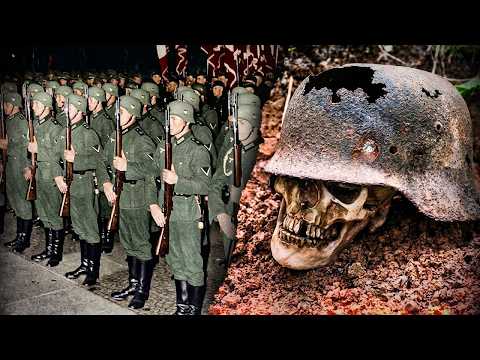
There are moments in history when bureaucracy becomes a lethal weapon. In March 1945, weeks before the final surrender, General Dwight D. Eisenhower made a decision that would alter the fate of millions. German soldiers captured by Western forces would cease to be classified as prisoners of war—a category protected by the Geneva Conventions—and would instead be assigned to new categories: Surrendered Enemy Persons (SEP) and Disarmed Enemy Forces (DEF). The justification was formally impeccable: Germany had ceased to exist as a state, therefore its soldiers could not claim protection under international treaties signed with a nation that no longer existed. The argument had a brilliantly circular logic from the victors’ perspective. Its practical consequences were brutal.
The distinction between POW and DEF was not semantic. It meant the difference between receiving food, shelter, and visits from the International Red Cross—or being pushed into an open field without any of those protections. The 1929 Geneva Convention guaranteed prisoners three fundamental rights: to be fed and housed at the same level as the captors’ rear troops, to send and receive mail, and to be visited by Red Cross delegates. DEFs had none of these rights. On May 4th, 1945, the first German prisoners in American hands were formally transferred to DEF status. That same day, the US War Department prohibited mail to or from those prisoners. On May 8th, the German government was dissolved and simultaneously the US State Department removed Switzerland as the protecting power for German prisoners. Without a protecting power, the Red Cross had no one to report to. Without anyone to report to, the Red Cross had no legal basis to visit the camps. They were invisible to the outside world.
The existing photographs of the Rheinwiesenlager are disturbing even decades later. Thousands and thousands of men in the green meadows of the western Rhine. No barracks, no tents, no structure to protect them from the sky—only barbed wire and earth. Men packed together like ants on ground that April and May rain turns into mud. The only visible difference from the images of the concentration camps the world had just discovered is the uniform. These men wear the gray of the Wehrmacht.
The Rheinwiesenlager were a set of 19 facilities established by the American Army between April and September 1945. Their official name was Prisoner of War Temporary Enclosures—PWTE. The irony of the acronym was perfect. Nothing about them was temporary for the men who lived there during those crucial weeks. Between 1 and almost 2 million German soldiers passed through these camps. The Sinzig camp held 116,000 men in a space designed for a fraction of that number. The Bad Kreuznach camp held up to 560,000 people at its worst moments. There were no sanitary facilities. Men used any patch of ground as a latrine. Water came from makeshift wells, often contaminated. Rations, when available, were miserable—less than 700 calories per day at the most critical moments, in a camp where men slept outdoors in the middle of a Central European spring that was exceptionally cold and rainy that year.
The men dug holes in the ground with spoons, with empty cans, with their bare hands. Not to find anything—to hide in them, to create the bare minimum of shelter against the night cold, which in April 1945 still included sub-zero temperatures and frequent snowfalls. Many of those holes filled with rainwater. The men who had dug them had to decide whether to get wet in the hole or in the open field. The difference was minimal. An American physician from the Army Medical Corps, Sergeant Benedict K. Zobrist, described the situation with a phrase that summarizes the mood of those inside the system: “Those camps were bad news. We were warned to stay as far away from them as possible.”
The diseases that spread under those conditions were predictable: dysentery, pneumonia, septicemia—all worsened by malnutrition and exposure to the elements. A contemporary American medical report noted that 9.7% of the documented deaths in the camps were directly due to malnutrition or dehydration. The rest were caused by diseases directly attributable to overcrowded conditions, lack of hygiene, and absence of medication. “Exposure, overcrowding in the pens, and the lack of food and sanitary facilities contributed to these excessive mortality rates,” the official document stated. Throughout the summer of 1945, while the camps were full of prisoners, the International Committee of the Red Cross was prevented from visiting them. Authorization to send humanitarian aid to the camps in the American occupation zone did not come until February 4th, 1946—nine months after surrender.
Historian Albert Cowdrey estimated that the total number of deaths in camps under American custody was approximately 56,000, representing around 1.1% of the 5 million prisoners in American hands. The Maschke Commission later raised the estimate of deaths in Western captivity to nearly 100,000. The controversy became public decades later with the publication of Other Losses by Canadian James Bacque in 1989, which claimed that deaths exceeded 1 million—a thesis widely criticized and rejected by historians. However, the research it generated forced the recognition that the conditions in the camps had been at the very least abject and that the number of deaths was significantly higher than official records indicated.
On July 10th, 1945, the Supreme Allied Headquarters formally transferred control of the Rheinwiesenlager camps to the French government of Charles de Gaulle. France had demanded 1.75 million German prisoners for forced labor on its territory—a demand explicitly sanctioned in the final protocol of the Yalta Conference. Around 182,400 prisoners from the camps were formally handed over to the French in this transfer. Many of the 740,000 prisoners that the Americans transferred to France in total during 1945 came directly from the Rheinwiesenlager. They arrived in a deplorable condition. A report by the International Red Cross noted that 200,000 of the prisoners already in French custody were so malnourished that they were unable to perform physical labor and would likely not survive the winter. As a result, the United States temporarily suspended transfers until France guaranteed minimum conditions of care in accordance with the Geneva Convention. The irony was perfect. The same convention that the Americans had suspended in their own camps now became the minimum standard they demanded from France for the prisoners they were handing over.
But the darkest dimension of forced labor in the west was not that of farms or quarries. It was that of the minefields. The Germans had laid millions of landmines across Europe during six years of war. In Norway, Denmark, France, the Netherlands, and Belgium, there were minefields that no conventional demining team could clear at the speed demanded by the victorious powers. The solution was to use German prisoners themselves for this task. The German government formally protested that this practice violated Article 32 of the Geneva Conventions, which explicitly prohibits prisoners of war from performing work directly related to war operations. The Allied response was the one already known: the men in question were not prisoners of war, they were disarmed enemy forces. The convention did not apply.
In Denmark, more than 2,000 prisoners cleared over 1.3 million German mines between May and September 1945. Of these, 149 lost their lives during operations, 165 were severely maimed, and 167 suffered minor injuries. Their story remained almost unknown for decades until it was dramatized in the Danish film Under Sandet (Land of Mine) in 2015. In Norway, casualty records indicated that 275 German soldiers had died while clearing minefields, with 392 additionally maimed. In France, historian Simon Mackenzie documented that by September 1945, French authorities internally estimated that 2,000 German prisoners were being mutilated or killed each month in accidents during demining and forced labor operations. It was a systematic cadence of death, invisible to the public, invisible to official history.
Most prisoners held by Western forces were eventually released. Those under American custody began to be freed in increasing numbers from late 1945, and the last were released before the end of 1948. Prisoners in French custody were mostly returned home before the end of 1949. Those held by the British followed a similar timeline. But release was not free. They returned to a ruined Germany, to cities they no longer recognized, to families that may have disappeared, and to homes that may have been destroyed or requisitioned. What awaited German prisoners in the East was unlike anything in the Western camps—not in scale, not in duration, not in mortality, not in the bureaucratic coldness with which the Soviet system processed them, exploited them, and when they were no longer useful, returned them or let them die.
The Soviet Union managed its German prisoners through the GUPVI system, subordinate to the NKVD—the same apparatus that administered the Gulag. Prisoners were registered, categorized, and assigned to labor camps across the entire Soviet territory: the mining basins of the Don and the Urals, the forests of Western Siberia, the coal mines of Ukraine, the uranium extraction facilities of Central Asia. The work was exhausting. “We received a watery soup and fell asleep so that the next day at 5:00 in the morning we could go back to work,” recalled Reinhold Braun. Another prisoner, Heinrich Eichenberg, wrote of what hunger did to men: “The soul and the body were sold for a bowl of soup or a piece of bread. Hunger broke people down, corrupted them, and turned them into animals.”
The Maschke Commission concluded that of 3,060,000 German soldiers taken prisoner by the Soviet Union, 1,094,250 died in captivity. The temporal distribution is even more revealing: 549,360 died during the war itself—but another 542,911 died between May 1945 and June 1950, entirely after the fighting had ended. The winter of 1945 to 1946 was the deadliest period. Nearly 70% of all deaths in Soviet captivity occurred during those months. Prisoners arriving weakened from transit camps, transported in cattle wagons for weeks without water, facing their first Siberian winter in summer clothing, died by the thousands.
The survivors of Stalingrad illustrate the scale with mathematical precision. Of the 91,000 men who began the march to Soviet camps in February 1943, 85,000 died in the months immediately following their capture. Only around 6,000 survived to be repatriated. The official Soviet repatriation concluded on May 5th, 1950, when TASS announced that 1,939,063 German prisoners had been sent home. The last significant group did not return until 1955 and 1956—a decade after the war—thanks to Chancellor Konrad Adenauer’s negotiations in Moscow. Upon his return, Adenauer was received at Bonn airport amid tears. The mother of one of the released prisoners was photographed thanking him through sobs.
Parallel to the soldiers runs another story, equally massive: that of the German civilians expelled from the eastern territories. Between 10 and 12 million ethnic Germans were expelled from East Prussia, Pomerania, Silesia, and the Sudetenland in the years following the war—the largest forced migration of a single ethnic group in modern history, sanctioned by the victorious powers at Potsdam. Some fled across the frozen Baltic Sea in temperatures of 20 below zero, in columns that sometimes broke through when the ice gave way under the weight of carts and livestock. In Czech transit camps, violence was particularly intense. Edward Kalthofen testified to having seen the commander of Chomutov camp beat a crippled soldier to death with his own crutch. Serious academic estimates speak of between 500,000 and 2 million civilians who died during the expulsions and transit.
Berlin in May 1945 was a different planet. 80% of its infrastructure had been destroyed. Running water had stopped working. The bodies of soldiers and civilians lay unburied in the streets. The Red Army arrived on May 2nd, with a mixture of victorious exaltation and hatred accumulated over four years of a war of extermination. Conservative estimates of women raped in Berlin range from 20,000 to 100,000; broader estimates across all Eastern territories speak of between 1.4 and 2 million. The anonymous author of A Woman in Berlin described the strategy many women adopted to survive: seeking the protection of a Soviet officer of sufficiently high rank to deter other soldiers. “The same soldiers who looted apartments and committed rape could the next day be kind to children and share the little food they had,” wrote Ruth Friedrich.
On November 20th, 1945, in courtroom 600 of the Nuremberg Palace of Justice, the history of international law changed irreversibly. Twenty-four men sat in the dock to be tried for crimes against humanity, war crimes, and crimes against peace. Göring, confronted with the evidence of the camps, whispered to his co-defendants: “If it weren’t for that damned Auschwitz, Himmler got us into this. Every time our name is mentioned, everyone thinks of Auschwitz or Treblinka. It’s like a reflex.” On October 16th, 1946, the executions took place in the gymnasium of the Nuremberg prison. Ribbentrop’s last words were, “May God have mercy on my soul.” Alfred Rosenberg, the racial ideologue, did not say a single word.
The winter of 1945 to 1946 was one of the coldest of the century. In Western Germany, it was estimated that around 60,000 people died from cold and hunger. Infant mortality was ten times the rate of 1944. The Trümmerfrauen, women of the rubble, became the symbol of reconstruction—thousands organized into human chains, removing debris, cleaning bricks, in exchange for bread or a few marks. It is estimated that they removed more than 500 million cubic meters of rubble, enough to build 150 pyramids the size of Giza.
From these ruins emerged two German states with radically divergent destinies. The monetary reform of June 1948 replaced the worthless Reichsmark overnight with the Deutsche Mark. The effect was almost magical in its speed: shops that had remained empty for months suddenly displayed goods in their windows. The Marshall Plan provided the foreign capital necessary for reconstruction. The result was the Wirtschaftswunder—the German economic miracle. In the East, the process was different: between 200 and 300 industrial plants were dismantled and transferred to the Soviet Union. On May 23rd, 1949, the Federal Republic of Germany was proclaimed. On October 7th, 1949, the German Democratic Republic followed. The two states would exist in parallel for 41 years.
And yet, in the midst of this accounting of rubble and corpses, something unexpected stirred. In the camps, in the ruins, in the cellars where families huddled around improvised stoves, people began to do the most ordinary and most extraordinary thing: they began to live again. Children returned to school in buildings without windows. Men found work clearing the very streets they had once marched down in uniform. Women who had buried husbands and sons learned to sign their own names on ration cards. It was not forgiveness. It was not forgetting. It was something more stubborn than either—the refusal of ordinary human beings to let the story end in ashes.
The war was over. The reckoning had only begun.
And you—if you had stood in those rubble-strewn streets in the summer of 1945, with the smell of smoke still in the air and the future unwritten before you, what would you have chosen to carry forward: the memory of what was done, or the hope of what might yet be built?
Report this article
Select a reason for reporting:






