Elena Martinez had spent the better part of her morning cataloging donations in the basement of the Boston Historical Society, the air thick with the smell of old paper and forgotten time. Outside, November rain drummed steadily against the small ground-level windows, a rhythm that had lulled her into a meditative state of sorting and labeling. She was about to close the final box when her fingers brushed against something wrapped in yellowed cloth.
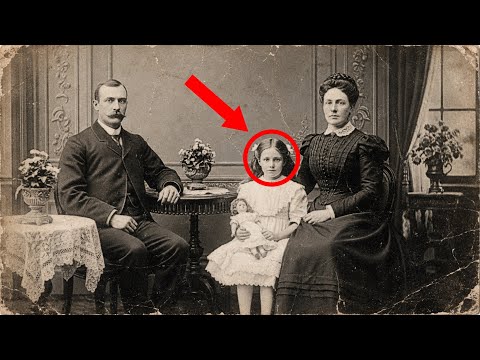
Carefully, she unwrapped the fabric to reveal a wooden frame containing a large photographic portrait mounted on heavy cardboard. The image showed a Victorian family posed in an ornate parlor: a stern-looking man in his forties with a thick mustache, a woman in an elaborate dark dress with her hair pulled severely back, and between them, a girl of perhaps eight or nine years old wearing a white lace dress and holding a porcelain doll.
Elena carried the portrait to her desk and positioned it under the lamp. The photograph was remarkably well preserved, the details sharp and clear despite its age. She could make out the pattern on the wallpaper behind the family, the texture of the carpet beneath their feet, even the individual buttons on the man’s waistcoat. According to the inscription on the back, written in elegant script, it read, “The Harrison Family, Boston, October 1890. Photographer Theodore Welch.”
As she studied the image more closely, something caught her attention. Elena leaned forward, her breath catching slightly. The shadow cast by the young girl didn’t align with the shadows of her parents. While the man and woman’s shadows fell naturally to their left, suggesting a light source from the right side of the room, the girl’s shadow extended almost straight behind her, as if illuminated from directly in front.
Elena blinked and looked again, certain her eyes were playing tricks. But no, the discrepancy was undeniable. She retrieved a magnifying glass from her drawer and examined every inch of the photograph. The shadows of the furniture, the elaborate curtains, even the decorative vase on a side table, all consistent with a single light source—except for the girl’s shadow.
Her hands trembled slightly as she turned the portrait over again, reading the inscription once more. Something about this photograph wasn’t right. In her fifteen years as a conservator, Elena had examined thousands of historical photographs, and she had never seen anything like this. Photographic anomalies weren’t uncommon—double exposures, chemical stains, scratches on the negative. But this was different. The shadow appeared intentional and possibly present, defying the basic laws of light and physics.
Elena glanced at the clock. It was past six, and the building would close soon. But she knew she wouldn’t be able to leave this mystery behind.
Elena arrived at the historical society before sunrise the next morning, the portrait carefully wrapped and tucked under her arm. She had barely slept, her mind racing with questions about the Harrison family and their impossible photograph. The November cold bit at her cheeks as she unlocked the heavy oak door and made her way down to the conservation laboratory.
The lab was her sanctuary, equipped with specialized lighting, microscopes, and chemical analysis tools that allowed her to peer into the secrets of historical artifacts. She positioned the portrait on the examination table and switched on the overhead lights, their bright white glow illuminating every detail of the image.
Under magnification, the photograph became even more mysterious. The paper showed no signs of manipulation or retouching. The emulsion was intact, the surface unmarred by the telltale signs of alteration that would have been common in Victorian-era photo editing. The shadow wasn’t painted on or added later. It was embedded in the original image, captured at the moment of exposure.
Elena documented everything with her digital camera, taking dozens of photographs from different angles and under various lighting conditions. She measured the angles of every shadow in the portrait, calculating the geometry of light and position. The parents’ shadows indicated a light source positioned approximately fifteen degrees to the right and slightly elevated, consistent with a typical photographer’s setup using natural window light supplemented by reflectors. But the girl’s shadow told a completely different story. Its angle suggested direct frontal illumination—as if someone had stood directly in front of her with a powerful light source. Yet there was no evidence of a second light in any other element of the photograph.
The mystery deepened with every measurement Elena took. She pulled up the historical society’s database on her laptop and began searching for information about the Harrison family. The name was common enough, but with the addition of the date and the photographer’s name, she hoped to narrow down her search. After an hour of sifting through census records, city directories, and newspaper archives, she found them.
Charles Harrison, age forty-three in 1890, had been a prominent merchant in Boston’s textile trade. His wife, Catherine, came from old Boston money, and their daughter, Grace, had been their only child. Elena’s fingers hesitated over the keyboard as she clicked on a newspaper article from November 1890, just weeks after the portrait had been taken. The headline made her blood run cold.
Tragedy Strikes Prominent Boston Family. Young Girl Vanishes Without Trace.
Grace Harrison had disappeared from her home on a foggy evening, never to be seen again. The article described a massive search effort, the family’s devastation, and the complete absence of clues. It was as if the child had simply ceased to exist. Elena sat back in her chair, staring at the portrait on the examination table. The girl’s face looked back at her, serene and unknowing, frozen in that moment before everything changed.
Elena spent the following days immersed in research, barely noticing the passage of time as she pieced together fragments of the Harrison family’s story. The more she learned, the more questions arose. Grace’s disappearance had devastated her parents. Catherine had become a recluse, rarely leaving their Beacon Hill mansion, while Charles had thrown himself obsessively into his business, working sixteen-hour days until his death from a heart attack in 1895.
But it was the photographer, Theodore Welch, who began to intrigue Elena most. She found his name listed in several city directories from the 1880s and early 1890s, operating a studio on Tremont Street. Welch had advertised himself as a specialist in scientific photography and experimental processes, which was unusual for the time. Most photographers focused on portraiture and commercial work, but Welch seemed to have broader ambitions.
Elena discovered that Welch had published several articles in photographic journals discussing his experiments with new chemical compounds and exposure techniques. He was particularly interested in capturing what he called the “essential nature” of his subjects. Though his writings were often vague about what exactly that meant, some colleagues had praised his innovation, while others dismissed him as an eccentric who prioritized experimentation over commercial success.
Then Elena found something that made her pause. In December 1890, just two months after taking the Harrison portrait and one month after Grace’s disappearance, Theodore Welch had died. The death certificate listed the cause as chemical poisoning, and a brief newspaper obituary mentioned that he had been found in his studio surrounded by bottles of photographic chemicals. The coincidence was too striking to ignore.
Elena contacted the Massachusetts State Archives and requested access to any records related to Welch’s death. While she waited for a response, she decided to examine the portrait more closely, this time looking for clues about the photographic process itself. Using a technique called raking light—shining a narrow beam across the surface at a sharp angle—Elena could see the texture of the photograph in minute detail. What she discovered made her heart race.
Along the edges of the girl’s shadow, there were microscopic variations in the emulsion density that didn’t appear anywhere else in the image. Under extreme magnification, these variations formed patterns, almost like residue from an unknown chemical compound. Elena carefully took samples from the very edge of the photograph where the mounting board met the image and prepared them for analysis.
The historical society didn’t have the equipment for detailed chemical testing, but she knew someone who did. Her former professor, Dr. Robert Chen, now ran the conservation science department at Harvard and had access to some of the most advanced analytical tools available. She called him that evening, explaining what she had found. His voice grew serious as she described the shadow anomaly and the chemical traces.
“Bring it to the lab tomorrow,” he said. “This sounds like something we need to examine very carefully. If Welch was experimenting with unknown compounds, we might be looking at something historically significant and potentially dangerous.”
That night, Elena locked the portrait in the society’s climate-controlled vault, but she couldn’t lock away her growing unease. The shadow in the photograph seemed to watch her, a dark presence that defied explanation and hinted at secrets buried for over a century.
The next morning, Dr. Chen met her at the Harvard Conservation Laboratory. Under the microscope, the image of young Grace Harrison filled the screen. “See those crystalline formations?” he pointed. “That’s not standard silver halide. There’s something else mixed into the emulsion.” He scraped a microscopic sample and transferred it to a slide for spectroscopic analysis.
When the results appeared, his expression shifted from curiosity to concern. “Mercury,” he said quietly. “High concentrations of mercury compounds, mixed with phosphorous and an organic binding agent. That would have been incredibly toxic—lethal if handled improperly.”
Elena told him about Grace’s disappearance and Welch’s death from chemical poisoning. He leaned back, assembling the pieces. “There were photographers in that era who believed they could capture more than physical appearance. Some thought that with the right chemicals, they could photograph the soul itself.”
They spent hours running tests. The mercury was concentrated only in the girl’s shadow, nowhere else. Whatever Welch had done, he had done it deliberately. As evening fell, Dr. Chen made a suggestion that would change everything. “You need to find Welch’s original glass plate negative. If this effect was created during exposure, the negative will show us exactly what he did.”
Finding Welch’s studio proved harder than Elena expected. The address on Tremont Street no longer existed in any recognizable form, and the original buildings had long since been demolished. She spent the next week at the Boston Public Library, combing through property records and estate inventories. Her breakthrough came from an obituary for Welch’s widow, Miriam, who had donated her late husband’s photographic materials to MIT in 1923.
Two days later, an archivist named Sarah confirmed the collection existed. “We’ve located a collection of glass plate negatives labeled Welch Photographic Estate, 1923. You’re welcome to examine them.”
In the climate-controlled storage room, Elena worked through crate after crate of Victorian portraits until Sarah returned with a smaller box found misfiled elsewhere. “This one is labeled experimental processes. Handle with caution.”
Inside were twenty glass plates marked with cryptic notations in Welch’s handwriting—phrases like “essence capture” and “vital force registration.” Third from the bottom, she found it: a negative labeled Harrison Family, October 12th, 1890. Formula 7, extended exposure. Even in negative, the impossible shadow was visible. But on the glass plate, she could see faint markings etched directly into the emulsion around the shadow’s edges, like tiny symbols or chemical formulas.
She printed high-resolution scans and spent an afternoon trying to decipher the annotations, but they remained stubbornly cryptic. Dr. Chen couldn’t crack the code either. “These aren’t standard chemical notations. Welch developed his own system. You need to find his working journals.”
Elena returned to MIT the following day. Sarah had already pulled additional materials from the collection—a leather-bound journal and several loose notebooks, their pages yellowed and fragile. Elena put on cotton gloves before opening the first one. Welch’s handwriting was small and precise, filling page after page with observations and philosophical musings about the nature of photography.
The early entries documented standard techniques and client commissions. But by 1888, the tone shifted. Welch had attended a lecture by a European scientist who proposed that living beings emitted a kind of energy that could be captured through specialized photographic processes. Welch became obsessed with developing methods to photograph what he called the “vital essence”—the invisible force that animated living things.
By 1890, his work had taken a darker turn. He wrote about using mercury compounds because of their unique interaction with light and organic matter, theorizing that mercury could act as a bridge between the physical and the energetic. Then Elena found the entry for October 12th, 1890—the day the Harrison portrait was taken.
“The Harrison commission may be my greatest opportunity. The child is ill. Her parents didn’t disclose this, but I could see it in her pallor. If my theories are correct, I should be able to capture not just her appearance, but her vital force—the energy that is already beginning to fade. Formula 7, extended exposure, mercury suspension in the shadow areas. This will be my proof.”
Elena’s hands trembled as she read. Grace Harrison had been ill. Her parents had commissioned the portrait knowing their daughter was sick, wanting to preserve her image while they still could. And Welch, driven by his obsessive theories, had seen an opportunity to test his most radical experiment.
The entries after October 12th were sparse and increasingly disturbed. Welch wrote about the success of his technique—the shadow had appeared exactly as his formulas predicted—but he also wrote about the cost. The mercury exposure during the extended session had affected him badly. His hands shook. He couldn’t sleep. When Grace disappeared three weeks later, his entries became almost illegible. He blamed himself, wondering if capturing her vital essence had somehow weakened the child.
The final entry, dated December 3rd, 1890, was brief: “I cannot undo what I have done. The mercury has poisoned more than my body. I see now that some forces should not be captured. Some boundaries should not be crossed. If anyone finds this work, let them learn from my mistakes. The shadow is not what I thought it was. It is something far more terrible.”
Elena closed the notebook, her mind reeling. Welch had died believing his experiments had contributed to Grace’s disappearance. But was there truth to his guilt, or was it simply the ravings of a mind poisoned by mercury and consumed by obsession? She needed the human story beneath the headlines.
At the Massachusetts Historical Society, she found a small collection of Charles Harrison’s business correspondence. Most were routine—orders, invoices, negotiations—but in the third box, she found personal letters misfiled among the business documents. There were letters from Catherine Harrison to her sister in New York, written in the months before and after Grace’s disappearance.
A letter dated September 1890 revealed the shadow over the household: “Grace has been unwell these past months. The doctors cannot agree on a diagnosis, but she grows weaker each week. Charles refuses to accept the gravity of her condition. I wanted to cancel the portrait sitting, but he insisted. He said we must have a proper family portrait while Grace can still sit for one. I fear what he cannot bring himself to say aloud—that this may be our last opportunity to capture our daughter’s image.”
Elena felt a pang of sorrow. The portrait that Welch had turned into an experiment had been commissioned by parents who knew they might be losing their child. It was meant to be a memorial.
The letters after Grace’s disappearance were harder to read. Catherine described the night it happened: Grace had been feeling slightly better and asked to sit in the garden for fresh air. Catherine stepped inside for just a moment to fetch a shawl, and when she returned, Grace was gone. The garden gate was closed. There were no signs of disturbance, and despite an extensive search, no trace of the child was ever found.
What struck Elena most was Catherine’s repeated mention of the portrait. “There’s something wrong with that photograph,” she wrote in December 1890. “Grace’s shadow doesn’t fall right. The photographer tried to explain it as an artifact of the process, but I see it differently. It’s as if part of her had already left us when that picture was taken—as if the photograph captured her departure rather than her presence.”
Then Elena found one final letter—written by Charles Harrison himself, dated 1894, addressed to Theodore Welch, though Welch had been dead for four years. It had never been sent, still sealed in its envelope. She carefully opened it.
“I must confess what I have never told another soul. I knew you were dying when I commissioned that portrait. Your assistant warned me of your experiments with dangerous chemicals, suggested I choose another photographer, but I had heard rumors of your special techniques. My daughter was dying, Mr. Welch, and I wanted more than a simple photograph. I wanted you to capture her essence, her soul—something that would remain after she was gone. I practically begged you to use your experimental methods. If anyone is to blame for what happened, it is not you, but me. I asked you to cross a boundary that should never have been crossed, and we all paid the price.”
Elena set the letter down, her heart heavy. This wasn’t just a story about a photographer’s dangerous experiments. It was about a father’s desperate love, his refusal to accept loss, and the terrible consequences of trying to hold on to something already slipping away.
She reached out to Dr. Patricia Morrison, a medical historian at Boston University who specialized in nineteenth-century diseases. Over coffee, Elena showed her copies of Catherine’s letters describing Grace’s symptoms—progressive weakness, pale complexion, periods of confusion and fever. Dr. Morrison studied them carefully.
“Based on these symptoms, I’d guess mercury poisoning or perhaps tuberculosis,” she said. “Both were common in that era and both often affected children.” Elena explained Welch’s experimental process and the high concentration of mercury found in the portrait’s emulsion. “Mercury vapor is extremely toxic, especially in enclosed spaces. If Welch was heating mercury compounds during an extended sitting, and the child was already weakened by illness, she would have been especially vulnerable.”
The realization hit Elena like a physical blow. “The photograph didn’t just capture her deterioration—it accelerated it.”
“Potentially, yes,” Dr. Morrison confirmed. “Mercury poisoning can cause neurological symptoms—confusion, disorientation, memory loss. If Grace was already ill and then received a significant exposure, it could have triggered a crisis.”
Elena thought about the night Grace disappeared. Catherine had said her daughter seemed better, had wanted to sit in the garden. But what if that improvement had been illusory—a brief surge before a collapse? What if the mercury had caused confusion that led Grace to wander away from the house?
With Dr. Morrison’s help, Elena requested access to historical medical records from Massachusetts General Hospital. The detailed files had long since been destroyed, but in the admission logs for November 1890, she found an entry that made her breath catch: November 2nd, 1890. Jane Doe, female child, approximately eight to ten years of age, found unconscious near the Charles River, admitted with suspected mercury poisoning, no identification. Died November 15th, 1890. Buried City Cemetery, Roxbury section.
The date of admission was exactly one week after Grace Harrison’s disappearance. Elena cross-referenced with newspaper archives and found a brief article about an unidentified child found by the river. The description matched Grace’s age and general appearance, but with mercury poisoning affecting her ability to communicate, she hadn’t been identified.
Elena felt tears sting her eyes as the tragic truth revealed itself. Grace hadn’t disappeared mysteriously. She had wandered from her home in a state of confusion caused by mercury poisoning, collapsed near the river, and been found by a stranger who brought her to the hospital. Without identification and unable to speak coherently, she had been listed as a Jane Doe. She had died alone while her parents desperately searched for her, never knowing she was lying in a hospital bed just miles away.
The shadow in the photograph suddenly took on a new meaning. It wasn’t capturing Grace’s vital essence or her soul departing. It was the literal shadow of death—the visual evidence of the mercury poisoning that would ultimately kill her. Welch’s experimental process hadn’t revealed some mystical truth. It had created the very tragedy he’d later feel guilty about.
Elena sat in the medical archives long after closing time. This photograph, commissioned by a father who couldn’t accept his daughter’s mortality, had become both memorial and murder weapon—capturing and causing the death it was meant to prevent. She knew what she had to do. She had to find Grace Harrison’s grave and confirm the identity of the Jane Doe buried in 1890.
The Roxbury Cemetery’s office maintained records going back to its founding in the 1850s. The registrar, an elderly man named Thomas who had worked there for forty years, helped Elena search through the burial logs. They found the entry for November 16th, 1890: Jane Doe, female child, age unknown, died MGH. City burial section K, row 12, plot 34.
The grave itself was in a forgotten corner of the cemetery where paupers and unidentified individuals had been buried. Unlike the elaborate Victorian monuments that dominated other sections, this area had simple markers—small stones with numbers rather than names. Thomas led Elena through overgrown paths to section K. They counted rows and plots until they found the small weathered stone marked only with 34 and the year 1890.
Elena knelt before it, placing her hand on the cold marble. Somewhere beneath this ground lay a child who had died alone and unnamed, while her parents grieved her disappearance miles away. “I need to confirm this is Grace Harrison,” Elena said, looking up at Thomas. “Is there any way to verify identity after all this time?”
Thomas considered the question. “The cemetery still has some burial records that include physical descriptions noted by the undertakers. They might not be detailed, but it’s worth looking.”
Back in the office, they found the undertaker’s ledger from November 1890. The entry for the Jane Doe included a brief description: Female child, fair hair, white dress with lace collar, porcelain doll clutched in arms. Elena felt her heart clench. In the portrait, Grace had been wearing a white lace dress and holding a porcelain doll—the same doll mentioned in the burial record. It couldn’t be a coincidence.
She contacted the Harrison family’s descendants, distant cousins who had inherited what remained of Charles and Catherine’s estate. After explaining her research and showing them the evidence, they agreed to permit the exhumation and DNA testing of the Jane Doe grave, using preserved samples from known Harrison family members for comparison.
The process took weeks. The exhumation was handled by forensic archaeologists who treated the grave with the respect and care it deserved. Elena wasn’t present—it felt too intrusive—but she received regular updates from the lead archaeologist. The DNA results came back in early February, confirming what Elena had already known in her heart. The Jane Doe buried in plot 34 was Grace Harrison. The child who had vanished in 1890 had been lying in an unmarked grave just three miles from her family home, unidentified and unmourned for over 130 years.
The Harrison descendants held a private ceremony when the results were confirmed. They arranged for a new headstone to replace the numbered marker—a simple but elegant stone engraved with Grace’s name, birth and death dates, and a line chosen by the family: Lost and found, finally home.
Elena attended the ceremony, standing with a small group of distant relatives who had never known Grace but felt connected to her story nonetheless. As they laid flowers on the newly marked grave, Elena thought about the portrait that had started this entire investigation—that impossible shadow that had defied scientific explanation. The shadow wasn’t supernatural. It wasn’t capturing souls or vital essences. It was evidence of a crime committed in ignorance and desperation, a physical record of the mercury poisoning that would end Grace’s life. The shadow that seemed to defy the laws of light was actually obeying a different law—the law of consequence, showing that every action, even one taken from love, carries weight and leaves traces.
Two months after Grace Harrison’s reburial, Elena finished her report on the portrait and its tragic history. The Boston Historical Society held a small exhibition featuring the portrait, accompanied by her research and historical context. The display included copies of Catherine’s letters, pages from Welch’s journals, and the medical records that had finally solved the mystery. The portrait itself was displayed behind protective glass, a warning label noting the presence of toxic compounds in its emulsion.
The exhibition drew unexpected attention. Local newspapers ran stories about the forgotten tragedy, and several academic journals requested permission to publish Elena’s findings. But for Elena, the most meaningful response came from visitors who stood before the portrait, reading the story and seeing the impossible shadow with new understanding.
An elderly woman approached Elena during the exhibition’s opening. She introduced herself as a professor of photographic history and shared her own research into Victorian-era experimental photography. “What you’ve uncovered here is important beyond this single case,” she said. “Welch wasn’t alone in his dangerous experiments. There were dozens of photographers in that era who used toxic chemicals in pursuit of artistic or scientific goals. How many other families suffered similar tragedies that were never documented or understood?”
Elena had wondered the same thing. She’d started looking into other photographers mentioned in Welch’s journals—colleagues who had shared his interest in experimental processes. Several had died young, and several had clients whose families experienced mysterious tragedies shortly after portrait sittings. The pattern was there once you knew to look for it.
Dr. Chen visited the exhibition and spent a long time examining the portrait. “The irony,” he said to Elena, “is that Welch achieved what he set out to do—just not in the way he imagined. He wanted to capture the essence of life, and instead he captured the precise moment and mechanism of death. The shadow is exactly what he thought it was: a record of something invisible made visible. Just not something mystical or spiritual—something chemical and tragically mundane.”
The Harrison family descendants donated the portrait to the historical society permanently, with the stipulation that it be displayed with the full story of Grace’s death and the dangers of nineteenth-century experimental photography. They also established a small memorial fund for researching and preserving the histories of other children who died in similar circumstances.
On the final day of the exhibition, Elena stood alone before the portrait after the museum had closed. She studied Grace’s face—the serious expression of a sick child trying to hold still for the camera, the porcelain doll clutched in her hands, and that impossible shadow that had led Elena down this path of discovery.
The shadow no longer seemed mysterious or supernatural. It was simply evidence. A physical trace of the mercury that had saturated the air during that long October photography session in 1890. The anomaly that had defied explanation was explained by chemistry, not mysticism—by human error, desperation, and the tragic consequences of crossing ethical boundaries in the name of art or science.
But Elena also recognized something else in the portrait. Despite the tragedy embedded in its creation, the photograph had ultimately served its intended purpose. Charles Harrison had wanted something that would preserve his daughter’s memory, something that would reveal the truth of her existence. The portrait had done exactly that—just not in the way anyone had imagined. It had preserved Grace’s story for over a century, keeping it safe until someone was willing to look closely enough to understand what the impossible shadow really meant.
Elena turned off the exhibition lights and locked the gallery door. Tomorrow, she would begin researching another mysterious photograph from the society’s archives, another puzzle waiting to be solved. But tonight, she felt the weight of closure—the knowledge that Grace Harrison was no longer lost, no longer unnamed, and that her story, however tragic, was finally understood and told.
The portrait remained in the gallery, Grace’s shadow falling impossibly across the frame—a permanent reminder that the past never truly disappears. It simply waits, patient and silent, for someone curious enough to zoom in and discover what lies hidden in plain sight.
What would you do if you found a photograph that seemed to break the laws of nature—would you walk away, or would you, like Elena, follow the shadow wherever it led?
Report this article
Select a reason for reporting:






