Laura Bennett had restored thousands of photographs in her fifteen-year career, but nothing could have prepared her for the water-damaged album discovered in a Boston attic in October 2024. The estate belonged to the recently deceased Elellanar Whitmore, a 93-year-old woman whose family was clearing out her Victorian townhouse in Beacon Hill. The photograph was tucked between pages of crumbling tissue paper, protected just enough to survive more than a century of New England humidity.
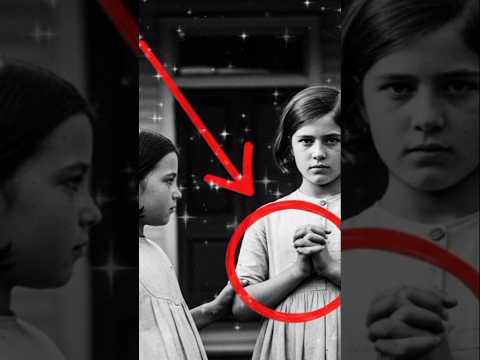
The image showed two young women, perhaps nineteen or twenty, standing on a wraparound porch with ornate columns and decorative railings. Their smiles were bright, their posture relaxed—two friends captured in a moment of pure joy. But as Laura examined the photo more closely, she noticed something odd. In the left woman’s hand, partially obscured by the folds of her dress, was a small, dark object that didn’t belong.
Laura’s heart quickened. She adjusted her lamp and zoomed in on the digitized scan. The object was metallic, cylindrical—maybe a vial or a small container. Why would someone hold that in a casual portrait? She glanced at the back of the photo, where faded handwriting read: “To my dearest Elellanar, with love and secrets. — C.”
The mystery deepened. Who was C.? And what secret was worth hiding in plain sight for over a century?
Laura called her colleague, Marcus, a forensic photo analyst. He confirmed her suspicion: the object had been deliberately concealed. “It’s not a flaw or a smudge,” he said. “Someone wanted it there, but not obvious.”
As Laura continued her restoration, she uncovered another detail—a faint inscription on the porch column behind the women. It was a date: June 17, 1899. The same day, according to local archives, a prominent Boston family reported a missing heirloom: a silver vial containing a rare poison.
Suddenly, the cheerful photo felt like a threat. Were these two friends involved in a crime? Or were they victims themselves?
Laura knew she had to find out. But before she could dig deeper, she received an anonymous letter: “Stop looking. Some secrets are meant to stay buried.”
Laura stared at the letter, her hands trembling. The paper was old, yellowed, but the ink was fresh. Someone knew she was investigating—and they wanted her to stop.
She called Marcus immediately. “We need to find out who sent this,” she said, her voice tight. Marcus agreed to run a handwriting analysis, but warned her to be careful. “If someone’s watching, you don’t want to be alone in this.”
Laura decided to visit the Whitmore townhouse herself. The family had given her permission to examine the attic, and she hoped to find more clues. The house was a relic of another era, its walls lined with peeling wallpaper and faded portraits. In the attic, dust motes danced in the thin November light.
She searched the spot where the album had been found and discovered a loose floorboard. Beneath it lay a small diary, its leather cover cracked with age. The first page read: “Property of Elellanar Whitmore, 1898.”
Laura’s pulse raced. She opened the diary and began to read. The entries described a whirlwind friendship between Elellanar and a woman named Clara—the “C” from the photograph. They were inseparable, until Clara became entangled with a wealthy suitor who turned out to be dangerous.
According to the diary, Clara had stolen the silver vial from the suitor—a man named Henry Blackwell—to protect herself. He had threatened her with the poison, and she planned to use it as leverage. But on June 17, 1899, something went wrong.
Laura turned the page, her breath catching. “Clara is gone. Henry says she ran away, but I know he lied. I saw the vial in his pocket. I will find proof, even if it takes a lifetime.”
The next entry was dated a week later, and Elellanar’s handwriting was frantic. She wrote of confronting Henry and being threatened herself. Then the entries stopped abruptly.
Laura closed the diary, her mind reeling. Elellanar had spent her entire life hiding this secret—and now someone wanted it to stay hidden forever. She pulled out her phone to call Marcus, but before she could dial, she heard a floorboard creak behind her.
Laura spun around. A figure stood in the attic doorway—a woman in her sixties, wearing a tailored coat and an expression that was impossible to read. “You must be the photograph restorer,” the woman said. “I’m Margaret Whitmore. Elellanar was my mother.”
Laura’s grip tightened on the diary. Margaret’s eyes dropped to the leather-bound book, and something flickered across her face—fear, or perhaps relief. “You found it, then,” she whispered. “I always wondered if she’d hidden it here.”
Margaret stepped closer, her heels clicking softly on the bare wood. She explained that her mother had been haunted by Clara’s disappearance for decades, hiring private investigators who all came back empty-handed. “She never stopped searching,” Margaret said. “Even on her deathbed, she asked me to keep looking.”
Laura hesitated, then showed Margaret the anonymous letter. Margaret’s face went pale. “That’s not from my family,” she said. “But I know who might have sent it.”
Margaret revealed that a man had visited the townhouse two weeks before Elellanar’s death—a historian named Dr. Elliot Vance who claimed to be researching Victorian Boston. He’d asked specifically about the attic and the old albums. “My mother refused to see him,” Margaret said. “She was terrified. She told me he had the same eyes as Henry Blackwell.”
Laura felt the pieces click into place. Vance wasn’t a historian—he was a descendant of Henry Blackwell, hunting for the vial and the evidence that could expose his family’s crime. The letter was a warning, and the diary was the proof he feared.
Margaret reached for the diary, but Laura pulled it back gently. “We need to take this to the police,” Laura said. “Along with the photograph and the letter.”
Margaret nodded slowly, then paused. “There’s something else,” she said. “My mother kept a locked box in her bedroom. She told me never to open it until after her death, but I couldn’t bring myself to look inside. Maybe now I should.”
They descended the narrow attic stairs together, the diary tucked under Laura’s arm. The box sat on Elellanar’s dresser—a small mahogany chest with a tarnished brass lock. Margaret produced a key from her pocket, her hand shaking as she turned it.
Inside lay a single object: a silver vial, its surface engraved with the initials H.B. Beside it was a folded note in Elellanar’s handwriting. Laura unfolded the paper and read aloud: “Clara did not run away. Henry buried her beneath the rose garden at his estate. I have kept this vial as proof. Forgive me for waiting so long.”
The room fell silent. Laura looked at Margaret, whose eyes glistened with tears. “The Blackwell estate,” Margaret said hoarsely. “It’s still standing. It’s a museum now.”
Laura reached for her phone. This time, she dialed Marcus. “We have proof,” she said. “And we know where Clara is.”
Within a week, archaeologists unearthed the rose garden at the Blackwell museum. Beneath a century of tangled roots, they found Clara’s remains—and a second vial, still sealed. Dr. Elliot Vance was arrested for harassment and tampering with an active investigation.
Margaret donated her mother’s diary and the photograph to the Boston Historical Society. “Clara finally gets her story told,” she said at the dedication, her voice steady for the first time in years.
Laura framed the restored photograph for her studio wall. Two friends, smiling on a porch, secrets no longer buried. Some mysteries demand to be solved—even if it takes a lifetime.
What would you have done if that anonymous letter landed on your desk?
Report this article
Select a reason for reporting:






