The forest was a black void of fog and snow, visibility barely ten feet. In that suffocating darkness, American soldiers learned to fight by sound—and every weapon had its own voice. The German MG 42 tore the air like ripping canvas, a buzzsaw that fired 1,200 rounds per minute. The American Browning answered with a measured thump, 400 to 600 rounds per minute. Pick up a German gun and fire it inside your own lines, and you wouldn’t draw the enemy—you’d draw your own artillery. That was the rule passed from veteran to replacement, a rule written in blood.
To understand it, you have to understand the sound. The MG 42’s rate of fire was so high that individual shots fused into one continuous tearing noise. The Germans called it the bone saw; the Soviets, the linoleum ripper; American GIs, Hitler’s zipper. The MP 40 submachine gun chugged out a slow, mechanical stutter—the burp gun. The M1 Garand ended each clip with a bright metallic ping. None of these signatures were accidental. They were the sound of two different philosophies of war.
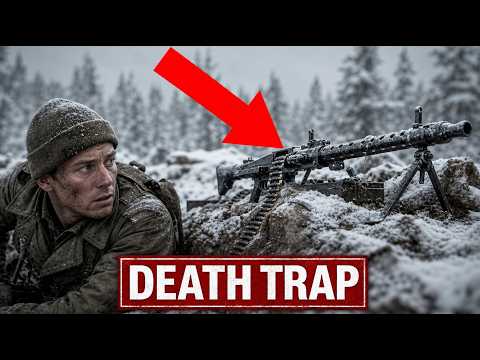
The German squad was built around the machine gun; the rifleman existed to carry its ammunition. An American squad was built around the rifleman; the machine gun supported him. So when the shooting started, the two armies sounded completely different. German fire was a storm of ripping machine guns; American fire was the steady crack of semi-automatic rifles. In the right conditions, that acoustic fingerprint became a matter of life and death.
Those conditions arrived on December 16, 1944. At 5:30 that morning, nearly 2,000 German guns opened up along a 100-mile front. Operation Wacht am Rhein—the last great German offensive in the west—aimed straight through the Ardennes, a dense pine forest the Allies had treated as a quiet sector. Thick coniferous forest, deep snow, and a fog that never lifted. Temperatures held below freezing for weeks, and daylight was gone by mid-afternoon. A man could not see the enemy until he was on top of him. So soldiers oriented themselves the only way left: they listened.
They fixed threats by sound and muzzle flash, and they told friend from foe by the voice of the guns. A weapon firing in the wrong place in the wrong language was an alarm bell. On the Schnee Eifel, Private Leon Goldberg manning a water-cooled Browning heard German trucks and tanks massing in the dark long before he could see them. And the paranoia ran deeper than the fog. German officer Otto Skorzeny had sent English-speaking commandos behind American lines in captured uniforms and Jeeps. Only a few dozen got through, but the rumor spread like fire. Sentries challenged each other with questions about baseball and movie stars. Everyone was hunting for the enemy among themselves.
In that atmosphere, an unexpected German sound inside the perimeter did not invite hesitation. It invited everything you had. You can hear all of this in one position on the first day of the battle. On a wooded ridge above the Belgian village of Lanzerath, 18 men dug into the snow. They were the intelligence and reconnaissance platoon of the 394th Infantry Regiment, 99th Infantry Division, led by 20-year-old Lieutenant Lyle Bouck. Beside them sat four artillery observers. That morning they watched a friendly tank destroyer unit pull out and leave them alone on the ridge. Their orders were three words: Hold at all costs.
Then came the paratroopers. More than 500 men of the 9th Fallschirmjäger Regiment advancing across open ground toward the ridge. Bouck’s 18 men, fighting partly by sight and partly by the sound and flash of guns in the failing light, broke one assault, then a second, then a third. By the end of the day, they had killed or wounded around 92 Germans. They held until they were out of ammunition, surrounded, many wounded. Bouck shot through the leg; one of his men, Sakonica, horribly wounded in the face. Every one of them survived as prisoners. And because 18 men had held that ridge for the better part of a day, the German armored column waiting behind those paratroopers—the spearhead under SS officer Joachim Peiper—lost roughly 20 hours.
Bouck later described it without drama: it felt hopeless, like a nightmare that would never end. Years later, his platoon became the most decorated American platoon of the entire war for a single action. This was the kind of fight where you lived or died by your ears.
By the night of the 16th, the fighting had spread north to the villages of Rocherath and Krinkelt, in front of Elsenborn Ridge. Here, the men of the 2nd and 99th Infantry Divisions found themselves in the purest version of the nightmare. German armor and infantry of the 12th SS Panzer Division pushed through the woods and fog in the dark. American soldiers were cut off inside individual houses, sometimes with German tanks rolling past the windows. They could not see the attack; they could only hear it. So the fighting was settled at point-blank range by interlocking machine gun and rifle fire from prepared positions, backed by massed artillery called in on sound and instinct.
The 99th Division was outnumbered something like 5 to 1. It inflicted casualties at a ratio closer to 18 to 1. It lost about a fifth of its strength doing it: 465 men killed in that one northern sector. German losses ran past 4,000 dead with around 60 tanks and guns destroyed. Elsenborn Ridge was the only place along the entire front of the Bulge where the Germans never broke through. One historian called the stand of those two divisions the most decisive action of the whole campaign. And it was fought in large part by men who were aiming at sounds in the dark.
So put yourself back in that forest. Out of ammunition, a dead German submachine gun lying in the snow at your feet. In the movies, you pick it up. In the Ardennes, you understood exactly what would happen if you did. The moment that gun chugged to life inside your own perimeter, every American near you would hear the burp gun, not a rifle, and reach the one conclusion the sound always meant: the Germans were inside the wire. The response would not be a question. It would be rifle fire, machine gun fire, and if there was time, artillery—all of it turned inward onto you.
And even if the sound did not kill you, the gun itself was a poor bargain. Its ammunition fit nothing in the American supply chain. The moment the captured rounds ran dry, it became dead weight. The MG 42 devoured ammunition and cooked its own barrel, which a crew had to swap out every 250 rounds or so. A captured German gun was useful for a few minutes and a liability after that. So the wisdom that moved from veteran to replacement was the safer one: Leave it. Drop the German gun in the snow and find an American one. In that forest, your life depended less on the weapon in your hands than on the sound it made.
There is a reason the men who survived that forest rarely talked about the cold or the hunger or even the fear when you asked them what they remembered. They talked about the sound. The ripping canvas of the MG 42. A noise so total that, as one veteran said, no one who ever heard it would forget it. It outlived the war. It outlived the men who feared it. West Germany would rebuild that very gun for its post-war army, and its mechanism would live on inside American and NATO machine guns still firing today.
But go back to where we started: the soldier in the movie, out of bullets, reaching for the enemy’s rifle. He never understood the thing the men in the Ardennes understood in their bones. On that battlefield, in that fog, your weapon was not just a tool for killing—it was your voice. It told everyone around you which side you were on. And the wrong voice, even for a few seconds, even in your own hands, could be the last sound you ever made.
Yet the story does not end with that rule. For every soldier who dropped the German gun and crawled back to an American one, there were moments when the rule bent, when necessity overrode doctrine. In the chaos of the first days, some men did pick up the enemy’s weapon. Not out of ignorance, but out of desperation—when the alternative was certain death. And when they did, they learned a second lesson, one that never made it into the manuals.
On the morning of December 17th, a squad from the 1st Infantry Division found itself cut off near the village of Büllingen. Their ammunition was gone. A German half-track rumbled past their position, and in its wake lay a dead Fallschirmjäger, an FG 42 rifle still clutched in his hands. The FG 42 was a rare weapon—a select-fire paratrooper rifle that fired the same 7.92mm round as the MG 42, but with a distinctive, sharper crack than the American M1. Private First Class Harold Kline, a farm boy from Iowa, grabbed it. His sergeant, a veteran of North Africa, grabbed his arm. “Don’t you dare,” the sergeant hissed. “That sound goes off near our lines, and we’re all dead.” Kline nodded. He understood. But then the half-track turned, its machine gun raking the treeline. Kline had no choice. He raised the FG 42 and fired a short burst. The sound was unmistakably German. Within seconds, a nearby American 81mm mortar team, hearing the alien report, dropped two rounds on the half-track. The German vehicle erupted in flames. Kline and his squad used the confusion to slip away. They survived. But the sergeant later admitted that for a terrifying moment, he had been certain they were about to be killed by their own side.
That was the paradox of the Ardennes. The same acoustic fingerprint that could save you could also destroy you. The men who fought there learned to read the soundscape like a language—not just to identify the enemy, but to anticipate the next move. A sudden silence in the German lines often meant they were regrouping for an assault. The distant clank of tracks signaled armor. The high-pitched whine of a Nebelwerfer rocket battery—the “screaming meemies”—sent everyone diving for cover before the first shell landed. And the American response, the steady thump of Brownings and the crack of Garands, became a reassurance, a chorus that said: we are still here.
In the end, the lesson of the Ardennes was not just about guns. It was about identity. In a war where uniforms could be faked and lines blurred, sound was the one thing that could not be easily forged. It was the final truth of the battlefield. And for the men who survived, it was the memory that lingered longest—the sound of the forest, the sound of the guns, and the sound of their own heartbeat in the dark.
The survivors carried that lesson home, though few could explain it to anyone who hadn’t been there. Kline never fired a German weapon again, and he never forgot the sergeant’s grip on his arm. “That sound goes off near our lines, and we’re all dead.” It was a sentence that saved more lives than any medal ever did.
Today the Ardennes is quiet. The pines have grown back over the foxholes, and the fog still settles in the trees each winter, thick and blind as it was in 1944. Walk that ground and you hear only wind and snowmelt—no ripping canvas, no burp gun, no metallic ping. The voices are gone. But the rule they taught remains, buried in the histories and the bones of the forest: know whose voice you carry before you open your mouth.
So here is the question for you. If you were the soldier in that frozen dark, out of bullets with an enemy rifle at your feet—would you trust the silence, or would you risk the wrong voice to survive one more minute? Tell us in the comments below.
Report this article
Select a reason for reporting:






