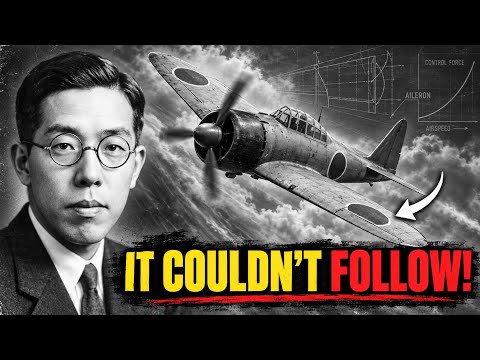
In late 1942, a new piece of advice began circulating among American fighter squadrons in the Pacific. It was short enough to say in one breath, and the first time a pilot heard it, it sounded like something you’d tell a man you wanted dead. If a Zero gets on your tail, don’t turn, don’t climb—push the stick forward, roll hard right, and dive away.
Every fighter pilot of that generation had been taught that maneuverability was the key to survival. And the Zero was the one aircraft in the world that no one could out-turn. So why give it your back? Why point your nose at the ocean? And why right, of all directions? Of all the things in that sentence, the direction seems the least logical—until you understand the aircraft’s design.
No one invented that advice in a ready room. It came in a printed report from a Navy test pilot in San Diego, who had just flown a Japanese fighter pulled from a swamp in the Aleutian Islands. The pilot of that fighter was nineteen years old. By the time the Americans hauled his aircraft out of the mud, he was already in a grave beside it.
The weakness described in that report wasn’t really an American discovery. It had been deliberately designed years before Pearl Harbor by a quiet engineer in Nagoya who knew exactly what he was giving up—because his navy had demanded a fighter that couldn’t be built any other way.
This is the story of that weakness. How it reached every Zero that left the factory. How the Japanese knew about it and lost test pilots trying to find its limits. How a teenager’s miscalculation about a patch of green grass delivered it to the United States while two of his squadron mates circled overhead, unable to fire. And how three words—“roll, right, dive”—turned the aircraft every Allied pilot in the Pacific feared into one that couldn’t chase.
The fear began over China, more than a year before Pearl Harbor. On September 13, 1940, thirteen Japanese Navy fighters escorted a bombing raid on Chongqing, China’s wartime capital. The Chinese pilots who rose to meet them flew Soviet-built fighters that had been giving real trouble to older Japanese aircraft. The Japanese claimed twenty-seven shot down. They lost none of their own.
One Chinese squadron leader, Louis Yim-koon, coaxed his biplane back to base and counted forty-eight bullet holes in it. News of the new fighter leaked to the United States. Claire Chennault, the American advisor to the Chinese Air Force who would later command the Flying Tigers, sent a report. Analysts at the War Department dismissed it as nonsense. The performance he described was, in their view, aerodynamically impossible.
A second, detailed report followed, based on a Zero the Chinese had captured and flown. The paper existed. Almost no one who would have to fight the aircraft ever saw it. Then came December 8, 1941.
Hours after the attack on Pearl Harbor, Zeros took off from Formosa—modern-day Taiwan—and escorted bombers 500 miles to American airfields in the Philippines. Single-engine fighters weren’t supposed to be able to do that and still have fuel to fight. Japanese pilots had experimented with throttle settings and fuel mixtures until they could. At Clark Field, they found American aircraft lined up in neat rows. By nightfall, nearly half the B-17s in the Philippines were wreckage.
Over the next five months, the Zero seemed to be everywhere at once. The Dutch East Indies, Darwin, New Guinea. Its range allowed it to appear so far from any Japanese base that Allied commanders believed there were several times as many Zeros as actually existed. Pilot after pilot learned the same lesson. Fight it the way you were trained—in a tight turning dogfight—and you would lose.
The Allies gave it an official code name: “Zeke.” Almost no one used it. They used its Japanese name, and they said “Zero” like a warning.
To understand why—and why the answer was three words long—you have to go back to a list of requirements that landed on a desk in Nagoya in October 1937.
Japan’s navy had been at war in China since that summer. Its bombers were flying long raids deep into the country, and its fighter at the time, the A5M, was agile but lacked the range to escort them. So the bombers went alone, and Chinese fighters slaughtered them.
The navy wrote down what it wanted next. A carrier fighter capable of 310 miles per hour at 13,000 feet. Able to stay airborne six to eight hours using an external fuel tank. Armed with two 20mm cannon, two machine guns, a complete radio, and a direction finder to guide a pilot home over open water. Able to maneuver at least as well as the A5M, one of the most nimble fighters in the world. And able to fit a carrier deck with a wingspan no greater than thirty-nine feet.
Read that list as an engineer, and the trap becomes obvious. Nearly every line adds weight, and the trait fighter pilots cared about most—agility—gets worse with every pound. The light engine that could do the job produced less than a thousand horsepower. America’s Hellcat would later get two thousand. There was no brute-force way out.
The engineer who received that list was Jiro Horikoshi, thirty-four years old, quiet, and already the designer of the A5M itself. He later wrote that merely reading the navy’s requirements made him feel depressed. The other company invited to compete, Nakajima, studied the same list and decided it was impossible. In January 1938, the company withdrew.
Keep that name in mind. Nakajima returns to this story in a way no one would have predicted.
Even inside the navy, no one could agree on what mattered most. At one 1938 conference, two officers argued in front of Minoru Genda—a show-flying fighter pilot who later helped plan the attack on Pearl Harbor and who wanted aerial fighting power above all else. Takeo Shibata wanted speed and range, and argued that a skilled pilot could compensate for a less agile aircraft. Horikoshi wanted someone to tell him which requirement he could sacrifice. No one did.
He left that room owing the navy every single requirement. So he turned to the only thing he could control. If he couldn’t add power, he would subtract weight. Every gram that didn’t justify its existence in the aircraft. His rule was that any part weighing more than 1/1000th of the finished plane had to be justified. For a fighter of that size, that was the weight of a few coins.
He used a brand-new Sumitomo alloy called extra-super duralumin for much of the structure—stronger and lighter than anything else in service, but with one flaw. Left unprotected, it corrodes and turns brittle. And instead of building the wings and fuselage separately and joining them the way American factories did, Horikoshi built the wings and the forward half of the fuselage as a single unit and bolted the tail on behind the cockpit.
Then came the choices that look reckless now. The pilot sat with nothing but a thin sheet of aluminum behind him. The fuel tanks had no self-sealing lining. In 1937, that wasn’t unusual. But by the time the Zero entered the war, combat over Europe had taught everyone that a fighter had to survive hits. The Zero kept its original covenant long after the rest of the world changed its mind.
And here Nakajima returns to the picture. The prototypes flew with a Mitsubishi engine that proved underpowered. The navy demanded the Sakae engine from Nakajima instead—an engine from a rival—and Mitsubishi reluctantly agreed. The company that had withdrawn from the competition ended up supplying the engine for the winning aircraft. Nakajima would eventually build more Zeros than Mitsubishi did, roughly 6,500 against fewer than 4,000. Even the propeller was a licensed American design.
Mitsubishi’s factory in Nagoya didn’t even have its own airstrip. And so the most advanced carrier fighter in the world began its life in the slowest way possible. Each aircraft was disassembled and hauled to an airfield more than twenty miles away on ox-drawn carts. That was how the prototype reached its first flight at Kagamigahara on April 1, 1939.
What all that discipline produced was an aircraft about a ton lighter than the Grumman Wildcat it would face in 1942, on a wing of roughly similar size. Engineers call that low wing loading. In air combat, it meant the Zero could hold a hard turn at speeds where heavier fighters lost lift.
But Horikoshi didn’t only care about weight. He cared enormously about how the aircraft felt in a pilot’s hands. And here is the real secret.
Here’s the physics, and you’ve felt it yourself. Put your hand out the window of a car doing thirty miles an hour, and the air pushes gently. At sixty, the push isn’t twice as strong. It’s four times as strong, because the force of moving air rises with the square of speed. A pilot has to push every control surface through that air, and the Zero had no hydraulic boost for its ailerons. It was a man’s arm against the wind.
The Zero’s ailerons—the hinged surfaces on the wings that roll the aircraft—were large, and at dogfighting speeds that was exactly what a pilot wanted. At around 200 miles an hour, a light touch was enough to roll it beautifully. But as speed increased, those big surfaces had to be forced against air pushing harder and harder. American labs later found that the controls were very light at 200 miles an hour and became noticeably stiff just a little above it.
Horikoshi listened closely to his test pilots, and one of their earliest complaints concerned the tail elevator, which points the nose up and down. The same small stick movement that felt right at landing speed could pitch the nose violently at top speed. So Horikoshi did something clever. He made the elevator control cables deliberately less rigid, so that at high speed, with heavy air pressure on the tail, they stretched slightly and reduced the elevator’s movement for the same stick input. The faster the Zero flew, the smoother it responded. Pilots loved it.
Twenty years after the war, Horikoshi published a lengthy technical paper about that exact idea. Think about what it means. The Zero was carefully and deliberately built to become less responsive the faster it went. For a fighter designed to win slow, tight turning fights, that was the right call. It also meant the aircraft would never be fast at high speed.
The ailerons were a harder problem. Pilots complained they were heavy above roughly 190 miles an hour. So Mitsubishi added small tabs to their trailing edges to let the airflow do some of the pilot’s work. The stick got lighter. That turned out to be dangerous, because a pilot could now throw the ailerons hard at high speed, and the Zero’s thin, light wing wasn’t built to take those loads.
High speed was already a dangerous environment for this aircraft. During navy trials, one prototype came apart in the air and killed its pilot. Then on April 17, 1941, a navy test pilot, Lieutenant Minoru Okuda, flew two Zeros through a series of steep dives. The first had no tabs, and he brought it back safely. The second had them. He made one dive safely. He didn’t survive the second.
After that, dive speeds were strictly limited, and on later models the tabs disappeared. The engineers accepted a stiff-handling aircraft over a fragile one. The Zero would stay heavy and slow to roll at high speed because the alternative was an aircraft that might tear itself apart.
So here is the flaw, in plain sight. No one made a mistake. This weakness was the price of everything the navy asked for, and every Zero that left the factory carried it. Below roughly 200 knots—about 230 miles an hour—it was the best fighter in the world. Above that, it became heavy, stubborn, and slow to roll.
Horikoshi knew it. The navy knew it. Their best pilots knew it too. For a while, the Americans didn’t. Then a test pilot in San Diego wrote it down in plain English.
If a Zero gets on your tail, don’t turn, don’t climb—push the nose down, roll hard right, and dive away. The fighter no one could out-turn couldn’t chase you. It never could. It was built that way.
So when you look at an old photo of a young man beside a plane, or hold a medal no one in the family can explain—do you know which weakness, which choice, which three words kept him alive?
Report this article
Select a reason for reporting:






