The question hung in the dry Afghan air, sharp as a blade: “Why didn’t you call?” It wasn’t the first time the Green Beret had asked it, but it was the first time he truly understood the answer. The man he was asking—a battered Australian SASR commander with a broken jaw and two loose teeth—simply looked at him with eyes that had seen too much and said nothing. Because some answers can’t be spoken. They have to be lived.
This is the story of two elite units, one target, and a mission that went sideways before it even began. It’s a story about a dry riverbed in Uruzgan, a bomb-maker’s courier, and the impossible choice between making a statement and keeping a secret. And it’s about a Green Beret who learned that sometimes, the loudest statement is the one no one hears.
The plan was simple: capture the courier alive, leave no trace. But in the unforgiving terrain of southern Afghanistan, nothing is simple. The Australian patrol—four men from the Special Air Service Regiment—had walked nine kilometers under cover of darkness, carrying everything they needed on their backs. No vehicles. No air support. No margin for error.
They dug a hide site into the north bank of a dry riverbed, a 40-meter-wide channel of gravel and fist-sized rocks that served as the only viable crossing between two valleys. Every vehicle, every motorcycle, every man carrying explosives passed through this one choke point. “If the crossing is compromised,” the patrol commander had argued, “the courier becomes worthless. The crossing is worth more than his life.”
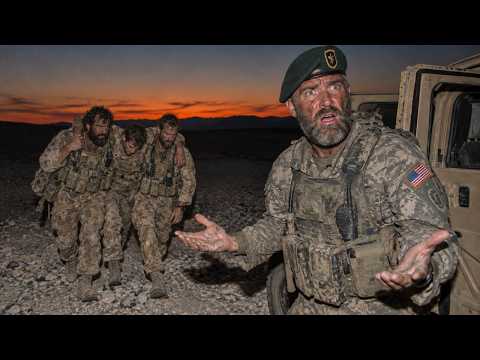
But the American Green Beret—a seasoned sergeant first class in his mid-forties—saw it differently. He wanted a daylight raid on the courier’s compound, complete with helicopter support and an Afghan element. He wanted the valley to see Coalition forces kicking down doors. He wanted deterrence. “You need to get dirty,” he had told the Australian commander, the words hanging between them like a challenge.
What the American didn’t understand—what he couldn’t understand—was that in this valley, visibility was a double-edged sword. Yes, a raid would send a message. But it would also shut down the crossing forever. The courier’s network would adapt, find another route, and the intelligence would dry up. The Australians had learned this the hard way, through years of operating in the shadows.
So they waited. Four men in a hole barely wide enough for two, covered by a camouflage net and a layer of dust. The temperature inside their hide site climbed past 44 degrees Celsius by mid-morning. They rationed water from the first kilometer. They breathed in shallow, controlled rhythms to avoid making noise. They lay motionless for hours as farmers, children, and old men passed within meters of their position.
On the second day, a boy of about eleven stopped directly above them, his goats grazing on the bank. The shadow of his small body fell across the mouth of the hide site. For twenty-six minutes, four of Australia’s most elite soldiers lay frozen, hands empty, weapons untouched, while the boy stood just two meters above them. They could hear him breathing. They could hear the click of his tongue as he called his animals.
The patrol’s standing order was absolute: no weapons in the presence of children. A single movement, a single sound, could trigger a chain of events no one could control. So they waited. And when the boy finally moved on, they discovered the cost: the lead scout had developed a cramp in his left thigh that would not release. The man who needed to move fastest when the moment came was now the least capable of doing so.
By the fourth night, they had less than a liter of water per man. The courier had not appeared. The crossing had been used three times that day by men who were not him. The patrol commander made a decision that would define everything that followed: they would not act on resemblance alone. They would wait, and they would record everything.
The notebook was a cheap waterproof pad, written in pencil because ink ran on wet paper. By the end of the second day, it held more than forty entries—time of crossing, direction, type of machine, color, number of passengers, what was carried and how it was secured. It was the most useful thing they did in that riverbed, and it would take two more weeks before anyone understood why.
Then, on the fifth morning, the courier came early. Not on a red Honda motorcycle, but in a white station wagon with three men inside. The vehicle crossed the gravel at speed, its rear suspension cracking against the rocks, and climbed the north bank nine meters from the root mat. Dust hung in the air for a full minute before settling into their hide site.
The patrol commander watched it go. The description they had been given—stiff right leg, welded rear rack, lone rider—no longer applied. The only way to identify the target now was up close, and that couldn’t be done through a gap in the camouflage net from nine meters away while the vehicle was moving.
So they waited. And when the station wagon returned at 1:51 PM and stopped on the north bank, engine running, the commander made his move. He crawled out of the hide site and lay flat on the dead ground at the base of the bank. The engine noise covered the sound of his approach. He heard the courier’s voice—the same voice he had listened to twice at the base before infiltration—and matched it to the face, the walk, the stiff right leg.
Four seconds. That’s how long it took to pull the man off the bank and into the riverbed. No shots fired. No weapons drawn. Just four men moving with the kind of precision that comes from years of training and a willingness to get dirty in a way the American sergeant had never fully understood.
The courier fought. His heel caught the commander’s jaw, splitting the inside of his cheek and loosening two teeth. The scout tore his right palm on a river stone the size of a fist. But within twenty seconds, three men were secured in plastic cuffs, and the patrol had the only thing they needed now: time.
What followed was eleven hours of erasing every trace of their presence. They filled the hide site by hand, scattered the excavated soil across the streambed to look like flood deposits, and dragged a sandbag across the ground to blur their tracks. They flipped every stone along the drag path. They removed the camouflage net, the ration wrappers, the cut-off bottles. They poured the last of their water—not to drink, but to darken the bare patch of earth at the base of the bank so it matched the surrounding ground.
By 1:15 AM, the patrol commander walked the length of the crossing with a night-vision device, searching for any sign of their five days in the riverbed. He found nothing. The bank, the root mat, the gravel, the dry channel—it all looked exactly as it had in the aerial photos they had planned from. No one who used that crossing in the weeks that followed had any reason to believe a patrol had ever been there.
But the hardest part was still ahead. The exfiltration point was eleven kilometers away. The scout who had suffered heat stress since the first afternoon and a cramp since the boy and the goats was now barely conscious. They stripped his gear, put the prisoner in the middle on a short chain, and began carrying him by turns across the gravel. One man under each arm, two hundred meters at a time, switching off. Their speed dropped to less than two kilometers per hour.
Dawn was breaking when they were still three kilometers from the link-up point, in open ground, with one man unconscious and four empty water bottles between them. They did not call for air support. The reason was the same logic that had governed the past five days: a helicopter landing in first light on exposed gravel would have exposed the entire operation in a language every farmer in that valley could understand. Eleven hours of concealment would have been wasted by a single approach and departure.
So they used the ground instead. Four hundred meters south of the track, there was a depression where a tributary met the main channel. They put the unconscious scout in the deepest part, laid the prisoner beside him, and went flat. For the next nine hours, they took turns cooling the scout’s skin with the contents of a sealed bottle that was never meant for drinking, while traffic moved on the track above them—tractors, motorcycles, a man with two donkeys—all passing within a hundred and fifty meters of four Australians who could no longer move quickly even if they wanted to.
The scout regained consciousness around 11:00 AM, answered to his name, then lost consciousness again by 1:00 PM. No one had anything to drink. The temperature in that depression was later recorded at 42 degrees Celsius.
What saved them was four lines on a piece of paper. The alternate link-up point—coordinates and a time window agreed upon at the base before infiltration—had been transmitted in a short burst on the second night because the hills had blocked everything else. It existed precisely for a situation where the patrol could not send a report, could not be found, could not communicate. The vehicle package at the primary link-up point had waited until midnight. When no one emerged from the darkness and no radio contact came, they did not report the patrol missing. They moved to the alternate site and stayed there all the next day with engines off.
The patrol reached the alternate link-up point at 6:18 PM, nine hours late, carrying the scout between two men with his arms over their shoulders and his feet dragging on the ground. The prisoner walked in the middle, wrists bound, and the packs were heavier than they had been on infiltration because of the captured items and the trash.
The American sergeant was there. He had come with the vehicle package—a personal decision, not an assignment. What he had expected, as he later admitted with embarrassment, was one of two outcomes: either an Australian request for a casualty evacuation that would prove his point about operations without air cover, or nothing at all. What he got was four men who could barely stand. One was unconscious. The prisoner had no mark on him except a scratch on one forearm where he had fallen on the bank.
The handover took four minutes. The prisoner was walked to the second vehicle for a medic to examine before anyone looked at the scout—that’s how things work in that chain, and no one objected. Then the patrol commander, with his cheek torn and his teeth loose and his voice hoarse from five days of dust, handed over two items. The first was a cheap mobile phone taken from the man at the vehicle. The second was a waterproof notebook from his shirt pocket.
The scout was moved to the medical chain that night and stayed in it for eleven days. Heat stress injury with compromised kidney function. The kind that keeps a man out of operations for a month, sometimes forever. He was the only casualty either side suffered in relation to that target.
The notebook was the thing no one at the link-up point realized the value of. A phone taken from a courier is, in itself, a list of numbers with times attached. In 2007, exploitation cells were drowning in that. What the notebook did was turn the list into a timeline. More than forty handwritten entries—crossing times to the minute, type of machine, color, number of passengers, cargo, whether the rider slowed at the north bank—all of it could be matched against call records and phone activity. Where a call occurred within minutes of a recorded crossing, the cell had a confirmed link between a number and a physical movement through a known point. Three numbers were resolved that way in the first week. Two of them belonged to the bomb-maker’s own resupply. One belonged to a man in a village that the task force had previously assessed as uninvolved.
The other operation—the one the American had wanted—could be measured precisely because it had already been measured. The compound four kilometers north was raided on the second night the American way, with helicopter insertion, an Afghan element in the outer cordon, and the building cleared under lights. The courier was not inside. Two men of military age were detained and released within nine days. A compound wall was breached and a storage room burned. Traffic on the border stopped—the very thing that had produced the mission in the first place. A review of traffic reports through that crossing and its two feeder routes showed four weeks of effectively empty channel in the areas the raid had touched.
The crossing in the valley was not one of them, because no one in that valley ever knew that four men had lain in the north bank for five days, because the courier was taken from above the open gravel in the middle of the day without a shot fired, without a vehicle recovered, without a family told anything. His network drew the conclusion that networks under pressure always draw: he had gone. He was carrying the money and the components, and he had stopped arriving. The assessment that came back through other reporting over the following month was that he had defected.
Chris Masters wrote that the hardest thing to buy in that war is time the enemy doesn’t know he’s been robbed of. The patrol bought six weeks of it. The same crossing was worked twice more by the same squadron element before the end of that rotation. Once the following month from a hide site thirty meters east of the original, which led to a vehicle intercept forty kilometers away three days later, so that nothing happened in the valley at all. And once in the fall, which produced nothing but eleven more pages in a notebook.
The American sergeant’s own detachment used the channel as a surveillance line twice in the same period. They did not dig into the bank because by then they had been briefed in detail on the cost of doing so. The post-operations report went through the task force, and a copy reached the firebase. It was a dry document. It explained the infiltration distance, the change of hide site, the heat injury, the loss of the exfiltration window, the condition of the detainee at handover, and then one line in the sequence about the withdrawal. Time spent restoring the ground before departure. Eleven hours.
He read it on the wooden table where he had prepared the original target packets. He did not write a response, and he never withdrew the entry in his own record that logged the Australians as having refused the mission. It is still there in the record, unamended. What he did was change his product. The next three target packets his detachment produced contained an additional annex that had not been in any of the previous ones. It carried a title his men had begun to use without irony: Signature Assessment. It was a page and a half long, and it asked in sequence what the ground would show afterward, who had used it, and what would be lost if they stopped.
In his end-of-tour report, there is a paragraph in the partner force integration section that was struck through before submission with a single line, readable under the strike, that begins by describing a method he had opposed at the planning table in April. Nothing was written in its place. The report was submitted with the space in it. As for the phrase he used across that table—the four words that gave every man at the firebase something to repeat for the rest of the rotation—it does not appear anywhere he wrote at all.
Years later, in a Canberra classroom, an instructor would draw a dry riverbed on a whiteboard and ask his students what it was worth. The answer was never the courier. “The crossing is the terrain,” he would say. “The terrain is the intelligence.”
The American never spoke the four words again. But the annex lived on in every packet his detachment produced, a quiet monument to a lesson learned at the cost of eleven hours of flipping stones by hand.
And somewhere in Uruzgan, a valley still believed a man had simply vanished—never knowing that four ghosts had lain beneath its bank and stolen six weeks it never knew it had lost.
What would you have chosen—the message everyone sees, or the silence no one hears?
Report this article
Select a reason for reporting:






