December 31st, 1944. As midnight tolled and the world welcomed a new year, the sky above Alsace erupted in a fiery crescendo of German artillery. Adolf Hitler had just unleashed Operation Nordwind, the last great German offensive in the West. But the most dangerous threat to the Allied cause that night wasn’t the eight German divisions crashing through the snow-covered American lines. It was a single piece of paper sitting on a desk at the headquarters of the First French Army.
It was a direct combat order from General Dwight D. Eisenhower, Supreme Commander of the Allied Expeditionary Force. The order instructed the French and American armies in the south to execute a tactical withdrawal to the Vosges Mountains. From a military standpoint, it was flawless. From a political one, it was a death sentence for the anti-Hitler coalition—because retreating meant abandoning Strasbourg to the advancing German army.
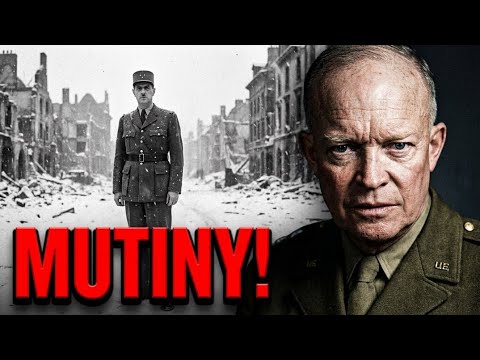
When the order reached French General Jean de Lattre de Tassigny, he read it, understood its devastating implications, and made a decision that could have ended his career—or put him before a firing squad. He decided he would not obey it.
What happens when a commanding general in the middle of the largest war in history flatly refuses to obey the Supreme Commander? How does a coalition survive when its second-largest European army threatens open mutiny? The Strasbourg crisis of January 1945 is, in my view, the most profound example of that impossible choice in the entire European theater.
To understand why Eisenhower issued an order that nearly tore the Allied armies apart, you have to look at the map of western Europe in the final week of 1944. The situation for the Americans was desperate. Two weeks earlier, the German army had launched a massive surprise offensive in the Ardennes Forest—the Battle of the Bulge. The German armored thrust had shattered the center of the American line, creating a deep, bleeding wound in the Allied front.
Eisenhower had reacted with cold, ruthless efficiency. He stripped every available reserve unit from across Europe and threw them into the Bulge. General George S. Patton’s Third Army was ordered to pivot 90 degrees and attack north to relieve the besieged paratroopers at Bastogne. But you cannot pull massive armies out of one sector without creating a catastrophic vacuum somewhere else.
When Patton moved north, the American line in the south—the region known as Alsace—was stretched to the absolute breaking point. The defense of this massive sector fell to Lieutenant General Alexander Patch and the United States Seventh Army. Historian Rick Atkinson, in his book The Guns at Last Light, documents exactly how vulnerable Patch was. The Seventh Army was forced to cover a front of more than 120 miles with only six infantry divisions and one single armored division.
This meant that American soldiers were spread so thin they could barely maintain visual contact with each other, let alone form a solid defensive line in depth. There were massive gaps in the front covered only by occasional patrols and light cavalry screens. The Seventh Army was exhausted, freezing in one of the worst European winters in recorded history, and dangerously overextended.
Eisenhower, sitting in his headquarters at Versailles, looked at the intelligence reports and saw the danger with absolute clarity. He was a master logistician and a brilliant staff officer. He saw the battlefield as a series of mathematical equations—force-to-space ratios, supply lines, defensive depth—and the math in the southern sector simply did not add up. If the Germans launched a major offensive against the Seventh Army, Patch’s thin line would shatter. The Germans could pour through the gap, surround the American forces, and potentially cut off the entire southern wing of the Allied advance.
Adolf Hitler saw the exact same mathematical weakness. Looking for a way to exploit the chaos caused by the Battle of the Bulge, Hitler ordered a secondary offensive in Alsace. Operation Nordwind was designed to smash through the weak American lines, recapture the territory lost in the autumn, and destroy the United States Seventh Army. To emphasize the terrifying political importance of this attack, Hitler placed the army group responsible for the northern pincer under the direct command of the architect of the Holocaust, Reichsführer Heinrich Himmler.
When Allied intelligence intercepted warnings of the impending German attack, Eisenhower realized he had to act immediately to save the Seventh Army. He could not send reinforcements because there were none left. Every spare soldier, every tank, and every artillery shell was already committed to the brutal fighting in the snow of the Ardennes. The only option left to a commander who lacks the troops to hold a long line is to retreat and shorten that line.
Eisenhower drafted a plan. The United States Seventh Army and the adjacent First French Army would execute a controlled, phased withdrawal to the west. They would pull back to the naturally strong, elevated defensive positions of the Vosges Mountains. By doing so, they would significantly reduce the length of the front line, concentrate their available forces, and establish a wall of American and French infantry in the mountains that the German armor could not easily penetrate.
From a staff college perspective, it was the only correct decision. It was prudent. It was logical. It protected the lives of American soldiers and preserved the structural integrity of the Allied front. But I believe this is the precise moment where Eisenhower’s background as a staff officer blinded him to the reality of the war he was fighting. Because Eisenhower was looking at a topographical map—he was looking at elevations, road networks, and defensible rivers. He was not looking at the political soul of the nation he was operating in.
Because right in the middle of the territory that Eisenhower was ordering his armies to abandon sat the city of Strasbourg.
To understand this mutiny, you have to look at Strasbourg not as an American general calculating supply lines, but as a Frenchman fighting for the survival of his nation. Strasbourg is the capital of the Alsace region. For seventy years, Alsace had been the bleeding open wound of French national pride. The territory had been violently taken by the German Empire in 1871 after the Franco-Prussian War. It was reclaimed by France at the cost of millions of lives after the First World War in 1918. And it was annexed again by Adolf Hitler in 1940.
For the French, Strasbourg was not just a piece of real estate. It was the ultimate sacred symbol of French resistance and national honor. In 1941, General Philippe Leclerc, the legendary commander of the French Second Armored Division, had led his men deep in the African desert in a solemn pledge known as the Oath of Kufra. They swore that they would not lay down their arms until the French tricolor flag flew once again over the great cathedral in Strasbourg.
And they had fulfilled that oath. In late November 1944, Leclerc’s armored division had launched a spectacular, violent drive through the German defenses, ignoring orders to slow down, and had liberated Strasbourg. The psychological impact on the French nation was electrical. For the first time in four years, the citizens of Alsace were free. The flag flew over the cathedral. The nightmare of Nazi occupation was over.
Or so they thought.
Now, barely a month later, the American Supreme Commander was ordering his armies to pack up their equipment and leave. The withdrawal to the Vosges Mountains meant leaving Strasbourg undefended on the eastern side of the mountains, completely exposed to the advancing German army. The consequences of this withdrawal would not just be symbolic. They would be steeped in blood.
Historian Antony Beevor has noted that when the French liberated Strasbourg, thousands of French citizens had openly celebrated in the streets, identified themselves as loyal to France, and actively aided the Allied armies in hunting down German sympathizers. If the Allies pulled out, the Gestapo and the SS would follow Himmler’s combat troops directly back into the city. There would be no mercy. The Germans considered the citizens of Alsace to be German citizens who had committed high treason. The lists of collaborators, resistance members, and pro-French officials had already been drawn up by German intelligence.
If the Americans left Strasbourg, there would be a massacre. The executions would not be counted in the hundreds. They would run into the tens of thousands. The streets of Strasbourg would become a slaughterhouse.
This was the horrifying reality of the order that arrived on the desk of General Jean de Lattre de Tassigny on the evening of December 31st. De Lattre was a proud, aristocratic, and fiercely patriotic French general. He commanded the First French Army, which held the line just south of the city. He read the withdrawal order from Eisenhower. He looked at the map. He understood the American military logic perfectly. And he understood the political and human catastrophe that would follow if he obeyed it.
De Lattre knew that if the French Army abandoned Strasbourg without firing a shot, the French people would never forgive them. He knew that the credibility of the French provisional government would collapse instantly. He knew that thousands of his countrymen would be murdered by the Gestapo while his soldiers watched from the safety of the mountains.
De Lattre made his decision. He would not order his troops to retreat. He picked up the telephone and demanded an immediate, secure connection to Paris. He needed to speak to the only man in Europe who possessed the political weight, the arrogance, and the sheer force of will to challenge the Supreme Commander of the Allied Expeditionary Force.
He needed to speak to General Charles de Gaulle.
The stage was set for the most dangerous internal confrontation of the Second World War. A senior French general was actively refusing a direct combat order. A political leader was preparing to blackmail the American High Command. And General Dwight David Eisenhower was about to learn that in a coalition war, military logic is sometimes the least important factor on the battlefield.
On the bitterly cold morning of January 1st, 1945, the command structure of the Allied forces in Western Europe began to violently disintegrate. The catalyst for this disintegration was a message delivered to the headquarters of the First French Army. The message contained the formal execution orders for the tactical withdrawal drafted by Supreme Commander Dwight David Eisenhower. The United States Seventh Army, commanded by Lieutenant General Alexander Patch, was to pull back to the naturally defensive positions of the Vosges Mountains immediately. The French forces, positioned to the south of the Americans, were ordered to conform to this movement, effectively leaving the city of Strasbourg wide open to the advancing German Army of Operation Nordwind.
When General Jean de Lattre de Tassigny, the commanding officer of the First French Army, read the order, he found himself facing the ultimate nightmare of a subordinate commander. He was a professional, highly experienced soldier. He had spent his entire life in the military establishment. He understood the absolute, unyielding necessity of the chain of command. In any normal military situation, an order from the Supreme Commander was absolute. It was not a suggestion. It was not a starting point for negotiation. It was a firm directive to be executed without hesitation, especially in the middle of a massive enemy offensive.
But de Lattre also understood the terrifying political reality that Eisenhower’s staff officers in Versailles had completely failed to grasp. If the French Army abandoned Strasbourg without firing a single shot, the psychological devastation inflicted upon the French nation would be catastrophic. The people of Alsace, who had cheered the arriving Allied armies barely a month earlier, would be left to the horrific vengeance of Heinrich Himmler’s Gestapo and the SS. The list of French citizens marked for execution by the returning German forces was already prepared.
Heinrich Himmler, the architect of the Holocaust, had been personally appointed by Hitler to command Army Group Upper Rhine, the force spearheading the attack toward Strasbourg. His presence was not a military necessity—it was a deliberate political statement of terror.
De Lattre understood that if he simply refused to move, he would be relieved and court-martialed. To defy Eisenhower, he needed de Gaulle. When the French president received the news, his reaction was one of pure fury. He immediately sent a counterorder: “I order you to take matters into your own hands and ensure the defense of Strasbourg.”
De Gaulle then unleashed a diplomatic offensive of staggering aggression, warning Roosevelt that abandoning Alsace would fracture the French-American relationship forever. Churchill, understanding the stakes, flew to Versailles to mediate.
In that room, Eisenhower laid out the grim mathematics. De Gaulle dismissed them. “War is not fought strictly with mathematics,” he said. “It is fought with the soul of a nation.” He vowed the French Army would fight alone if necessary.
Eisenhower, swallowing his pride, capitulated. He rescinded the order. The line would hold.
What followed was savage: twelve days of house-to-house slaughter at Hatten and Rittershoffen, American and French soldiers bleeding white in the snow. But the line did not snap. By late January, Nordwind was spent. Strasbourg was saved.
Was Eisenhower’s reversal a act of weakness—or the wisest command decision of the war? Tell us in the comments.
Report this article
Select a reason for reporting:






