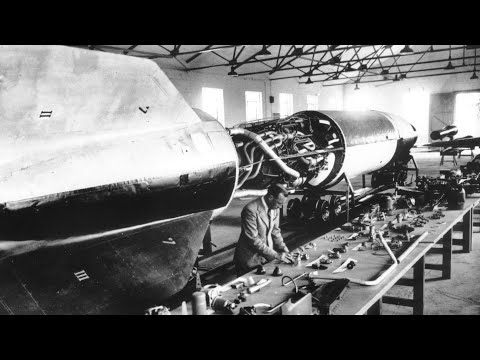
Dr. Robert Goddard stood motionless in the dimly lit warehouse, his fingers tracing the cold aluminum skin of the German V-2 rocket. His voice, already reduced to a rasping whisper by the throat cancer that would claim him within months, was silent. For two decades, he had been America’s lone voice in the wilderness of rocketry, building liquid-fueled rockets on shoestring budgets while the government ignored his pleas. Now, surrounded by Army Ordnance officers and Navy engineers, Goddard confronted a truth that would haunt American rocket science for the next decade. The Germans hadn’t just built a rocket—they had built an entire industrial revolution in rocketry, and America had been asleep at the launchpad.
What Goddard didn’t know as he circled that 46-foot missile was that this examination would reveal a technological chasm so vast that American scientists would spend the next 15 years desperately trying to close it. The V-2 wasn’t just ahead of American capabilities—it represented technologies that didn’t exist in the United States, engineering solutions to problems American scientists hadn’t even identified, and manufacturing precision that American factories couldn’t replicate.
The story of how America discovered it was years behind in rocket technology begins not in 1945, but in April when American forces racing across Germany stumbled onto something that would change the trajectory of human history.
April 11th, 1945. The Harz Mountains, Germany. Soldiers of the United States Third Armored Division descended into the Mittelwerk underground factory complex near Nordhausen, expecting to find another German weapons facility. What they found instead was an industrial operation on a scale that defied comprehension. Tunnels carved deep into the mountains stretched for miles. Production lines contained partially assembled V-2 rockets at various stages of completion. Components filled warehouses, technical documents stacked in rooms, and everywhere evidence of forced labor—emaciated prisoners from the Mittelbau-Dora concentration camp, some barely alive, who had been enslaved to build Hitler’s vengeance weapons.
Major James Hamill of Army Ordnance walked through those tunnels with growing disbelief. The Germans had been producing V-2 missiles at a rate of 600 per month. Each rocket required 50,000 individual parts. The precision machining, the quality control, the logistics of moving components through those underground production lines—it represented an industrial achievement that seemed impossible for a nation supposedly on the brink of defeat.
But Hamill understood something the infantry soldiers didn’t. These weren’t just weapons. They were the key to the future. The Soviet Union’s occupation zone was scheduled to begin in weeks. Everything in this facility—every document, every component, every rocket—would fall into Stalin’s hands unless the Americans moved fast.
Within hours, Colonel Holger Toftoy received urgent orders from Washington: Get the rockets. Get the documents. Get them out before the Soviets arrive.
What followed was Special Mission V-2, one of the most critical intelligence operations of the war’s final days. American troops worked around the clock loading railway cars—341 rail cars filled with V-2 components, enough hardware to build approximately 100 complete rockets. Technical documents weighing tons, all of it racing against time toward the port of Antwerp, where Liberty ships waited to carry America’s captured prize across the Atlantic.
By late May, the first components arrived at the White Sands Proving Ground in New Mexico’s Tularosa Basin. Army engineers began cataloging what they’d captured, and with each crate they opened, with each technical drawing they examined, the magnitude of German achievement became clearer and more disturbing.
The V-2 rocket, designated Aggregate 4 by its creators, was 46 feet tall and weighed nearly 28,000 pounds at launch. It could carry a one-ton warhead 200 miles with reasonable accuracy. But these basic specifications, impressive as they were, told only part of the story. The real revelation came when American engineers began disassembling the rocket to understand how it worked.
The engine sat at the base, a massive combustion chamber capable of producing 60,000 pounds of thrust. To American engineers familiar with Goddard’s work, this number was staggering. Goddard’s largest rocket engine had achieved 985 pounds of thrust after years of experimentation. The Germans had created an engine 60 times more powerful—and they were mass-producing it.
Dr. Theodore von Kármán, director of the Jet Propulsion Laboratory at Caltech, was among the first American scientists to examine the V-2 in detail. His team had been developing rocket technology for the Army since 1942, working on what would become the Corporal missile. When von Kármán saw the V-2’s propulsion system, his reaction was blunt: “We are at least seven years behind.”
The propulsion system alone represented multiple technological breakthroughs. The combustion chamber used a double-wall design. Alcohol fuel flowed through the outer jacket before entering the chamber, simultaneously cooling the chamber walls and preheating the fuel. This regenerative cooling solved one of rocketry’s fundamental problems—preventing the chamber from melting under the extreme temperatures of combustion that reached 5,100°F.
But it was the turbopump that truly shocked American engineers. At the heart of every V-2 sat a steam-driven turbine that spun at 4,000 revolutions per minute, powering centrifugal pumps that forced fuel and liquid oxygen into the combustion chamber at 125 liters per second. The turbine itself produced 600 horsepower, driving pumps that had to handle cryogenic liquid oxygen at minus 297°F while operating at pressures that would destroy conventional pumps.
American engineers stared at this device with a mixture of admiration and despair. The turbopump represented seven years of German development incorporating metallurgy, precision machining, and engineering solutions that didn’t exist in American industry. The turbine blades were forged from nickel-chromium alloys that could withstand both extreme temperatures and rotational forces that would tear apart lesser materials. The pumps featured seals that prevented cryogenic liquid oxygen from leaking while spinning at speeds where any imbalance would cause catastrophic failure.
Lieutenant Commander Robert Truax, a Navy engineer who examined the V-2’s propulsion system, wrote in his report: “The German turbopump is not simply ahead of American technology. It is technology we do not possess. Building a duplicate would require developing new alloys, new casting techniques, new manufacturing processes. We estimate 18 months minimum to create a single working prototype, assuming unlimited funding and access to materials currently unavailable due to post-war shortages.”
Then came the guidance system, and with it another revelation of how far behind America had fallen.
The V-2 used an analog computer called the Mischgerät, developed by Helmut Hölzer, that integrated inputs from gyroscopes and accelerometers to control the rocket’s flight. Two free gyroscopes—one for pitch, one for yaw and roll—constantly measured the rocket’s orientation. A pendulous integrating gyroscopic accelerometer, the first of its kind, measured acceleration and integrated it over time to calculate velocity. When the rocket reached its programmed velocity, typically around 3,500 mph, the guidance system cut off the engine.
The sophistication of this system stunned American engineers. The gyroscopes were manufactured by Siemens and Zeiss with precision that American firms couldn’t match. The analog computer processed multiple inputs in real time, sending signals to eight control surfaces—four external rudders on the tail fins and four graphite vanes in the rocket’s exhaust stream. These vanes, positioned directly in the rocket’s jet stream at temperatures exceeding 5,000°F, were made of graphite that could withstand the heat while providing steering control during the critical first 60 seconds of flight.
Dr. Charles Stark Draper of MIT, America’s leading expert in guidance systems, examined the V-2’s controls with professional respect. Draper had spent years developing gyroscopic instruments for aircraft and submarines. When he saw the German system, he immediately recognized innovations his laboratory hadn’t conceived.
“They solved the integration problem,” Draper noted in his technical assessment. “They created an accelerometer that doesn’t just measure force but calculates velocity by integrating acceleration over time. This is the first fully electronic active control system ever deployed on any vehicle. It’s essentially a fly-by-wire system decades ahead of anything in aviation.”
But perhaps nothing revealed the technological gap more clearly than the manufacturing quality. American engineers examining V-2 components found precision machining that exceeded peacetime commercial standards. Welds were flawless. Tolerances were measured in thousandths of an inch throughout. Components that experienced high stress were overbuilt with safety margins that American designers, constrained by material shortages, would never specify.
An Army Ordnance officer examining the turbopump assembly noted: “Every component appears designed to survive worst-case scenarios. The Germans built for reliability under combat conditions. The fuel lines include redundancy we would consider wasteful. The electrical system has more circuit breakers than necessary. The structure is heavier than optimal weight calculations would require. This is engineering from a nation with resources to build things right—not engineering from a nation scrambling to build things cheap.”
The electrical system alone represented sophistication beyond American practice. The V-2 used a 24-volt architecture with generators driven by both the main turbopump and a separate auxiliary turbine. American rockets, when they used electrical systems at all, employed 12-volt designs with single generators. The V-2’s electrical harness contained eight miles of wiring, all carefully routed, bundled, and protected. The system included motor-driven valves, gyroscope power, ignition systems, and telemetry equipment that could transmit flight data in real time.
When Robert Goddard examined the V-2 that May afternoon in Annapolis, he saw immediately that many features paralleled his own work. Liquid oxygen and alcohol as propellants. Turbine-driven centrifugal pumps. Gyroscopic stabilization. Blast vanes for steering. In a letter to his patron Harry Guggenheim, Goddard wrote with barely concealed bitterness: “The Germans have used my patents. They have taken concepts I developed and built them at a scale I could never achieve. The V-2 is what my rockets could have become if anyone in America had listened.”
But Goddard, for all his brilliance, missed the crucial distinction that other American engineers immediately grasped. The Germans hadn’t stolen American technology. They had developed an entirely independent rocket program that by 1945 exceeded American capabilities by nearly a decade. Hermann Oberth’s theoretical work in Germany had paralleled Goddard’s. Wernher von Braun’s team at Peenemünde had begun liquid-fuel rocket experiments in 1932, building on their own research tradition. By 1934, their A-2 rocket had already exceeded Goddard’s highest altitude.
The German program had state funding, military priority, access to Germany’s finest technical universities, and the labor of thousands of scientists and engineers from every discipline. Goddard’s highest altitude was 9,000 feet, achieved in 1937. The A-4 routinely reached 50 miles altitude, crossing into space before arcing down toward its target 200 miles away. Goddard’s most powerful engine produced 985 pounds of thrust. The V-2 engine produced 60,000 pounds.
Goddard worked with a handful of assistants in the New Mexico desert, funding from the Guggenheim Foundation, and indifference from the U.S. military. The Germans worked at Peenemünde, a sprawling facility that consumed resources equivalent to America’s Manhattan Project. The comparison wasn’t between American technology and German technology. It was between one brilliant physicist working essentially alone and an entire nation’s industrial and scientific establishment focused on rocket development as a military priority.
By June 1945, as American engineers continued examining captured V-2s, a consensus emerged in classified reports circulating through the War Department. The United States faced a critical strategic vulnerability. Rocket technology would define future warfare. The Germans had proven that ballistic missiles could strike targets hundreds of miles away with no defense possible. The Soviet Union had captured Peenemünde, the V-2 production facilities, and thousands of German rocket technicians. Unless America acted decisively, the post-war world would find the United States hopelessly behind in the most important military technology of the emerging era.
This assessment led directly to Operation Paperclip, one of the most controversial decisions of the post-war period. In September 1945, Wernher von Braun and 126 German rocket scientists arrived at Fort Bliss, Texas under military custody. These men had built Hitler’s vengeance weapons. Many had used slave labor from concentration camps. Their rockets had terrorized London and Antwerp—but they possessed knowledge America desperately needed.
“We have the hardware. We have the men who designed it, but we don’t have the industrial infrastructure that built it,” Colonel Harold Turner remarked after the first failed White Sands launch in April 1946. Over the following years, 67 captured V-2s were fired from the New Mexico desert, each teaching American engineers lessons about propulsion, guidance, and high-altitude flight.
By 1953, the Redstone rocket emerged—a direct descendant of the V-2, but built by American hands with American improvements. When Sputnik shocked the world in 1957, America answered with Explorer I, launched on Jupiter-C technology. Twelve years later, von Braun watched Apollo 11’s Saturn V—its F-1 engines producing 1.5 million pounds of thrust each—carry Americans to the moon.
The V-2 was Germany’s vengeance weapon. For America, it became a wake-up call. Technological gaps can be closed—but only if a nation first admits the gap exists.
What do you think—was Operation Paperclip a necessary evil, or a moral line that should never have been crossed?
Report this article
Select a reason for reporting:






