What if the wildest sci-fi dreams of the 1960s weren’t just entertainment, but blueprints for the world we live in today? Back then, filmmakers imagined thinking machines, constant surveillance, and cities ruled by screens. Half a century later, those fantasies feel more like forecasts. These weren’t strange relics—they were prophecies.
From neural interfaces to climate chaos, these forgotten films predicted our 2025 reality with uncanny precision. And once you see the connections, you’ll never look at the past the same way again.
In 1969, Disney released The Computer Wore Tennis Shoes, a cheerful college comedy with an eerie prediction hidden beneath its laughs. Kurt Russell plays Dexter Riley, a student who becomes a walking supercomputer after an electrical accident links his brain to a mainframe.
The premise sounded ridiculous in 1969, but it was the first movie to imagine the human mind fused with digital intelligence. What began as a family film became a startling metaphor for the age of data.
Dexter becomes a sensation admired for his limitless recall, but overwhelmed by what he knows—an uncanny reflection of our relationship with technology today. Every modern concern—privacy, data overload, digital dependency—is hiding beneath the film’s glossy G-rated surface.
Critics at the time brushed it off as disposable fun, but its ideas aged better than anyone expected. It predicted neural interfaces, wearable tech, and the dream—and nightmare—of limitless connectivity.
Once knowledge becomes instant, wisdom becomes optional. The Computer Wore Tennis Shoes might have been sold as a joke, but it ended up writing the first chapter of digital humanity.
Three years earlier, François Truffaut’s Fahrenheit 451 imagined a world where books are outlawed and firemen burn them. When it premiered, audiences saw it as a metaphor for censorship in Cold War societies, but Truffaut’s vision cut much deeper.
He foresaw a future where people willingly traded critical thought for comfort, where citizens were hypnotized by wall-sized screens and shallow entertainment. Sound familiar?
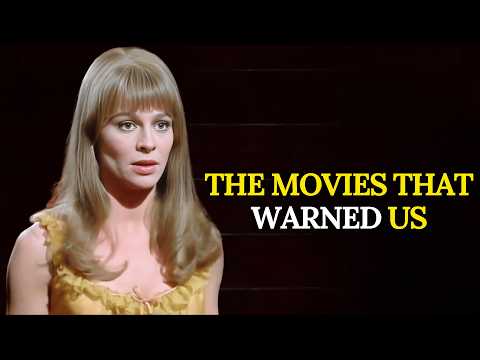
The film’s sterile suburbs, endless screens, and passive citizens eerily resemble our modern obsession with streaming and scrolling. Oskar Werner’s performance as Montag, a man slowly awakening from emotional numbness, remains haunting. Julie Christie’s dual roles symbolize the split between conformity and curiosity.
Shot in cool, clinical colors, Truffaut’s only English-language film feels strangely timeless. Critics in 1966 found it slow and emotionless, but in hindsight, that detachment is the point. It shows a society where emotion itself is rationed.
Today, when digital feeds replace printed pages, Fahrenheit 451 feels less like a dystopia and more like a user agreement we all signed without reading. It wasn’t predicting fire—it was predicting distraction.
Then came The Andromeda Strain, a clinically precise nightmare about science on the edge of control. Directed by Robert Wise, the film follows a team of scientists racing to contain a deadly microorganism brought back from space.
There are no aliens, no ray guns—just sterile laboratories, flashing warning lights, and human error waiting to happen. Adapted from Michael Crichton’s debut novel, the movie’s obsession with detail bordered on obsessive.
Wise hired real-life scientific consultants to design the sets, and the multi-level lab complete with airlocks and quarantine zones still feels chillingly plausible. Critics in 1969 admired its realism but found it too cold. Decades later, that same detachment makes it prophetic.
The film predicted not only the fear of global infection but also how bureaucratic systems would fail under pressure. Its clean visuals and data-driven storytelling mirror the language of today’s medical briefings and digital dashboards.
Watching it now feels unsettlingly current. The Andromeda Strain didn’t imagine little green men. It imagined us trapped in glass rooms, trusting technology more than intuition, and discovering too late that our safety protocols are only as strong as the humans running them.
In Alphaville, Jean-Luc Godard transformed a Paris hotel into a dystopian metropolis ruled by an emotionless computer named Alpha 60. It wasn’t about gadgets or effects—it was about control through logic.
Every citizen in Alphaville lives by mathematical command, stripped of love, poetry, and individuality. Disobedience isn’t punished by force—it’s deleted.
When it premiered, Godard’s mix of noir detective story and avant-garde philosophy baffled audiences. Critics called it incomprehensible. Yet today, its vision feels painfully clear: a city run by artificial intelligence, citizens judged by data, surveillance woven into daily life.
Eddie Constantine’s trench-coated secret agent feels like a relic from another time wandering into our own. The film’s decision to shoot real Paris locations instead of futuristic sets gives it a surreal immediacy. It’s not the future—it’s now.
In an era of predictive software and social credit systems, Alphaville looks less like science fiction and more like the first documentary of digital obedience.
And then there’s Seconds, where director John Frankenheimer turns the fantasy of a second chance into a claustrophobic nightmare. A secret corporation grants wealthy clients total physical transformation through surgery and a fake death.
But once reborn, their perfect new lives come with constant surveillance and crushing emptiness. Rock Hudson, best known for light comedies, gives the performance of his career as a man who learns that freedom is just another illusion sold by powerful systems.
The film was too bleak for audiences in 1966. Critics dismissed it as grotesque, and it flopped. But Seconds predicted a world obsessed with youth, reinvention, and curated identity long before social media made reinvention the norm.
Shot with haunting black-and-white cinematography by James Wong Howe, the camera twists and distorts like a fever dream. Faces stretch, mirrors fracture, and every frame feels invasive—as if someone is always watching.
Today, Seconds looks prophetic: a story about algorithmic beauty, artificial enhancement, and the cost of hiding from who we really are. It was the first great warning about the price of becoming someone else.
These five films were just the beginning. The decade had more warnings in store—visions of time travel, ape-ruled planets, and environmental collapse that would only grow more relevant with each passing year.
George Pal’s The Time Machine might seem quaint now with its pastel sets and brass dials, but beneath the retro charm lies a haunting prediction. Based on H.G. Wells’ novel, the film sends its Victorian inventor far into the future, where humankind has split into two species: the idle surface-dwelling Eloi and the predatory Morlocks who live below.
Audiences in 1960 saw an adventure. What Wells and Pal were really warning about was social decay—the widening gap between those who live comfortably and those who labor unseen to sustain them. Sound familiar?
The Eloi’s blind dependence on unseen systems mirrors modern society’s reliance on invisible infrastructure: data centers, gig labor, automated production. Rod Taylor’s earnest performance anchors a story that’s both nostalgic and chilling.
Its vision of humanity divided by comfort and ignorance has aged like prophecy. For all its colorful optimism, The Time Machine ends with a quiet horror: that progress left unchecked might send us circling right back to the start. In an era of automation and inequality, the machine feels less like fantasy and more like a mirror.
When Planet of the Apes hit theaters in 1968, it wasn’t just a twist ending that shocked audiences. It was the revelation that we might one day become the architects of our own downfall. Astronauts land on a strange planet ruled by intelligent apes, only to discover they’re standing on the ruins of Earth.
It’s a warning wrapped in pulp adventure. Charlton Heston’s performance, all raw defiance and disbelief, gave the film its heartbeat, but the real star was the allegory. The story tackled genetic manipulation, animal rights, and ecological collapse before those were household conversations.
The apes’ rigid class system—scientists, warriors, politicians—mirrored the very human hierarchies the film set out to critique. Beneath the makeup and spectacle, Planet of the Apes predicted the consequences of arrogance and environmental neglect.
Its bleak finale remains one of cinema’s most haunting images: a statue buried in sand, civilization reduced to ruins. In two hours, it encapsulated what countless climate reports now scream: if we can build, we can also destroy. And the warning still stands.
Few films captured the quiet terror of environmental collapse like The Day the Earth Caught Fire. This British gem begins not with monsters, but with a weather report. The Earth has tilted off its axis after simultaneous nuclear tests, sending the climate spiraling into chaos.
Cities swelter, rivers dry, and panic spreads faster than truth. Shot in stark black and white with flashes of orange-tinted heat, the film blends newsroom realism with apocalyptic anxiety. Edward Judd stars as a weary journalist documenting civilization’s unraveling while trying to hold onto fragments of hope.
In 1961, it was dismissed as alarmist fantasy. Six decades later, it feels chillingly prescient. Director Val Guest and writer Wolf Mankowitz weren’t just telling a disaster story—they were predicting the era of climate change, misinformation, and media spin.
The film ends on an ambiguous note: church bells ring, but no one knows if they signal salvation or extinction. The Day the Earth Caught Fire dared to imagine a warming world before the phrase even existed. Today, it plays like a time capsule that knew exactly where the thermometer was heading.
Before micro-robots and nanotech were buzzwords, Fantastic Voyage shrank an entire crew to microscopic size and sent them into a human body to perform life-saving surgery. The concept was so far-fetched that even the studio hesitated, but what emerged was both a technical marvel and an eerie glimpse into the future of medicine.
Directed by Richard Fleischer, the film turns science fiction into surreal spectacle. Submarines drift through arteries like coral reefs. Antibodies attack like sentient guardians. Beneath the dazzling visuals lies a startling idea: that the greatest frontiers of exploration aren’t in space, but inside ourselves.
That’s exactly where 21st-century science has gone—mapping genomes, editing DNA, sending miniature robots through veins. Stephen Boyd and Raquel Welch play explorers in a literal sea of life, yet the real star is the concept itself.
Critics praised the imagination but doubted its realism. Decades later, their disbelief seems almost quaint. Fantastic Voyage wasn’t just ahead of its time—it was the first cinematic forecast of biotechnology’s promise and peril. What seemed impossible in 1966 now fits on a microchip.
Technically released just before the ’60s, The World, the Flesh, and the Devil belongs to the new decade in spirit because it dared to imagine the end of civilization without explosions or monsters. It opens on a hauntingly empty New York City where a lone survivor, played by Harry Belafonte, roams silent streets after a mysterious disaster wipes out humanity.
What begins as isolation turns philosophical. How do you rebuild society when there’s no one left to argue with? When two other survivors appear, the story becomes a quiet study of race, loneliness, and moral survival.
Audiences in 1959 didn’t know what to make of it. Its vision of desolate cities, silent infrastructure, and one man communicating through radio frequencies feels prophetic. If the network shut down, who are we without them?
Then The Illustrated Man wove three chilling futures through the tattoos of a mysterious drifter. The segment The Veldt stands as an eerie prototype for virtual reality addiction—children preferring their simulated savanna over real life. Replace the walls with screens and you have the psychology of the 21st century.
Before reality television, The 10th Victim imagined entertainment as blood sport, where murder is broadcast as primetime fun. Its glossy, candy-colored aesthetic masks a dark commentary on spectacle. How far will you go for attention? What once looked absurd now looks uncomfortably familiar.
Told almost entirely through still photographs, La Jetée predicted a future where memory becomes the only reliable currency. In our era of digital archives and algorithmic nostalgia, Marker’s vision feels painfully real. It saw our obsession with remembering before we even started forgetting.
And finally, The War Game, banned from television for being too realistic. Shot like a documentary, it imagined how governments, media, and ordinary people would crumble under the illusion of control. What it truly predicted wasn’t nuclear war—it was our dependence on fragile systems of information and trust.
The future didn’t arrive. It was remembered. Those forgotten ’60s visions weren’t fantasies—they were blueprints. Artificial minds, virtual lives, collapsing worlds—they all started on film.
Which of these eerie predictions do you think came closest to our reality? Share your thoughts below—because sometimes yesterday’s fiction becomes tomorrow’s truth.
Report this article
Select a reason for reporting:






