The Dnieper River stretched wide and cold under the gray winter sky, a natural barrier that should have stopped the Soviet juggernaut in its tracks. But as Marshal Erich von Manstein stood on the western bank, staring across the frozen expanse, he knew the truth: there was no defensive line. No bunkers, no trenches, no fortifications—just open ground and the bitter wind. “The Red Army is like a Hydra,” he had once said, and now the heads were multiplying faster than he could cut them down.
His Army Group South was a shadow of its former self. After the failure of Operation Citadel, his once-mighty panzer divisions had been ground to dust. Of the 14 Panzer divisions under his command, fewer than 200 tanks remained operational. His infantry divisions were barely regimental strength. In some sectors, 65 men defended over two kilometers of front. Across the river, the Red Army massed over two million troops, thousands of tanks, and aircraft that blotted out the sun. The numbers were not just daunting—they were apocalyptic.
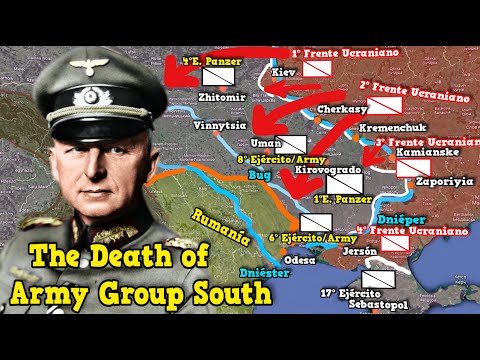
Manstein had pleaded with Hitler to fortify the Dnieper, to build a defensive line that could hold. But the Führer refused. Defensive lines in the rear, he insisted, would only encourage his generals to retreat. And so, when the Soviets reached the river in October 1943, they crossed it almost unopposed, establishing bridgeheads at will. Bukrin, Cherkasy, Kremenchuk—each one a dagger pointed at the heart of German defenses.
For months, Manstein performed miracles, shuffling his dwindling forces to plug gaps, counterattacking where he could, and praying for reinforcements that never came. But the Hydra kept growing. By mid-December, the Soviets had broken through west of Kiev, and the situation spiraled beyond control. The deep penetration near Cherkasy threatened to encircle entire German armies. Manstein begged Hitler to allow a withdrawal to the Bug River, to shorten the front and free up troops for a counterattack. Hitler refused.
On January 5, 1944, the second Ukrainian front struck toward Kirovohrad, tearing another hole in the German lines. Manstein flew to Hitler’s headquarters in East Prussia, desperate for a solution. He asked to abandon the Dnieper salient, to withdraw the 17th Army from Crimea, and to appoint a supreme commander for the Eastern Front—himself. Hitler listened, then dismissed every request. “Resist without backing down,” was the only order.
When Manstein returned to Ukraine, the chaos had only worsened. The Soviets had trapped 60,000 Germans near Cherkasy. Manstein threw five panzer divisions into a rescue attempt, including the elite Leibstandarte SS. The fighting was savage; Michael Wittmann destroyed more enemy tanks in a few days than most commanders did in a year. But the cost was unbearable. Eighteen thousand men were captured, and the rescue divisions were reduced to skeletons. The Leibstandarte, once 20,000 strong, now numbered barely a thousand.
The spring thaw brought a brief pause, but it was merely the calm before the storm. The Soviets were preparing their next blow—two massive offensives aimed at the Carpathians and Odessa. On March 5, the first and second Ukrainian fronts surged forward, advancing unstoppably toward Chortkiv. The Soviet tide was relentless, and Manstein’s army group was split in two. Hitler, furious at the retreats, dismissed Manstein on March 30, 1944. The marshal would never hold a military post again.
But the battle was far from over. The Red Army pressed on, reaching the Dniester River by April 6, encircling Odessa, and pushing into Romania. The Crimea fell a month later. In just four months, the Soviets had advanced 400 kilometers, inflicting a quarter of a million German casualties. The Wehrmacht was shattered, its reserves drained, its allies wavering. And as the spring rains gave way to summer, a new storm was gathering in the east—one that would dwarf even this catastrophe.
The collapse of Army Group South sent shockwaves through the entire German high command. What remained of the southern front was now split into two weakened army groups—North Ukraine and South Ukraine—each clinging desperately to whatever ground they could hold. The once-proud Wehrmacht, the instrument of blitzkrieg that had conquered half of Europe, was now reduced to firefighting on a front that stretched thousands of kilometers. There were simply no reserves left to plug the gaps.
For the soldiers in the trenches, the reality was even bleaker. Divisions that had once numbered fifteen thousand men were now lucky to field a few thousand. Replacements arrived in dribs—boys barely out of training, older men recalled from factories, and a growing number of foreign volunteers whose loyalty was increasingly questionable. Romanian, Hungarian, and Slovak units fought alongside the Germans, but their morale was crumbling. They had seen the Red Army up close, and they knew what was coming.
Hitler, however, refused to see the writing on the wall. In his headquarters, the Führer pored over maps and issued orders for counterattacks that existed only in his imagination. Divisions that had been destroyed weeks ago were still listed as combat-ready on his situation maps. When generals reported the truth, they were dismissed as defeatists—or worse. The gulf between the fantasy in East Prussia and the reality in Ukraine had never been wider.
And yet, even as the southern front crumbled, something far more ominous was taking shape to the north. In the vast forests and swamps of Belorussia, the Red Army was massing an armada of men and machines on a scale the world had never seen. Four Soviet fronts—over two and a half million men, six thousand tanks, and five thousand aircraft—were poised to strike at Army Group Center. The Germans, their attention fixed on the south, had no idea what was about to hit them.
The irony was brutal. Every division Hitler had rushed south to save Manstein’s crumbling front had been stripped from Army Group Center. The very reinforcements sent to plug one leak had opened a catastrophic hole elsewhere. The Germans had traded a slow defeat in Ukraine for an impending catastrophe in Belorussia. It was a strategic nightmare from which there would be no awakening.
In Berlin, the intelligence services picked up whispers of Soviet troop movements—railway traffic, radio intercepts, partisan reports—but the warnings were dismissed. Hitler was convinced the next blow would come in the south, toward the Romanian oil fields. “The Russians will attack where their objectives are obvious,” he declared. He was wrong. The most obvious target was the one he refused to see.
The stage was set. On the morning of June 22, 1944—three years to the day since the invasion of the Soviet Union—the silence of the Belorussian forests would be shattered by the greatest artillery barrage in history. Operation Bagration was about to begin, and it would destroy an entire German army group in less than two weeks. But that is a story for another day.
For now, the survivors of the Dnieper battles could only watch as the Red Army gathered its strength once more. The Hydra had grown new heads, and this time, there would be no cutting them off.
Word of Manstein’s dismissal spread through the ranks like a shockwave. Veterans who had served under him since the glory days of 1940 could scarcely believe it. “If the Marshal couldn’t save us,” one grizzled sergeant muttered to his comrades, “what chance do the rest of us have?” No one answered. They didn’t need to. The answer was written in the endless columns of refugees fleeing westward, in the burned-out tanks littering the roadsides, in the hollow eyes of men who had seen too much.
His replacement, General Ferdinand Schörner, was a different breed entirely—a fanatic who wore a monocle and carried a riding crop, demanding his soldiers fight to the last bullet. Schörner’s orders were simple: no retreat, no surrender, no excuses. He executed deserters on the spot and threatened officers with courts-martial for the slightest withdrawal. The troops despised him, but they obeyed—not out of loyalty, but out of fear.
Meanwhile, the Red Army wasted no time celebrating its victories. Fresh divisions poured westward, their tanks freshly painted with slogans like “On to Berlin!” and “Death to the Fascist Beast!” The Soviet soldiers who had survived the brutal winter fighting were now hardened veterans, their confidence soaring with every liberated village. For them, the Dnieper had been a turning point—the moment when the tide became an unstoppable flood.
But the Germans had one last card to play in the south. The Romanian oil fields at Ploiești were the lifeblood of the Wehrmacht—without them, the panzers would grind to a halt, the Luftwaffe would be grounded, and the entire war machine would seize up. Hitler was determined to hold Romania at all costs, even if it meant sacrificing the last reserves of the Reich.
Yet the Romanians themselves were wavering. Their young king, Michael, watched helplessly as German troops flooded his country, stripping it of resources and treating his people like servants. Behind closed doors, Romanian politicians began secret negotiations with the Allies. The Axis alliance was fracturing, and everyone knew it—everyone, that is, except Hitler.
As April turned to May, the spring rains finally ceased and the ground hardened. Both sides knew what that meant. The mud that had slowed the Soviet advance was gone, and the roads were once again open. The Red Army was already massing for its next great push—this time toward the Carpathian Mountains and the gates of Hungary.
In the German trenches, soldiers stared eastward at the endless columns of Soviet armor and felt a cold dread settle in their stomachs. They had no reserves, no air support, and no hope of relief. “We’re not fighting for victory anymore,” a young lieutenant wrote in his diary. “We’re just trying to stay alive until the end.” It was a sentiment shared by hundreds of thousands of men on the Eastern Front—men who had once marched east with dreams of empire, and who now simply prayed to see another sunrise.
The summer of 1944 brought no relief, only a new kind of terror. As the Red Army paused to regroup, the Germans scrambled to rebuild shattered divisions, but the losses could not be replaced. “We are bleeding to death,” one staff officer noted grimly. The once-mighty panzer armies were now skeletal, held together by a handful of tanks and the desperate courage of men who knew they were expendable.
In Romania, the situation deteriorated faster than anyone had predicted. The young King Michael, emboldened by the Soviet advance, made his move on August 23. In a single day, Romania switched sides, turning its guns on its former German allies. The oil fields at Ploiești, the lifeblood of the Wehrmacht, fell into Soviet hands almost overnight. Hitler was furious, but there was nothing he could do. The southern front had collapsed entirely.
With Romania out of the war, the Red Army poured through the Balkans, sweeping toward Hungary and the gates of Budapest. The German Sixth Army, rebuilt after Stalingrad, was once again encircled—this time in the streets of the Hungarian capital. The siege would last for months, a brutal urban battle that consumed men and material the Reich could ill afford.
By the time the autumn rains turned the roads to mud, the Wehrmacht had been pushed back to the very borders of the Reich. The Dnieper, once a symbol of German hubris, was now a distant memory—a river crossed, a line broken, a defeat that had opened the floodgates. “The war in the East is lost,” a weary staff officer wrote in his diary. “All that remains is to see how long we can delay the inevitable.”
For the survivors of Manstein’s armies, the end was no longer a question of if, but when. They had fought with skill and courage, but courage alone could not stop the Red tide. The Hydra had grown too many heads, and the Wehrmacht had run out of swords.
What do you think—was Manstein right to beg for a withdrawal, or was Hitler’s hold-at-all-costs strategy the only hope? Share your thoughts in the comments below.
Report this article
Select a reason for reporting:






