On a cold December day in 1972, construction workers near the Lea railway station in West Berlin unearthed a gruesome discovery: two skeletons buried just feet below the surface. These were the bodies of men last seen in the final, brutal hours of the Battle for Berlin. Could they be key Nazis of the Third Reich? How did they end up here?
In the chaos of April 1945, with Hitler dead and the Soviets closing in, the remaining members of the Führerbunker faced a stark choice: surrender or attempt a desperate escape through a city turned into a hellscape. Among them were Martin Bormann, Hitler’s powerful private secretary, and Artur Axmann, the Hitler Youth leader. Their flight would become one of history’s greatest mysteries.
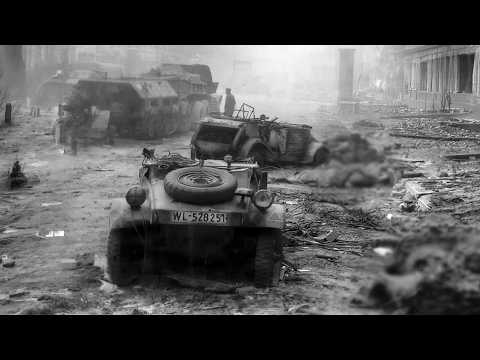
The situation was dire. Soviet forces had encircled Berlin and were fighting street to street. The bunker’s occupants were trapped in a shrinking pocket of Nazi control. “The only real chance to escape lay to the north,” where German forces still held out. But to get there, they would have to pass through Soviet lines, via a few isolated buildings in a sea of over two million Soviet troops.
For the men in the bunker, capture by the Soviets was a terrifying prospect. After years of brutal warfare and horrific war crimes on the Eastern Front, the advancing Red Army showed no mercy. “Soviet rage was most firmly aimed at the surviving Nazi leadership,” and at the top of their wanted list was Martin Bormann.
Bormann, born in 1900, had risen through Nazi ranks with ruthlessness and manipulation to become Hitler’s private secretary. He controlled access to the Führer and was intensely disliked by other Nazi leaders. “Many said he was the real power behind Hitler,” but with his chief dead, his position was precarious. He was desperate to escape Berlin and reach Grand Admiral Dönitz before his enemies could move against him.
Also in the bunker was 32-year-old Artur Axmann. A die-hard Nazi who had lost his right arm in combat, Axmann was the leader of the Hitler Youth and held considerable power. They were not alone; a host of senior generals, including Krebs, Burgdorf, and Müller, along with propaganda minister Goebbels, faced the same choice.
Most chose to attempt an escape. But how? Berlin was a wasteland of ruins, crawling with Soviet tanks and infantry. The only option was the underground railway network. “The plan, launched under cover of darkness on the evening of May 1st, 1945,” involved splitting into small groups and navigating the tunnels beneath the city.
The first group, led by Brigadeführer Mohnke, headed into the Kaiserhof U-Bahn station. Others followed, including Bormann, Axmann, and Hitler’s secretaries. They moved through the dark, damaged tunnels, but chaos soon reigned. “Bormann’s group missed a turning and emerged into a sea of flame and shellfire,” forcing them to retrace their steps.
They eventually reached the Friedrichstraße station, but the area around the Weidendammer Bridge was heavily defended. A roadblock blocked their path. “Just when all seemed lost, a King Tiger tank from the SS Nordland division appeared,” providing a momentary shield. Bormann, Dr. Stumpfegger, and others tried to break through under its cover.
But the tank was hit, and in the explosion, the group was scattered. “Bormann and Stumpfegger were tossed into the air like dolls,” and Axmann, wounded, lost consciousness. When he came to, he was alone. The escape had failed.
In the aftermath, rumors swirled. “Bormann was tried in absentia at Nuremberg and sentenced to death,” but sightings persisted for decades. Had he escaped to South America? The mystery deepened.
Then, in 1972, the skeletons were found. Forensic analysis and DNA testing eventually confirmed that one was Martin Bormann. “He had never left Berlin.” The other was Dr. Stumpfegger. Their desperate flight had ended just steps from the bunker.
But how did they die? And what of the others? The story of the escape from the Führerbunker is one of chaos, betrayal, and the last gasps of a dying regime. The hunt for the truth would take decades to unravel.
Axmann’s account, given to US intelligence in January 1948, provides the most detailed version of those final moments. He described scrambling out of a bomb crater with Bormann, Stumpfegger, and State Secretary Naumann, then following the railway tracks toward the Lehrter station. “We were intercepted there by Russians,” he recalled. Bormann ran on while Axmann stayed and talked his way past the patrol, using his wooden arm and a story about being a Volkssturm man on his way home.
But the account did not end there. Axmann claimed he then walked toward Almoabit, only to see Soviet tanks approaching and turn back. “Going back, I saw Bormann and Stumpfegger lying on their backs” near the Invaliden bridge. He recognized their faces clearly in the dim light of about 2:30 a.m. on May 2nd. Neither stirred when touched. He concluded they were dead.
For years, that testimony was treated with suspicion. Axmann was a lifelong Nazi, and his account could not be independently verified. Yet its details had the ring of truth, and much of what he described would later be corroborated in ways he could never have anticipated.
The first confirmation came quietly. The postmaster at Lehrter station contacted Dr. Stumpfegger’s wife, explaining that railway employees had found her husband’s body by the Invalidenstraße bridge and buried him nearby. He had been identified by documents and photographs. For Stumpfegger to be found in exactly the spot Axmann described would have been an astonishing coincidence given the size of Berlin and the scale of the fighting.
Then, in 1963, a retired postman named Albert Krumnow reported to police that he had buried several bodies on May 8th, 1945. Excavations around the Lehrter station followed in 1965, but they turned up nothing. The trail seemed to have gone cold once again.
Seven years later, chance intervened. In December 1972, workers laying a cable near the old station unearthed two skeletons, just twelve meters from the earlier search site. One was significantly shorter than the other. Forensic experts compared dental records, examined old injuries, and reconstructed the faces. The findings were sent to the United States for an independent opinion.
The conclusion was unmistakable. The smaller skeleton was Martin Bormann. He had never escaped to South America. He had never lived under a false name in Argentina or Peru. His war, and his life, had ended within sight of the bunker he had fled.
Even then, conspiracy theories persisted. Some claimed the dental work on the teeth was too modern, the soil staining on the skull too unusual, the whole discovery too convenient. Each claim collapsed under academic scrutiny. Finally, in 1999, mitochondrial DNA testing settled the question once and for all. The skeleton found in December 1972 was unquestionably that of Martin Bormann.
Very few of those who fled the Führerbunker avoided Soviet captivity. Most endured years of hard labor in the far reaches of the Soviet Union. Among the fortunate few were Erich Kempka, Hitler’s driver, who was captured but later escaped, and Hitler’s secretaries, who slipped away from Mohnke’s group dressed as regular soldiers.
Axmann himself acquired civilian clothing, used his wooden arm to support his story, and eventually reached the American zone. He was arrested in December 1945 and sentenced to three years in prison. After his release, he became a businessman and lived quietly until his death in October 1996, the last surviving senior Nazi.
Yet the fate of the fugitives was only one strand of the story. For the ordinary citizens of occupied Berlin, the nightmare was just beginning. Weeks of brutal reprisals for the horrors committed on the Eastern Front were meted out to men and women of all ages. In the ashes of a city that had once been among the finest in Europe lay the last charred remnants of a brutal ideology that had indelibly scarred the twentieth century and cost tens of millions of lives.
But the mystery of the Lea station skeletons was not quite the end of the affair. Even as the DNA results were announced in 1999, another question lingered: what of the second man, the taller of the two? For decades, Dr. Ludwig Stumpfegger’s fate had been treated as a footnote, a name mentioned alongside Bormann’s but rarely examined in its own right.
Stumpfegger was no ordinary physician. Born in 1910 in Munich, he had joined the SS in 1933 and risen steadily through its medical ranks. By 1944 he had become Hitler’s personal surgeon, a man trusted with the Führer’s own body. He was also, according to testimony from the bunker, the man who administered the cyanide capsules to Hitler’s children on the night of April 30th, 1945.
When the skeletons were examined, the taller figure showed signs of a healed collarbone fracture, consistent with injuries Stumpfegger had suffered earlier in the war. The dental records matched. The identification was confirmed, yet it raised as many questions as it answered.
How had the two men come to lie side by side, when Axmann insisted he had seen them both dead near the Invaliden bridge? And why had no official Soviet report ever recorded their deaths, even though Red Army soldiers must have passed the spot within hours?
The answer, it seems, lies in the sheer scale of the chaos. In the final days of the battle, Berlin’s streets were littered with thousands of bodies. Soviet burial details worked quickly, often dumping the dead into mass graves or leaving them where they fell. Two anonymous corpses in Wehrmacht uniforms would have attracted little attention.
What is certain is that Bormann and Stumpfegger never made it more than a few hundred meters from the bunker. Their grand escape, planned with such care, collapsed within minutes. Whether they died in the tank explosion, from Soviet fire, or by their own hands remains a matter of debate.
Some historians have argued that the two men, realizing escape was impossible, swallowed cyanide capsules rather than face capture. The position of the bodies, found close together and without obvious trauma, lends weight to this theory. Others insist they were cut down by machine-gun fire from the Soviet roadblock.
What is beyond doubt is that the escape from the Führerbunker was a tragedy of errors. The carefully planned route through the U-Bahn tunnels was thrown into confusion by missed turnings, damaged stations, and the constant threat of Soviet patrols above. Of the dozens who set out that night, only a handful reached safety.
The rest were swallowed by the ruins of a city they had once ruled. Some were captured and sent east to labor camps. Others simply vanished, their bodies never identified, their names never recorded. The Lea station discovery in 1972 was a rare moment of closure in a story that otherwise remains shrouded in silence.
For the families of the missing, that closure came too late. Wives and children had spent years clinging to rumors of escape, only to learn their husbands and fathers had died within sight of the bunker. “The uncertainty was its own kind of torture,” one relative later recalled.
Today, the site where Bormann and Stumpfegger fell is an unremarkable stretch of pavement near Berlin’s main station. No plaque marks the spot. No memorial recalls the desperate men who perished there. Only the trains rumbling overhead remember.
The story of the Führerbunker’s last fugitives is a reminder that history’s greatest mysteries often have the simplest answers. Bormann never fled to South America. He never lived under a false name. He died in the rubble of the city he had helped destroy, and the truth took nearly thirty years to surface.
Yet questions remain. What if Axmann’s account was incomplete? What if the two men did not die where he claimed? Do you believe the case of Martin Bormann is truly closed, or does something still not add up?
Report this article
Select a reason for reporting:






