The sky over Simpson Harbor was already bleeding orange when Lieutenant Robert Hansen rolled his Corsair inverted and pointed the nose straight into the middle of twenty-one Japanese fighters. He was twenty-three years old. He had six months of combat behind him, eighteen confirmed kills, and a transport ship waiting to take him home in seven days. He was not supposed to be flying that morning.
But a squadronmate had fallen ill overnight, and someone had to fill the gap. So Hansen strapped into the cockpit of his battered F4U Corsair—the same one that had been patched in a dozen places, the same one that had already saved his life once—and climbed into a sky that was about to become a meat grinder.
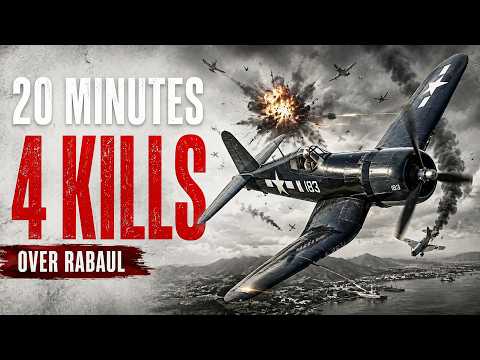
The math was simple and brutal. Twenty-one enemy fighters rising to meet eight American Corsairs and a vulnerable line of torpedo bombers. The bombers would die first, then the fighters, then Hansen. The other seven pilots held formation and waited for orders. Hansen didn’t wait. He flipped his Corsair upside down and dove alone into the center of the enemy formation.
What happened in the next twenty minutes over that harbor would earn him a nickname whispered across the South Pacific—and it would not save his life for long.
Rain had fallen over Villa Lavella in warm sheets that morning, drumming on canvas tents and pooling in the ruts where trucks had turned coral dust into red mud. It was mid-1943, and the airstrip smelled of aviation fuel, wet earth, and the choking odor of men who hadn’t washed properly in weeks. Mosquito nets hung over every cot like shrouds, and the nights filled with the drone of insects that competed with the distant roar of engines on the flight line.
The Marine Fighter Squadron 215 had just been formed—a collection of pilots pulled from training commands and reserve units to fly a new, temperamental fighter called the Corsair. Among them was a slim, sun-baked lieutenant named Robert Murray Hansen, twenty-three years old, and unlike anyone else on that airstrip, he hadn’t grown up in America at all.
He was born in Lucknow, British India, to Methodist missionary parents from Massachusetts. He spent his childhood in the heat and dust of the Indian plains, in mission schools and church compounds thousands of miles from the country whose uniform he now wore. He remembered monsoon rains that were fiercer than anything the Solomon Islands could produce, the smell of wood smoke and spice markets, and the sound of his father’s voice drifting through open windows during evening prayers.
He had crossed the ocean to study in the United States as a teenager, carrying an accent that was neither quite British nor quite American, and a habit of watching people carefully before he spoke—something some mistook for shyness. He didn’t talk much about any of it. The other pilots knew him as quiet, bookish on the ground, the kind of man who read letters from home twice before folding them and tucking them into his flight jacket. In the air, he was someone else entirely.
Hansen’s first combat tour had come earlier that summer with Marine Fighter Squadron 214, the unit that would soon be famous as the “Black Sheep” under Major Gregory Boyington. It was a squadron already filling with characters—hard-drinking, hard-flying pilots who treated the Corsair’s reputation as a dangerous, unforgiving aircraft, prone to ground-looping and known to training instructors as the “ensign eliminator,” as a point of pride. Surrounded by men who would become some of the most famous aces of the Pacific war, Hansen flew his missions quietly, engaged the enemy when he encountered them, and came away with two confirmed victories. Competent. Unremarkable. He was, by every account from those weeks, just another young lieutenant learning to trust an aircraft that killed careless pilots as efficiently as it killed the enemy.
The aircraft itself demanded a certain kind of pilot. The Corsair’s bent wings and long nose, built around a massive Pratt & Whitney engine, gave it visibility over the cowling that made every landing an exercise in precise judgment, and its narrow, flexible landing gear had already killed more than one careless pilot before he ever faced the enemy. But pilots who mastered it found themselves flying the fastest, most lethal fighter in the Pacific theater, and Hansen adapted to it with the same quiet, methodical patience he brought to everything else.
In October, he moved to Marine Fighter Squadron 215, the “Fighting Corsairs,” first based at Villa Lavella and soon advancing toward Bougainville. As the Marine advance ground through the Solomons, his new commander was Major Robert Owens, a steady, watchful man who ran his squadron with a combination of fatherly patience and hard-earned caution, having already lost pilots to the Corsair’s vicious stall characteristics before an enemy aircraft ever fired a shot at them. Owens would come to know Hansen better than anyone else in the squadron, and he would spend the coming months caught between pride in his pilot and a growing, silent dread he could not put into words during briefing sessions.
By late 1943, the war in the South Pacific had become a grinding campaign of island-hopping. Each step brought American airfields closer to the great Japanese bastion at Rabaul on the island of New Britain. Rabaul was not just a base. It was a fortress ringed with anti-aircraft batteries and stacked with fighter squadrons, watched over by observation posts on every hill overlooking Simpson Harbor. Pilots who flew there and came back spoke of it the way sailors once spoke of dangerous reefs, in hushed voices full of respect. Every Marine and Navy pilot who flew north from the Solomons understood that Rabaul was where the real war was fought, and where the casualty lists were longest.
On November 1, 1943, the First Marine Division stormed ashore at Empress Augusta Bay on Bougainville, opening a new front that put American bombers within range of Rabaul itself. Hansen was in the air that morning, providing cover over the invasion beaches, watching the gray shapes of landing craft crawl toward the shore below while the sky above filled with aircraft from both sides and the surface of the bay turned white with the wakes of ships and the spray of naval gunfire. During that cover patrol, six Japanese torpedo bombers appeared, flying low and fast, heading straight for the invasion fleet anchored off the beachhead.
A loaded torpedo bomber that broke through the defenses to reach the ships could kill hundreds of men in a single pass, tearing open a transport or a destroyer before its crew had a chance to sound general quarters. Hansen didn’t wait for orders and didn’t wait for support. He flipped his Corsair over and dove alone toward the formation of six enemy aircraft, his airspeed indicator climbing past 400 miles per hour and the sea rushing up to meet him.
What happened in the next few minutes was later recorded in almost technical prose in the citation that would accompany his Medal of Honor. Hansen attacked with such ferocity that the Japanese pilots broke formation and jettisoned their torpedoes into the sea rather than continue their runs, spoiling the strike before it could reach the fleet. In the chaos of that engagement, with tracer fire arcing in every direction, Hansen managed to shoot down one of the bombers, watching it fall away in flames, trailing black smoke toward the water.
But the men flying those bombers were not defenseless. A torpedo bomber carried a rear gunner. As Hansen closed on one of the fleeing aircraft, the gunner hit him. The bullets tore through the belly of Hansen’s Corsair, ripping fuel lines, and in seconds the cockpit filled with the sweet, sickening smell of gasoline vapor, so thick he could taste it in his throat. There was no time for a controlled landing at any airfield. Hansen put his crippled fighter down on the surface of the ocean in a violent, shuddering crash that any pilot would have counted himself lucky to survive, the canopy half torn from its tracks and seawater already flooding over the wing.
He pulled himself out of the sinking wreckage, inflated his life raft, and settled in to wait alone somewhere in the waters off Bougainville, while Japanese aircraft still prowled the skies above him and there was no guarantee that anyone had seen him go down.
He drifted for six hours. The Pacific sun beat down all afternoon. His skin, already burned from months in the tropics, began to blister, and thirst became a constant, aching presence long before there was any prospect of rescue. Every distant engine overhead might have been a rescuer or a Japanese floatplane searching for a pilot just like him. He kept his eyes on the horizon, watching the swells rise and fall, counting the minutes the way a man counts them to avoid thinking about the alternative. Six hours is a long time to spend in uncertainty, watching the light change, scanning the horizon for a silhouette that might mean salvation or might mean the end.
When darkness was close, the destroyer USS Sigourney found him. Sailors pulled the exhausted, salt-crusted lieutenant aboard, wrapped him in blankets, and brought him hot coffee while the ship continued its patrol through waters still practically within range of Japanese air power. Hansen didn’t talk much about the experience afterward, deflecting questions with the same quiet reserve that had marked him since his first day in the squadron. Within days, he was back with the squadron, back in the cockpit, flying again as if the ocean had scarcely swallowed him.
Major Owens noticed something in his young pilot after that day. Most men who went into the water and spent hours waiting for rescue came back changed, more cautious, more aware of their own fragility, flinching slightly at every engine hiccup that would once have gone unnoticed. Hansen came back sharper. If anything, the ordeal seemed to have burned away whatever hesitation had remained. He had looked at the ocean that might have been his grave and returned to the war as if the experience had settled something in his mind rather than shaken it.
The squadron didn’t know it yet, but the pilot who had just spent an afternoon alone in a rubber raft off Bougainville was about to begin the most devastating stretch of aerial combat of any Marine fighter pilot in the war. In the weeks to come, the skies over Rabaul and the harbor town below would come to know his name, though not in the way most fighter pilots hoped to be remembered. They would call him “Butcher Bob,” and the nickname was less a compliment than a description of an arithmetic, a tally of Japanese aircraft that went into the sea and did not come back up.
By the second week of January 1944, the pace of the air war over the northern Solomons had become unbearable in its intensity. Marine Fighting Squadron 215 flew escort missions almost daily, shepherding formations of Navy and Marine bombers north toward Rabaul, where the Japanese still held on with a garrison of tens of thousands of men and what remained of their aircraft despite mounting losses.
Ground crews worked through the night by lantern light, patching bullet holes, changing engines, and coaxing exhausted Corsairs back into service for missions that came faster than the aircraft could be repaired. Pilots slept in their flight suits some nights, ready to be woken before dawn for a briefing that might send them a hundred miles north into the most heavily defended airspace in the Pacific.
The squadron’s gull-winged fighters lined the runway each morning like a row of waiting hawks, their engines ticking as they cooled from the previous day’s missions. Hansen kept to himself during those long stretches between missions, writing letters that said little about what he actually did in the air, cleaning his pistol, and checking the harness of his parachute over and over with the same meticulous care he gave everything else.
On January 18, the squadron drew one of its largest escort missions yet, covering a raid on Simpson Harbor. The briefing officer marked the approach routes in red grease pencil, warned of the anti-aircraft density, and reminded every pilot in the room that Japanese resistance over that particular patch of water had gotten worse, not better, in the weeks since the new year began.
It was a savage fight. Observers counted nearly seventy enemy fighters rising to meet the American formation, a swarm dense enough to blot out patches of sky, climbing from the Rabaul fields in successive waves that seemed to have no end. In the melee that followed, formations dissolved into hundreds of separate duels, individual aircraft and pairs twisting through smoke trails and tracer fire across ten thousand feet of open air. The radios filled with overlapping shouts, warnings, and distress calls that blended into a continuous roar of noise and adrenaline.
Somewhere in that chaos, Hansen found himself alone, as he often did, separated from his wingman by a sharp turn and a sky suddenly crowded with enemy aircraft. He used the isolation rather than fighting it. He picked his targets with the same patient deliberation the other pilots remembered from his manner on the ground. He closed to point-blank range before firing rather than spraying bursts from far out like nervous, inexperienced pilots. He came down from above and behind, where the Corsair’s speed advantage mattered most and the Zero’s turning ability counted for little.
By the time the engagement ended and the American formation reassembled for home, Hansen had shot down five enemy fighters in that single afternoon. Five kills in one afternoon was the kind of thing that spread like wildfire through the squadrons. By evening, pilots from other units on the strip were passing the news around, half in admiration and half in disbelief, and some came over from neighboring tents just to see the man himself.
Hansen didn’t talk much at the debriefing table, answering the intelligence officer’s questions in short, clipped sentences, as if describing a routine training flight rather than the most productive day of aerial combat any of the men on that airstrip had ever witnessed. When another pilot clapped him on the shoulder and asked how he felt, Hansen shrugged and said it was just a job.
Four days later, on January 22, Hansen was airborne over New Britain again, and the Japanese rose to meet him again. He shot down three more that day, bringing his confirmed tally for the stretch to fourteen victories. The nickname had begun to circulate by then, whispered first as a joke, then repeated often enough that it stopped being a joke at all. Butcher Bob. Some of the men smiled when they said it, proud to have a pilot like that flying beside them. Others said it quietly, with something like unease, the way one might describe a man doing something you weren’t entirely sure you wanted to watch closely—something that seemed less like combat flying and closer to a kind of hunting in which there was no longer much room left for fear.
Major Owens watched the numbers climb with the peculiar mixture of pride and worry that military commanders develop. A pilot who could not be assigned to routine cover missions, who always found himself alone against impossible odds and somehow survived to fly again the next morning, was either the greatest asset the squadron had or a man living on borrowed time, and Owens was not sure there was a way to tell the difference before it was too late. He said as much to Hansen directly, more than once, standing beside the wing of his Corsair after a mission with the engine still ticking as it cooled. Hansen listened, nodded, thanked him for his concern, and went on flying exactly the same way the next day.
The mission that would eventually be selected for the Medal of Honor came two days later, on January 24. The squadron was providing high cover for a bomber strike over Simpson Harbor, holding altitude above the formation and watching for the kind of interception that had become routine over Rabaul by that stage of the campaign. In the middle of the maneuvering, in the constant adjustments of speed and heading that high-cover missions require, weaving to keep pace with the slower bombers without stalling, scanning the sun for the glint of enemy aircraft, Hansen lost contact with the rest of his division. One moment he was part of a formation, four Corsairs moving together as a single organism. The next he was alone, deep over enemy territory, with the bomber formation still miles ahead and no wingman to call for help if things went bad.
Below and ahead, a group of Japanese fighters was climbing into position, circling patiently, waiting for the altitude and angle that would let them fall on the American bombers with maximum advantage. It was the most dangerous moment of any escort mission, the moment just before interception, when the defending fighters still held every advantage of position while the bombers below remained unaware of the threat gathering above them. In another two or three minutes, those fighters would be diving on men who could not maneuver, who could not shoot back except with a handful of hand-held machine guns in the tail and sides of aircraft designed to carry bombs, not to fight.
Hansen made a decision that would define the rest of his short career. Instead of searching for his division or climbing for safety, the two options any flight instructor and any tactical manual would have recommended without hesitation, he turned his Corsair toward the Japanese formation and dove on it alone.
What followed became, in the dry language of his citation, a single-handed and gallant engagement against enemy interceptors. Hansen used the one advantage his Corsair held over every Zero in that formation, raw diving speed, to slash through their loose defensive circle again and again, refusing to slow enough to let their superior turning radius bring their guns to bear on him. Each pass put him in range of a different target for only seconds, long enough to fire before his momentum carried him clear and gave him room to climb and dive again. It was punishing, disciplined flying, the kind that left no margin for error, with the airframe shuddering under the g-forces of each pull-up and vision fading at the edges for a moment before it cleared again. Every maneuver was calculated on the awareness that one moment of slow, level flight in front of that many enemy guns would end the fight permanently.
By the end of the engagement, Hansen had shot down four Japanese Zeros with his guns, and a fifth had been damaged so badly it was listed as probably destroyed, though that was never fully confirmed. More importantly, the Japanese formation had been broken. Its pilots scattered and confused, robbed of the coordinated attack they had been climbing to make against the bombers below. The strike force Hansen had lost contact with completed its mission and returned home without being touched. The crews of those bombers, most of them, had no idea how close they had come to being jumped from above. No one in a position to intervene had been anywhere near them.
News of the engagement spread through the squadron faster even than the numbers from the 18th. This was not just a pilot running up a personal score. This was a single fighter breaking up an ambush aimed at an entire formation of American bombers at a moment when no one else was in a position to stop it. Whatever doubts some of the pilots had expressed about Hansen’s habit of finding himself alone against impossible odds, the events of January 24 answered them in the most convincing way possible in a war zone. It had worked.
Major Owens took Hansen aside that evening and walked with him along the edge of the runway as the last light faded over the water. The tour was nearly over. Rotation orders would send him back to the United States in a matter of days. A well-earned assignment training the next generation of Marine fighter pilots far from the gunfire and the Zeros and the long, cold hours in a life raft. Owens told him plainly that he had done enough, that no one would blame him if he spent his last week flying easy patrols well away from Rabaul instead of risking anything more. He reminded Hansen of the raft, of the six hours he had spent adrift with no certainty of rescue, and asked him, not entirely rhetorically, how many times a man could survive odds like that. No one in the squadron, no one in the entire Marine air wing operating from Bougainville, would have argued that Hansen had anything left to prove.
Hansen thanked Owens and kept flying.
Six days later, on January 30, the squadron was tasked with escorting a formation of eighteen Grumman Avenger torpedo bombers on a raid against Rabaul. Intelligence estimated as many as seventy Japanese fighters still operational at that fortress base, though the eight Corsair pilots assigned to protect the Avengers that morning had little more than hope that the actual number they would face was smaller.
Hansen walked out to his Corsair in the gray dawn light. The same aircraft he had flown through most of the month. Its fuselage patched in a dozen places where enemy fire had struck and been repaired. The big Pratt & Whitney radial engine coughed on the third try and settled into its familiar, thundering roar.
The formation climbed over the Bougainville Strait, the Avengers heavy and slow under their bomb loads, the eight Corsairs weaving above and around them in a flexible screen. Below, the water changed color with the depth of the coral reefs, from pale green to deep blue as the coastline fell away behind them. Ahead, beyond a horizon that had not yet appeared, lay Simpson Harbor and whatever the Japanese still had in the air to defend it.
Ninety miles of open water separated Bougainville from the target. Ninety miles in which there was nothing to do but climb, check instruments, and watch the empty sky for the first specks that would signal combat had found them again. The radios crackled with routine position calls as the formation crossed the midpoint, the bomber leader confirming course and altitude, the Corsair pilots answering one by one. It was the same routine every pilot in the formation had practiced dozens of times that month, familiar enough to be mechanical, and for a few minutes the ordinary rhythm of the mission made the danger ahead seem distant, almost theoretical.
The number was not smaller. As the American formation crossed toward Simpson Harbor, a large group of Japanese fighters rose to intercept them, a formation the pilots watching from below and from observation posts on Bougainville estimated at twenty-one aircraft, rising together to meet eight Corsairs and the thin line of torpedo bombers they guarded. It was an interception that, even by the standards of the Rabaul campaign, was lopsided, and every pilot in the American formation understood immediately what it meant for the Avengers below if all those fighters reached them unopposed. Eighteen slow, heavy bombers, packed with crews who had trained for months to fly straight and level through anti-aircraft fire long enough to drop their weapons, would have almost no chance against that many fighters if the interception were allowed to proceed as the enemy intended.
For a few seconds, the radio net was almost silent. Every pilot in the formation was doing the same grim arithmetic. Twenty-one against eight, with eighteen unarmed torpedo bombers in the balance. Hansen did what he had already done twice that month. He broke formation and dove alone into the middle of the Japanese fighters, committing to single combat against odds that no manual or tactical doctrine or rational calculation of survival would have recommended.
The other seven Corsairs held their positions with the bombers, watching the sky fill with tracer fire around the lone fighter tearing through the enemy formation beneath them. It was almost a familiar sight by then, Hansen alone against a swarm of enemy aircraft, using speed and altitude and the unpredictability of his diving attacks to keep any Zero from getting into a firing position behind him. He struck fast, pulled away before his speed bled off, then climbed and struck again from a different angle, refusing to give the more maneuverable Japanese fighters the sustained close combat that would have favored them. The Corsair’s advantage lay entirely in that vertical dimension, in speed gained in the dive and traded for altitude in the climb, and Hansen exploited it again and again with a discipline that left no room for the long turning fight that would have killed him in minutes.
Each time he pulled up from a firing pass, the sky behind him seemed to fill with pursuing fighters, and each time he was already gone, climbing toward the sun before they could close the gap. By the time the engagements ended and the Avengers completed their runs against the harbor, Hansen had destroyed four more enemy aircraft, and the Japanese interception had come apart just as it had on the 24th before it could do serious damage to the bombers it had been meant to stop.
The eighteen Avengers turned for home with empty bomb bays, their crews unaware of how close the morning had come to disaster. Word of the mission spread through the squadron, then through the wing, then further still, carried by war correspondents hungry for exactly this kind of story. A single Marine pilot diving into a formation three times the size of his squadron’s escort and coming out of it alive for the third time that month.
Confirming an enemy aircraft kill was not a simple matter of a pilot’s word. Each Corsair carried a gun camera that activated automatically when the trigger was pulled, and intelligence officers reviewed the developed film after every mission, matching footage of smoke and disintegrating airframes against each pilot’s account. Claims that lacked clear film or corroborating witnesses were classified as probables and kept out of the official record, however confident the pilot had been in the cockpit. Hansen’s films that week left no room for doubt. Officer after officer signed off on the kills, and the number that finally entered the squadron’s official record was not an exaggeration or a wartime rumor. It was simply what the camera had recorded.
His confirmed total now stood past twenty, closing in on the record set by Eddie Rickenbacker for the Army Air Service a generation earlier in the First World War. He was on the verge of becoming the highest-scoring Marine fighter pilot then fighting in the Pacific.
That evening at Bougainville, the squadron’s mood swung between celebration and disbelief. The pilots who had flown beside Hansen for months, who had watched him rise from a quiet, unremarkable replacement out of the Black Sheep squadron to the most dangerous and successful fighter pilot in the field, struggled to explain what they had seen him do that evening. It was not recklessness in the conventional sense. Hansen was too precise, too deliberate in his target selection and his timing for that word to fit. It was closer to an utter absence of hesitation at the moment when every other pilot in that formation would have felt it, a kind of clarity that came over him when the odds were at their worst.
Major Owens congratulated him as duty required, but he had been feeling a particular unease for weeks that a man could not keep making that choice and survive it. He had seen enough young pilots in his career to know that luck, however spectacular, was not the same as immunity, and that the arithmetic of combat eventually caught up with even the most skilled men.
Hansen had only seven days left before his transport ship was due to leave for the United States. Seven days and one combat mission in the most dangerous flying of the Pacific theater, already accomplished several times over in the eyes of everyone who had watched him fly through that month. He had, by any rational measure, nothing left to prove, and everything to lose.
The ground crews of the squadron, who had spent more hours with the Corsairs than any pilot, had their own quiet way of marking that month. They counted the patches on the fuselage, tallied the number of panels replaced, and noted any aircraft that kept coming back with damage that should have kept it on the ground for a week instead of a day. Hansen’s Corsair had become something of a legend among the mechanics themselves, an airframe that seemed to absorb punishment and come back to fight the next morning with fresh paint over patched bullet holes, as if the machine itself had adopted its pilot’s refusal to quit.
Other squadrons operating from Bougainville began asking about him too. Pilots from bomber units who owed their survival that month to a fighter escort they had never met personally. Men who knew him only as a name repeated over the radio net and in briefing rooms along the strip. It was an unusual kind of fame for a fighter pilot, built on the simple fact that the formations he flew near usually came back intact. To those Avenger crews, who were still too young to fully absorb what they had watched happen above them that morning over Simpson Harbor, Hansen was becoming less a name than a kind of quiet insurance. The reason a mission that should have ended in disaster ended instead with every bomber safely on the ground. None of them knew him personally. Most of them never would. But they knew his call sign, and they learned within a few weeks to feel a measure of comfort whenever they heard him answer a distress call.
On February 2, with his rotation orders ready and half his gear packed for the transport ship, Hansen flew once more. The mission brought him against Japanese aircraft again. Among them, according to intelligence reports filed later, were at least two types the squadron had not encountered before in that sector. When the engagement ended, four more enemy aircraft had fallen under his guns, and his confirmed aerial victories for the war totaled twenty-five.
Twenty-five kills placed Hansen among the highest-scoring Marine fighter pilots of the entire war. A score that in the end would be surpassed only by Gregory Boyington’s twenty-eight, achieved over a longer stretch of combat flying. For a pilot who had left the Black Sheep squadron with only two victories to his name and spent six hours adrift in a life raft off Bougainville convinced he would never be found, it was almost impossible to connect that number to the man himself. Quiet, reserved, more likely to be found rereading a letter from home than boasting about his kill count in the squadron tent.
The other pilots had stopped being surprised by the scoreboard weeks ago. But what they never stopped noticing was how little any of it seemed to affect him on the ground, how he still ate his meals in silence and folded his letters with the same exacting care he had always shown. His twenty-fourth birthday was two days away. The transport ship that would carry him back toward the United States, toward training assignments and staff duties and eventually whatever life awaited the son of missionaries who had become one of the deadliest pilots in the Pacific war, was waiting at anchor. The ground crews were already joking that his Corsair, patched and repatched over two months of combat, deserved a rest as much as its pilot did. Letters from home had begun arriving with questions about exactly when he would be back. Questions his parents, still on the other side of the world in their quiet corner of missionary life, could not have known he might never be able to answer.
On February 3, 1944, Hansen flew a mission that was supposed to be routine, a sweep near Rabaul alongside other pilots from the squadron, without the desperate odds or broken formations that had marked nearly every flight that had made headlines the month before. The strike went against its assigned targets as planned. There was no swarm of twenty enemy fighters waiting to be torn apart this time. No bombers hanging defenseless while Hansen dove alone into an ambush. By the standards of the previous three weeks, it was an almost quiet morning in the air.
On the return flight, the formation passed near Cape St. George at the southern tip of New Ireland, where a lighthouse stands on the point, a structure Japanese observers had used more than once to help direct anti-aircraft fire toward American aircraft passing overhead. It had become over the previous weeks a minor but persistent nuisance to pilots taking that route home from Rabaul, the kind of target that invited a quick strafing run from any flight with ammunition to spare and a few minutes before fuel became a concern.
Hansen broke away to make a strafing run on the lighthouse, flying his Corsair low and fast over the water while his guns hammered the white tower as he passed. The muzzle flashes winked in time with the gray morning light. It was the kind of low-level ground attack pass fighter pilots in every theater of the war made routinely, unremarkable in itself. It bore no resemblance to the desperate, high-altitude dogfighting that had made his name over the previous month. Dozens of pilots made identical runs every week without incident.
As he pulled up and away from the pass, flying low over water with swells higher than usual that morning, his wingtip caught a wave. Captain Harold Spears, flying nearby, saw it happen. The impact tore the controls out of the Corsair, and for a moment, according to Spears’s later account, it almost looked as though Hansen might be able to wrestle the crippled fighter into a landing on the choppy surface below. The same survival instinct that had saved his life once before off Bougainville. Then the aircraft flipped, one wing slamming into the water with terrible force, and the Corsair broke apart, scattering across the surface in seconds. There was no parachute. No life raft deploying on the surface as there had been three months earlier off Bougainville. No six hours of drifting and waiting for a destroyer to find him. Spears circled the wreckage and the spreading oil slick as long as he could, searching the water for any sign that the pilot who had survived so much might somehow survive this too. There was nothing to find.
Robert Murray Hansen was gone a day before his twenty-fourth birthday, while the ship that was supposed to carry him home still waited at anchor. The squadron’s war diary recorded his loss in a single dry line, the kind of understatement combat units use when there is not enough to say. Lieutenant Hansen failed to return from this flight. Major Owens read the entry that evening and said nothing to anyone, walking alone out to the flight line where Hansen’s tent still stood, his letters folded inside, his gear half-packed for a ship that would sail without him.
On the airstrip, the pilots who had flown with him spent that evening the way squadrons in every theater of the war had learned to spend such evenings, quietly and without much talk, each man left alone for a while with his own arithmetic of survival. That Hansen had beaten odds that should have killed him three times in a month, and that the fourth time had come on an ordinary morning while doing something as unremarkable as strafing a lighthouse, seemed to disturb them more than any dramatic loss in open combat would have.
News reached the United States within days, carried by the same war correspondents who had been filing stories about the young pilot from a missionary family who broke Japanese formations over Rabaul. A man who had survived being shot down once, who had dove alone into groups of Japanese fighters outnumbering him ten and twenty to one on three separate occasions in a single month and come back each time, had not been killed in one of those savage dogfights but on a routine strafing mission, brought down by a wave rather than enemy fire. It was an ending that seemed almost impossible to believe for the men who had watched him fly, a small, ordinary death for a pilot who had cheated so many larger ones.
Robert Hansen was posthumously promoted to captain and awarded the Medal of Honor, the citation resting specifically on his actions over Bougainville on November 1 and over New Britain on January 24, the two engagements that embodied what his fellow pilots had watched him do again and again that winter, making himself the only obstacle between a Japanese ambush and an American bomber formation, refusing each time to calculate the odds before making that choice. He also received the Navy Cross, a Purple Heart with a gold star for injuries suffered in an earlier crash, and the Air Medal, a chest full of decorations that were ultimately presented to parents who had raised their son in a mission compound in India and never imagined he would be remembered this way.
In May 1945, the Navy commissioned a new Gearing-class destroyer bearing his name, USS Hansen, returning his name to the sea aboard a warship built to hunt the same kind of enemy he had spent his last winter fighting from the cockpit of a Corsair. His body was never recovered from the waters off Cape St. George. Like thousands of other Americans lost across the vast distances of the Pacific war, he has no grave but the ocean itself, and a name carved on a memorial to the missing, alongside the many other young men who flew over that water and did not come home.
For his parents in their mission compound, the telegram arrived the way such telegrams always arrive, without warning, compressing months of pride and worry into a single rigid sentence that no citation, however eloquent, could soften. Their son, born in a country that was not his own, raised on faith and quiet discipline rather than aggression, had become the most feared American fighter pilot over Rabaul. And then, within days of orders finally sending him home, he was gone.
He had flown against odds any rational calculation would have called suicidal three separate times in a single month, alone against Japanese fighter formations outnumbering him by more than ten to one. And on that last morning over Rabaul, when more than twenty-one enemy fighters rose to meet eight American Corsairs escorting Avengers against odds of more than twenty to one, that was the moment he broke formation and dove in alone. Each time, his answer was the same. He turned toward the largest concentration of enemy aircraft in the sky and flew straight into it alone, trusting only his aircraft’s speed and his own steady hands to bring him out the other side. It was an answer that stunned the pilots of the entire South Pacific theater. The veterans of Guadalcanal and the Slot and every island fought over in between, men who had seen so much by that stage of the war and were rarely surprised by anything a fellow pilot did in the air. Twenty-five confirmed victories, a Medal of Honor, and a nickname that began as an uneasy joke and ended as a simple description. Butcher Bob Hansen survived the fighters of Rabaul, its anti-aircraft guns, and the full weight of everything the Japanese Empire could put in the air to stop him, only to be lost at last in the same ocean that had once given him back on a quiet morning when no one, least of all the men who watched him fly, expected to lose him at all.
So here is the question that lingers over that water off Cape St. George: was it luck that finally ran out, or a man who had simply decided, long before that last morning, that he would never turn away—and what would you have done with those seven days left?
Report this article
Select a reason for reporting:






