On a sweltering morning in August 1964, the Gulf of Tonkin erupted in fire and thunder. U.S. Navy aircraft screamed over the water, their bomb bays opening to release a new kind of weapon—one that would go on to shape every major conflict for the next sixty years. That weapon was the Mark 80 series, and its most famous variant, the Mark 82, was about to make history.
But this isn’t just a story about a bomb. It’s a story about ingenuity, adaptation, and the relentless pursuit of precision. From the jungles of Vietnam to the deserts of Iraq, the Mark 82 has been the invisible hand of air power—always present, rarely acknowledged. And its journey is far from over.
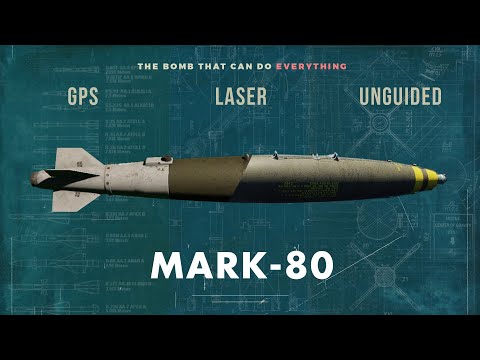
In the early 1950s, the U.S. military faced a problem: its stockpile of gravity bombs was a mishmash of World War II relics and newer designs, each with its own quirks and limitations. The Mark 80 series was conceived as a solution—a family of four bombs ranging from 250 to 2,000 pounds, designed with a revolutionary aerodynamic shape that reduced drag and improved stability.
At the heart of this innovation was Ed Heinemann, a self-taught engineer at Douglas Aircraft. His studies in 1946 led to the Aero1A shape, which the Mark 80 would adopt. With a length-to-diameter ratio of 8:1 and fuse wells in the nose and tail, the bomb was not only more lethal but also more efficient, allowing aircraft to carry more and fly faster.
When the Vietnam War broke out, the Mark 80 was thrown into the crucible. Within months, it proved its worth in everything from carpet bombing to bridge strikes. The Snake Eye modification, with its retarded tail fins, allowed low-level attacks without catching crews in their own shrapnel. But it was the Mark 82—the 500-pound workhorse—that truly shone. Its balance of size and power made it ideal for a wide range of missions.
However, combat revealed a flaw: the smallest variant, the Mark 81, was too light to be effective. It was pulled from service, only to be revived decades later for precision roles. Meanwhile, a tragic incident aboard the USS Forrestal in 1967 led to safety overhauls, including thermal coatings to prevent cook-offs. From that point on, Navy and Marine Mark 80s sported distinctive yellow bands—a mark of survival in the harshest conditions.
By the war’s end, the Mark 80 family had become the most efficient gravity weapon in the U.S. arsenal. But its evolution was just beginning. The need for precision would soon transform it into something far more deadly.
In the decades after Vietnam, the Mark 80’s true potential began to unfold—not as a dumb bomb, but as the backbone of precision warfare. The Paveway series turned it into a laser-guided marvel, and the results were staggering. During the 1972 Linebacker II campaign, laser-guided Mark 84s destroyed the infamous Dragon’s Jaw Bridge with a single strike—a target that had survived hundreds of unguided bombs. The age of precision had dawned, and the Mark 80 was at its center.
But engineers weren’t done. The 1980s brought Paveway II and III, with folding fins and proportional guidance that made the bombs deadlier and easier to store. In 1986, Operation El Dorado Canyon saw Paveway II bombs strike Libyan targets with surgical accuracy, proving the design’s worth on the global stage. Then came Desert Storm, where laser-guided Mark 80s became the weapon of choice for coalition forces, shattering Iraqi tanks and bunkers with unprecedented efficiency.
Yet even as Paveway bombs dominated, a new problem emerged: lasers couldn’t see through dust, smoke, or clouds. In 1992, the U.S. Air Force launched a bold program to create a bomb that could guide itself without any external input—using the Global Positioning System. The result was the Joint Direct Attack Munition, or JDAM, a kit that bolted onto the Mark 80 and turned it into an all-weather precision weapon.
The first test in 1993 was a direct hit. By 1999, during the Kosovo War, JDAMs were ripping through clouds and rain to strike targets with devastating accuracy. The Mark 82, now a GBU-38, could be dropped from 15 miles away and land within 10 feet of its target—no laser needed. It was a game-changer, and the Mark 80 family had evolved yet again.
As the new millennium dawned, the Mark 80 was no longer just a bomb. It was a system—a modular platform that could be fitted with laser seekers, GPS kits, or even wings for extended range. From Afghanistan to Iraq, the Mark 82 and its larger siblings became the go-to munitions for close air support, their small size and precision minimizing civilian casualties while maximizing destruction of enemy positions.
But the story doesn’t end there. In recent years, new upgrades have pushed the Mark 80 even further. The addition of inertial navigation systems and anti-jam GPS has made it harder to disrupt. And with the rise of drone warfare, the Mark 82 has found a new home on unmanned aircraft, proving its adaptability once again.
Yet for all its technological leaps, the Mark 80’s core design remains virtually unchanged since the 1950s. The same aerodynamic shape that Ed Heinemann conceived in 1946 still guides it to targets today. It is a testament to the genius of simplicity—a weapon that was built to be cheap, reliable, and effective, and that has remained so for over six decades.
As the U.S. military looks to the future, the Mark 80 shows no signs of retirement. New guidance kits, new warheads, and new platforms continue to breathe life into the design. In an era of hypersonic missiles and stealth drones, the humble Mark 80 remains the unsung hero of air power—always present, rarely acknowledged, and utterly indispensable.
The next chapter is already being written, with advanced seekers and networked guidance on the horizon. And when the next conflict erupts, you can bet the Mark 80 will be there, just as it has been since that sweltering morning in the Gulf of Tonkin.
To understand why the Mark 80 has endured, you have to look beyond the battlefield and into the factory floor. The bomb was designed for mass production from the very start—its simple steel casing, standardized fuse wells, and modular components meant that any machine shop with basic tooling could churn them out by the thousands. During the Vietnam War, production lines ran around the clock, and the same philosophy holds today. A Mark 82 costs roughly $16,000—a rounding error compared to the million-dollar missiles that often miss their mark.
That cost advantage has a strategic dimension. In a prolonged conflict, the side that can replace its munitions fastest wins the attrition game. The Mark 80 family was built with that brutal arithmetic in mind. Its components are interchangeable across variants, and even the guidance kits—Paveway, JDAM, or newer systems—can be swapped in the field with minimal training.
But perhaps the most surprising chapter in the Mark 80’s story is its role in a domain its creators never imagined: urban warfare. In the crowded streets of Fallujah and Mosul, the Mark 82’s small blast radius and precision guidance made it the weapon of choice for rooting out insurgents without leveling entire neighborhoods. Its ability to be dropped danger-close—sometimes within 100 feet of friendly troops—earned it a grudging respect from ground commanders who once dismissed air power as too blunt an instrument.
That flexibility extends to the bomb’s growing role in maritime strike missions. Recent exercises have seen Mark 82s fitted with new seekers designed to track and destroy fast-moving naval targets. The same bomb that once pounded the Ho Chi Minh Trail now threatens warships in the South China Sea. It is a remarkable reinvention for a design that predates the transistor.
Meanwhile, the Mark 80’s legacy is being reshaped by emerging technologies. The U.S. Navy has begun testing a new variant called the QuickSink, which adds a hardened nose and delayed fuse to the Mark 82 for anti-ship missions. And in a nod to the future, the Air Force is experimenting with 3D-printed guidance fins that can be produced in forward theaters—cutting logistics chains from weeks to hours.
Yet for all these advances, the Mark 80’s most enduring quality may be its simplicity. In an age of cyber vulnerabilities and supply chain fragility, a bomb that works without a software update is a rare asset. It can be loaded by hand, armed by a single technician, and dropped from anything with a bomb rack—from a Cold War-era F-4 Phantom to a modern F-35.
As the sun sets over another testing range, a lone F-15E banks hard and releases a Mark 82. The bomb falls, its fins making tiny corrections, and strikes a mock bunker with a flash and a plume of smoke. The dust settles, and the range officer nods. Another successful test. Another chapter in a story that began seventy years ago and shows no sign of ending.
But the true measure of the Mark 80 isn’t found in test ranges or production figures. It’s found in the stories of the crews who trusted it with their lives. Pilots who dropped it from treetop height in Vietnam, who watched it thread through clouds over Kosovo, who called it in danger-close over Helmand—they all describe the same thing: reliability. When everything else fails, the Mark 80 works.
That trust was earned the hard way. In 1972, a single laser-guided Mark 84 ended a bridge’s decade-long defiance. In 1991, dozens of them turned Iraqi armor into scrap in minutes. In 2003, a JDAM-equipped Mark 82 killed a senior al-Qaeda leader with a single bomb through a sandstorm. Each time, the weapon did exactly what it was asked to do—no drama, no excuses.
Today, the Mark 80 family stands at a crossroads. New competitors like the Small Diameter Bomb and hypersonic glide vehicles promise speed and standoff range the old bomb can’t match. Yet the Pentagon’s budget requests keep funding Mark 80 production lines, year after year. The reason is simple: nothing else offers the same mix of cost, quantity, and proven performance.
And as the character of war shifts toward great-power competition, that math matters more than ever. A conflict in the Pacific would demand thousands of munitions, not dozens—and only the Mark 80 family can be surged to that scale. Its factories can run three shifts a day; its kits can be assembled in weeks, not years.
So the next time you see grainy footage of an airstrike, look closely at the weapon that falls. It may look like a simple gray cylinder, but it carries seventy years of history in its steel. From the Gulf of Tonkin to the skies over Kyiv, the Mark 80 has been the constant companion of air power—always present, rarely acknowledged, and utterly indispensable.
The sweltering morning of 1964 feels distant now. But the bomb that screamed over the water that day is still flying, still fighting, still evolving. Its story is not one of glory, but of quiet, relentless service. And it is far from over.
So what do you think—has any other weapon in modern history matched the Mark 80’s combination of longevity, adaptability, and sheer effectiveness? Share your thoughts in the comments below.
Report this article
Select a reason for reporting:






