July 1944. The Texas sun was already burning when a bus full of captured German women rolled through the red dust of Camp Hereford. They had been told they were going to prison. They expected guns, fences, and hunger. But as the dust cleared, they saw something strange. Real cowboys, men on horses wearing wide hats, singing under the open sky. The women blinked. Were they dreaming? Had they stepped into an American movie?
The smell of leather and hay replaced fear. The sound of hooves echoed through the fields. This was not war anymore. It was freedom, wild, loud, and real. And for these women, it would change everything they thought they knew about America, about enemies, and even about themselves.
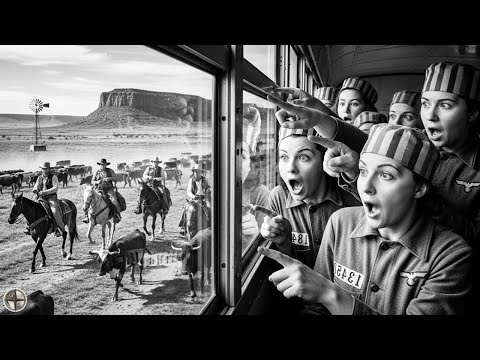
Inside the bus, 32 German women wiped sweat from their faces. Most had been nurses, clerks, or volunteers with the Red Cross. Now they were prisoners of war. They had crossed the ocean expecting wire fences, armed guards, and cold metal beds. Instead, the first thing they saw made them blink in disbelief.
Out in the open field, men on horseback moved through clouds of dust. Their wide hats shaded tanned faces, their boots clicked with silver spurs, and their ropes swung in slow circles as they guided cattle across the plain. The smell of animals and sunbaked grass drifted through the air.
One of the prisoners, Greta Schneider, whispered to the woman beside her, “Are those real cowboys?” The guard, half smiling, said quietly, “Ma’am, that’s Texas for you.”
It was a strange sight for women raised on discipline and steel. Back home, Germany’s fields had been full of soldiers and orders, not singing men on horses. Here, there was rhythm, but no shouting, work, but no fear. The women pressed their faces against the glass, trying to understand this new kind of order. One built not on control, but on balance.
The bus engine clicked as it cooled, and a cowboy tipped his hat toward them as if welcoming guests, not enemies. When they stepped down from the bus, the ground felt soft with dust, not the hard gravel of a prison yard. The guards were calm, almost casual. There were fences, yes, but inside those fences, the air smelled of hay and fresh bread from the kitchen.
Camp Hereford held over 5,000 prisoners that summer. Most were men from captured German divisions, but a few women had been sent to help with hospital and clerical work. America had space, food, and too few hands to harvest it all. Every pair of hands mattered, even those once opposed to it.
That first night, Greta lay on a bunk and listened. No bombers, no air raid sirens, no barking commands, only crickets and the distant low of cattle. For the first time in years, she could see stars through the barracks window. “It’s too quiet,” one of the nurses whispered. “I don’t trust it.” But another answered softly, “Maybe peace sounds like this.”
The next morning, the camp commander explained their new duties. “Texas needs workers,” he said. “Cotton to pick, cattle to tend. You’ll be paid small wages, treated fairly, and expected to work hard.” He paused, looking around the room. “You are prisoners, but you are also human beings. Remember that.”
For many of the women, it was the first time an officer had spoken that word, human, with respect. The paradox was sharp: captured by the enemy, yet freer than they had been in years. Outside the mess hall, they saw the same cowboys riding by. Their laughter carried on the wind. Greta thought they looked like something from a movie. But movies were lies. This was real. And that made it even harder to believe.
Over 425,000 German prisoners were held in America during the war, scattered across more than 500 camps. About 4,000 worked on Texas ranches and farms. They picked cotton, repaired fences, and learned that the enemy was not always what they had been told. Camp Hereford was one of the largest, stretching over 700 acres of dry grassland. To the women who had known bombed cities, it looked endless.
As evening came, the sun fell red over the plains. Greta watched a cowboy ride along the fence line, silhouette sharp against the light. He wasn’t a guard, but somehow he kept order just by being there, quiet, calm, certain. She realized that control didn’t always need shouting. Sometimes it came from trust between rider and horse, between people and the land. It was a kind of discipline she had never been taught.
The camp dogs barked once, then went quiet. The heat softened, and the smell of supper, beans, cornbread, and smoked meat, drifted through the barracks. The women lined up in silence, still unsure what to expect. One of them whispered, “Maybe tomorrow they will wake us with whips.” Greta shook her head. “No,” she said, staring out at the fading orange sky. “These people don’t need whips. They have freedom.”
But this was only the beginning. What they would see next out on the open range would challenge everything they had learned about work, control, and what it meant to be civilized.
The next morning, the women woke to the sound of a bell and the smell of coffee. The Texas sun was already bright through the small windows. Greta sat on her bunk, still half in disbelief that this place, calm, dusty, and full of laughter, was a prison. Guards walked by, but they didn’t shout. They carried clipboards, not rifles. It felt more like a work camp than a jail.
After breakfast, a tall American officer stepped forward. “Ladies,” he said, his voice firm but kind. “You are prisoners of war, but under the Geneva Convention, you have rights. You’ll work. You’ll be paid, and you’ll be treated with respect. You’ll be helping local farmers and ranchers. Texas needs help.” The room stayed silent. Then he added, “We’re short on men. Our young farmers are overseas fighting in Europe. The crops still need planting, and the cattle still need care. You will help us keep this country alive while the war goes on.”
The women looked at each other, confused. Back home, they had been told Americans were cruel, that they treated prisoners like animals. Yet here they were being asked to work, not beaten, not starved. The paradox was almost too much to understand. They had come as enemies, but the Americans were handing them gloves and tools, not weapons.
Outside, a truck engine rattled. Wooden signs showed the names of local ranches. Henderson, Miller, Carson, all waiting for labor crews. Around 10,000 prisoners across Texas were already working on farms by mid-1944. They picked cotton, built fences, harvested wheat, and even helped in canning factories. The United States Army called it the prisoner work program. For many Americans, it was a strange sight: German soldiers wearing denim instead of uniforms, working side by side with civilians.
That afternoon, Greta and her group were assigned to a ranch called Double H, fifty miles away. The camp commander explained, “You’ll stay there for months. You’ll earn eighty cents a day, paid to the US Army, not to you. You can buy small things from the camp store. Soap, paper, stamps. Fair enough.” The women nodded slowly. Some were grateful. Others stayed cold and silent. They didn’t trust kindness from their captors.
As the truck bounced along the dirt road, the women stared out the windows. The land stretched forever. Yellow grass, windmills turning, cattle moving like slow shadows. They passed small wooden houses, old barns, and fields of corn. Every few miles they saw families working the soil: mothers, children, even old men. It hit them then. America was fighting a world war, yet its land was still alive and growing.
Greta thought about home. Her town in Saxony had been bombed twice. Fields were burned, families scattered. Here, everything seemed untouched. She whispered, “So much land and so few soldiers.” Another prisoner replied, “Maybe this is why they can fight so far away. Their farms still stand.”
When the truck reached Double H Ranch, the first thing they saw was a tall man leaning against a fence post. His name was Jim Henderson, the ranch owner. He looked them over with quiet eyes and said, “Welcome to Double H. You’ll be treated fair if you work fair.” His wife, Maria, brought out a tray of water and cornbread. The women hesitated. Prisoners didn’t expect to be offered food, but Maria smiled. “You’ll need strength for what’s ahead.”
That night, they slept in a small wooden bunkhouse that smelled of hay and soap. The sound of horses breathing outside was strangely peaceful. Greta couldn’t sleep. She thought about the officer’s words. You have rights. It sounded simple, but in a war that had taken millions of lives, it felt powerful.
The camp reports said it clearly. Prisoners in Texas produced over 90,000 tons of food and helped save more than 2,000 farms from collapse during the war. Their labor wasn’t just tolerated. It was vital. And it worked because of a simple rule the Americans believed in: work could bring order, and respect could build peace faster than punishment.
Before dawn, Maria knocked on the bunkhouse door. “Time to get up. You’re Texans now,” she said, half joking. The women laughed quietly. The sky outside was still gray, the air cool and sweet. Greta stepped out and saw the horses lined up in the corral, their breath like smoke in the morning air. Somewhere in her chest, something shifted. Fear turning slowly into curiosity.
This was not the war she had known. This was something else. And what they would learn next, when they touched saddle leather and felt the earth move beneath a living animal, would change their idea of control forever.
The morning sun turned the sky gold as the truck rolled away from Camp Hereford. Dust rose behind the wheels like smoke. The German women sat in the back holding their small bags, unsure what to expect. They had been prisoners, nurses, and secretaries, not farmers. Now they were being sent to a ranch in the middle of Texas to live and work among cowboys.
Greta sat by the wooden railing, her hair tied back with a piece of cloth. Every mile felt like a journey to another planet. The land was wide and quiet, broken only by windmills and herds of cattle moving slowly across the plains. “It looks empty,” one of the women said. “No soldiers, no war.” Greta nodded. “Maybe that’s what peace looks like.”
After a few hours, the truck stopped beside a wooden gate with two big letters burned into it. Double H Ranch. Beyond it, the land stretched as far as they could see: fences, barns, and horses running free. A tall man walked toward them, his shirt sleeves rolled up, his boots dusty. This was Jim Henderson, the ranch owner. His handshake was firm and his voice calm. “Morning, ladies. I’m Jim. You’ll be working here with my wife, Maria, and a few ranch hands. We’ve got a lot to do before the next roundup.”
The women looked at him with surprise. No insults, no barking orders, just a simple welcome. Maria stepped out from the porch, her brown hair tied back, carrying a tray with tin cups. “You look thirsty,” she said, handing out cold water. “We’ll get you settled before the heat rises.”
The prisoners were led to a bunkhouse near the barn. Inside were wooden bunks, blankets, and shelves for clothes. It smelled of soap, hay, and old wood. Greta touched one of the beds and whispered, “It’s clean.” In a war where everything had turned to rubble, a clean bed felt almost unreal.
Later that afternoon, Jim explained the rules. “You’ll work eight hours a day,” he said. “No one will carry a gun. You’ll be watched but not chased. You’ll eat the same food we do. You follow orders. You stay safe.” The women nodded slowly. It sounded fair. More than fair, it sounded human.
He handed out work clothes: old jeans, cotton shirts, and wide-brimmed hats. “You can’t do ranch work in those uniforms,” he said with a grin. The women looked down at themselves. Their gray German uniforms were stiff reminders of who they had been. Maria spoke softly. “Try these. They’ll make you one of us.”
When Greta pulled on the rough denim, it felt strange, heavy, but also freeing. It was the first time in years she wore something that wasn’t marked by war. That evening, Maria showed them around. “That’s the barn. Horses are fed at sunrise, the corral for training, and out there,” she said, pointing at the horizon, “that’s work you’ll learn to love, even if it breaks your back.”
The women laughed nervously. One of them asked, “Do you trust us not to run?” Jim shrugged. “Where would you go? The next town’s thirty miles away, and the sheriff knows every stranger in these parts. Besides,” he added with a small smile, “you’ll find there’s nowhere else you’d rather be.”
Dinner was served under the porch roof: beans, fresh bread, and strong coffee. It wasn’t much, but it was warm and shared. Greta had never eaten at the same table as her captors. Yet here there was no captor, only people trying to live through the war in their own ways. “You’ll earn a little each day,” Jim told them. “You can buy small things from the commissary. Postcards, candy, soap. You’ll see that hard work pays in any language.”
That night, the sound of crickets filled the dark. Greta sat by the window, watching the moon rise above the ranch. She thought about her brother fighting on the eastern front, about the ruins of her city, and about this strange land that seemed untouched by war. It was hard to hate people who gave you bread and spoke gently.
She opened her diary and wrote in small handwriting: Today I met a man who wore a hat instead of a helmet. His horse listened better than most soldiers I’ve known. The bunkhouse fell silent as the women drifted to sleep. Outside, the wind rustled through dry grass, and the distant sound of horses echoed like waves on a faraway sea.
Greta didn’t know it yet, but this ranch would change her more than any battlefield could. Tomorrow she would touch a saddle for the first time, and with it she would begin to learn the American way of trust, not by command, but by balance.
Report this article
Select a reason for reporting:






