Imagine waking up one morning to find soldiers storming your home, your father dragged away, and your entire world erased. For the children of Sultan Abdul Hamid II, this was not a nightmare—it was reality. In 1909, the Ottoman Sultan was overthrown, and his family was cast out of the palace, their titles stripped, their wealth confiscated. They went from gilded halls to cramped hotel rooms, from servants to poverty, scattered across foreign cities where no one knew their names. This is the untold story of what happened to the children of the last powerful Ottoman Sultan.
Abdul Hamid II ruled for 33 years with absolute power, but his fall was swift and brutal. On the night of April 27, 1909, he was deposed and exiled to Thessaloniki, along with 38 members of his household. His children—some of them adults, others just toddlers—were left behind in Istanbul, expelled from the palace and forced to fend for themselves. The family would never recover.
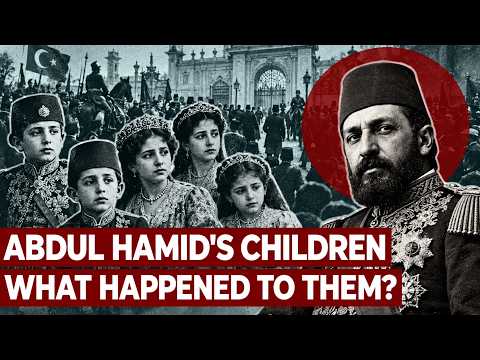
His eldest son, Şehzade Mehmed Selim, was 39 and had been the obvious heir. But instead of the throne, he inherited exile and financial ruin. He ended up in Lebanon, dying in obscurity in 1937. His daughter Zekiye Sultan, once her father’s favorite, spent her final years in a modest hotel room in France, buried far from the empire she once knew. “An Ottoman princess, the daughter of a sultan who ruled 25 million people, dying in a French hotel room.”
The sons fared no better. Şehzade Burhaneddin ended up in New York City, working ordinary jobs, his grandson Ertuğrul Osman living in a walk-up apartment in Manhattan for decades. “The grandson of a sultan, who played in a 285-room palace, riding the subway.” Another grandson, Abdul Karim, took his own life in Queens in 1935 after a failed scheme to incite rebellion in Central Asia.
The exile decree of 1924 was the final blow. Every member of the dynasty was expelled from Turkey—men given 24 hours, women a week—forbidden from taking assets. Properties were seized, bank accounts frozen. “Centuries of wealth vanished overnight.” The family scattered to Lebanon, France, Albania, the United States, and beyond. Some, like Refia Sultan, died young in Beirut. Others, like Sadia Sultan, lived to 90, outliving the empire itself.
But the story is not just about loss—it’s about survival. The children of Abdul Hamid II carried a name that once shook empires, but in exile, it meant nothing. They had been trained for roles that no longer existed: princes as soldiers, princesses as musicians. “They were people without a country and without a purpose.” Yet the bloodline endured. Today, descendants live ordinary lives, some still fighting for confiscated properties, others simply bearing the weight of history.
This is the beginning of their story—a saga of power, betrayal, and resilience that spans continents and generations. But the most haunting question remains: what happens when the mighty fall? For the children of Abdul Hamid II, the answer is a century of displacement, a slow fade into anonymity, and a legacy that refuses to die.
But to truly understand how complete that fall was, you have to look at the ones history tends to skip over—the consorts, the mothers, the women who had spent their lives inside the harem’s velvet cage and were now expected to survive on nothing. Pavevest Hanım, a consort the Sultan had honored with the Order of the Medjidie, ended up in a cramped apartment on Via General Orsini in Naples, robbed blind by the very servant she trusted to collect her allowance. The mother of a prince, begging in a foreign city.
The letters tell the story better than any chronicle. Ottoman princes wrote to British officials, to French ministries, even to the rulers of India, pleading for money to keep the lights on. Researchers who uncovered these letters called them heartbreaking—grown men, raised as soldiers and statesmen, humiliating themselves for a few pounds. And still London blocked most of it, terrified that a single lira reaching the wrong pocket might revive the caliphate.
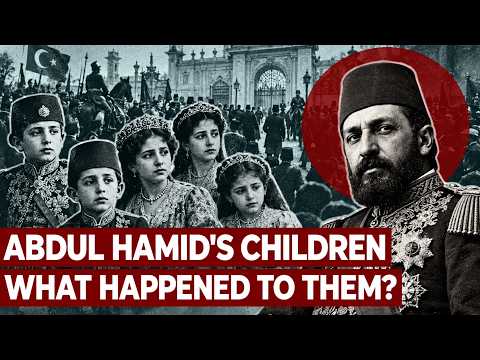
Then there was the inheritance myth. Word spread that Abdul Hamid had stashed a fortune in foreign banks, and a handful of shady companies advanced dynasty members small sums to chase the claim. It was a mirage. Historians now describe the whole affair as a coordinated effort between London and Ankara to make sure the family never saw a penny. One more door slammed shut.
And yet, in the middle of all this ruin, there were moments that were almost absurd in their dignity. When Ertuğrul Osman finally returned to Turkey in 1992 after fifty-three years, the prime minister offered him a private tour of Dolmabahçe Palace. He refused. He joined the ordinary tour group instead, shuffling along with the tourists, listening to the guide explain his own family’s house to him. He did not want to fuss, he said.
That is the strange afterlife of a fallen dynasty—princes who once commanded armies now queuing behind schoolchildren to see their own bedrooms. The Osmanoğlu name survives today in Istanbul law offices and New York apartments, in Syrian childhoods where teachers hurled insults at boys for ancestors they never met. The line continues; the power does not.
But the exile decree of 1924 was not the end of the story. It was only the beginning of a long, slow unwinding—one that would stretch across decades, through world wars and new republics, and would leave the family’s fate tangled in the politics of a century. And it is there, in the years after the expulsion, that the strangest chapters of all begin to unfold.
Because the decree did not just scatter the family—it also created a new kind of Ottoman, one who had never seen the Bosphorus. Children were born in exile who spoke French or English or Arabic before they ever heard a word of Turkish. They carried the most famous surname in the Muslim world and could not read a single line of the history it came from.
Take the case of Dündar Ali Osman, Abdul Hamid’s great-grandson. Born in Damascus in 1930, he grew up in a household where the past was present but the future was thin. His father, Şehzade Mehmed Abdülkerim—the same man who had fled to New York after the Japanese scheme collapsed—had died by his own hand when Dündar was only five. The boy was raised by relatives who had nothing to give him but the name.
He studied in Beirut, then drifted through the Middle East doing clerical work, always one step ahead of poverty. For decades he lived in a modest flat in Damascus, receiving visitors who came to pay respects to a prince with no principality. When he finally returned to Turkey in the 1990s, he wept at the sight of the Bosphorus. He had spent sixty years imagining a place he had never seen.
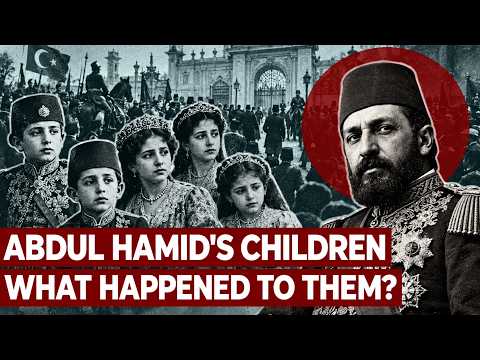
And then there is the question of the women who returned. The 1952 law letting princesses back into Turkey created a strange homecoming. Women in their sixties and seventies, who had left as young brides, came back to a republic that had erased their world. They found their palaces turned into museums, their gardens into parking lots, their names struck from the record.
Some of them did not last long. The climate, the culture, the memories—it was too much. One princess reportedly walked through the halls of Dolmabahçe as a paying visitor, stopped before a portrait of her father, and had to be helped to a bench. The guide, not recognizing her, kept talking.
But the most persistent ghost of all was the money. For generations, the family believed that somewhere—in Swiss vaults, in London banks, in the Ottoman public debt—there was a fortune waiting. Lawyers were hired. Claims were filed. Committees were formed in Paris and New York and Istanbul, each promising to recover what had been stolen.
In the 1980s, a Turkish researcher named Edhem Eldem began digging through the Ottoman archives and found something unexpected. The Sultan’s personal fortune, vast as it appeared, had been almost entirely tied up in imperial properties that legally belonged to the state. When the monarchy fell, there was shockingly little private wealth to seize. The gold that the family remembered had mostly been spent on railways, palaces, and the endless cost of ruling.
It was a cruel revelation. The exile had not been a robbery—it had been a liquidation of something that was never really theirs. The princes had inherited a myth, and the myth had no cash value. Some refused to believe it. Others, quietly, began to let the dream go.
And yet the family kept multiplying. By the 1970s, the House of Osman had grown to several hundred people, scattered from Brazil to Australia. They married into English gentry, Lebanese merchant families, American academia. The bloodline that had once been guarded like a state secret was now diluted into the ordinary gene pool of the twentieth century.
There were reunions, occasionally. In the 1990s, a grand gathering was organized in Istanbul, and dozens of Osmanoğlus flew in from around the world. They met in a hotel ballroom, strangers bound by a name. Old women wept. Young men in suits shook hands and exchanged business cards. For one evening, the dynasty existed again—not as a power, but as a family.
But even that was complicated. Arguments broke out over who was the rightful head of the house, over which branch had been slighted, over money that may or may not have existed. The old court intrigues had survived the empire that spawned them. The harem’s whisper was replaced by the lawyer’s letter.
And through it all, the Turkish republic watched with a mixture of suspicion and nostalgia. Every few years, a newspaper would run a story about a prince driving a taxi in Paris or a princess working as a seamstress in Cairo. The public ate it up—the romance of the fallen mighty. But the family itself rarely spoke. They had learned that attention brought no advantage.
By the time the twenty-first century arrived, the story had almost faded. The last of Abdul Hamid’s grandchildren were dying off, and the great-grandchildren were too busy with mortgages and school runs to dwell on the past. The name Osmanoğlu still opened doors in some circles, but it also raised eyebrows. In the new Turkey, the Ottoman legacy was a political football—celebrated by some, cursed by others.
And then, in 2009, Ertuğrul Osman died in Istanbul at ninety-seven, and the world briefly remembered. Obituaries ran in every major paper. The last Ottoman, they called him. A man who had ridden the subway in New York and queued with tourists in his own palace. A man who had said, quietly, that he had no desire to reclaim a throne.
His funeral was a strange affair. Dignitaries came. So did ordinary Turks, curious to see the end of an era. The coffin was draped in the Ottoman flag—a flag that no longer existed as anything but a symbol. And as the prayers were recited, it was impossible not to think of all the others who had died in exile, buried in small cemeteries in France and Lebanon and Queens, waiting for a homecoming that never came.
Ertuğrul’s death closed a chapter, but not the book. His successor as head of the house, Bayezid Osman, was born in Paris in 1924—the very year of the decree—and lived quietly in New York for decades, a librarian’s son who never saw the throne his ancestors had occupied. He died in 2017, the first head of the house never to have lived in Turkey at all.
Then came Dündar Ali Osman, the weeping child of Damascus, who finally took the title in 2017 at eighty-six. He held it for just three years before dying in Istanbul in 2021—home at last, buried in the land his great-grandfather had ruled.
Today the house is headed by Harun Osman, a great-great-grandson of Abdul Hamid, living an ordinary life in Turkey. The fortune never materialized. The palaces are museums. The titles are words on a family tree. And yet every few years, a new descendant steps forward, files a claim, or simply visits Dolmabahçe and stands before the portraits.
One hundred and sixteen years after the soldiers marched through the gates, the children of the last powerful Sultan are still scattered, still ordinary, still carrying a name that once shook the world. What do you think—should the modern Turkish state return what it confiscated, or was the exile the only way forward?
Report this article
Select a reason for reporting:






