New York City, 1780. The war for independence rages on, but in the drawing rooms of the Schuyler mansion, another battle is being waged—one of wit, longing, and forbidden desire. Alexander Hamilton, a rising star in General Washington’s army, is known for his sharp mind and even sharper tongue. But when he meets Angelica Schuyler, the eldest daughter of the wealthy and influential Schuyler family, something shifts. She is not like the other women who flutter their fans at him. She matches him quip for quip, her intellect as dazzling as her charm. “I’m a general,” he might have said. “Why so hesitant?” she could have replied, her eyes flashing with a challenge. But there’s a problem: Angelica is already married.
In the musical Hamilton, their connection is electric—a love story that never was, a what-if that haunts the stage. Angelica sings of her inability to be with Hamilton because she lacks wealth, but the truth is far more complicated. The real Angelica had already eloped with John Barker Church in 1777, and by the time she met Hamilton, she was a mother of two. Yet the letters they exchanged crackle with an intimacy that borders on the scandalous. “I wish you were here,” she wrote to her sister Eliza, Hamilton’s wife, “so I could borrow your husband for a while.” Was it a joke between sisters, or a window into a deeper longing?
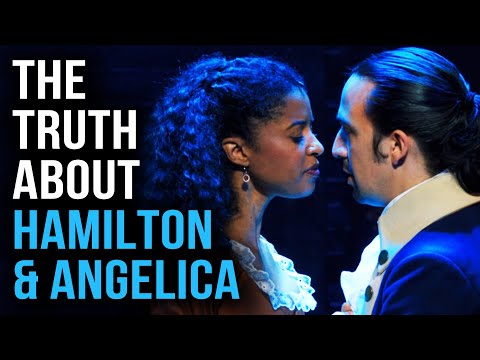
Historians agree: there was no physical affair. Angelica was fiercely loyal to Eliza, and the three were inseparable—so close that Angelica was buried beside her sister and brother-in-law. But the emotional bond between Alexander and Angelica was undeniable. They were intellectual equals in a world that rarely allowed women such ground. “She was the one person who could keep up with him,” one biographer noted. In an era when letters were the primary means of courtship, their correspondence blurred the lines between friendship and flirtation.
So what really happened behind closed doors? The musical takes liberties, exaggerating the romance for dramatic effect. But the truth is no less compelling. Angelica was not the tragic heroine forbidden from love by poverty—she was a married woman navigating the delicate balance of family loyalty and personal desire. And Hamilton, ever the charmer, found in her a kindred spirit. “If she had been unmarried,” Ron Chernow wrote, “Hamilton might have proposed to her instead of Eliza.” That single possibility has fueled centuries of speculation.
As the curtain rises on their story, one thing is clear: the line between history and legend is as thin as a letter’s page. And in the space between words, a love—or something like it—flourished.
The letters tell their own story. In one, Angelica teases Hamilton about his reputation, calling him a flirt who cannot help himself. He fires back with equal wit, but there is a warmth beneath the banter that feels less like friendship and more like a secret shared. “You are a dangerous man, Alexander,” she might have written, and he would have laughed, knowing she meant it.
Yet the stage version compresses time and emotion, turning a slow-burning correspondence into a breathless romance. On Broadway, Angelica sings of being forced to marry for money, of stepping aside for her sister. In reality, she had already chosen her path years before Hamilton entered her orbit. Her marriage to John Barker Church was a scandal in its own right—an elopement that defied her father’s wishes. She was not a woman waiting to be saved; she was one who had already saved herself.
Still, the musical’s most poignant invention is the idea that Angelica introduced Hamilton to Eliza out of selflessness. In truth, the three became close quickly, their bond forged in the chaotic energy of war and ambition. Angelica’s loyalty to Eliza was fierce, almost maternal. She would never have betrayed her sister, not with a touch, not with a word. But the heart is not always obedient to loyalty.
Consider this: when Angelica wrote to Eliza asking to “borrow” her husband, she was thousands of miles away in Europe, surrounded by the formality of diplomatic life. Perhaps the joke was a way of reaching back toward the intimacy of those early New York days. Perhaps it was a test—to see if Eliza would laugh, or if she would sense the ache beneath the words. Eliza, ever trusting, likely laughed. But Hamilton, reading over his wife’s shoulder, might have felt the ground shift beneath him.
The musical gives Angelica a solo where she declares she will never be satisfied. It is a powerful moment, but it belongs to the stage, not the archive. The real Angelica was satisfied—or at least resigned—to a life of duty and intellect. She hosted salons, advised her husband, and raised children. But in her letters to Hamilton, there is a flicker of something else: a hunger for the life of the mind that only he seemed to understand.
Historians caution against reading too much into these exchanges. Eighteenth-century correspondence was performative, full of florid language and exaggerated sentiment. Yet even by those standards, the Hamilton-Angelica letters stand out. They are playful, yes, but also probing. She asks about his ambitions; he asks about her reading. They trade opinions on politics and poetry. “You are the only woman I know who reads as I do,” he wrote to her once, and she kept the letter until her dying day.
The keeping of that letter matters. Angelica Schuyler Church was not a sentimental hoarder; she burned what did not serve her. The fact that Hamilton’s words survived her careful curation suggests she understood their worth—not as evidence of scandal, but as proof that someone had seen her mind and found it beautiful.
And what of Eliza? The musical paints her as the wronged wife who burns her correspondence in fury, erasing herself from the narrative. The real Eliza was made of sterner, quieter stuff. She did not burn letters; she preserved them. After Hamilton’s death, she spent decades assembling his papers, defending his legacy, and founding orphanages in his name. If she suspected a deeper intimacy between her husband and her sister, she carried it with the same dignity she carried everything else.
Perhaps that is the truest tragedy of the story—not a love triangle, but a triangle of loyalty. Angelica loved Eliza too much to betray her. Eliza loved Angelica too much to accuse her. And Hamilton, caught between two women who understood him better than anyone alive, loved them both in ways that defied easy categories.
There is a scene in the musical where Angelica, watching Hamilton and Eliza together, sings the word “helpless” with a break in her voice. It is a brilliant theatrical choice, but it is also a lie. The real Angelica was never helpless. She was calculating, ambitious, and deeply aware of the consequences of her choices. When she married John Barker Church, she chose passion over propriety. When she befriended Hamilton, she chose intellectual kinship over romantic fulfillment. These were not the decisions of a woman undone by love.
Yet the letters remain. In one, Hamilton addresses her as “my dear, dear sister”—the repetition a tell, perhaps, of something he could not say plainly. In another, Angelica writes of missing him with an ardor that would raise eyebrows in any era. “I am sure you would laugh if you saw how often I think of you,” she confessed, and then, as if catching herself, added a line about the weather.
Historians like to draw a clean line: flirtation, not consummation; affection, not adultery. And they are almost certainly right. But the line feels less like a boundary and more like a wound that never quite healed. The musical understands this instinctively, even as it bends the facts. It gives us a love story that never happened because the real one—messier, quieter, buried in letters and shared glances—was too complicated for a three-minute song.
So when Angelica steps forward on that stage and declares she will never be satisfied, she is not speaking for the woman who eloped with a British officer and charmed the courts of Europe. She is speaking for the ache that lives in all of us—the ache of wanting something just beyond reach, of loving someone the world will not allow you to have.
The real Angelica would have understood that ache. She lived with it for the rest of her life.
And so the story closes not with a kiss, but with a letter never sent. Angelica returned to Europe, to her husband, to the life she had chosen. Hamilton stayed in New York, building a nation and a legacy, his pen never still. Their correspondence continued—sporadic, warm, careful. “I have not forgotten you,” she wrote in 1790, “nor ever shall.” He replied with the same measured affection, the same careful distance.
When Hamilton died in 1804, Angelica was in London. She mourned him quietly, far from the public grief that consumed Eliza. Years later, she returned to New York and stood beside her sister at the gravesite. “We were both his, in different ways,” she might have whispered, and Eliza, ever silent, might have nodded.
The musical ends with Eliza stepping forward, gasping, asking for more time. It is a powerful image—the woman who outlived them all, who preserved the story. But the real Eliza was not gasping. She was writing, organizing, defending. She built orphanages and schools. She lived to be ninety-seven. And she never once spoke publicly of Angelica’s letters, or of what they might have meant.
Perhaps that is the final truth: the story belongs not to the historians or the playwrights, but to the women who kept it. Angelica kept Hamilton’s letters. Eliza kept everything else. Between them, they preserved a man’s legacy—and a secret that was never quite a secret, never quite a scandal.
“Who lives, who dies, who tells your story?” the musical asks. The answer, for Hamilton and Angelica, is the women who loved him—each in her own way, each with her own silence.
Now it is your turn to decide: was it love, or was it something else entirely—a meeting of minds too rare for its time, too dangerous to name? What do you think really lived in those letters? Tell us in the comments below.
Report this article
Select a reason for reporting:






