May 24, 1969. Quang Tri Province, South Vietnam. The jungle ridge erupted in fire and chaos as an entire North Vietnamese Army regiment descended upon 135 Montagnard soldiers and their Australian commander. Within minutes, the defensive perimeter collapsed. Soldiers fled. American advisers withdrew. And 36-year-old Warrant Officer Keith Payne, shrapnel already embedded in his skull and hands, made a choice that would echo through generations.
He went back. Not toward safety. Not toward survival. But into the darkness of enemy-controlled jungle, alone, to find the wounded men he refused to abandon. What followed was nine hours of hell—a one-man rescue mission against impossible odds.
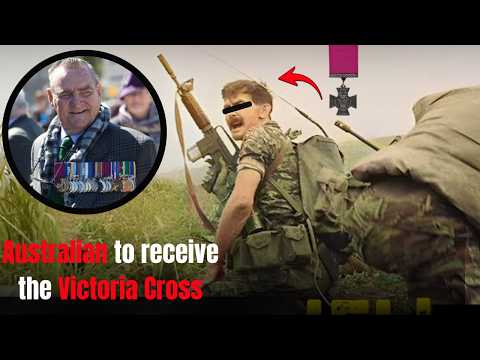
Keith Payne was no stranger to war. Born in 1933 in Ingham, Queensland, he grew up during the Great Depression, one of 13 children. His father went to war when Keith was young, leaving the family to survive on their own. By 11, Keith was working—picking potatoes, delivering milk, doing whatever it took to keep the family alive. School became secondary. Survival came first.
When World War II reached Australia’s doorstep, North Queensland lived under constant threat of invasion. Towns dug trenches and held air raid drills. Young Keith joined the regimental cadets at 14, carrying rifles and full military equipment. “We didn’t know what the situation was in the world,” he later recalled. At 17, after punching his apprentice master at a cabinet-making shop and getting sacked, he walked straight to Brisbane and enlisted in the Australian Regular Army.
Korea shaped him. Arriving in 1952 at just 18, Keith went straight into the line with the 1st Battalion, Royal Australian Regiment. The war had stabilized into brutal static positions, with both sides dug in, patrolling and fighting in bitter winter conditions. “The older soldiers from World War II couldn’t stand the cold,” Keith remembered. “They shifted them out and sent us young ones. We stood the cold, but believe me, it was bloody hard.”
Seven and a half months later, Keith became a casualty—wounded and evacuated by helicopter to Japan. At 19, he returned to Australia as a wounded veteran. But the army had become home. Over the next 15 years, he built a career as a professional infantry soldier: hunting communist insurgents in Malaya, training indigenous soldiers in Papua New Guinea, earning diving and parachute qualifications, mastering small-scale raid tactics. He became the kind of soldier others wanted leading them—competent, calm under pressure, someone who genuinely cared about the men under his command.
In February 1969, Keith was posted to the Australian Army Training Team Vietnam. He’d been waiting for this deployment, trained for it, understood what it meant. By May, he was appointed company commander of the 212th Company, 1st Mobile Strike Force Battalion—135 Montagnard soldiers, indigenous mountain people recruited to fight the North Vietnamese. Good troops, loyal, but inexperienced. Keith had them for just one week of training before the battle that would change everything.
That week revealed something about his leadership. After a small firefight, Keith noticed his soldiers weren’t firing accurately. “Bugger, I know,” he said. So he requested and got a week’s training cycle—not for himself, for them. Marksmanship, fire discipline, working together as a unit. “After that training, suddenly on the next operation, I had four soldiers around me, self-appointed bodyguards,” Keith recalled. “I thought, well, I must be on a good foot here.”
The Montagnard soldiers couldn’t pronounce Keith. They called him Kit. And Kit became like family. “They stuck by me and that’s why I had to stick by them,” Keith said simply. “You do those things.” This loyalty—earned through respect and training—would become crucial on May 24th when everything went to hell.
The 212th Company moved into position on a ridge near Ben Het camp on May 23rd. Intelligence indicated enemy activity, but nothing suggested what was actually coming. At 18:30 hours on May 24th, the North Vietnamese Army attacked with overwhelming force—elements of the 66th NVA Regiment, approximately 2,000 soldiers, hitting 135 defenders from three directions simultaneously.
“We were holding them,” Keith recalled. “I was using grenades, rifle fire, machine gun fire, but it got too heavy because the enemy started closing in on our right flank. We had to withdraw.” In those first minutes, Keith was hit—shrapnel from a grenade burst lodging in his skull, arms, and hands. Blood ran into his eyes. His left hand barely functioned. He kept fighting.
The defensive perimeter collapsed. The battalion commander and American advisers withdrew with remnants of other companies. Keith Payne’s company was being overrun. Standard doctrine: fighting withdrawal, preserve combat effectiveness, extract to fight another day. Keith made a different choice.
“I decided to try and get some of the wounded off the hill,” he said. He organized a covered withdrawal, positioning himself at the rear—the most dangerous position—throwing grenades and firing to buy time for soldiers to escape. About 50 made it down the ridge toward friendly lines. Then Keith went back.
Into the darkness. Into enemy-controlled jungle. Alone. Hunting for the wounded who couldn’t walk, couldn’t escape, couldn’t survive without help. Hunting for his men—the ones he promised he wouldn’t abandon.
He found the first one within minutes—a young Montagnard soldier with shattered legs, curled against a fallen log, crying softly. He’d heard the enemy patrols passing, had felt their footsteps through the earth, and had been certain he’d been left to die. When Keith knelt beside him, the boy’s eyes went wide with disbelief.
“I came back,” Keith whispered in broken Vietnamese, one hand covering the soldier’s mouth to keep him quiet. “You’re going home.” He fashioned a drag harness from equipment webbing, hooked it around his own shoulders, and began pulling the boy through the jungle toward a rally point he’d marked on his mental map. Every few meters he stopped, listened, waited for the flashlights to sweep past.
Then he went back for another. And another. A soldier with a sucking chest wound, barely conscious, his breathing a wet rattle. Keith dressed the wound with the man’s own bandage, gave him water, carried him in a fireman’s carry as far as his ruined left hand would allow, then dragged him the rest of the way. Then back again.
The North Vietnamese knew someone was out there. They heard sounds—snapping twigs, a muffled groan, the scrape of a body through undergrowth. They hunted for whoever was evacuating wounded from the battlefield. Three times Keith hid in vegetation while enemy soldiers passed within touching distance. Once, a flashlight beam caught him and a wounded soldier square in the face. Keith froze. The wounded man stopped breathing from fear. After an eternity, the light moved on.
The enemy were looking for a large rescue force. They couldn’t conceive that one wounded man was doing this alone. And that was the only advantage Keith had—their assumption that no one would be that reckless, that stubborn, that loyal.
Around midnight, he’d consolidated about 27 wounded soldiers at a rally point. Most could walk with assistance. Some had to be carried. All were exhausted, in pain, terrified—but alive because one man refused to leave them. He organized them into a column: walking wounded supporting each other, the most seriously injured on improvised stretchers. Keith positioned himself at the rear, covering the movement, making sure nobody fell behind.
They moved at perhaps 100 meters an hour. Painfully slow. Every step a small victory. Every sound a potential compromise.
At 0320 hours, the column ran into a North Vietnamese listening post. A brief, vicious firefight erupted in the dark. Keith charged the position with his rifle, emptied his magazine, killed two enemy soldiers, scattered the rest. The firing stopped—but the damage was done. Every NVA unit in the area now knew where they were. Behind them, voices shouted commands, equipment rattled as troops mobilized. The hunt was on.
For three hours, Keith led his column through jungle in darkness, pursued by forces that outnumbered them twenty to one. Several times, the rearmost soldiers reported seeing flashlights behind them. Twice, rifle fire cracked overhead. Keith kept them moving. “Stay quiet,” he whispered down the line. “Stay with me. We’re going home.”
At 0520 hours, with dawn approaching, Keith spotted the perimeter of an American firebase—two kilometers from where the battle had started. He approached cautiously, identifying himself, guiding his column in. American soldiers stared in disbelief at the blood-soaked Australian warrant officer leading 40 wounded Montagnard soldiers out of jungle controlled by an NVA regiment.
The American base commander approached, his face a mask of astonishment. “How the hell did you get them out?”
Keith’s response became legendary. “I didn’t consider I was risking my life. I considered I was doing the job I was sent there to do—the one I volunteered to do.”
Then his legs gave out. Medics rushed forward. His wounds were worse than he’d acknowledged—shrapnel in his skull, hands, and arms, multiple lacerations, severe dehydration, borderline shock from blood loss. He’d been operating on adrenaline and will for nine hours. Now that his men were safe, his body admitted it couldn’t continue.
The citation for Keith Payne’s Victoria Cross, read at formal ceremonies, cannot capture what those soldiers experienced that night. The official words speak of “heroic personal efforts and exceptional bravery.” They don’t speak of the fear, the darkness, the certainty of death transforming into hope.
When Kit came back, one of Keith’s self-appointed bodyguards tried to explain years later. “We heard him in the darkness whispering our names. We thought we were dead. The Americans had left. Our officers had left. Then we heard Kit. He came back. He kept his promise.”
Another soldier Keith rescued said simply: “He was our father, our brother, our commander. We knew Kit was truly a warrior.” Forty men who would have died or been captured survived because one man refused to abandon them. Forty families exist today because Keith Payne kept a promise.
Keith received his Victoria Cross from Queen Elizabeth II aboard the Royal Yacht Britannia in Brisbane on April 13, 1970. He became a freeman of his hometown. A park was named after him. But none of the medals captured what the night actually cost him—because May 24th, 1969 never truly ended.
Post-traumatic stress was a term that barely existed in 1969. Keith came home sick with ulcers, was hospitalized, given a weekend leave pass, met by dignitaries—then sent back. “There I am, just been awarded the Victoria Cross, and this young soldier hands me a weekend pass. That was the welcome home.”
The decades that followed were harder than any battle. “Time went by and I started feeling sort of lost,” Keith admitted. “Being a bit of a bloody menace in the house. It was post-traumatic stress. Little things crop up and all of a sudden it comes to the fore.” Florence, his wife of 70 years, provided the stability that kept him alive. “If our love for one another hadn’t been as strong as it is, I probably wouldn’t have lasted.”
In 1978, Keith lost his first mate to suicide from PTSD. The death hit him like a mortar round. He discovered the government’s response was nothing—lock them in asylums and forget them. “That’s simply not on. Not on to the veteran community, not on to those prepared to give their life for their country.”
Keith Payne’s second war began then and continues today. Not fighting enemy soldiers, but fighting bureaucracy and indifference. He worked to establish the Keith Payne Unit at Greenslopes Hospital in Brisbane, a dedicated facility for veterans with PTSD. “There’s 27 vets there now with post-traumatic stress, seven of whom are suicidal,” he said recently. “We can’t let it go another generation.”
At 92 years old, with failing eyesight and hearing loss, Keith Payne remains the oldest living Victoria Cross recipient in the world. He still fights for his mates. “Pride is not mine,” he said after receiving his VC. “Pride is for the people who were with me that night.”
This humility defines him more than any medal. He didn’t rescue 40 men for glory. He rescued them because they were his responsibility, his soldiers, his brothers. Leaving them was never an option.
The Ridge in Quang Tri Province was Keith’s first battlefield of national recognition. The halls of government, the offices of bureaucrats, the hospitals where veterans seek help—these are his battlefields now. And he fights them with the same courage and refusal to quit he showed on May 24th, 1969.
Keith Payne came back for 40 men in 1969. And he’s been coming back for veterans ever since. That’s what warriors do. That’s what heroes do. That’s what Keith Payne does.
No one gets left behind. Always has. Always will.
If you take one thing from Keith Payne’s story, let it be this: the promise to never abandon a mate doesn’t end when the guns fall silent. What promise will you keep for someone who needs you today?
Report this article
Select a reason for reporting:






