My mother’s text arrived on a Tuesday in May, tucked between a photo of her tomato plants and a reminder about Aunt Carol’s birthday. It said: “Your sisters-in-law are coming this year. No room for you and the kids. Maybe next year.” I read it twice, wooden spoon in hand, then typed back the only thing I’d ever learned to say: “No problem, Mom. Have fun.”
For ten summers, fourteen of us had spent the third week of June at the beach house on Topsail Island. This year, there would still be fourteen. They just wouldn’t include me, my twelve-year-old daughter, or my nine-year-old son, who had been crossing days off the calendar since Easter.
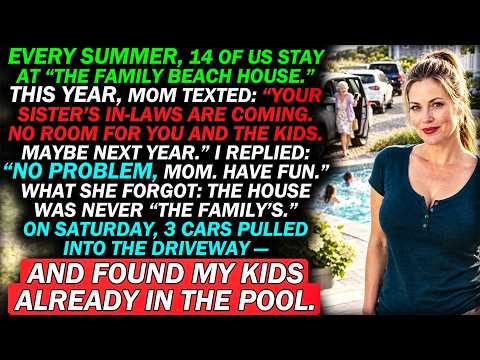
Here is what my mom had decided to forget: The house was never the family’s. For a decade, every tax bill had come to my mailbox. Every insurance premium. Every repair. I was the one who bought it from my grandfather when his stroke emptied his savings—paid the appraised price, $385,000, so he could get every dollar he needed for his care. I signed a thirty-year mortgage in my name alone.
My mom cried with relief in the hallway that day. “You saved Dad’s house,” she said. My grandfather took my hand in his good right hand and held it longer than he needed to. “Keep the door open for them, Nikki. Just don’t let them forget whose door it is.”
I promised him I would. I meant it. But over the years, I only ever remembered the first half.
Mia found my phone on the counter twenty minutes later and read the text before I could turn it over. She’s twelve, and she reads the way I do—fast and all the way to the end. She didn’t say anything at first. She just put the phone down very carefully, the way you set down something that might break. Then she asked, “Is it because of us?”
I told her no. I said Grandma just had a full house this year. It was the kind of answer I’d been giving my whole life—smooth and harmless—and I watched her decide not to believe it.
Owen came skidding in from the living room in his socks, wanting to know if he could bring Great Grandpa Walt’s fishing rod this time, the long one with the cork handle. Last summer he’d been too short to cast it. I didn’t have the heart to answer him, so I asked him to set the table.
After dinner, Mia dried the dishes beside me without being asked. When the last plate was in the cabinet, she said very quietly, “You always say no problem, Mom.” Then she went upstairs.
I stood in the kitchen for a long time. Before bed, I moved my mother’s number to the top of my favorites, so I would call her in the morning.
I called her the next day at lunch from the parking lot of a dental office in Durham, where a burst pipe had flooded three exam rooms. I’m a property claims adjuster. I spend my days in other people’s worst weeks, measuring water lines and asking who owns what. I tried to sound light. “Hey, Mom, I got your text. I was just wondering about the bunk room. The kids don’t need much.”
She sighed the way she does when she has already decided something and resents having to explain it. “Nicole, Richard and Elaine have never seen the house. Lauren and Pete are bringing their two little ones. Brooke wants it to be just right. You know how those people are.” Then she said the sentence I would turn over in my head for weeks: “It’s Brooke’s turn to host.”
I asked, “Host where, Mom?”
There was a pause long enough for me to hear her kitchen radio in the background. “Don’t start,” she said. “You know what I mean. You’ve always been the flexible one.” She suggested I take the kids down in August when it was quiet and cheaper to be on the island anyway. As if cheap had anything to do with it. As if August were a favor.
I said, “Okay.” I didn’t argue. I didn’t explain. I hung up and a minute later she sent me a red heart. And for the first time in my life, I didn’t send one back.
I sat there with the sandwich going warm and the word host sitting in my chest like a stone. Because I remembered a time ten years earlier when nobody in my family had wanted to host anything at that house at all.
It was the fall of 2016. My grandfather, Walt Dorsey, had a stroke in March. He was eighty-one, stubborn, a retired shrimp boat mechanic who still drove himself to the hardware store every morning. The stroke took the feeling out of his left hand and the speed out of his words. He needed months of rehab and then an assisted living apartment near my parents in Greensboro, and none of it was cheap.
We sat around the kitchen table at the beach house one Sunday in September. My mom had a yellow legal pad covered in numbers. My dad stared at the coffee maker. My sister, Brooke, was on speakerphone from Atlanta. Grandpa sat at the head of the table looking out the window at the strip of ocean you could just see between two other roofs.
My mom finally put her pen down and said, “We’ll have to list it. There’s no other way.”
Brooke said over the speaker, “I can’t help you guys. We’re barely making rent.” Nobody else said anything. My dad had his pension and not much else. Grandpa didn’t say a word. He just kept looking at that strip of water like he was trying to memorize it.
I was thirty-five. Mia was two years old and asleep in the bunk room. I had some savings, a steady job, and a decent credit score. And before I could talk myself out of it, I said, “What if I buy it?”
Everyone turned to me. I said I would pay the appraised price, the same as any stranger, so Grandpa could get every dollar he needed for his care. We had it appraised that month. $385,000. I emptied my savings for the down payment and signed for a thirty-year mortgage in my name alone.
We closed in October at a little title office in Hampstead with a fake ficus in the corner. My mom cried with relief and hugged me in the hallway and said, “You saved Dad’s house.” Our neighbor at the beach, Hal Benning, Grandpa’s fishing buddy, drove him there and sat in the back of the room in his good shirt.
Afterward, in the parking lot, Grandpa took my hand in his good right hand and held it longer than he needed to. He spoke slowly because by then everything he said took effort. “Keep the door open for them, Nikki. Just don’t let them forget whose door it is.”
I promised him I would. I meant it. But over the years that followed, I only ever remembered the first half of what he said.
The next June, everybody came, the same as always. I didn’t make an announcement. I didn’t want anyone to feel like a guest in a place they had loved for decades. So I kept the door open and quietly did the rest.
The property tax bills came to my mailbox. So did the wind and flood insurance, which on that island costs more than some people’s rent. When a hurricane peeled half the shingles off in 2018, I paid for the roof. When I got divorced in 2019, I traded away my share of our retirement account so I could keep the house. And I never told my family that part.
In the fall and winter, a local management company rented it out on weekends, which covered some of the mortgage. In the summer, it belonged to everyone free of charge. Nobody ever asked how the lights stayed on. I don’t think it occurred to them, and for a long time I liked it that way. It felt like a gift that didn’t have to be thanked.
One summer my dad noticed the new hot water heater and said, “Huh, that’s nice,” and went back to his crossword. Another summer my mom collected forty dollars from every adult for a new gas grill and handed me the receipt to hold onto for the family records. I paid the extra two hundred at cost and put the receipt in a drawer.
Hal Benning, sitting on his porch next door, would sometimes catch my eye while I was dragging the recycling bins to the curb on a Sunday morning. He never said anything. He would just lift his coffee cup an inch, like a man saluting someone at a funeral.
Somewhere in those years, my mom started calling it the family house. After Grandpa died in 2021, she started calling it Dad’s house. When Brooke married Tyler Whitaker in 2023, they took their wedding photos on the back deck at sunset, and Brooke posted them with the words, “Our family beach house, where it all began.”
Last summer I had the pool resurfaced and the old pump replaced. It came to $9,800. On the first night, my mom stood at the edge of the water with a glass of white wine and raised it toward my sister. “To Brooke,” she said, “for keeping this place going.” Brooke had made the grocery list that year. Everyone clinked glasses. I clinked mine, too. I didn’t say a word. I just watched the new blue water catch the porch lights.
Standing beside that pool, I felt the way I used to feel when I was fourteen. That was the year my parents moved us to a bigger house in Greensboro, and I picked the bedroom with the window that looked out at the big oak in the backyard. I spent a whole weekend arranging my books on the windowsill. Then I came home from a sleepover and found my things already packed in cardboard boxes in the hallway.
Brooke was eight, and she had decided she was scared of the dark in the small room, and the window would help. My mom didn’t ask me. She just smoothed my hair and said, “You’re the flexible one, honey. Brooke needs things to be just so.”
I carried the boxes into the little room myself. I hung my posters back up that night. My mom came to the doorway, looked around, and said, “That’s my easy girl.” I remember how warm that felt. I have spent thirty years earning that sentence, one small surrender at a time.
My mother’s red heart went unanswered, and I sat in my car with the word host still lodged in my chest. Then my work phone buzzed: a tropical storm had hit Wilmington, and a live oak had opened a ninety-one-year-old man’s kitchen like a can.
At the claim, his three grown children stood in the yard arguing over insurance money. When I asked whose name was on the deed, it was only the youngest daughter’s. “I bought it when Dad’s money ran out,” she said, arms crossed. Her brothers called her a thief in front of the neighbors. I recognized that look—the one that says I’ve been paying all along—so completely I had to walk around the house.
That night, Tasha told me, “Paperwork doesn’t make people kind, Nick. It just tells you who gets sued.” I went home and hugged my kids. Owen was marking his height on his bedroom door frame. “The beach one has everybody,” he said. Mia asked, “Are we still family if we’re not there?” I said yes, but it sounded thin.
Two weeks later, a lock alert: code 0614 used. No renters were booked in June. Hal told me Brooke had been out back with a contractor, measuring. The quote was $48,000, paid by Richard Whitaker, Brooke listed as owner. My mother’s text made sense now: that week wasn’t a vacation—it was a showing.
I called the contractor and refused to authorize the work. When Brooke called, bright and urgent, I asked, “Did you tell them it’s your house?” She said, “You just hold the paper.” I said, “I hold the mortgage, Brooke. I pay the taxes. I paid for the roof and the pool.” She hung up. My mom drove up with a peach pie and an offer: skip this year, and I could have July—just me and the kids—in my own house. “No, Mom,” I said. “I’m not signing it.” At the door she said, “I never thought you’d be the selfish one.”
That night I texted the group: “The kids and I are going down Friday for our week, like always. Your guests are welcome in the rooms that are free.” My mom begged me not to. Brooke wrote, “Don’t you dare show up.” I didn’t answer. I didn’t explain. I let the words sit there, plain and true.
Friday morning we drove down. I typed 0614 into the keypad, and the lock gave. The kids ran straight for the pool. Saturday at 3:40, three cars pulled in. Elaine stepped out of the minivan, saw my children splashing, and asked, “Who are these two?” Brooke’s face went white. “Nick, you mixed up the dates, didn’t you?” I set my iced tea down. “No mix-up, Brooke. This is our week.”
Richard Whitaker didn’t raise his voice. He took out his phone, looked up the county records, and read the screen aloud: “Owner, Nicole A. Lambert. Deed recorded October 2016.” From next door, Hal’s gravelly voice floated over the hedge: “I was at the closing. Walt cried like a baby.”
My mom tried one last time. “Tell them you would never take it away from this family.” I said, “I’ve never taken anything from this family, Mom. I’ve given you this house every summer for ten years. This year, I was told there was no room in it for my children.” Richard called the contractor and canceled the check. They left. My dad stayed. He fired up the grill and said, “I should have said something ten years ago.”
Five weeks later, Brooke texted that she and Tyler were seeing a counselor. I wrote back, “Whenever you’re ready, I’m here.” Then my cousin Jenna called—the first person in a decade to ask for the house. I said of course. On Labor Day weekend, my phone lit up with Mom. She asked if she and Dad could come down Sunday, just for the day. “Let me check the calendar,” I said. “Sunday works. Come for lunch.”
After we hung up, Mia handed me her carpenter’s pencil. “Your turn,” she said. I stood against the pantry frame and she drew a line on the top of my head and wrote Nicole 2026 right next to Grandpa’s blocky capitals. I still keep the door open, just like I promised him. I’ve only learned to remember the whole sentence.
What would you have done that Saturday—let them in, or kept your keys in your pocket?
Report this article
Select a reason for reporting:






