The war was supposed to be simple: find the enemy, fight, survive. But in the hedgerows of Normandy, the line between friend and foe blurred into a nightmare that would haunt two soldiers forever.
This is the story of a friendly fire incident that HBO’s Band of Brothers never showed—a moment of tragic confusion involving Buck Compton and Joe Liebgott that remains one of Easy Company’s most painful secrets.
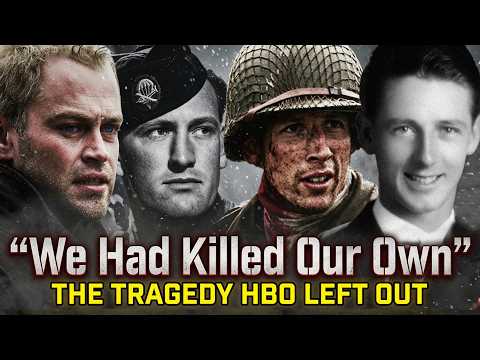
In the summer of 1944, Easy Company was still reeling from the assault on Brecourt Manor. The men were exhausted, their nerves frayed. Compton and Liebgott were on patrol at dusk, scanning the perimeter of a fortified position. Across a field, about fifty yards away, two figures moved slowly along another embankment.
They wore German camouflage ponchos. One carried a German hunting rifle—Compton recognized the silver disc on the stock where the sling attaches. They were Germans. No doubt.
Compton called out to Liebgott. They raised their weapons and fired.
When they reached the bodies, they turned them over. The faces were American. The identification cards confirmed it. They had killed two of their own.
The horror was indescribable. The men had been wearing captured German gear—ponchos, weapons—a reckless choice that left no room for error. In the fading light, there was no way to tell friend from foe without getting close. And getting close meant risking your life.
Compton later wrote: “I’m not trying to justify myself. There’s a guilt that will always be with me from the war. The guilt of making mistakes. The guilt of surviving.”
Survival, he realized, came with its own burden. Why him and not others? “Why does one man survive a chaotic situation while another doesn’t?” he asked. He never found an answer.
The incident shook both men. In the weeks that followed, during the brutal winter at Bastogne, the pressure only mounted. Joe Liebgott was pulled from the line twice by Captain Winters due to combat stress—a detail the miniseries left out. The friendly fire incident undoubtedly added to his breaking point.
Buck Compton would eventually collapse after witnessing his friends Joe Toye and Bill Guarnere wounded. He was sent away, his war over. But the memories stayed.
After the war, Liebgott disappeared for two years. His family didn’t know where he was. Some said he struggled to adjust to civilian life. Who could blame him? You don’t come back from hell and expect the burns to stop hurting.
These were the moments Band of Brothers didn’t show—the gut-wrenching, complicated truths that wounded soldiers as deeply as any bullet. And as we’ll see, the story of Easy Company is filled with such untold tragedies.
But the story doesn’t end with that single patrol. To understand what happened between Compton and Liebgott, we have to step back—back to the chaotic days right after D-Day, when Easy Company was still learning just how brutal the hedgerows could be.
In those early weeks in Normandy, the front lines weren’t lines at all. They were tangled knots of field and ditch, where German patrols slipped through the darkness and American sentries fired at shadows. Every man was jumpy. Every sound could be a threat. The men of Easy Company had been trained to shoot first and ask questions later—a lesson that would cost them dearly.
Compton, a former college athlete from UCLA, had earned a reputation for coolness under fire. But even he admitted that the nights were the worst. “You couldn’t see your own hand in front of your face,” he later recalled. “And you knew the Germans were out there, somewhere, waiting.”
It was into this fog of fear and exhaustion that the two soldiers stumbled—the two Americans who would never make it home. They were from a different unit, a replacement outfit that had been rushed to the front. According to later reports, they had been ordered to scout a path through the hedgerows. Why they chose to wear captured German ponchos remains a mystery. Perhaps they thought the camouflage would help them blend in. Perhaps they were simply cold and wet and didn’t think at all.
Either way, their decision set in motion a tragedy that would ripple through the lives of everyone involved.
When Compton and Liebgott opened fire, they did so with the certainty of men who believed they were facing the enemy. The two figures had been moving cautiously, weapons raised—behavior that screamed “German patrol” to any experienced soldier. In that split second, there was no time for doubt.
The shots rang out. The figures fell. And then came the silence—the terrible silence that follows when the shooting stops and the truth begins to dawn.
Compton described the moment he and Liebgott reached the bodies. “We turned them over. We saw their faces. We looked at their dog tags. They were Americans.” He paused in his memoir, as if the memory still had the power to stop him cold. “We had killed two of our own.”
Word of the incident spread quickly through the company, though it was never officially documented in after-action reports. Friendly fire was a dirty secret that commanders preferred to bury. But the men of Easy Company knew. They saw the haunted look in Compton’s eyes. They noticed how Liebgott grew quieter, more withdrawn.
Some soldiers avoided the two men, unsure of what to say. Others offered awkward condolences. But most simply looked away—because looking at Compton and Liebgott meant confronting the possibility that any of them could have made the same mistake.
And that, perhaps, was the most terrifying truth of all.
The tragedy in the hedgerows wasn’t unique—it was a symptom of a war where the enemy could be anywhere and nowhere at once. Compton understood this better than most. He wrote that the age of neat, precise battle lines had vanished long before World War II. “The enemy hides and disguises himself,” he noted. “When that happens, accidents are bound to occur.”
But understanding the logic of war didn’t ease the weight of it. The faces of those two dead Americans stayed with him—young men whose names he never forgot, whose families he never dared contact. What could he possibly say to them? That their sons had died because of a poncho? Because of a silver disc on a rifle stock? Because the light was fading and the world had gone mad?
Liebgott carried the burden differently. Where Compton grew quieter and more withdrawn, Liebgott grew sharper, his temper flaring at the smallest provocation. The men noticed. They whispered about it in their foxholes. Some said he drank more than he should. Others said he didn’t sleep at all.
By the time Easy Company reached Bastogne in December 1944, the cold had settled into their bones and the ghosts had settled into their minds. The Ardennes forest was a frozen hell, and the men of Easy were stretched thin, holding a line that seemed to exist only on maps drawn by men who had never seen the snow pile high over foxholes.
It was here that the cracks began to show. Joe Liebgott was pulled from the line—not once, but twice. Captain Winters, ever the calm center of the storm, recognized the signs: the thousand-yard stare, the trembling hands, the way Liebgott flinched at every mortar round. Combat stress, they called it later. Battle fatigue. A polite way of saying a man’s soul was coming apart at the seams.
Winters didn’t judge. He simply moved Liebgott to a rear position, gave him a chance to breathe. But the damage was done. The friendly fire incident had planted a seed, and Bastogne watered it with blood and ice.
Compton’s breaking point came later, after he watched Joe Toye and Bill Guarnere torn apart by artillery. Two friends, two men he had trained with, laughed with, survived with—gone in an instant. He collapsed. The medics took him away, and Easy Company lost one of its finest officers.
But here’s what the miniseries never showed: Compton’s collapse wasn’t just about Toye and Guarnere. It was about everything. The two dead Americans in the hedgerows. The randomness of survival. The guilt that had been gnawing at him for months. “I felt anger and frustration that Lieutenant Dyke had disappeared again,” he admitted later—a strange detail that revealed how even the smallest failures of leadership could compound the trauma of men already at their limit.
After the war, the survivors scattered. Compton returned to California, became a detective, then a judge. He built a life, raised a family, and rarely spoke of Normandy. But the memories never left. They never do.
Liebgott’s path was darker. He went home to San Francisco, but something in him had broken. For two years, he disappeared. His family didn’t know where he was, whether he was alive or dead. Some said he was homeless. Others said he was working odd jobs, drifting from place to place, trying to outrun the war that had followed him home.
When he finally resurfaced, he trained as a barber—a quiet profession, a chance to be ordinary. But the men who knew him said he was never the same. How could he be?
There’s a scene in the final episode of Band of Brothers that captures something of this truth. Easy Company is in Austria, the war finally over. Sergeant Chuck Grant, a quiet man who rarely spoke of his feelings, visits Major Winters one last time before shipping home. “In Virginia,” Grant begins, struggling to find the words, “I don’t know how to explain all this. You see, I’ve seen… I’ve seen…”
Winters stops him gently. “You’re a fine soldier, Chuck. No more explanation needed.”
Grant looks up, grateful. “Thank you, sir.” They exchange a salute, and Grant walks away.
That scene—brief, quiet, devastating—is the closest the miniseries ever comes to acknowledging what Compton and Liebgott carried. The unspeakable things. The mistakes. The guilt. Men like Grant, Winters, Compton, and Liebgott didn’t just fight a war. They absorbed it. It became part of them, a shadow that followed them through every quiet afternoon and every sleepless night.
They carried more than any human being should have to carry. And they did it so that the rest of us could live in a world where the lines between friend and foe are clear, where the sound of a car backfiring doesn’t send us diving for cover, where we can sleep without seeing the faces of the dead.
But for the men of Easy Company, the war never really ended. It just changed shape.
Compton once wrote that he had long ago given up trying to understand why he survived when so many others did not. “I’ll never know why I lived while so many didn’t,” he admitted. That question, unanswerable and unbearable, followed him from Normandy to Bastogne and all the way home.
Perhaps that is why he wished the miniseries had shown the friendly fire incident. Not to shock, not to condemn, but to tell the truth. “Yes, it’s ugly. It’s chaotic. It’s hard. But it’s the reality of war.”
Easy Company’s story is one of heroism, but also of accidents, regrets, and split-second decisions made in the dark. The men carried all of it—the glory and the guilt—so that we might never have to.
What do you think—should Band of Brothers have shown this darker truth, or was it right to leave it buried? Let us know in the comments below.
Report this article
Select a reason for reporting:






