In the annals of aviation history, some aircraft are celebrated for their brilliance, others for their infamy. The Yak-28 falls into a different category altogether: it was mass-produced, yet has been almost completely forgotten. On paper, it promised speed and power, but in reality, it was one of the most unstable and delicate jets the Soviets ever built—a flying contradiction that demanded everything from its pilots and gave little in return.
Imagine strapping yourself into a machine that could theoretically break the sound barrier, but doing so risked the controls locking up, leaving you a passenger in a supersonic coffin. The Yak-28 was a product of its time, a stopgap solution born from political pressure and Cold War urgency, but it became a legend among those who flew it for all the wrong reasons.
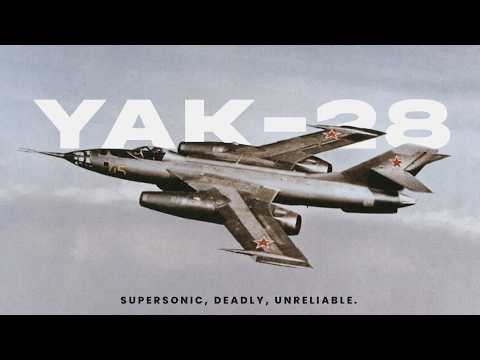
In the early 1950s, the Soviet Union found itself at a crossroads. The need for a new tactical bomber was pressing, but resources and attention were diverted to strategic bombers and interceptors. The Yak-28 emerged from this compromise, designed to fly interdiction missions and support troops, but it was never meant to be a masterpiece. Instead, it was a hurried attempt to fill a gap, and the result was an aircraft that pushed the limits of what its airframe could handle.
The requirements were ambitious: a twin-seat tactical bomber capable of reaching Mach 1.2, with a service ceiling of 55,000 feet and a range of over 2,200 kilometers. But as the design took shape, it became clear that the Yak-28 was a marriage of convenience rather than innovation. Using existing design principles and conventional shaping, the Yakovlev design bureau aimed to get the aircraft into production quickly, but trouble was evident from the start.
One veteran engineer at the Irkutsk factory, where the Yak-28 was assembled, later remarked that no other aircraft had raised so many questions regarding machining and assembly. What was supposed to be a straightforward project soon became a complex web of refinements and redesigns. The first prototype flew on March 5, 1958, and initial tests showed decent handling at lower speeds, but the engines were a persistent problem. The nacelle design produced drag and was inefficient at high speeds, making acceleration sluggish and often preventing the aircraft from reaching Mach 1 before fuel ran out.
Despite these issues, the Yak-28 entered mass production in 1960, with variants like the Brewer A and B filling tactical bomber roles. The improved Yak-28I followed, featuring better radar and autopilot, while the Yak-28U trainer and Yak-28R reconnaissance models expanded its versatility. The interceptor variant, the Yak-28P or Firebar, pushed the airframe to its limits, rated for Mach 1.8 and armed with advanced missiles. But even as it filled crucial roles, the Yak-28’s flaws were impossible to ignore.
At low levels, poor handling was exacerbated, and the airframe’s structural integrity was questionable under heavy loads. Pilots reported that the controls could lock up at transonic speeds, and even a slight overcorrection could tear the wings off. One claim holds that if the cockpit was left open during loading, the canopy would sometimes jam when the pilot tried to close it. These were not minor inconveniences; they were life-threatening defects that made every flight a gamble.
Yet, the Yak-28 soldiered on, a testament to the Soviet doctrine that numbers mattered more than reliability in a potential war. It was a stopgap that put lives at risk whenever it was flown, but it also formed a crucial component of the Air Force for many years. And in one role, it would shine: electronic warfare.
The Yak-28PP, or Brewer E, emerged in 1970 as the first specialized electronic warfare platform to enter Soviet service. While largely overlooked, this was arguably the most impressive model delivered. Sent out alongside bombers—initial other Brewers, and later Fencers—the 28PP used a configuration method similar to the recon models, with components loaded into the bomb bay in a large rectangular box.
To target specific frequency bands, two primary jamming suites were on board: the Bouquet, available in three units, and the Fasol, available in four. This allowed a flight to be sent up with each aircraft jamming a different frequency—a tactic that turned a formation of Brewers into a coordinated wall of electronic noise.
For self-defense, it carried standard chaff and flares, an RWR system called Sirena-3 that could trigger countermeasures, and an ECM suite supposedly tailored to jam the MIM-23 Hawk, known as Lilac, available in three modules. Finally, there was the S-5P, a rocket that could be launched in front of the aircraft, detonating after launch and releasing a cloud of chaff.
These electronics were kept cool by installing two heat exchangers, and several other visual changes were evident on the aircraft. In the West, the Yak-28 would be best remembered for one incident.
In 1966, crew Captain Boris Kapustin and Lieutenant Yuri Yanov experienced a catastrophic failure over East Berlin. Losing control, the aircraft strayed into West Berlin, and rather than eject, the crew sacrificed themselves to steer it away from built-up housing, crashing it into a lake. The crew were returned with full military honors to the USSR, and the RAF would review the crashed Yak.
The incident was somewhat symbolic of the platform as a whole: a stopgap that put lives at risk whenever it was flown. The problems it had were numerous, extending far beyond transonic handling issues. At low level, it was a similar story—poor handling was exacerbated and the airframe’s poor structural integrity was even more pronounced under heavy loads. Together, this limited its ability to even operate as an effective conventional bomber.
It was also supposed to flex at odd points. The problems faced seem to indicate that the design had been an attempt to tick boxes, pushing too much into what was, at its core, a fundamentally outdated design. It had been built using 1940s principles without integrating newer methods such as area ruling, more advanced intakes, and blending.
This compromise for meeting goals also seems evident in the wing. Despite its older shaping, it was heavily swept—more than the Vautour—which was generally avoided and seemingly done as a work-around for transonic flight. On the upside, the outboard podded engines offered separation in case something went wrong. But even then, they posed their own risks.
Interestingly, issues with this design approach were likely recognized by the mid to late ’50s due to problems B-58 crews had experienced. Engine failures, for example, led to pronounced asymmetry and at times catastrophic failure—something that would have been even more pronounced on the delicate Yak airframe with its highly swept wing.
All these choices indicated that the Yak had probably been both a byproduct and a victim of political pressure. Designers, likely working as best they could, drew up a plane that could do most of what was asked of it on a budget and under a time limit. And to its credit, the Yak could technically do what it was asked to do. It was just a question of how risky it would be.
As noted earlier, there were probably other reasons that led to it taking the form it did. Using old design methods, getting it to fly off the drawing board would have been relatively easy with minimal R&D, in theory. In practice, however, development proved difficult, with engineers in Irkutsk describing a complex, inefficient process of refinements and redesigns to pull everything together.
If the goal was simply to fill a gap in large numbers, this indeed worked. What’s more, the Soviet military’s decision to push it into mass production regardless of reliability may have been justified. Certain Soviet battle doctrines at the time assumed that aircraft wouldn’t last long in an all-out European war. In such a case, numbers mattered. Similar logic was likely applied to the interceptor role—one that had to be filled regardless of what was available.
Regardless, the Yak-28 would eventually be replaced and its roles handed off to other platforms. From reconnaissance to interception to strike, new jets ranging from the Foxbat to the MiG-27 could do all of these better. As a bomber, its primary replacement would be the Su-24 Fencer, a better performer all round. As the Fencer took over these responsibilities, the platform would primarily live on in its electronic warfare variant, which was paired with the new Sukhoi to assist it in its bombing role, and the Maestro trainer, which lived on until the fall of the Soviet Union.
Yet, the question remains: was the Yak-28 actually any good? It was certainly a stopgap solution. With few particularly forward-thinking design principles, it seems to have been an attempt to force everything the military was asking for into a single package. To put it into perspective, the Yak-28’s first flight was in the same year as the F-4 Phantom—an aircraft that could fill roughly the same tasking, albeit far more reliably.
Nevertheless, the Yak-28 technically filled the gap. It was affordable, mass-produced, and in a war could theoretically have done its job. Where it would shine was as an electronic warfare platform—the first of its class in the Soviet Union, and the role it performed without issue for many years.
By the time the Fencer arrived, the Soviets had far better tactical bombing capabilities, and in the case of a war, the Yak-28 would probably have been supporting the bomber fleet as an EW platform. And that’s where the Brewer would have shone.
But the story of the Yak-28 is not just one of technical shortcomings and political compromise. It is also a story of the men who flew it—pilots who climbed into a machine they knew was dangerous, who learned to coax it through the transonic barrier with the gentlest touch, and who accepted that every mission might be their last. Their experiences, passed down through informal channels and hushed conversations in squadron ready rooms, paint a picture of an aircraft that demanded a peculiar kind of courage.
One former pilot recalled that flying the Yak-28 was like “balancing on a knife’s edge, except the knife was also on fire.” The controls would go numb as you approached Mach 1, and you learned to anticipate the exact moment to ease back on the stick. Push too hard, and the aircraft would bite. Ease off too much, and you’d lose the speed you needed to stay ahead of whatever was chasing you.
Landing was another ordeal entirely. The Yak-28’s high landing speed and delicate handling meant that even experienced pilots approached the runway with white-knuckled concentration. Crosswinds were a particular nightmare, and the aircraft had a tendency to float, refusing to settle onto the tarmac until the last possible moment. More than one Brewer was lost not to enemy fire, but to a gust of wind at the wrong moment.
Maintenance crews had their own tales of woe. The podded engines, while offering separation in case of failure, also meant that accessing them for routine servicing required a small army of ground personnel and a great deal of patience. The electronics in the EW variants were particularly finicky, requiring constant attention to keep the jamming suites operational. A single faulty connection could render an entire mission’s electronic cover useless.
Yet, despite all of this, the Yak-28 earned a strange affection from those who served with it. It was never loved in the way pilots loved the MiG-21 or the Su-27, but it was respected for what it represented: a machine that did its job against the odds, that asked for everything and gave what it could.
In the end, the Yak-28’s legacy is not one of glory or innovation. It is a reminder that in the shadow of the Cold War, compromises were made, risks were taken, and men flew aircraft that should never have left the drawing board. The Brewer was a stopgap, a victim of political pressure and outdated thinking, but it was also a testament to the resilience of those who flew it—and to the peculiar kind of history that is written not in victories, but in survival.
And perhaps that is why the Yak-28, forgotten by many, still holds a place in the memories of those who knew it best. It was not a good aircraft, but it was an aircraft that did what was asked of it. In the brutal arithmetic of the Cold War, that was sometimes enough.
Today, no Yak-28 flies. A handful of airframes survive in museums, their glazed noses and podded engines frozen in time. Yet for a generation of Soviet pilots and ground crews, the Brewer remains vivid—a machine that demanded everything and forgave nothing.
The Yak-28 was never meant to be a masterpiece. It was meant to fill a gap, and it did. In the brutal arithmetic of the Cold War, that was sometimes enough.
Was the Yak-28 a noble stopgap or a flying compromise that cost too many lives—and would you have trusted it? Share your thoughts below.
Report this article
Select a reason for reporting:






