They were the elite of the Nazi war machine, feared for their ruthlessness and fanaticism. But when the Third Reich crumbled, the men of the Waffen SS faced a reckoning unlike any other. Hunted by the Allies, shunned by their own countrymen, and haunted by their crimes, their post-war fate was a brutal descent into chaos, retribution, and oblivion.
In the final days of the war, SS soldiers fought not for victory, but for survival. With Soviet forces advancing from the east and the Western Allies from the west, they were trapped in a vise of their own making. “Even in the last desperate days, the idea of surrendering our weapons was unthinkable,” recalled one SS veteran. For many, surrender meant almost certain death at the hands of the Soviets, who showed no mercy to those who had ravaged their homeland.
The average life expectancy of a Waffen SS soldier on the front line was a mere two months. By 1945, divisions had been reduced to battalion strength, and morale was shattered. Yet they fought on, driven by a toxic mix of ideology, camaraderie, and fear. “We knew important things were happening, that amazing weapons would soon come into action and because of that the war would completely change,” said Eric Wallin, a Swedish volunteer in the Nordland division. It was a delusion that kept them fighting until the bitter end.
As Berlin fell, SS units disintegrated. Some officers, like Karl Wolff, sought to negotiate a separate peace with the Western Allies, hoping to save their own skins. Others, like Heinrich Himmler, tried to vanish. Himmler, the architect of the Holocaust, bit into a cyanide capsule after his capture by the British, cheating the hangman. But for the ordinary SS soldier, there was no such escape.
They returned home on foot, crossing a devastated landscape where bridges were bombed and railways destroyed. Many were shot without warning by Allied troops who had witnessed their atrocities. The Canadians, in particular, were unforgiving—they took SS prisoners only when explicitly ordered, and even then, with reluctance. For those who surrendered to the Soviets, the chances of survival were slim; many were executed on the spot or sent to die in the gulags.
Capture by the Western Allies offered a glimmer of hope, but it came with its own perils. The SS blood type tattoo, etched under the left arm, was a death sentence. American interrogators made German POWs march shirtless with arms raised, scanning for the telltale mark. Some SS men cut out their tattoos or covered them with makeup, but many were identified and separated. Low-ranking soldiers, especially those conscripted late in the war, might be released after a few years. But high-ranking officers faced interrogation, imprisonment, or execution.
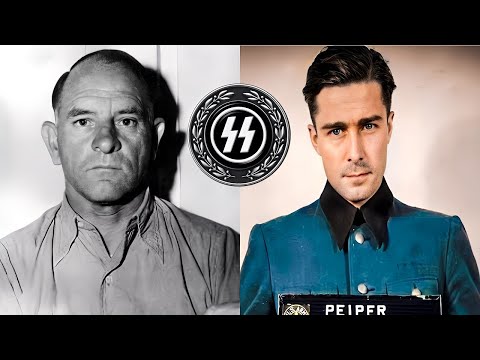
The Nuremberg trials brought the SS to justice as a criminal organization, and subsequent trials, like the Malmedy massacre trial, held individuals accountable for specific atrocities. Joachim Peiper, the commander whose men gunned down 84 American POWs, was sentenced to death, later commuted to life, and finally released in 1956. But justice was uneven; thousands of SS men never faced trial, their crimes buried in the chaos of post-war Europe.
In the decades that followed, former SS members organized, seeking to rehabilitate their image. HIAG, the veterans’ association, lobbied for the legal rehabilitation of the Waffen SS, portraying them as honorable soldiers, separate from the death camp guards. They found some sympathy in West Germany, where the new Bundeswehr admitted a small number of former SS men. But the stain of their crimes could not be erased.
Some, like Peiper, lived quietly until their past caught up with them. Peiper, who had settled in France, was killed in 1976 when his house was firebombed by anti-Nazi activists. Others, like Günter Grass, the Nobel laureate, only admitted their SS past decades later. The legacy of the Waffen SS remains a dark chapter, a reminder of how ordinary men can be twisted into instruments of terror—and how the consequences of their actions echo through generations.
The search for the men of the Waffen SS did not end with the Nuremberg verdicts. Across Europe, governments reconstituted after liberation launched their own reckonings, and the results were as varied as the nations themselves. In Yugoslavia, captured SS men—particularly those from the notorious Prinz Eugen division, raised from ethnic Germans in the Balkans—were often tried and executed within days. Tito’s partisans had suffered grievously at their hands, and mercy was in short supply.
Norway took a different path. The country had been occupied for five years, and thousands of Norwegians had volunteered for the Waffen SS, many in the Nordland division. After the war, these men faced long prison terms, and some were executed for treason—the only Western European country to carry out death sentences on its own SS volunteers. Their families bore the shame for decades, their names whispered in villages that never forgot.
In the East, the reckoning was even more brutal. The Soviets held show trials for those they had captured, and entire units that surrendered were sometimes wiped from the earth. One account tells of a Waffen SS division that surrendered to the Red Army in Czechoslovakia; of the thousands who laid down their arms, fewer than ten were ever seen again. They vanished into the vast machinery of the gulag, their names erased from the record.
Yet not every SS man met a grim end. Some slipped through the cracks of a collapsing continent. Using forged papers and the chaos of displaced persons camps, a number made their way to South America, the Middle East, or even North America. The ratlines, originally established to smuggle Nazi officials out of Europe, also carried ordinary SS soldiers seeking a new life. Argentina, Brazil, and Chile became quiet refuges for men who had once worn the death’s head insignia.
Others simply went home and tried to disappear into civilian life. In the small towns of Bavaria and Lower Saxony, former SS men became farmers, mechanics, and shopkeepers, their pasts known to neighbors but rarely spoken of. The silence was a form of protection—for the men themselves, and for a society that preferred not to ask too many questions about what had been done in its name.
But the past had a way of resurfacing. In the 1950s and 1960s, as West Germany rebuilt its institutions, the question of former Nazis in public life became impossible to ignore. Investigations revealed that the Federal Criminal Police Office, the BKA, was riddled with former SS and Gestapo men—33 of its 57 senior officials had served in the Nazi apparatus. The revelation caused a scandal, but few resignations followed.
The case of Horst Tappert, one of Germany’s most beloved actors, illustrated the depth of the concealment. Tappert, famous for his role as Inspector Derrick, had served in the Totenkopf division and kept his past hidden until five years after his death in 2008, when his wartime records were discovered. The revelation shocked a nation that had grown up watching him on television, a reminder that the men of the Waffen SS had not vanished—they had simply changed their uniforms.
For the survivors, old age brought no peace. Some remained unrepentant, attending HIAG meetings and insisting they had been soldiers, not criminals. Others were haunted by what they had seen and done. One former SS man, interviewed in the 1990s, confessed that he still woke in the night hearing the screams of the people he had helped to murder. He had never told his children what he had been.
The Waffen SS had been destroyed as a military force, but its legacy proved far harder to kill. The men who survived carried their memories—and their guilt—into a new Germany that preferred to forget them.
Yet forgetting was not the same as escaping. In the decades after the war, a handful of former SS men found themselves in the crosshairs of a new kind of justice—one pursued not by armies or tribunals, but by relentless individual investigators. Simon Wiesenthal, the famed Nazi hunter, and later the German prosecutors of the Central Office for the Investigation of Nazi Crimes in Ludwigsburg, dedicated their lives to tracking down men who had slipped through the net. Their efforts ensured that even in old age, some SS veterans were dragged from their quiet retirements to face charges for crimes committed half a century earlier.
One such case was that of Erich Priebke, a former SS captain who had participated in the Ardeatine Caves massacre in Rome, where 335 civilians were murdered in reprisal for a partisan attack. Priebke had lived for decades in Argentina, but in 1994, a television journalist tracked him down. His extradition and subsequent trial in Italy became a media sensation, a late reckoning that forced the world to remember what had been done in the name of the Reich.
Other SS men were not so easily found. The fall of the Soviet Union in 1991 opened previously sealed archives, revealing the names of thousands of men who had served in the Waffen SS and had never been prosecuted. Some were still alive, living in Germany, Austria, or further afield. The revelations sparked a new wave of investigations, but time was running out. Most of the suspects were in their eighties or nineties, and many died before they could be brought to trial.
In the 2000s and 2010s, a series of high-profile cases kept the Waffen SS in the headlines. In 2011, John Demjanjuk, a Ukrainian-American who had served as a guard in the SS-run Sobibor death camp, was convicted in Germany of being an accessory to the murder of 28,060 Jews. His trial set a legal precedent: even without direct evidence of participation in specific killings, serving in a death camp was enough to establish guilt. The verdict opened the door for further prosecutions, but by then, the men of the Waffen SS were almost all gone.
The last trials were more symbolic than punitive. In 2016, Reinhold Hanning, a former SS guard at Auschwitz, was sentenced to five years in prison—but at 94, he was unlikely to serve them. He died a year later. The courts were racing against mortality, and mortality was winning.
For the families of the victims, these late trials offered a measure of closure, but they also reopened old wounds. Survivors of the Malmedy massacre testified again in the 1970s and 1980s, their memories as vivid as they had been on the day they were liberated. Some expressed frustration that so many SS men had escaped punishment, while others simply wanted the world to remember what had happened.
The Waffen SS veterans themselves grew old and died, most of them in obscurity. HIAG, the veterans’ organization, was officially dissolved in 1992, though its influence lingered in the far-right fringe of German politics. The men who had once marched in black uniforms with silver insignia were now frail old men, their numbers thinning with each passing year. Some remained defiant to the end, insisting they had been honorable soldiers. Others took their secrets to the grave.
The last of them died in silence, their names fading from memory. But the questions they left behind still haunt us. How many of the men who wore the death’s head lived out their lives unnoticed, their crimes buried beneath decades of denial? The Waffen SS was destroyed, but its legacy lingers in the shadows of history—a warning of what ordinary men can become when ideology replaces conscience.
Today, as the last witnesses fade, we are left to sift through the fragments of their stories. What do we owe to the victims, and what do we learn from the perpetrators? The answers are not easy, but the asking matters.
What do you think—can justice ever truly be served when the guilty are allowed to grow old and die in peace?
Report this article
Select a reason for reporting:






